Bayesian Network Modeling of Marital Conflict: Attachment Styles, Communication Patterns, Emotional Reactivity, and Cognitive Distortions
Keywords:
Marital Conflict, Bayesian Network Modeling, Attachment Styles, Emotional Reactivity, Cognitive Distortions, Communication PatternsAbstract
Objective: The present study aimed to develop and validate a Bayesian network model to examine the probabilistic relationships among attachment styles, communication patterns, emotional reactivity, cognitive distortions, and marital conflict in married adults.
Methods and Materials: This cross-sectional correlational study was conducted on 486 married individuals (243 couples) residing in Canada, selected through community-based and online recruitment strategies. Participants met inclusion criteria including a minimum of two years of marital duration and absence of severe psychiatric conditions. Data were collected using validated instruments, including the Revised Conflict Tactics Scales (CTS2) for marital conflict, the Experiences in Close Relationships-Revised (ECR-R) for attachment styles, the Communication Patterns Questionnaire (CPQ), the Emotional Reactivity Scale (ERS), and the Cognitive Distortions Scale (CDS). Data preprocessing included missing value imputation and normalization procedures. Bayesian network modeling was conducted using a hybrid structure-learning approach combining constraint-based and score-based algorithms. Parameter estimation was performed using maximum likelihood and Bayesian methods. Model validation included 10-fold cross-validation, bootstrapping, and evaluation of predictive accuracy indices.
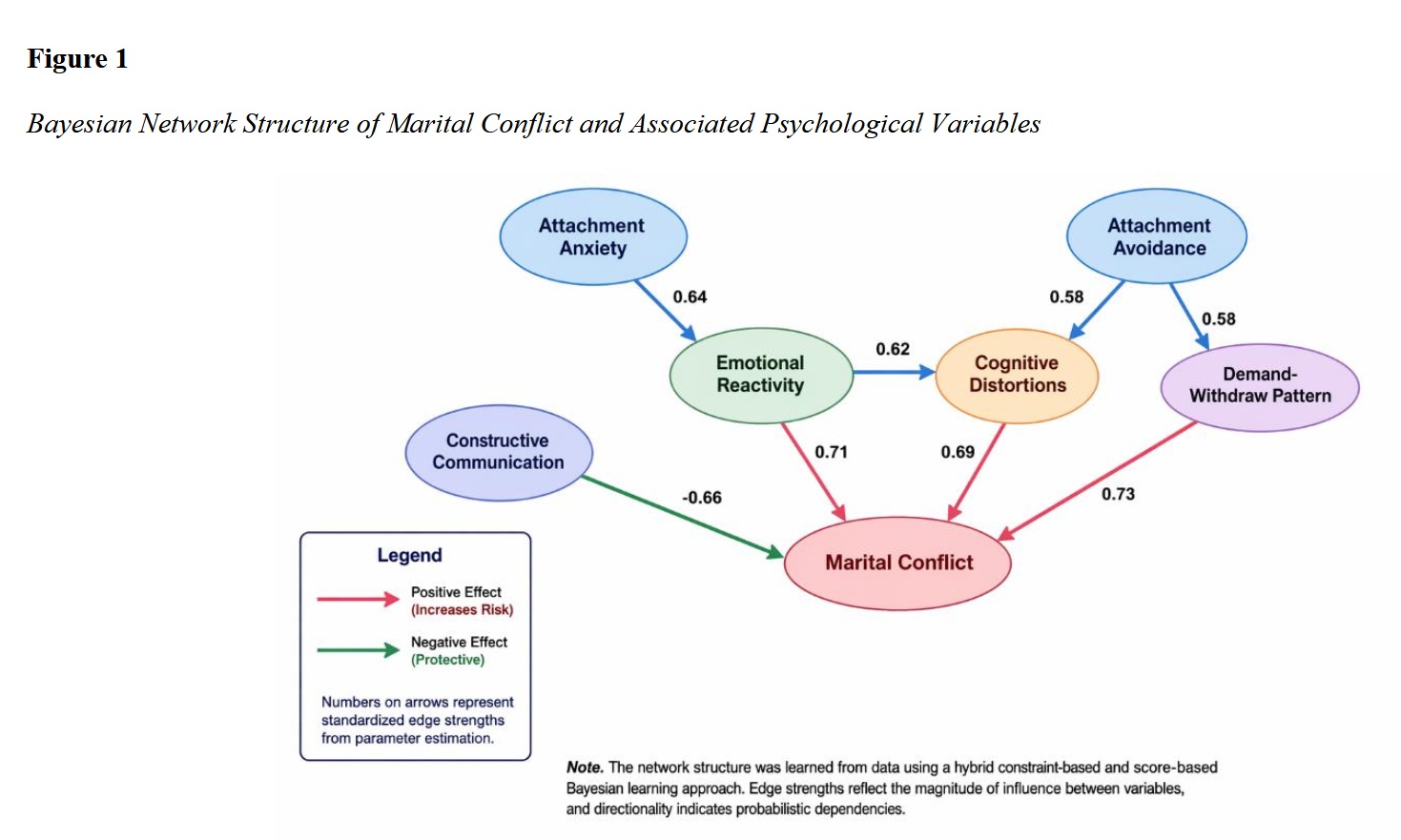
Findings: The Bayesian network revealed that demand-withdraw communication (β = 0.73), emotional reactivity (β = 0.71), and cognitive distortions (β = 0.69) were the strongest direct predictors of marital conflict, while constructive communication showed a significant negative effect (β = -0.66). Attachment anxiety exerted indirect effects through emotional reactivity (β = 0.64), whereas attachment avoidance influenced conflict via demand-withdraw patterns (β = 0.58). Emotional reactivity also significantly predicted cognitive distortions (β = 0.62), indicating a mediating pathway. The model demonstrated high predictive performance (AUC = 0.87, accuracy = 0.81), confirming strong discriminative capacity and structural stability.
Conclusion: The findings highlight marital conflict as a multifactorial phenomenon emerging from dynamic interactions among emotional, cognitive, and communication processes, with attachment styles functioning as distal vulnerabilities. The Bayesian network approach provides a robust framework for capturing these complex interdependencies and offers valuable implications for targeted and personalized interventions in couple therapy.
Downloads
References
Camadan, F. (2025). The Mediating Role of Social Connectedness and Perceived Spousal Support in Explaining the Relationship Between Parental Burnout, and Their Interpersonal Cognitive Distortions. Sage Open, 15(3). https://doi.org/10.1177/21582440251378391
Čepukienė, V., & Neophytou, K. (2024). Intergenerational Transmission of Familial Relational Dysfunction: A Test of a Complex Mediation Model Based on Bowen Family Systems Theory. Journal of Social and Personal Relationships, 41(11), 3385-3408. https://doi.org/10.1177/02654075241265472
Farrell, A. K., Stanton, S. C. E., & Sbarra, D. A. (2021). Good Theories in Need of Better Data: Combining Clinical and Social Psychological Approaches to Study the Mechanisms Linking Relationships and Health. https://doi.org/10.31234/osf.io/a9fnh
Kornaszewska-Polak, M. (2021). The Crisis of Dialogue and Relationship in Marriage in the Perspective of the Attachment Theory. Kwartalnik Naukowy Fides et Ratio, 46(2), 205-221. https://doi.org/10.34766/fetr.v46i2.839
Lee, Y. E. (2022). Relations Between Childhood Emotional Insecurity, Self‐esteem, and Adulthood Marital Conflict in South Korea. Family Relations, 72(4), 1926-1941. https://doi.org/10.1111/fare.12743
Manevich, A., Rubin, S. S., Katz, M. B., Ben‐Hayun, R., & Aharon‐Peretz, J. (2022). Spousal Mourning for Partners Living With Cognitive Impairment: The Interplay of Attachment and the Two-Track Model of Dementia Grief. OMEGA - Journal of Death and Dying, 91(2), 811-836. https://doi.org/10.1177/00302228221142632
Mavroudis, I., Franekova, K., Petridis, F., Ciobîcă, A., Dăscălescu, G., Anton, E., Ilea, C., Papagiannopoulos, S., & Kazis, D. (2025). Risk, Precipitating, and Perpetuating Factors in Functional Neurological Disorder: A Systematic Review Across Clinical Subtypes. Brain Sciences, 15(9), 907. https://doi.org/10.3390/brainsci15090907
Misurell, J. R., & Schwartz, J. B. (2024). Therapeutic Interventions for High-Conflict Separated Parents Families: a Road Map for Early-Career Therapists. The Family Journal, 32(4), 510-521. https://doi.org/10.1177/10664807241264808
Morgan, S. D., & Woodin, E. M. (2025). Perceptions of Conflict at the Transition to Parenthood: Exploring Adult Attachment Pairings as Predictors of Emotional Flooding. Family Process, 64(3). https://doi.org/10.1111/famp.70057
Nassif, Y. B., Hamonnière, T., Rahioui, H., & Varescon, I. (2024). Integrative Therapy for Youth With Cannabis Use Disorder Targeting Attachment Insecurity and Emotion Dysregulation: A Process-Based Case Study. Clinical Case Studies, 24(2), 135-153. https://doi.org/10.1177/15346501241307220
Neoh, M. J. Y., Lieu, A. A., Perinelli, E., Balagtas, J. P. M., Nah, H., Ho, M. H. R., & Esposito, G. (2023). An Intergenerational Study of Parental Bonding on Perceptions of Parental and Spousal Criticism and Marital Relationship Quality in Singapore. Family Process, 63(2), 947-966. https://doi.org/10.1111/famp.12942
Ni, N., Ahrari, S., Zaremohzzabieh, Z., Zarean, M., & Roslan, S. (2025). A Meta-Analytic Study of Partner Phubbing and Its Antecedents and Consequences. Frontiers in psychology, 16. https://doi.org/10.3389/fpsyg.2025.1561159
Saracini, C., Cornejo-Plaza, M. I., & Cippitani, R. (2025). Techno-Emotional Projection in Human–GenAI Relationships: A Psychological and Ethical Conceptual Perspective. Frontiers in psychology, 16. https://doi.org/10.3389/fpsyg.2025.1662206
Shrestha, P. S., Shaver, S. R., Perlman, T. T., & Walsham, W. (2023). Emotional Dimensions of Infidelity: An Analysis of Psychological and Emotional Factors Affecting Relationship Infidelity. Sosateris, 11(2), 88-103. https://doi.org/10.35335/85rbw180
Talib, M. A., Guo, J., Nordin, N. M., & Anne Noor Sri Juwaneeta, J. (2025). Integrative Behavioral Couple Therapy (IBCT) for Marital Reconciliation: A Systematic Review of Outcomes. The Family Journal, 34(1), 54-64. https://doi.org/10.1177/10664807251384198
Uchino, B., Ong, A., & Sbarra, D. (2025). Relationships, Social Support, and Health. 589-609. https://doi.org/10.1037/0000394-027
Uluyol, F. M., & Özen‐Çıplak, A. (2024). Dyadic Relationship of Adult Attachment Patterns and Interpersonal Schemas in Marital Adjustment: Actor–partner Effect Model. Family Relations, 73(3), 2152-2169. https://doi.org/10.1111/fare.13002
Xie, Y., & Feeney, B. C. (2024). A Narrative Review of Mechanisms Linking Romantic Relationship Experiences to Sleep Quality. Sleep Advances, 5(1). https://doi.org/10.1093/sleepadvances/zpae049
Yakeley, J. (2021). The Search for Tailored Treatments: Discussion of Five Interventions for Perpetrators of Intimate Partner Violence. Journal of Clinical Psychology, 78(1), 80-98. https://doi.org/10.1002/jclp.23291
Zarifi, M. (2026). Identifying the Harms Experienced by Married Women With Relationship Obsessive– Compulsive Disorder. https://doi.org/10.21203/rs.3.rs-8407007/v1
Downloads
Additional Files
Publication Timeline
- Submitted
- Revised
- Accepted