Being-With-Algorithm: Psychotherapists’ Lived Experiences of Artificial Intelligence and the Therapeutic Relationship
DOI:
https://doi.org/10.61838/kman.jarac.5364Keywords:
Artificial intelligence, psychotherapy, therapeutic relationship, phenomenology, psychotherapists, therapeutic alliance, digital mental health, lived experienceAbstract
Objective: The present study aimed to explore psychotherapists’ lived experiences of artificial intelligence and its perceived influence on the therapeutic relationship within contemporary psychotherapy practice.
Methods and Materials: This study employed a qualitative phenomenological design using Interpretative Phenomenological Analysis (IPA). The participants consisted of 20 psychotherapists practicing in Tehran, Iran, selected through purposive sampling with maximum variation based on therapeutic orientation, years of experience, and familiarity with artificial intelligence technologies. Inclusion criteria included a minimum of three years of clinical experience and prior exposure to AI-assisted therapeutic or professional tools. Data were collected through semi-structured in-depth interviews lasting between 60 and 95 minutes. Interview questions focused on therapists’ experiences regarding empathy, therapeutic presence, ethical concerns, professional identity, emotional authenticity, and human-AI interaction in psychotherapy. Interviews were audio-recorded, transcribed verbatim, and analyzed using iterative phenomenological coding procedures. Strategies including member checking, peer review, reflexive memo writing, and audit trail documentation were employed to enhance trustworthiness and credibility.
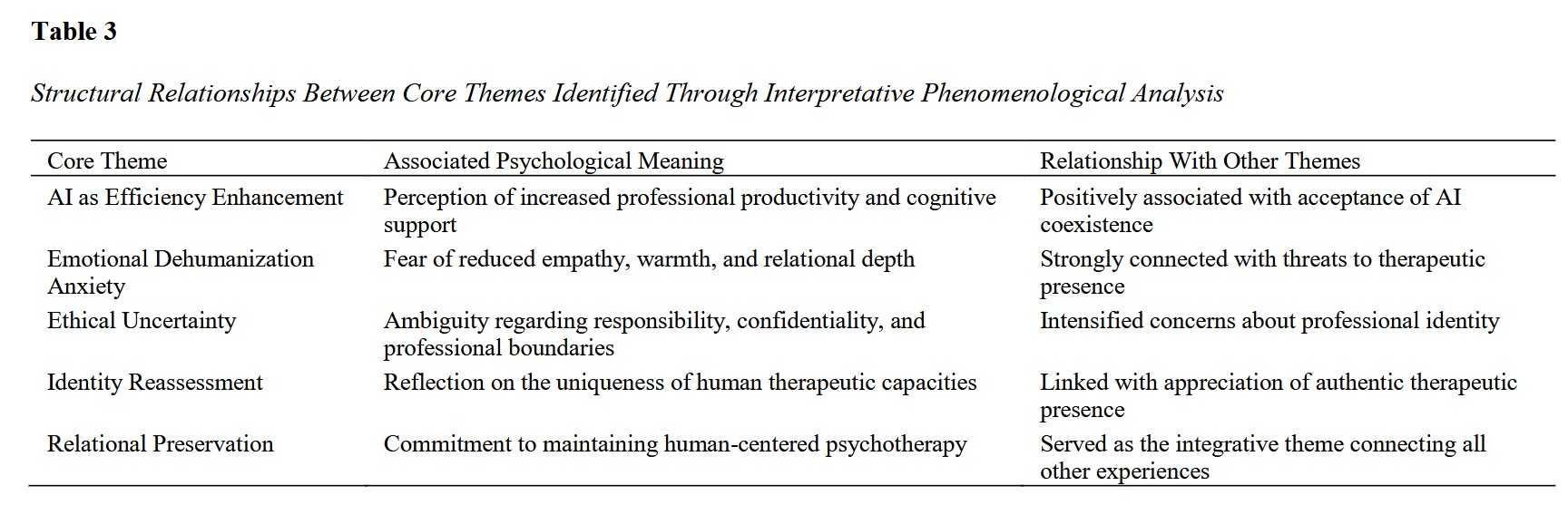
Findings: The findings revealed that psychotherapists experienced artificial intelligence through a complex coexistence of acceptance, ambivalence, and existential concern. Five superordinate themes emerged from the data: AI as a clinical companion, threats to therapeutic presence, ethical and professional ambivalence, reconfiguration of therapist identity, and human-AI coexistence in therapy. Participants acknowledged the usefulness of AI for administrative efficiency, cognitive support, and clinical organization while simultaneously expressing concerns regarding emotional dehumanization, diminished empathic attunement, weakened authenticity, and ethical uncertainty. Therapists emphasized that empathy, emotional resonance, and relational presence were fundamentally human dimensions that could not be authentically replicated by algorithmic systems. The emergence of AI also prompted deeper reflection on the uniqueness of human therapeutic engagement and the preservation of relational centrality within psychotherapy.
Conclusion: The findings suggest that psychotherapists perceive artificial intelligence as both a valuable professional resource and a potential challenge to the relational foundations of psychotherapy. Although AI technologies may enhance efficiency and accessibility, therapists continue to regard authentic human connection, emotional attunement, and existential understanding as irreplaceable components of therapeutic healing. The future integration of AI into psychotherapy therefore requires careful ethical regulation, professional adaptation, and preservation of human-centered therapeutic values.
Downloads
References
Benosman, M. (2024). On the Ethics of Chatbots in Psychotherapy. https://doi.org/10.31234/osf.io/mdq8v
Bogatyńska-Kucharska, A., Kucharski, J., & Jabłoński, M. (2023). Paternalism and Autonomy: Psychotherapists’ Choices in Dilemmas and Their Justifications as Ethical Aspects of the Therapeutic Relationship. Psychiatria I Psychologia Kliniczna, 23(1), 3-11. https://doi.org/10.15557/pipk.2023.0001
Cooper, M. (2026). Young People’s Perceptions of Therapist Interpersonal Skills and Alliance: How Distinct Are They? Psychotherapy, 63(1), 79-90. https://doi.org/10.1037/pst0000611
Du, J. S. (2024). Applications of AI in Psychotherapy: An Innovative Tool. Camb. Sci. Adv., 2024(2), 1-6. https://doi.org/10.62852/csa/2024/8
Frisone, F., Pupillo, C., Rossi, C., & Riva, G. (2025). SOCRATES. Developing and Evaluating a Fine-Tuned ChatGPT Model for Accessible Mental Health Intervention. Cyberpsychology Behavior and Social Networking, 28(5), 366-368. https://doi.org/10.1089/cyber.2025.45510.cyeuro
Giotakos, O. (2025). Artificial Intelligence-Based Psychotherapy: Focusing on Common Psychotherapeutic Factors. Frontiers in Psychiatry, 16. https://doi.org/10.3389/fpsyt.2025.1710715
Grodniewicz, J. P., & Hohol, M. (2023). Waiting for a Digital Therapist: Three Challenges on the Path to Psychotherapy Delivered by Artificial Intelligence. Frontiers in Psychiatry, 14. https://doi.org/10.3389/fpsyt.2023.1190084
Guhan, P., Awasthi, N., McDonald, K., Bussell, K., Reeves, G., Manocha, D., & Bera, A. (2025). Developing a Machine Learning–Based Automated Patient Engagement Estimator for Telehealth: Algorithm Development and Validation Study. Jmir Formative Research, 9, e46390. https://doi.org/10.2196/46390
Huțul, T. D., Popescu, A., Karner‐Huțuleac, A., Holman, A. C., & Huțul, A. (2024). Who's Willing to Lay on the Virtual Couch? Attitudes, Anthropomorphism and Need for Human Interaction as Factors of Intentions to Use Chatbots for Psychotherapy. Counselling and Psychotherapy Research, 24(4), 1479-1488. https://doi.org/10.1002/capr.12794
Kabrel, N. (2025). When Can AI Psychotherapy Be Considered Comparable to Human Psychotherapy? Exploring the Criteria. Frontiers in Psychiatry, 16. https://doi.org/10.3389/fpsyt.2025.1674104
Magnavita, J. J., Magnavita, E. G., & Ingram, B. L. (2024). Unified Psychotherapeutics: Are We Any Closer to Our Aspirations and What Are the Dangers? Journal of Psychotherapy Integration, 34(3), 315-328. https://doi.org/10.1037/int0000334
Obremski, D., & Wienrich, C. (2024). Autonomous VR Exposure Therapy for Anxiety Disorders Using Conversational AI—Ethical and Technical Implications and Preliminary Results. Journal of Computer and Communications, 12(04), 111-138. https://doi.org/10.4236/jcc.2024.124010
Olive, M. V., Tona, A. L., Coco, G. L., Compare, A., Cafazzo, J. A., & Masella, C. (2025). Assessment of a Digital Platform for Routine Outcome Monitoring in Psychotherapy: Usability Study and Thematic Analysis. Jmir Medical Informatics, 13, e75885-e75885. https://doi.org/10.2196/75885
Plakun, E. M. (2023). Psychotherapy and Artificial Intelligence. Journal of Psychiatric Practice, 29(6), 476-479. https://doi.org/10.1097/pra.0000000000000748
Potash, J. B., McClanahan, A., Davidson, J. A., Butler, W. E., Carroll, N., Ruble, A. E., Yaden, M., King, D. R., Torous, J., Zandi, P. P., Kennedy, K. G., Smith, T. E., Waghray, A., Trestman, R. L., & Wills, M. M. (2025). The Future of the Psychiatrist. Psychiatric Research and Clinical Practice, 7(2), 80-90. https://doi.org/10.1176/appi.prcp.20240130
Rabeyron, T. (2025). Artificial Intelligence and Psychoanalysis: Is It Time for psychoanalyst.AI? Frontiers in Psychiatry, 16. https://doi.org/10.3389/fpsyt.2025.1558513
Rad, D., Maier, M., Triff, Z., & Marcu, R. (2025). Entangled Autopoiesis: Reframing Psychotherapy and Neuroscience Through Cognitive Science and Systems Engineering. Brain Sciences, 15(10), 1032. https://doi.org/10.3390/brainsci15101032
Raile, P. (2024). The Usefulness of ChatGPT for Psychotherapists and Patients. Humanities and Social Sciences Communications, 11(1). https://doi.org/10.1057/s41599-023-02567-0
Rudwan, S. J. (2023). Online Psychological Care and Psychotherapy: Reality, Evidence, and Indicators. Ijsr, 2(11), 71-97. https://doi.org/10.59992/ijsr.2023.v2n11p4
Rutkowska, E., Furmańska, J., Marques, C., Martins, M. J., Lane, H., & Meixner, J. (2025). Psychotherapists’ Ethical Dilemmas Regarding Online and Face-to-Face Psychotherapy During the COVID-19 Pandemic: Survey Study. Journal of medical Internet research, 27, e69154. https://doi.org/10.2196/69154
Sauerbrei, A., Kerasidou, A., Lucivero, F., & Hallowell, N. (2023). The Impact of Artificial Intelligence on the Person-Centred, Doctor-Patient Relationship: Some Problems and Solutions. BMC Medical Informatics and Decision Making, 23(1). https://doi.org/10.1186/s12911-023-02162-y
Singh, V., Sarkar, S., Gaur, V., Grover, S., & Singh, O. P. (2024). Clinical Practice Guidelines on Using Artificial Intelligence and Gadgets for Mental Health and Well-Being. Indian Journal of Psychiatry, 66(Suppl 2), S414-S419. https://doi.org/10.4103/indianjpsychiatry.indianjpsychiatry_926_23
Stade, E. C., Stirman, S. W., Ungar, L., Boland, C. L., Schwartz, H. A., Yaden, D. B., Sedoc, J., DeRubeis, R. J., Willer, R., & Eichstaedt, J. C. (2023). Large Language Models Could Change the Future of Behavioral Healthcare: a Proposal for Responsible Development and Evaluation. https://doi.org/10.31234/osf.io/cuzvr
Stade, E. C., Stirman, S. W., Ungar, L., Boland, C. L., Schwartz, H. A., Yaden, D. B., Sedoc, J., DeRubeis, R. J., Willer, R., & Eichstaedt, J. C. (2024). Large Language Models Could Change the Future of Behavioral Healthcare: A Proposal for Responsible Development and Evaluation. NPJ Mental Health Research, 3(1). https://doi.org/10.1038/s44184-024-00056-z
Sufyan, N. S., Fadhel, F. H., Alkhathami, S., & Mukhadi, J. Y. A. (2024). Artificial Intelligence and Social Intelligence: Preliminary Comparison Study Between AI Models and Psychologists. Frontiers in psychology, 15. https://doi.org/10.3389/fpsyg.2024.1353022
Wagner, J., & Schwind, A.-S. (2025). Investigating Psychotherapists’ Attitudes Towards Artificial Intelligence in Psychotherapy. BMC psychology, 13(1). https://doi.org/10.1186/s40359-025-03071-7
Westbye, H. J., Moltu, C., & McAleavey, A. A. (2024). eXplainableAI for Routine Outcome Monitoring and Clinical Feedback. Counselling and Psychotherapy Research, 25(1). https://doi.org/10.1002/capr.12764
Yirmiya, K., & Fonagy, P. (2025). Mentalizing Without a Mind: Psychotherapeutic Potential of Generative AI. Journal of medical Internet research, 27, e79156. https://doi.org/10.2196/79156
Zhang, Z., & Wang, J. (2024). Can AI Replace Psychotherapists? Exploring the Future of Mental Health Care. Frontiers in Psychiatry, 15. https://doi.org/10.3389/fpsyt.2024.1444382
Zubala, A., Pease, A., Lyszkiewicz, K., & Hackett, S. (2025). Art Psychotherapy Meets Creative AI: An Integrative Review Positioning the Role of Creative AI in Art Therapy Process. Frontiers in psychology, 16. https://doi.org/10.3389/fpsyg.2025.1548396
ОСАДЧИЙ, О. (2023). Використання Штучного Інтелекту В Діагностиці Психологічного Стану. Information Technology and Society(1 (7)), 59-65. https://doi.org/10.32689/maup.it.2023.1.8
Downloads
Additional Files
Publication Timeline
- Submitted
- Revised
- Accepted