Structural Modeling of the Relationship Between Mindfulness and Posttraumatic Growth: The Mediating Role of Difficulties in Emotion Regulation and Self-Compassion in Patients with Rheumatoid Arthritis
DOI:
https://doi.org/10.61838/kman.jarac.5489Keywords:
Rheumatoid arthritis, mindfulness, posttraumatic growth, difficulties in emotion regulation, self-compassionAbstract
Objective: The present study aimed to model the structural relationship between mindfulness and posttraumatic growth through the mediating roles of difficulties in emotion regulation and self-compassion in patients with rheumatoid arthritis.
Methods and Materials: In terms of purpose, the present study was applied research, and in terms of data collection method, it was a descriptive correlational study using a structural equation modeling approach. The statistical population consisted of all patients with rheumatoid arthritis who attended hospitals and rheumatology clinics in Tehran during the autumn of 2025. A total of 550 patients were selected using purposive sampling and completed the Five Facet Mindfulness Questionnaire developed by Ruth A. Baer and colleagues (2006), the Difficulties in Emotion Regulation Scale by Kimberly L. Gratz and Lizabeth Roemer (2004), the Self-Compassion Scale by Kristin Neff (2003), and the Posttraumatic Growth Inventory by Richard G. Tedeschi and Lawrence G. Calhoun (1996). Data analysis was conducted using Pearson correlation coefficients and structural equation modeling with SPSS version 26 and AMOS version 24 software.
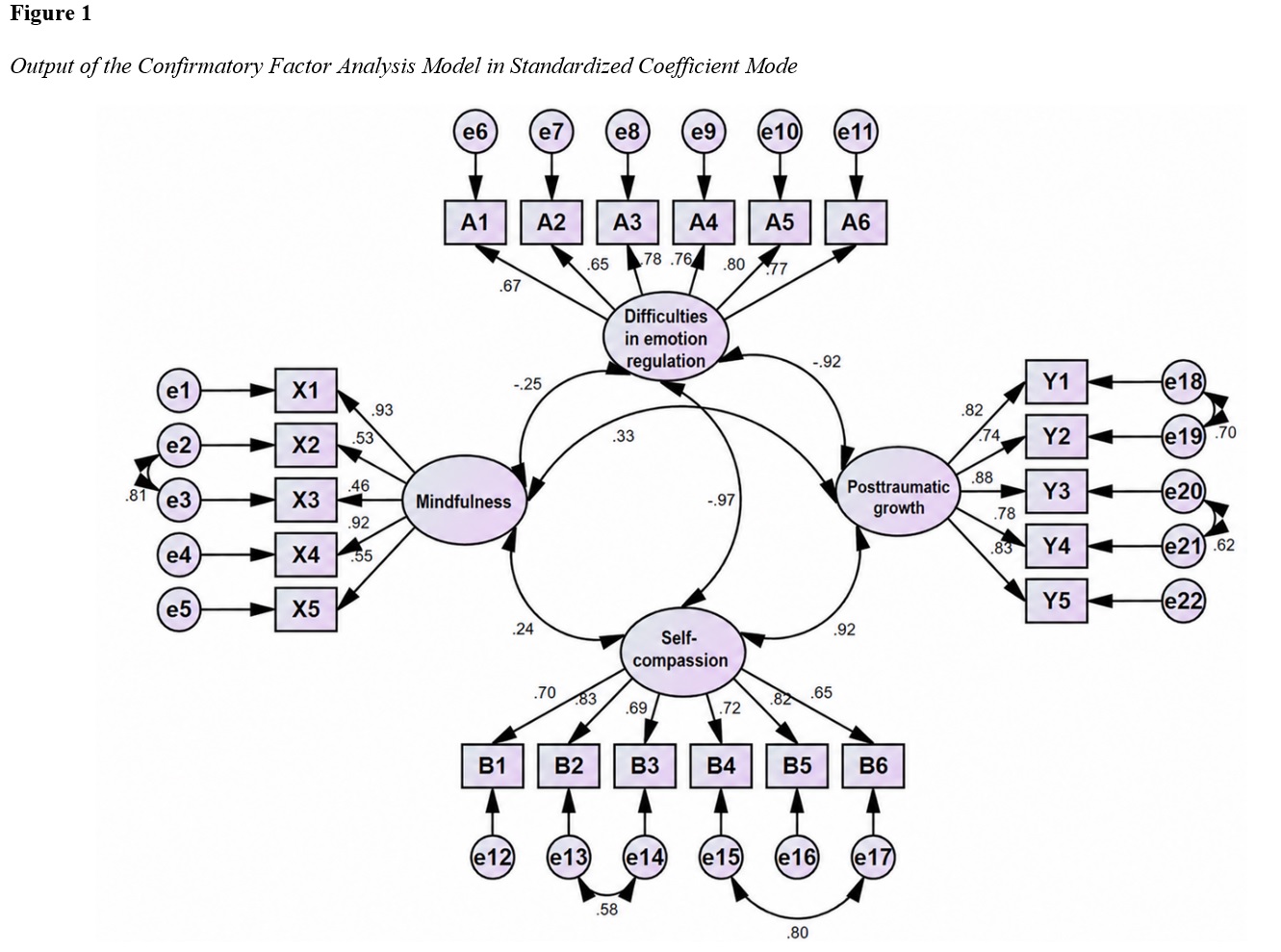
Findings: The findings indicated that the proposed model demonstrated a good fit (GFI = 0.995, CFI = 0.987, IFI = 0.987, RMSEA = 0.034, χ²/df = 1.623). All direct and indirect path coefficients in the structural model were significant (P < 0.001). Mindfulness had a positive and significant effect on self-compassion (β = 0.243) and a negative and significant effect on difficulties in emotion regulation (β = -0.263). In addition, difficulties in emotion regulation had a negative and significant effect on posttraumatic growth (β = -0.641), whereas self-compassion had a positive and significant effect on posttraumatic growth (β = 0.607). The indirect effect of mindfulness on posttraumatic growth through difficulties in emotion regulation and self-compassion was 0.316 and statistically significant (P = 0.012).
Conclusion: Mindfulness is a significant predictor of posttraumatic growth in patients with rheumatoid arthritis, both directly and indirectly through reducing difficulties in emotion regulation and enhancing self-compassion. Therefore, the design and implementation of psychological interventions based on mindfulness, emotion regulation, and self-compassion may serve as effective approaches for improving mental health and facilitating posttraumatic growth in these patients.
Downloads
References
Alkasir, E., Masjedi-Arani, A., Dehkordi, F. J., Kianimoghadam, A. S., Afshari, B., & Yousefi, S. (2025). Comparison of the Effectiveness of Mindfulness-Based Stress Reduction versus Cognitive-Behavioral Therapy on Emotion Regulation, Mindfulness, and Cognitive-Executive Functions in Female Patients with Rheumatoid Arthritis. Journal of education and health promotion, 14(1), 99.
Amiri, A. R., Raeisi Shahraki, H., Ahmadi, A., & Mousavi, M. S. (2024). Prevalence and Factors Associated with Rheumatic Disorders among Shahrekord Cohort Study Population. Epidemiology and Health System Journal, 11(1), 43-46.
Amouei, K., Manookian, A., Faezi, S. T., & Sayadi, L. (2025). Effect of Writing Based on Self-Compassion on Body Image and Psychological Distress among Women with Systemic Lupus Erythematosus: A Randomized Clinical Trial. BMC Rheumatology, 9(1), 106.
Azhdari, F., & Yousefi, F. (2023). The Mediating Role of Self-Efficacy in the Relationship between Mindfulness and Academic Engagement. Studies in Education and Learning, 13(2), 73-100.
Baeza-Velasco, C., Carton, S., Almohsen, C., Blotman, F., & Gely-Nargeot, M. C. (2012). Alexithymia and Emotional Awareness in Females with Painful Rheumatic Conditions. Journal of psychosomatic research, 73(5), 398-400.
Barakat, M. M., Arafa, H. A. E. M., & Abo Zeid, E. N. (2024). Self-Compassion, Body Image and Depressive Symptoms among Patients with Systemic Lupus Erythematosus. Assiut Scientific Nursing Journal, 12(45), 410-424.
Bolursaz Mashhadi, H., Jafari, A., & Moghadamzadeh, A. (2024). The Effectiveness of Acceptance and Commitment Therapy on Anxiety Sensitivity, Perceived Pain Intensity, and Emotion Management in Elderly Women with Rheumatoid Arthritis. Health Psychology, 13(52), 81-96.
Cui, Y., Lei, S., & Yang, F. (2026). Mechanism of the Effectiveness of Mindfulness on Intrinsic Capacity in Elderly Patients with Cardiovascular Diseases. BMC Geriatrics, 26(1), 452.
Dirik, G., & Karanci, A. N. (2008). Variables Related to Posttraumatic Growth in Turkish Rheumatoid Arthritis Patients. Journal of Clinical Psychology in Medical Settings, 15(3), 193-203.
Edwards, K. A., Pielech, M., Hickman, J., Ashworth, J., Sowden, G., & Vowles, K. E. (2019). The Relation of Self-Compassion to Functioning among Adults with Chronic Pain. European Journal of Pain, 23(8), 1538-1547.
Ghazanfari Harandi, M., Sarlak, N., Pourhasan Najafabadi, M., & Madani, M. (2025). The Effectiveness of Cognitive Behavioral Therapy on Pain Perception and Alexithymia in Patients with Rheumatoid Arthritis. Health Psychology and Behavioral Disorders, 3(4), 1-13.
Ghiggia, A., Tesio, V., Colonna, F., Fusaro, E., Geminiani, G. C., & Castelli, L. (2025). Stressful Life Events and Psychosomatic Symptoms in Fibromyalgia Syndrome and Rheumatoid Arthritis. International journal of environmental research and public health, 22(3), 366.
Goldipoor, M., Zamani, B., & Omidi, A. (2026). Investigating the Effect of Body Awareness Training on Self-Compassion, Body Awareness, and Somatic Symptoms in Patients with Rheumatoid Arthritis. Mental Health and Lifestyle Journal, 4(3), 1-12.
Harooni, J., Pourjavid, A., Amirkhizi, F., Hamedi-Shahraki, S., Kiani, F., Zolghadrpour, M. A., Monfared, V., Asghari, S., & Jowshan, M. R. (2025). Combined Healthy Lifestyle Score and Odds of Rheumatoid Arthritis in Iranian Adults: A Nested Case-Control from PERSIAN Dena Cohort Study (PDCS). BMJ open, 15(3), e097715.
Keshtvarz Kendazi, A., Hedayati, A., Akhlaq-Aali, S., & Ashkani, Z. (2024). Mindfulness and Psychological Well-Being: The Mediating Role of Cognitive Emotion Regulation and Self-Compassion. Quarterly Journal of Applied Psychological Research, 15(3), 293-313.
Khanzadeh, M., Saeedian, M., Hossein-Chari, M., & Edrisi, F. (2012). Factor Structure and Psychometric Properties of the Difficulties in Emotion Regulation Scale. Behavioral Sciences, 6(1), 24-33.
Largatta, R., Gentile, A., & Di Trani, M. (2025). The Ultra-Brief DERS-8: Psychometric Properties and Clinical Cut-Off in a Large Italian Sample. BMC psychology, 13(1), 1-14.
Lee, H., Kim, J., & Cho, S. (2023). Validation of the Posttraumatic Growth Inventory-Expanded (PTGI-X) in Korean Trauma Survivors and Bereaved Individuals. Journal of Traumatic Stress, 36(2), 345-356.
Paknahad, N., & Saffarinia, M. (2023). The Effectiveness of Mindfulness-Based Stress Reduction on Perceived Stress, Negative Mood, Self-Efficacy, and Pain Perception in Patients with Rheumatoid Arthritis. Health Psychology, 12(45), 129-146.
Rashidghalami, M., & Kiamarthi, A. (2022). The Effectiveness of Mindfulness-Based Stress Reduction Training on Pain-Related Beliefs and Anger in Women with Rheumatoid Arthritis. International Journal of Health and Occupational Psychology, 7(3), 43-54.
Rezaei, F., Neshat-Doost, H. T., Molavi, H., Abedi, M. R., & Karimifar, M. (2013). The Relationship between Emotional Deficit and Pain in Patients with Rheumatoid Arthritis in Isfahan. Journal of Shahid Sadoughi University of Medical Sciences and Health Services, 21(4), 448-458.
Rzeszutek, M., Oniszczenko, W., & Kwiatkowska, B. (2017). Stress Coping Strategies, Spirituality, Social Support and Posttraumatic Growth in a Polish Sample of Rheumatoid Arthritis Patients. Psychology, Health & Medicine, 22(9), 1082-1088.
Seyed Mahmoudi, S. J., Rahimi, C., & Mohammadi-Jaber, N. (2013). Psychometric Properties of the Posttraumatic Growth Inventory in an Iranian Sample. Psychological Methods and Models, 3(12), 93-104.
Shahbazi, M. R., Moghami, A., & Jaloudari, A. (2015). Confirmatory Factor Analysis of the Persian Version of the Self-Compassion Scale. Psychological Methods and Models, 6(19), 31-46.
Tang, Y. Y., Tang, R., & Posner, M. I. (2016). Mindfulness Meditation Improves Emotion Regulation and Reduces Drug Abuse. Drug and Alcohol Dependence, 163, S13-S18.
Yazdanfar, M., Manshei, G., & Ghamarani, A. (2020). The Effectiveness of Therapy Based on the Emotion Regulation Strategies Model on Pain Anxiety in Patients with Rheumatoid Arthritis. Anesthesiology and Pain, 11(3), 44-61.
Downloads
Additional Files
Publication Timeline
- Submitted
- Revised
- Accepted