Comparison of Neuropsychological Factors and Childhood Maltreatment Between Children with DMDD and ODD: A Cross-Sectional Comparative Study
DOI:
https://doi.org/10.61838/kman.jarac.5513Keywords:
Childhood Maltreatment, Neuropsychological Factors, Disruptive Mood Dysregulation Disorder, Oppositional Defiant DisorderAbstract
Objective: The present study aimed to compare executive function domains and childhood maltreatment experiences between children diagnosed with Disruptive Mood Dysregulation Disorder (DMDD) and those diagnosed with Oppositional Defiant Disorder (ODD).
Methods and Materials: This cross-sectional comparative study was conducted during 2024–2025 among children and adolescents referred to psychiatric clinics in Fars Province, Iran. The final sample consisted of 63 participants, including 30 children with DMDD and 33 children with ODD, selected through purposive sampling. Diagnoses were confirmed according to DSM-5 criteria by a child and adolescent psychiatrist. Data collection involved the parent-report Behavior Rating Inventory of Executive Function (BRIEF) and the child self-report Child Maltreatment Questionnaire. Executive functioning was assessed across eight domains, including inhibition, working memory, initiation, planning, and emotional control. Childhood maltreatment was evaluated in three domains: neglect, physical abuse, and psychological/emotional abuse. Data were analyzed using SPSS version 28. Multivariate analysis of variance (MANOVA) was employed to compare executive function and maltreatment scores between the two groups.
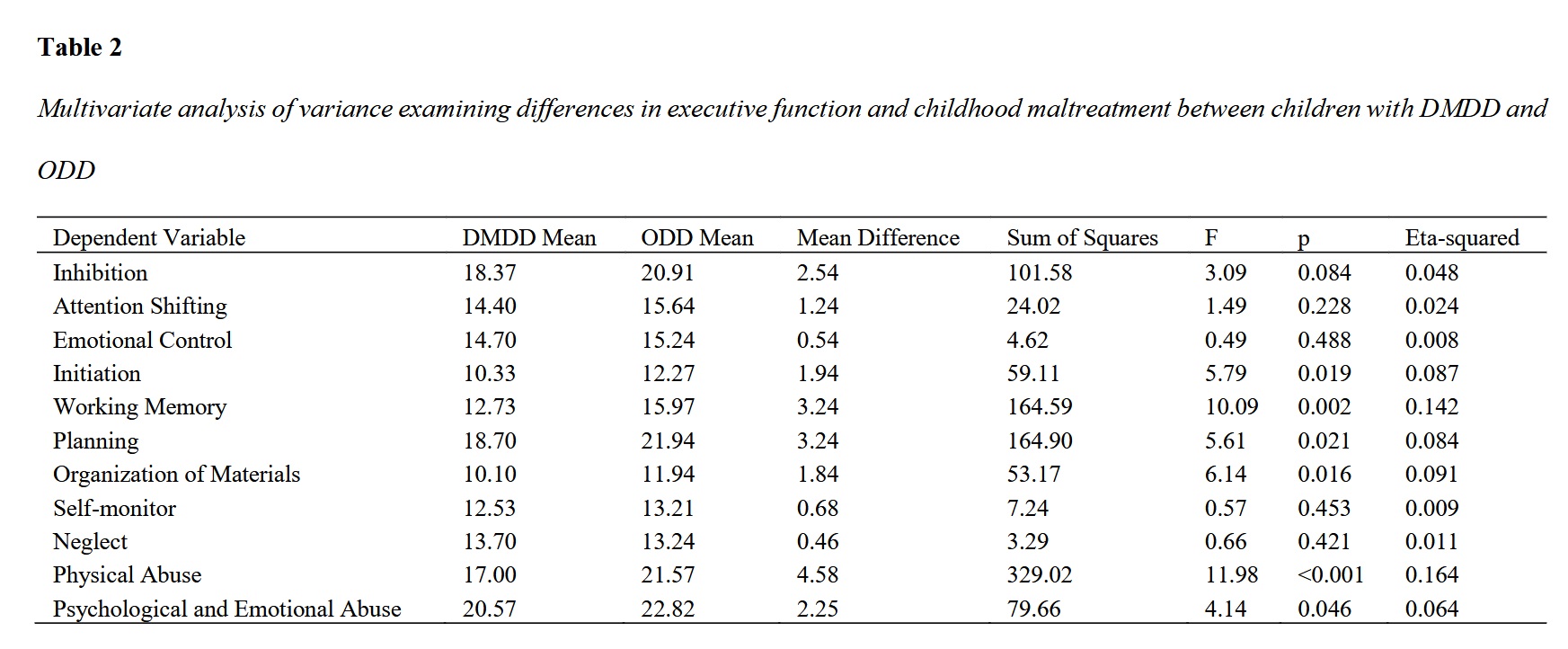
Findings: The findings demonstrated significant differences between the DMDD and ODD groups in several executive function domains. Children with ODD obtained significantly higher scores, indicating greater dysfunction, in initiation (F=5.79, p=0.019), working memory (F=10.09, p=0.002), planning (F=5.61, p=0.021), and organization of materials (F=6.14, p=0.016). Working memory showed the largest effect size (η²=0.142). No significant differences were observed in inhibition, emotional control, attention shifting, or self-monitoring. Regarding childhood maltreatment, children with ODD reported significantly higher levels of physical abuse (F=11.98, p<0.001) and psychological/emotional abuse (F=4.14, p=0.046) compared with children with DMDD, whereas neglect did not significantly differ between the groups.
Conclusion: The results suggest that although both DMDD and ODD are associated with executive dysfunction and adverse childhood experiences, children with ODD exhibited more severe impairments in specific executive function domains and reported greater exposure to childhood maltreatment. These findings highlight important neuropsychological and environmental distinctions between the two disorders and emphasize the need for comprehensive trauma-informed and neuropsychological assessment in the differential diagnosis and treatment planning of disruptive behavioral disorders in children and adolescents. Longitudinal studies are recommended to clarify causal pathways and developmental mechanisms underlying these associations.
Downloads
References
Abdolmohamadi, K., Alizadeh, H., Ghadiri Sourman Abadi, F., Taiebli, M., & Fathi, A. (2018). Psychometric Properties of Behavioral Rating Scale of Executive Functions (BRIEF) in Children Aged 6 to 12 Years. Training Measurement, 8(30), 135-151. https://sid.ir/paper/214630/en
Abursu, H., Ceylan, M. F., & Hesapcioglu, S. T. (2024). Irritability in Youth: Trauma, Maltreatment, and Bullying in Mood Disorders. European Journal of Trauma & Dissociation, 8(4), 100461. https://doi.org/10.1016/j.ejtd.2024.100461
Bhargav, M., & Swords, L. (2022). Role of Thwarted Belongingness, Perceived Burdensomeness and Psychological Distress in the Association between Adverse Childhood Experiences and Suicidal Ideation in College Students. BJPsych Open, 8(2), e39. https://doi.org/10.1192/bjo.2021.1087
Braenden, A., Coldevin, M., Zeiner, P., Stubberud, J., & Melinder, A. (2024a). Executive Function in Children with Disruptive Mood Dysregulation Disorder Compared to Attention-Deficit/Hyperactivity Disorder and Oppositional Defiant Disorder, and in Children with Different Irritability Levels. European Child & Adolescent Psychiatry, 33(1), 115-125. https://doi.org/10.1007/s00787-023-02143-6
Braenden, A., Coldevin, M., Zeiner, P., Stubberud, J., & Melinder, A. (2024b). Neuropsychological Mechanisms of Social Difficulties in Disruptive Mood Dysregulation Disorder versus Oppositional Defiant Disorder. Child Neuropsychology, 30(3), 402-424. https://doi.org/10.1080/09297049.2023.2205632
Copeland, W. E., Shanahan, L., Egger, H., Angold, A., & Costello, E. J. (2014). Adult Diagnostic and Functional Outcomes of DSM-5 Disruptive Mood Dysregulation Disorder. American Journal of Psychiatry, 171(6), 668-674. https://doi.org/10.1176/appi.ajp.2014.13091213
Dorrenbacher-Ulrich, L., & Bregulla, M. (2024). The Relationship between Self-Regulated Learning and Executive Functions: A Systematic Review. Educational psychology review, 36(3), 95. https://doi.org/10.1007/s10648-024-09932-8
Feifer, S. G. (2024). Disruptive Mood Dysregulation Disorder and Trauma: A Neuropsychological Perspective. In Clinician Guide to Disruptive Mood Dysregulation Disorder in Children and Adolescents (pp. 259-279). Springer. https://doi.org/10.1007/978-3-031-57398-9_16
Frankovich, J., Thienemann, M., Pearlstein, J., Crable, A., Brown, K., & Chang, K. (2015). Multidisciplinary Clinic Dedicated to Treating Youth with Pediatric Acute-Onset Neuropsychiatric Syndrome: Presenting Characteristics of the First 47 Consecutive Patients. Journal of Child and Adolescent Psychopharmacology, 25(1), 38-47. https://doi.org/10.1089/cap.2014.0081
Goksu, M., Erdogdu Yildirim, A. B., & Tugen, L. E. (2024). Predisposing Variables in Children with Risk of Disruptive Mood: A Clinical Case-Control Study. Deviant Behavior, 45(3), 410-421. https://doi.org/10.1080/01639625.2023.2248542
Goldstein, S. (2024). Exploring the Relationship between Executive Functioning and DMDD. In Clinician Guide to Disruptive Mood Dysregulation Disorder in Children and Adolescents (pp. 133-142). Springer International Publishing. https://doi.org/10.1007/978-3-031-57398-9_9
Hawes, D. J., Gardner, F., Dadds, M. R., Frick, P. J., Kimonis, E. R., Burke, J. D., & Fairchild, G. (2023). Oppositional Defiant Disorder. Nature Reviews Disease Primers, 9(1), 31. https://doi.org/10.1038/s41572-023-00441-6
Hosseinkhani, Z., Nedjat, S., Majdzadeh, R., Mahram, M., & Aflatooni, A. (2014). Design of the Child Abuse Questionnaire in Iran. Journal of School of Public Health and Institute of Public Health Research, 11(3), 29-38.
Lin, X., He, T., Heath, M., Chi, P., & Hinshaw, S. (2022). A Systematic Review of Multiple Family Factors Associated with Oppositional Defiant Disorder. International journal of environmental research and public health, 19(17), 10866. https://doi.org/10.3390/ijerph191710866
Lin, Y. J., Tseng, W. L., & Gau, S. S. (2021). Psychiatric Comorbidity and Social Adjustment Difficulties in Children with Disruptive Mood Dysregulation Disorder: A National Epidemiological Study. Journal of affective disorders, 281, 485-492. https://doi.org/10.1016/j.jad.2020.12.039
McQuade, B., Diem-Wille, G., Merems, N., & Nielsen, C. (2018). The Early Years of Life: Psychoanalytical Development Theory according to Freud, Klein, and Bion. Routledge. https://doi.org/10.4324/9780429481529
Muerner-Lavanchy, I., Kaess, M., & Koenig, J. (2023). Diagnostic Instruments for the Assessment of Disruptive Mood Dysregulation Disorder: A Systematic Review of the Literature. European Child & Adolescent Psychiatry, 32(1), 17-39. https://doi.org/10.1007/s00787-021-01840-4
Nuno, L., Gomez-Benito, J., Carmona, V. R., & Pino, O. (2021). A Systematic Review of Executive Function and Information Processing Speed in Major Depression Disorder. Brain Sciences, 11(2), 147. https://doi.org/10.3390/brainsci11020147
Salimi Nave, F., Andishmand, V., Zeinaddini, Z., & Soltani, A. (2022). Factor Structure and Validation of the Electronic Form of Persian Behavioral Rating Inventory of Executive Functions in Male School Students with Learning Disabilities. Scientific Journal of Rehabilitation Medicine, 11(1), 144-153. https://doi.org/10.32598/SJRM.11.1.15
Sandhu, S., Gill, M. K., Kakkar, R., Dhaliwal, K. K., Kamboj, V. S., & Deol, I. S. (2025). Emerging from the Shadows: A Qualitative Report with Panjabi Women Caregivers to Partners with Substance Use Disorder. Journal of Ethnicity in Substance Abuse, 1-27. https://doi.org/10.1080/15332640.2025.2505748
Schulze, K., Mueller, I., Holt, D. V., Putz, S., Barnow, S., & Pruessner, L. (2026). Rethinking the Link between Cognitive Control and Emotion Regulation: A Meta-Analytic Review. Neuroscience & Biobehavioral Reviews, 106708. https://doi.org/10.1016/j.neubiorev.2026.106708
Sharifi, A., Shojaeian, N., Mashhadi, A., Tabibi, Z., & Soltanifar, A. (2021). Comparison of Executive Functions in Disruptive Mood Dysregulation Disorder and Attention-Deficit Hyperactivity Disorder. Learning and Motivation, 75, 101747. https://doi.org/10.1016/j.lmot.2021.101747
Sorter, M., Chua, J., Lamy, M., Barzman, D., Ryes, L., & Shekhtman, J. A. (2022). Management of Emotion Dysregulation and Outbursts in Children and Adolescents. Current psychiatry reports, 24(3), 213-226. https://doi.org/10.1007/s11920-022-01325-4
Stadler, C., Freitag, C. M., Popma, A., Nauta-Jansen, L., Konrad, K., & Unternaehrer, E. (2024). START NOW: A Cognitive Behavioral Skills Training for Adolescent Girls with Conduct or Oppositional Defiant Disorder: A Randomized Clinical Trial. Journal of Child Psychology and Psychiatry, 65(3), 316-327. https://doi.org/10.1111/jcpp.13896
Vidal-Ribas, P., Brotman, M. A., Salum, G. A., Kaiser, A., Meffert, L., & Pine, D. S. (2018). Deficits in Emotion Recognition Are Associated with Depressive Symptoms in Youth with Disruptive Mood Dysregulation Disorder. Depression and Anxiety, 35(12), 1207-1217. https://doi.org/10.1002/da.22810
Wang, S., Hu, Z. Y., & Liu, H. Z. (2023). Childhood Trauma and Disruptive Mood Dysregulation Disorder. The Lancet Psychiatry, 10(3), 166. https://doi.org/10.1016/S2215-0366(22)00433-3
Warren, A., Blundell, B., Chung, D., & Waters, R. (2024). Exploring Categories of Family Violence across the Lifespan: A Scoping Review. Trauma, Violence, & Abuse, 25(2), 965-981. https://doi.org/10.1177/15248380231169486
Yang, Y., Shields, G. S., Zhang, Y., Wu, H., Chen, H., & Romer, A. L. (2022). Child Executive Function and Future Externalizing and Internalizing Problems: A Meta-Analysis of Prospective Longitudinal Studies. Clinical psychology review, 97, 102194. https://doi.org/10.1016/j.cpr.2022.102194
Zhang, W., He, T., Zhou, N., Duan, L., Chi, P., & Lin, X. (2024). Children's Oppositional Defiant Disorder Symptoms and Neural Synchrony in Mother-Child Interactions: An fNIRS Study. NeuroImage, 297, 120736. https://doi.org/10.1016/j.neuroimage.2024.120736
Downloads
Additional Files
Publication Timeline
- Submitted
- Revised
- Accepted