Predicting Emotional Dysregulation Using Artificial Neural Networks Based on Childhood Trauma, Attachment Insecurity, Alexithymia, and Mindfulness
Keywords:
Emotional dysregulation, Artificial neural network, Childhood trauma, Attachment insecurity, Alexithymia, Mindfulness, Machine learningAbstract
Objective: This study aimed to predict emotional dysregulation using artificial neural networks based on childhood trauma, attachment insecurity, alexithymia, and mindfulness among adults in Armenia.
Methods and Materials: This quantitative, cross-sectional, predictive study was conducted on 842 adults from Armenia. Participants were selected through convenience sampling from universities, community centers, healthcare settings, and online research platforms. Data were collected using the Difficulties in Emotion Regulation Scale, Childhood Trauma Questionnaire-Short Form, Experiences in Close Relationships-Revised questionnaire, Toronto Alexithymia Scale, Five Facet Mindfulness Questionnaire-Short Form, and a demographic information form. After data screening, normalization, and reliability assessment, descriptive and correlational analyses were performed in SPSS version 29. Artificial neural network modeling was conducted in Python using TensorFlow and Keras. The dataset was divided into training, validation, and testing subsets, and model performance was evaluated using MAE, MSE, RMSE, MAPE, R², and five-fold cross-validation. SHAP analysis was used to interpret predictor importance.
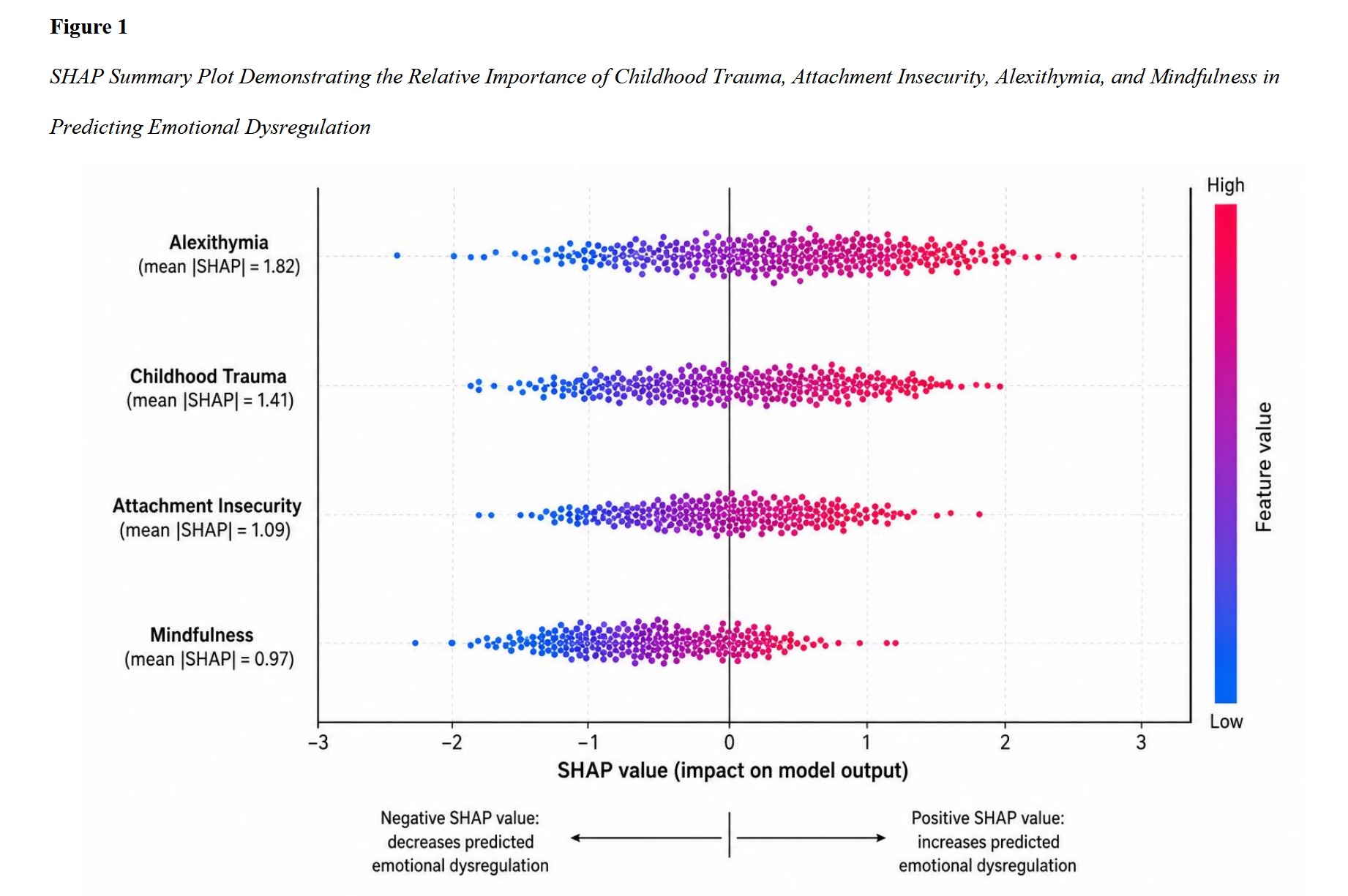
Findings: Emotional dysregulation showed significant positive correlations with childhood trauma (r = .69, p < .001), attachment insecurity (r = .64, p < .001), and alexithymia (r = .72, p < .001), and a significant negative correlation with mindfulness (r = −.67, p < .001). The optimized artificial neural network demonstrated strong predictive performance, explaining 91.4% of variance in the training set, 90.1% in the validation set, and 89.6% in the independent testing set. The model produced low prediction errors, including MAE = 4.28, RMSE = 5.64, and MAPE = 5.81%. Five-fold cross-validation confirmed model stability, with a mean R² of .902. SHAP analysis identified alexithymia as the strongest predictor, followed by childhood trauma, attachment insecurity, and mindfulness.
Conclusion: Emotional dysregulation was accurately predicted through a nonlinear artificial neural network model based on developmental, relational, emotional-awareness, and mindfulness-related factors. The findings highlight alexithymia and childhood trauma as central risk indicators and mindfulness as an important protective factor.
Downloads
References
Akpinar, B. (2024). Examining the Relationship Between Childhood Traumas, Alexithymia and Emotional Regulation Difficulties in University Students. https://doi.org/10.5772/intechopen.1005138
Civilotti, C., Nisticò, V., Tedesco, R., Cuoco, S., Bisogno, R., Barone, P., Celeghin, A., Fini, G. D., Gandino, G., Erro, R., & Demartini, B. (2024). Attachment State of Mind and Complex Traumatization in Patients With Functional Motor Disorder (Motor Conversion Disorder). Brain Behavior & Immunity - Health, 42, 100913. https://doi.org/10.1016/j.bbih.2024.100913
Cruz, D., Lichten, M., Berg, K., & George, P. S. (2022). Developmental Trauma: Conceptual Framework, Associated Risks and Comorbidities, and Evaluation and Treatment. Frontiers in Psychiatry, 13. https://doi.org/10.3389/fpsyt.2022.800687
Freeman, B., Salivar, E. G., & Thayer, K. K. (2024). The Impact of the Military Lifestyle on Adult Military Children Relationships. Couple and Family Psychology Research and Practice, 13(1), 1-14. https://doi.org/10.1037/cfp0000252
Gibson, J. (2024a). Meditation and Interoception: A Conceptual Framework for the Narrative and Experiential Self. Frontiers in psychology, 15. https://doi.org/10.3389/fpsyg.2024.1393969
Gibson, J. (2024b). Trauma, Early Life Stress, and Mindfulness in Adulthood. BMC psychology, 12(1). https://doi.org/10.1186/s40359-024-01563-6
Glaus, J., Moser, D. A., Serpa, S. R., Jouabli, S., Turri, F., Plessen, K. J., & Schechter, D. S. (2022). Families With Violence Exposure and the Intergenerational Transmission of Somatization. Frontiers in Psychiatry, 13. https://doi.org/10.3389/fpsyt.2022.820652
Gori, A., Topino, E., Cacioppo, M., Craparo, G., Schimmenti, A., & Caretti, V. (2023). An Integrated Approach to Addictive Behaviors: A Study on Vulnerability and Maintenance Factors. European Journal of Investigation in Health Psychology and Education, 13(3), 512-524. https://doi.org/10.3390/ejihpe13030039
Grady, S., Crowley, N., Scott, S., Ndukwe, C. I., Donohoe, R. T., & Gaynor, K. (2025). The Role of Trauma, Attachment, Dissociation, and Alexithymia in Pathways to Negative Symptoms in Psychosis. British Journal of Clinical Psychology, 64(4), 1002-1019. https://doi.org/10.1111/bjc.12554
Greenman, P. S., Renzi, A., Monaco, S., Luciani, F., & Trani, M. D. (2024). How Does Trauma Make You Sick? The Role of Attachment in Explaining Somatic Symptoms of Survivors of Childhood Trauma. Healthcare, 12(2), 203. https://doi.org/10.3390/healthcare12020203
Jin, X., Jiang, Q., Xiong, W., & Zhao, W. (2023). Effects of Use Motivations and Alexithymia on Smartphone Addiction: Mediating Role of Insecure Attachment. Frontiers in psychology, 14. https://doi.org/10.3389/fpsyg.2023.1227931
Kahya, Y., & Uluç, S. (2023). Maternal Childhood Trauma and Postpartum Well-Being in a Turkish Sample: The Path From Attachment to Alexithymia. Klinik Psikoloji Dergisi, 7(1), 1-10. https://doi.org/10.57127/kpd.26024438m000076x
Karmakar, A., Tanwar, S., & Parmar, V. (2024). Reducing Alexithymic Traits Using an Ideal Attachment Style Approach; A Correlational Study. Eatp. https://doi.org/10.53555/kuey.v30i5.3616
Liang, Y. (2024). Attachment Anxiety and Nomophobia: A Moderated Parallel Mediation Model. Psychological Reports, 128(6), 4273-4303. https://doi.org/10.1177/00332941241226907
Lin, X. (2024). Childhood Trauma: Effects on Adolescents' Mental Health. Applied & Educational Psychology, 5(3). https://doi.org/10.23977/appep.2024.050306
Mattar, E., Sawma, T., Hallit, R., Malaeb, D., Sakr, F., Dabbous, M., Hallit, S., Fekih‐Romdhane, F., & Obeïd, S. (2025). The Mediating Role of Distress Tolerance in the Relationship Between Childhood Maltreatment and Anxiety in a Sample of Lebanese Adults. Scientific reports, 15(1). https://doi.org/10.1038/s41598-025-98417-x
McGovern, P. (2023). Understanding Somatization Through the Prism of Deficit Pathology and Winnicott's False Self. British Journal of Psychotherapy, 39(3), 501-518. https://doi.org/10.1111/bjp.12848
Muzi, S., & Pace, C. S. (2023). Attachment and Alexithymia Predict Emotional–behavioural Problems of Institutionalized, Late‐adopted and Community Adolescents: An Explorative Multi‐informant Mixed‐method Study. Clinical Psychology & Psychotherapy, 30(5), 1130-1145. https://doi.org/10.1002/cpp.2862
Omidbakhsh, Z., & Soltanabadi, S. (2025). Childhood Maltreatment and Complex PTSD: A Systematic Literature Review. Trauma Violence & Abuse, 27(3), 558-578. https://doi.org/10.1177/15248380251320985
Panagou, C., & MacBeth, A. (2022). Deconstructing Pathways to Resilience: A Systematic Review of Associations Between Psychosocial Mechanisms and Transdiagnostic Adult Mental Health Outcomes in the Context of Adverse Childhood Experiences. Clinical Psychology & Psychotherapy, 29(5), 1626-1654. https://doi.org/10.1002/cpp.2732
Pellegrini, R. A., Finzi, S., Veglia, F., & Fini, G. D. (2021). Narrative and Bodily Identity in Eating Disorders: Toward an Integrated Theoretical-Clinical Approach. Frontiers in psychology, 12. https://doi.org/10.3389/fpsyg.2021.785004
Price, J., Hinton, R., Baker, C., Richardson, S. R., & Wilson, C. (2025). The Impact of Childhood Experiences on Sexual Behaviours and Intimate Relationships: A Systematic Review. https://doi.org/10.21203/rs.3.rs-6905929/v1
Scharfe, E. (2026). Attachment Representations and Depression. 423-439. https://doi.org/10.1037/0000437-023
Ścigała, D. K., Fabris, M. A., Badenes‐Ribera, L., Zdankiewicz-Ścigała, E., & Longobardi, C. (2021). Alexithymia and Self Differentiation: The Role of Fear of Intimacy and Insecure Adult Attachment. Contemporary Family Therapy, 43(2), 165-176. https://doi.org/10.1007/s10591-021-09567-9
Ścigała, D. K., Sikora-Ścigała, J., & Zdankiewicz-Ścigała, E. (2025). Alexithymia and Attachment Dimensions in Relation to Parental Burnout: A Structural Equation Modelling Approach. PLoS One, 20(11), e0334647. https://doi.org/10.1371/journal.pone.0334647
Stroink, L. (2024). Autonomy-Related Personality Factors in Patients With Functional Neurological Symptom Disorder. https://doi.org/10.5772/intechopen.1004200
Tambelli, R., Cimino, S., Marzilli, E., Ballarotto, G., & Cerniglia, L. (2021). Late Adolescents’ Attachment to Parents and Peers and Psychological Distress Resulting From COVID-19. A Study on the Mediation Role of Alexithymia. International journal of environmental research and public health, 18(20), 10649. https://doi.org/10.3390/ijerph182010649
Vergés-Báez, L., Lozano‐Paniagua, D., Requena, M., García‐González, J., García-Álvarez, R., & Alarcón, R. (2021). Alexithymia and Insecure Attachment Among Male Intimate Partner Violence Aggressors in the Dominican Republic. Healthcare, 9(12), 1626. https://doi.org/10.3390/healthcare9121626
Wagner‐Skacel, J., Riedl, D., Kampling, H., & Lampe, A. (2021). Mentalization and Dissociation After Adverse Childhood Experiences. https://doi.org/10.21203/rs.3.rs-907657/v1
Zainab, S., Arzeen, N., & Arzeen, S. (2023). Impact of Parental Bonding on Alexithymia and Psychological Distress Among Pakistani Adolescents. International Journal of Psychology and Cognitive Education, 2(1), 21-30. https://doi.org/10.58425/ijpce.v2i1.141
Zhang, M., Dou, G., Shi, M., & Yue, P. (2025). Childhood Abuse, Distress Disclosure, Resilience, and Alexithymia: Testing a Moderated Mediation Model. https://doi.org/10.21203/rs.3.rs-6858058/v1
Downloads
Additional Files
Publication Timeline
- Submitted
- Revised
- Accepted