CatBoost Classification of High-Risk Perfectionism Using Conditional Self-Worth, Fear of Evaluation, and Cognitive Fusion
Keywords:
CatBoost, High-risk perfectionism, Conditional self-worth, Fear of negative evaluation, Cognitive fusion, Machine learning, University students, IndonesiaAbstract
Objective: This study aimed to classify high-risk perfectionism among Indonesian university students using a CatBoost machine-learning model based on conditional self-worth, fear of negative evaluation, and cognitive fusion.
Methods and Materials: This cross-sectional predictive study was conducted among 436 university students in Indonesia during the 2025–2026 academic year. Participants were selected through convenience sampling from public and private universities. High-risk perfectionism was defined according to the upper quartile of perfectionistic concerns scores, while the remaining participants were classified as non-high-risk. Data were collected using standardized self-report instruments measuring perfectionistic concerns, conditional self-worth, fear of negative evaluation, and cognitive fusion. After screening the dataset for incomplete responses, invalid cases, and response irregularities, the data were divided into stratified training and testing subsets. A CatBoost classifier was trained using five-fold cross-validation, and model performance was evaluated using accuracy, balanced accuracy, sensitivity, specificity, precision, F1-score, ROC-AUC, PR-AUC, confusion matrix indices, and calibration statistics. Feature importance and SHAP values were used to interpret the contribution of predictors to model output.
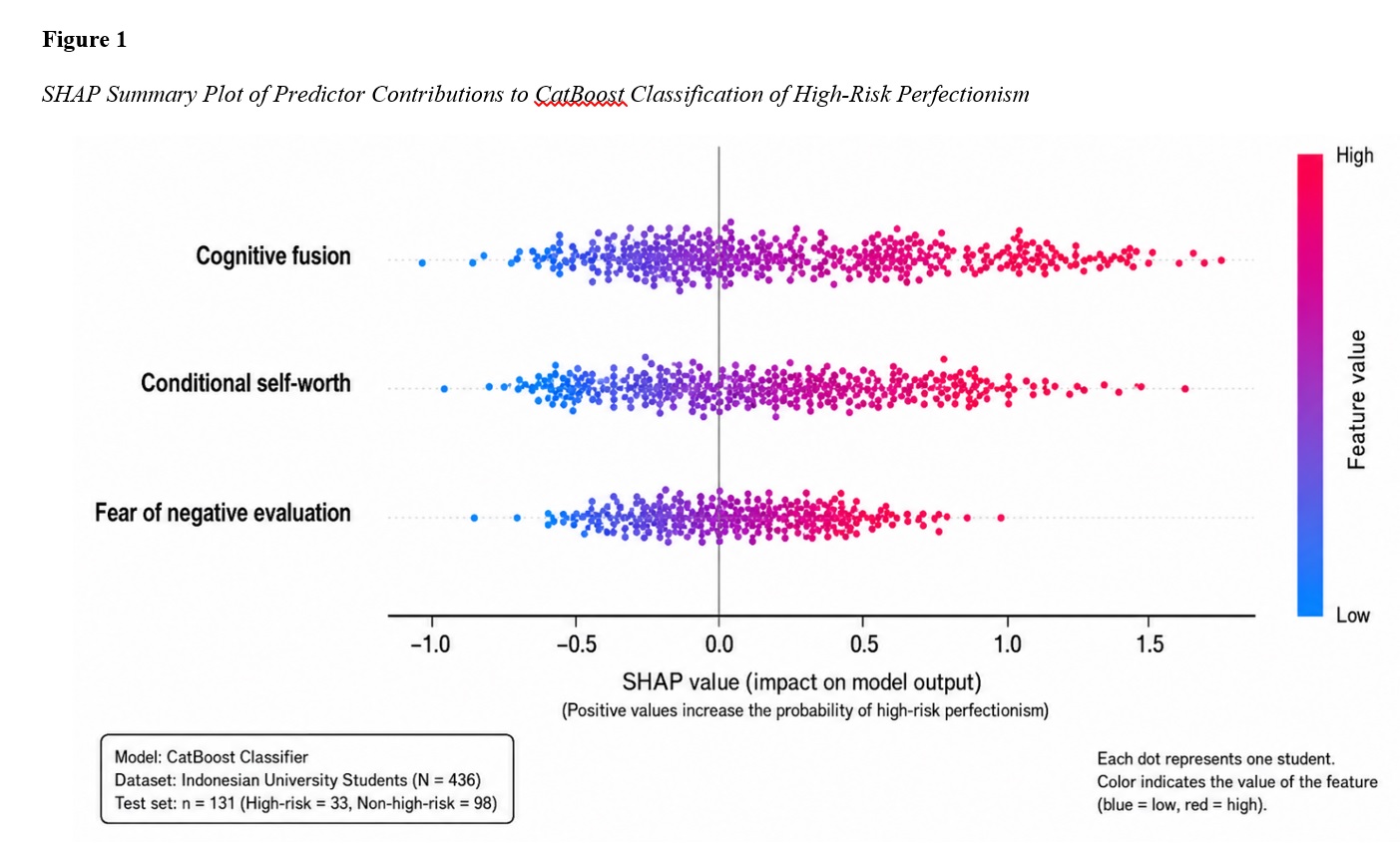
Findings: The CatBoost model demonstrated strong classification performance in identifying high-risk perfectionism. In the independent test set, the model achieved an accuracy of 0.885, balanced accuracy of 0.863, sensitivity of 0.818, specificity of 0.908, precision of 0.750, F1-score of 0.783, ROC-AUC of 0.926, PR-AUC of 0.812, Matthews correlation coefficient of 0.711, and Brier score of 0.104. The confusion matrix showed that 27 of 33 high-risk students were correctly classified, while 89 of 98 non-high-risk students were correctly identified. SHAP analysis indicated that cognitive fusion was the strongest predictor, followed by conditional self-worth and fear of negative evaluation.
Conclusion: The findings suggest that high-risk perfectionism among Indonesian university students can be accurately classified using an interpretable CatBoost model and that cognitive fusion, conditional self-worth, and fear of negative evaluation are important psychological indicators for screening and preventive counseling.
Downloads
References
Arbinaga, F., Moreno-San-Pedro, E., & Sierra, M. I. M. (2023). Chronotype and Self-Reported Perception of Sleep Quality in Relation to Psychological Inflexibility in Dance Students. https://doi.org/10.20944/preprints202310.1712.v1
Arbinaga, F., & Sierra, M. I. M. (2025a). Pain Catastrophizing in Music Students: Examining Its Relationship With Psychological Inflexibility and Perfectionism. Musicae Scientiae, 30(2), 215-238. https://doi.org/10.1177/10298649251378257
Arbinaga, F., & Sierra, M. I. M. (2025b). Psychopathological Symptoms in Soccer Referees: The Role of Psychological Inflexibility and Perfectionism. Peerj, 13, e19790. https://doi.org/10.7717/peerj.19790
Arbinaga, F., Vargas, G. A., & Moreno, E. (2025). Soccer Refereeing and Resilient Behavior: Relationships With Psychological Inflexibility and Perfectionism. Perceptual and Motor Skills. https://doi.org/10.1177/00315125251365290
Balzan, R., Gilder, M., Thompson, M., & Wade, T. (2023). A Randomized Controlled Feasibility Trial of Metacognitive Training With Adolescents Receiving Treatment for Anorexia Nervosa. International Journal of Eating Disorders, 56(9), 1820-1825. https://doi.org/10.1002/eat.24009
Capel, L. K., & Twohig, M. P. (2024). ACT for OCD: An Example of ACT and Values‐Based Exposures. Journal of Clinical Psychology, 81(2), 93-101. https://doi.org/10.1002/jclp.23759
Cervantes-Perea, W., Martínez‐Bacaicoa, J., & Gámez‐Guadix, M. (2025). Psychological Flexibility and Inflexibility of University Students: An in-Depth Qualitative Study. International journal of environmental research and public health, 22(7), 1141. https://doi.org/10.3390/ijerph22071141
Cheli, S., Cavalletti, V., Flett, G. L., & Hewitt, P. L. (2022). Perfectionism Unbound: An Integrated Individual and Group Intervention for Those Hiding Imperfections. Journal of Clinical Psychology, 78(8), 1624-1636. https://doi.org/10.1002/jclp.23365
Chełkowska-Zacharewicz, M., & Baran, L. (2023). Psychological Flexibility for the Well-Being of Musicians: New Possibilities for Psychological Counseling. Musicae Scientiae, 27(4), 913-931. https://doi.org/10.1177/10298649231179430
Chung, C. H. P., & Lee, A. M. (2024). Bidimensional Perfectionism and Psychological Distress: The Roles of Self-Esteem and Self-Compassion. https://doi.org/10.1101/2024.07.24.24310699
Consiglio, M. D., Fabrizi, G., Conversi, D., Torre, G. L., Pascucci, T., Lombardo, C., Violani, C., & Couyoumdjian, A. (2021). Effectiveness of NoiBene: A Web‐based Programme to Promote Psychological Well‐being and Prevent Psychological Distress in University Students. Applied Psychology Health and Well-Being, 13(2), 317-340. https://doi.org/10.1111/aphw.12251
Delakeh, N. K. (2026). School Based- Group Cognitive Behavioral Therapy for Maladaptive Perfectionism: Effects on Anxiety and Self Esteem- In Adolescent Girls in a Nonwestern- Cultural Context. https://doi.org/10.21203/rs.3.rs-8766716/v1
Dell’Osso, L., Nardi, B., Giovannoni, F., Bonelli, C., Cremone, I. M., & Pini, S. (2025). Orthorexic Tendencies Are Associated With Autistic Traits in Patients With Borderline Personality Disorder. Journal of clinical medicine, 14(11), 3891. https://doi.org/10.3390/jcm14113891
Ebrahimi, S., Moheb, N., & Vafa, M. A. (2024). Comparison of the Effectiveness of Cognitive-Behavioral Therapy and Acceptance and Commitment Therapy on Cognitive Distortions and Rumination in Adolescents With Social Anxiety Disorder. Practice in Clinical Psychology, 12(1), 81-94. https://doi.org/10.32598/jpcp.12.1.922.1
Écija, C., Catalá, P., Sanromán, L., López-Roig, S., Pastor-Mira, M. Á., & Peñacoba, C. (2020). Is Perfectionism Always Dysfunctional? Looking Into Its Interaction With Activity Patterns in Women With Fibromyalgia. Clinical Nursing Research, 30(5), 567-578. https://doi.org/10.1177/1054773820973273
Galfano, V., Syurina, E. V., Valente, M., & Donini, L. M. (2021). When “Healthy” Is Taken Too Far: Orthorexia Nervosa—Current State, Controversies and Future Directions. 159-176. https://doi.org/10.1007/978-3-030-81174-7_14
Giles, S., Hughes, E. K., Fuller‐Tyszkiewicz, M., Treasure, J., Fernández‐Aranda, F., Karwautz, A., Wagner, G., Anderluh, M., Collier, D., & Krug, I. (2022). Bridging of Childhood Obsessive‐compulsive Personality Disorder Traits and Adult Eating Disorder Symptoms: A Network Analysis Approach. European Eating Disorders Review, 30(2), 110-123. https://doi.org/10.1002/erv.2885
Grubi, T. (2021). Factors in University Teaching Staff Perfectionism. Організаційна Психологія Економічна Психологія, 4(24), 15-21. https://doi.org/10.31108/2.2021.4.24.2
Habibi, M., Vand, H. D. A., Yegaei, P. S., Hooman, F., Ahmadi, R., Baglioni, C., & Moradi, S. (2023). The Contribution of Transdiagnostic Vulnerability Factors in Patients With Chronic Insomnia. Frontiers in Psychiatry, 14. https://doi.org/10.3389/fpsyt.2023.1162729
Haraldsen, H. M., Solstad, B. E., Ivarsson, A., Halvari, H., & Abrahamsen, F. E. (2020). Change in Basic Need Frustration in Relation to Perfectionism, Anxiety, and Performance in Elite Junior Performers. Scandinavian Journal of Medicine and Science in Sports, 30(4), 754-765. https://doi.org/10.1111/sms.13614
Howard, L. R., Earleywine, M., DeCount, T. A., & Forsyth, J. P. (2026). Acceptance and Commitment Therapy (ACT) for Comorbid Generalized Anxiety Disorder and Premenstrual Dysphoric Disorder: A Transdiagnostic Approach. Clinical Case Studies. https://doi.org/10.1177/15346501261421541
Inoué, K., Yamada, T., & Ohtsuki, T. (2024). Relationships Between Throwing Yips in Baseball, Experiential Avoidance, Cognitive Fusion, Values, and Social Factors. Journal of Clinical Sport Psychology, 18(3), 374-395. https://doi.org/10.1123/jcsp.2022-0057
Khosravi, R., Mohammadi, E., Esmaeili, N., & Zandi, H. (2023). Perfectionism and Writing Anxiety as Predictors of Iranian EFL Learners’ Performance in IELTS Writing Module: A Multi-Dimensional Perspective. Frontiers in Education, 8. https://doi.org/10.3389/feduc.2023.1108542
Mansur‐Alves, M., Muniz, M., Rueda, F. J. M., & Zeferino, G. G. (2023). Psychometric Properties of the Hewitt and Flett Multidimensional Perfectionism Scale in Brazilian Adults. Psicologia Teoria E Pesquisa, 39(spe). https://doi.org/10.1590/0102.3772e39nspe09.en
Mata‐Saenz, B., Rodríguez‐Cano, T., Muñoz-Martínez, V. E., & Beato‐Fernández, L. (2020). Relationship Between Neuropsychology, Clinical Traits, Psychopathology and Attitudes Towards Change in Eating Disorders. https://doi.org/10.21203/rs.3.rs-21795/v2
Menon, S., Aiswarya, V. R., & Rajan, S. K. (2024). Parental Expectations and Fear of Negative Evaluation Among Indian Emerging Adults: The Mediating Role of Maladaptive Perfectionism. Indian Journal of Psychological Medicine, 47(5), 479-487. https://doi.org/10.1177/02537176241252949
Ong, C. W., Levin, M. E., & Twohig, M. P. (2020). Beyond Acceptance and Commitment Therapy: Process-Based Therapy. The Psychological Record, 70(4), 637-648. https://doi.org/10.1007/s40732-020-00397-z
Pellino, V. C., Lovecchio, N., Puci, M. V., Marin, L., Gatti, A., Pirazzi, A., Negri, F., Ferraro, O. E., & Vandoni, M. (2022). Effects of the Lockdown Period on the Mental Health of Elite Athletes During the COVID-19 Pandemic: A Narrative Review. Sport Sciences for Health, 18(4), 1187-1199. https://doi.org/10.1007/s11332-022-00964-7
Podină, I. R. (2020). Concluding Commentary: Treating Perfectionism Transdiagnostically With an Eye on the Future. Journal of Clinical Psychology, 76(11), 2109-2115. https://doi.org/10.1002/jclp.23061
Rozental, A. (2020). Beyond Perfect? A Case Illustration of Working With Perfectionism Using Cognitive Behavior Therapy. Journal of Clinical Psychology, 76(11), 2041-2054. https://doi.org/10.1002/jclp.23039
Steinert, C., Heim, N., & Leichsenring, F. (2021). Procrastination, Perfectionism, and Other Work-Related Mental Problems: Prevalence, Types, Assessment, and Treatment—A Scoping Review. Frontiers in Psychiatry, 12. https://doi.org/10.3389/fpsyt.2021.736776
Styk, W., Zmorzyński, S., & Samardakiewicz, M. (2023). Persistence Is Multi-Trait: Persistence Scale Development and Persistence Perseveration and Perfectionism Questionnaire Into Polish Translation. Brain Sciences, 13(6), 864. https://doi.org/10.3390/brainsci13060864
Uğur, E., Kaya, Ç., & Tanhan, A. (2020). Psychological Inflexibility Mediates the Relationship Between Fear of Negative Evaluation and Psychological Vulnerability. Current Psychology, 40(9), 4265-4277. https://doi.org/10.1007/s12144-020-01074-8
Veloso, P. (2025). Third-Generation Cognitive and Behavioral Therapies for Obsessive-Compulsive Disorder: A Narrative Review. Cureus. https://doi.org/10.7759/cureus.94299
Zuo, Z., & Zhang, X. (2023). A Randomized Controlled Trial of Group CBT With Positive Psychotherapy Intervention for University Students With Maladaptive Perfectionism in China. Frontiers in psychology, 14. https://doi.org/10.3389/fpsyg.2023.1161575
Завада, Т. (2020). Theoretical Aspects of Perfectionism Influence on the Personality. 250-269. https://doi.org/10.30525/978-9934-588-37-2.1.15
Downloads
Additional Files
Publication Timeline
- Submitted
- Revised
- Accepted