Artificial Intelligence-Based Assessment and Intervention for Specific Learning Disabilities: A Systematic Review
Keywords:
Artificial intelligence, specific learning disabilities, dyslexia, dyscalculia, dysgraphia, machine learning, adaptive intervention, systematic reviewAbstract
Objective: This study aimed to systematically review the existing evidence on the application of artificial intelligence-based methods in the assessment, screening, prediction, diagnosis, intervention, and progress monitoring of specific learning disabilities.
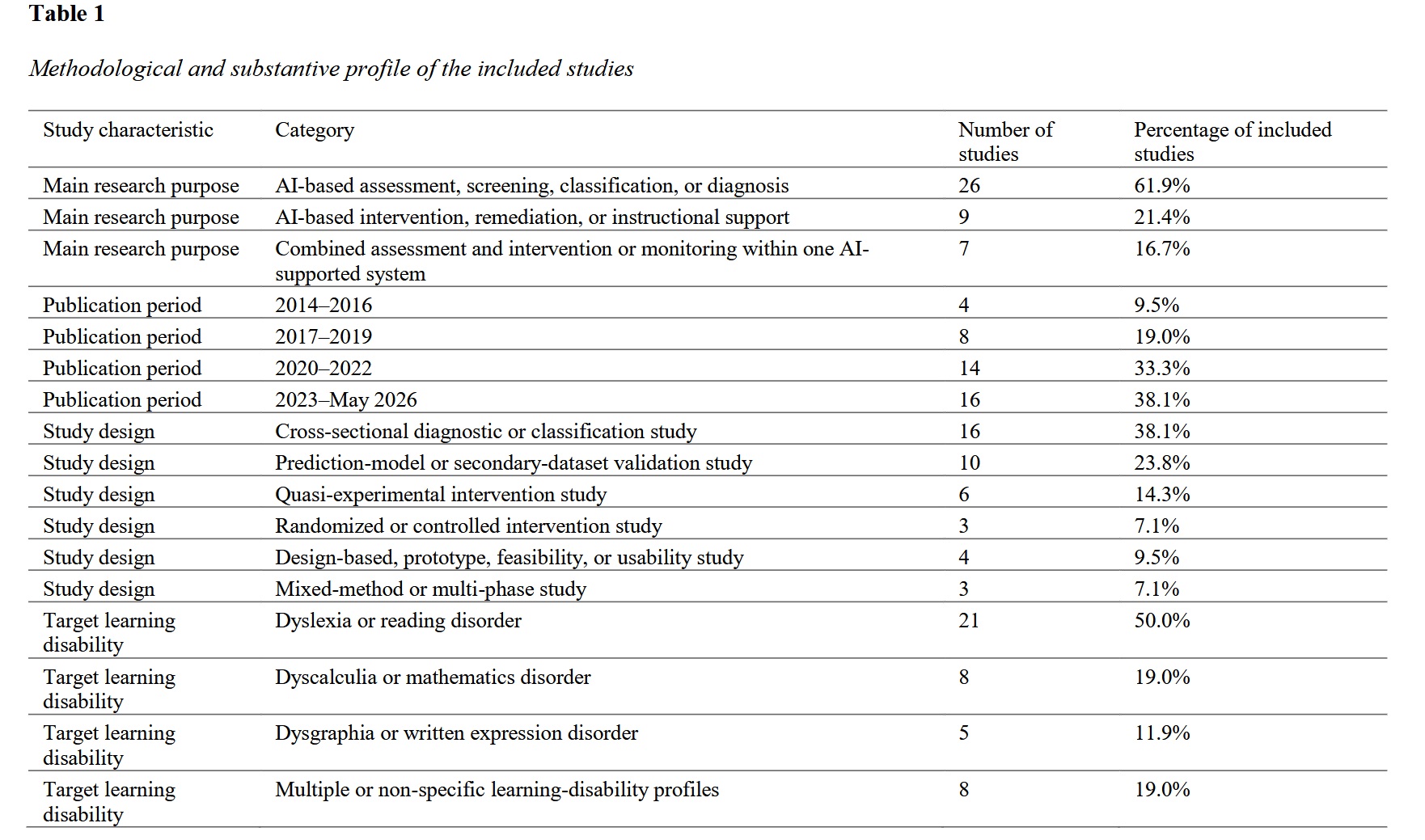
Methods and Materials: This systematic review was conducted according to PRISMA-based principles. Scientific databases including Scopus, Web of Science, PubMed/MEDLINE, ERIC, PsycINFO, IEEE Xplore, and ScienceDirect were searched for studies published between January 2014 and May 2026. The search combined terms related to artificial intelligence, machine learning, deep learning, expert systems, adaptive learning, intelligent tutoring, dyslexia, dyscalculia, dysgraphia, and specific learning disabilities. From 1,286 initially identified records, 362 duplicates were removed, 924 titles and abstracts were screened, and 153 full-text articles were assessed for eligibility. Finally, 42 studies met the inclusion criteria and were analyzed through descriptive and narrative synthesis.
Findings: Inferential synthesis of the included studies indicated that artificial intelligence-based models showed the strongest evidence in assessment-related functions, particularly early screening, diagnostic classification, and academic-risk prediction. Classification and prediction models generally demonstrated acceptable to high performance, especially when multidimensional cognitive, linguistic, academic, behavioral, handwriting, or digital-learning data were used. Evidence was strongest for dyslexia and reading disorder, while dyscalculia and dysgraphia were less frequently investigated but showed promising results, particularly in handwriting analysis and mathematics-risk detection. Intervention-related findings indicated that AI-based adaptive learning systems, intelligent tutoring platforms, mobile applications, serious games, and personalized feedback tools were associated with improvement in short-term academic outcomes, especially reading accuracy, decoding, mathematical performance, writing accuracy, engagement, and progress monitoring. However, evidence for long-term intervention effectiveness, transfer, and sustained educational outcomes remained limited.
Conclusion: Artificial intelligence has considerable potential to support the early identification, individualized assessment, adaptive intervention, and continuous monitoring of learners with specific learning disabilities. Nevertheless, current evidence is stronger for screening and classification than for intervention effectiveness. Future studies should prioritize external validation, longitudinal designs, explainability, ethical implementation, cultural adaptation, and integration with professional educational and clinical judgment.
Downloads
References
Achiek, A. N., & Selugo, J. (2024). How the Learning Disabilities Cause Psychosocial Problems Among Children in South Sudan: A Case of Jamjang Refugee Camps. Texila International Journal of Academic Research, 11(1), 175-186. https://doi.org/10.21522/tijar.2014.11.01.art016
Alabbad, M., Khan, M. A., Siddique, N., Hassan, J. A., Bashir, S., & Abualait, T. (2023). Early Predictors in Language-Based Learning Disabilities: A Bibliometric Analysis. Frontiers in Psychiatry, 14. https://doi.org/10.3389/fpsyt.2023.1229580
Ali, S. A., Ali, S. N., & Khan, R. (2023). ≪strong>Investigating the Efficacy of Transcranial Direct Current Stimulation in Managing ADHD and Co-Occurring Conditions ≪/Strong>. https://doi.org/10.20944/preprints202304.0170.v1
Alzahrani, S., & Algahtani, F. (2024). Implications and Identification of Specific Learning Disability Using Weighted Ensemble Learning Model. Child Care Health and Development, 51(1). https://doi.org/10.1111/cch.70026
Alzubi, K. A. A. (2023). The Effect of Using Mobile Applications in Treating Learning Difficulties Among Students in Jordan. International Journal of Interactive Mobile Technologies (Ijim), 17(22), 52-66. https://doi.org/10.3991/ijim.v17i22.43659
Andrade-Arenas, L., & Yactayo-Arias, C. (2024). Expert System for Diagnosing Learning Disorders in Children. International Journal of Electrical and Computer Engineering (Ijece), 14(3), 2965. https://doi.org/10.11591/ijece.v14i3.pp2965-2975
Asdaq, S. M. B., Alhowail, A., Rabbani, S. I., Nayeem, N., Asdaq, S. M. E., & Nausheen, F. (2025). Learning Disabilities in the 21st Century: Integrating Neuroscience, Education, and Technology for Better Outcomes. Sage Open, 15(3). https://doi.org/10.1177/21582440251365483
Ashidiqi, A. S., Widaningrum, I., & Karaman, J. (2023). Implementation of the Certainty Factor Method in the Expert System for Early Diagnosis of Dyslexia in Childhood. Intensif Jurnal Ilmiah Penelitian Dan Penerapan Teknologi Sistem Informasi, 7(1), 18-32. https://doi.org/10.29407/intensif.v7i1.18433
Azar, E. F., Hejazi‐Shirmard, M., & Mirzaie, H. (2024). Cognitive Enhancement Through Technology: A Review of Transcranial Electrical Stimulation (TES) Interventions in Children and Adolescents With Specific Learning Disabilities. Child Care Health and Development, 50(5). https://doi.org/10.1111/cch.13318
Benedetti, I., Barone, M., Panetti, V., Taborri, J., Tony, U., Zingoni, A., & Calabrò, G. (2021). Analysis of Factors Affecting Academic Career: Clustering of University Students With Dyslexia in Italy. https://doi.org/10.21203/rs.3.rs-775951/v1
Bhushan, S., Sharmila, A., Eisa, T. A. E., Nasser, M., Singh, A. K., & Kumar, P. (2024). AI-Enhanced Dyscalculia Screening: A Survey of Methods and Applications for Children. Diagnostics, 14(13), 1441. https://doi.org/10.3390/diagnostics14131441
Calı̀, F., Blasi, F. D. D., Avola, E., Vinci, M., Musumeci, A., Gloria, A., Greco, D., Raciti, D., Zagami, A. S., Rizzo, B., Città, S., Federico, C., Vetri, L., Saccone, S., & Buono, S. (2023). Specific Learning Disorders: Variation Analysis of 15 Candidate Genes in 9 Multiplex Families. Medicina, 59(8), 1503. https://doi.org/10.3390/medicina59081503
Coacci, V. T., Cardoso, F. c. B., Sholl‐Franco, A., & Guimarães, C. d. C. (2023). Does the Use of Exergames Have a Positive Influence on Executive Functions and Academic Performance of School-Age Children With Specific Learning Disorder? A Literature Review. Creative Education, 14(02), 349-366. https://doi.org/10.4236/ce.2023.142023
Dzulkifli, M. A. (2024). Children With Learning Disabilities in Malaysia. https://doi.org/10.5772/intechopen.113230
Fajariyanti, F. M., Agata, D., & Harsono, T. (2022). Expert System for Learning Disability Classification in School-Age Children. https://doi.org/10.2991/assehr.k.220301.039
Fallah, A. (2025). AI-driven Approaches for Dysgraphia Diagnosis Using Online and Offline Handwriting Data: A Comprehensive Scoping Review. PLoS One, 20(12), e0328722. https://doi.org/10.1371/journal.pone.0328722
Galitskaya, V., & Drigas, A. (2021). The Importance of Working Memory in Children With Dyscalculia and Ageometria. Scientific Electronic Archives, 14(10). https://doi.org/10.36560/141020211449
Gupta, M., & Gupta, S. B. (2024). A Systematic Analysis of Ai-Empowered Educational Tools Developed in India for Disabled People. Information Technologies and Learning Tools, 100(2), 199-216. https://doi.org/10.33407/itlt.v100i2.5501
Gyarmathy, É., & Plosz, J. (2021). Atypical Development Spectra Considering the Hunter-Breeder Culture Transition. https://doi.org/10.31219/osf.io/k2tfx
Hande, V., & Hegde, S. (2021). Deficits in Musical Rhythm Perception in Children With Specific Learning Disabilities. NeuroRehabilitation, 48(2), 187-193. https://doi.org/10.3233/nre-208013
Kunhoth, J., Al-Máadeed, S., Kunhoth, S., Akbari, Y., & Saleh, M. (2024). Automated Systems for Diagnosis of Dysgraphia in Children: A Survey and Novel Framework. International Journal on Document Analysis and Recognition (Ijdar), 27(4), 707-735. https://doi.org/10.1007/s10032-024-00464-z
Luciano, M., Yutong, A., McKinlay, M., Mubarak, R., & Paracchini, S. (2025). Shaping UK Research Priorities in the Area of Specific Learning Difficulties by Surveying People With Lived Experience. Neurodiversity, 3. https://doi.org/10.1177/27546330251348559
Mohamed, S., Ben-Jaafar, A., Frimpong, M., Roy, S., Sanker, V., Nkrumah-Boateng, P. A., Imran, S., Mumeen, A. A., Mohamed, S., & Wireko, A. A. (2026). Applying Artificial Intelligence in Neurodevelopmental Disorders Management and Research. European Journal of Medical Research, 31(1). https://doi.org/10.1186/s40001-025-03740-8
Nejati, V., Ghafouri, F., Hejazi, M., & Behroozmand, R. (2026). The Effectiveness of Attention Training in Specific Learning Disorders:A Systematic Review and Transfer Analysis. https://doi.org/10.21203/rs.3.rs-7853101/v1
Paglialunga, A., & Melogno, S. (2025). The Effectiveness of Artificial Intelligence-Based Interventions for Students With Learning Disabilities: A Systematic Review. Brain Sciences, 15(8), 806. https://doi.org/10.3390/brainsci15080806
Parvathy, V. S. (2023). Predicting Dyslexia With Machine Learning: A Comprehensive Review of Feature Selection, Algorithms, and Evaluation Metrics. Journal of Behavioral Data Science, 3(1), 1-14. https://doi.org/10.35566/jbds/v3n1/s
Patil, A. U., Madathil, D., Fan, Y. T., Tzeng, O. J. L., Huang, C. M., & Huang, F. Y. (2022). Neurofeedback for the Education of Children With ADHD and Specific Learning Disorders: A Review. Brain Sciences, 12(9), 1238. https://doi.org/10.3390/brainsci12091238
Santhiya, S., & Kanimozhiselvi, C. S. (2023). A Study on Dyslexia Detection Using Machine Learning Techniques for Checklist, Questionnaire and Online Game Based Datasets. Applied and Computational Engineering, 5(1), 837-842. https://doi.org/10.54254/2755-2721/5/20230722
Shaikh, M. F., Higley, C., Campanile, C., Francis, B., Panja, E., Santacaterina, S., Pratesi, G., & Piaggio, D. (2024). Technology and Serious Gaming for Neurodevelopmental Disorders: A Systematic Literature Review (Preprint). https://doi.org/10.2196/preprints.64627
Shaikh, M. F., Higley, C., Campanile, C., Francis, R. M., Panja, E., Santacaterina, S., Pratesi, G., & Piaggio, D. (2025). Serious Gaming and Eye-Tracking for the Screening, Monitoring, Diagnosis and Treatment of Neurodevelopmental Disorders in Children: A Systematic Literature Review. https://doi.org/10.1101/2025.09.16.25335869
Škunda, J., Nerušil, B., & Polec, J. (2022). Method for Dysgraphia Disorder Detection Using Convolutional Neural Network. 152-157. https://doi.org/10.24132/csrn.3201.19
Sokolowski, H. M., & Levine, B. (2022). Common Neural Substrates of Diverse Neurodevelopmental Disorders. Brain, 146(2), 438-447. https://doi.org/10.1093/brain/awac387
Vetri, L., Pepi, A., Alesi, M., Maltese, A., Scifo, L., Roccella, M., Quatrosi, G., & Elia, M. (2023). Poor School Academic Performance and Benign Epilepsy With Centro-Temporal Spikes. Behavioral Sciences, 13(2), 106. https://doi.org/10.3390/bs13020106
Weraduwa, S., Asanka, D., & Mahanama, T. V. (2025). Early Detection and Risk Assessment of Dysgraphia in Sinhala-Speaking Children Using a Multi-Modal Machine Learning Approach. https://doi.org/10.21203/rs.3.rs-6588752/v2
Yuniari, N. M. (2024). Learning Disability (Dysgraphia): A Case Study on a Second Grade Student at Elementary School. Jurnal Pendidikan Bahasa Inggris Undiksha, 11(2), 159-166. https://doi.org/10.23887/jpbi.v11i2.72837
Downloads
Additional Files
Publication Timeline
- Submitted
- Revised
- Accepted