Comparing the Effectiveness of Cognitive Empowerment Based on Cognitive Games and Executive Function–Based Parenting on Working Memory in Children with Executive Function Deficits
Keywords:
Cognitive Empowerment, Cognitive Games, Executive Function–Based Parenting, Working Memory, Executive Function Deficits, Cognitive DevelopmentAbstract
Objective: This study aimed to compare the effectiveness of cognitive empowerment based on cognitive games and executive function–based parenting training on improving working memory among children with executive function deficits.
Methods and Materials: This research employed a quasi-experimental design with a pretest–posttest control group structure. The statistical population consisted of all 5- and 6-year-old children with executive function deficits in the city of Qaemshahr. A total of 60 participants were selected through purposive sampling based on inclusion and exclusion criteria and were randomly assigned to three groups (n = 20 per group): a cognitive game–based cognitive empowerment group, an executive function–based parenting group, and a control group. The first experimental group participated in 11 sessions of 90-minute cognitive game activities designed to enhance working memory, while the second experimental group received 11 sessions of 90-minute executive function–based parenting training. The control group received no intervention during the study period. Working memory was assessed using a standardized Working Memory Test. Data were analyzed using Multivariate Analysis of Covariance (MANCOVA).
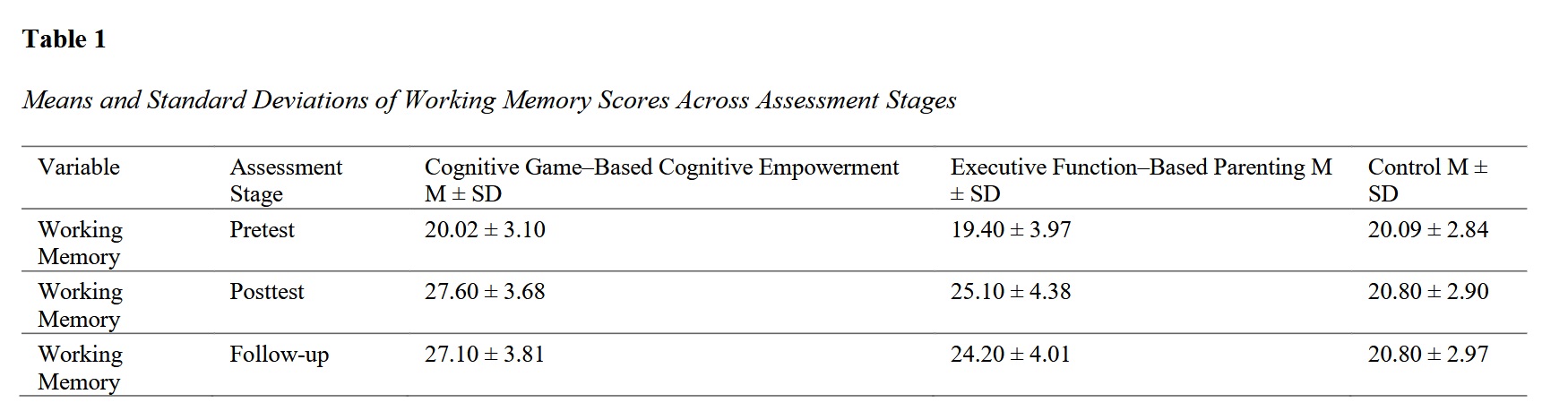
Findings: The results of the multivariate analysis of covariance indicated significant differences among the three groups in posttest working memory scores after controlling for pretest performance (p < .05). Both cognitive empowerment based on cognitive games and executive function–based parenting interventions significantly improved working memory in children with executive function deficits compared with the control group (p < .05). Furthermore, post hoc comparisons demonstrated that the cognitive game–based cognitive empowerment intervention produced significantly greater improvements in working memory than the executive function–based parenting program (p < .05), indicating superior effectiveness in enhancing cognitive performance.
Conclusion: The findings suggest that both cognitive game–based cognitive empowerment and executive function–based parenting interventions are effective approaches for improving working memory in children with executive function deficits. However, cognitive empowerment through structured cognitive games appears to yield stronger outcomes. These results highlight the value of incorporating cognitive training programs and parent-focused executive function interventions into educational and therapeutic settings to support cognitive development in young children experiencing executive function challenges.
Downloads
References
Arjomandnia, A. A., Talebi, S., & Miri, M. A. (2019). Construction and preliminary norming of the Tehran Working Memory Assessment Test. Applied Psychological Research, 10(4), 141-160.
Bailey, R. (2022). Working memory and attention in preschool children: Relations to early academic achievement. Developmental science, 25(2), e13109.
Barkley, R. A. (2020). Executive Functions: What They Are, How They Work, and Why They Evolved. Guilford Press.
Bharadwaj, S. V., Yeatts, P., & Headley, J. (2022). Efficacy of Cogmed working memory training program in improving working memory in school-age children with and without neurological insults or disorders: A meta-analysis. Applied Neuropsychology: Child, 11(4), 891-903. https://doi.org/10.1080/21622965.2021.1920943
Bombonato, C., Del Lucchese, B., & Ruffini, C. (2024). Far transfer effects of trainings on executive functions in neurodevelopmental disorders: A systematic review and meta-analysis. Neuropsychology Review, 34, 98-133. https://doi.org/10.1007/s11065-022-09574-z
Chutko, L. S., Surushkina, S. Y., Yakovenko, E. A., Anisimova, T. I., Didur, M. D., & Chekalova, S. A. (2022). Impairments to executive functions in children with dyslexia. Neuroscience and Behavioral Physiology, 52(1), 1-7. https://doi.org/10.1007/s11055-022-01200-y
Diamond, A., & Ling, D. S. (2020). Review of the evidence on, and fundamental questions about, efforts to improve executive functions, including working memory. In J. M. Novick, M. F. Bunting, M. R. Dougherty, & R. W. Engle (Eds.), Cognitive and Working Memory Training: Perspectives from Psychology, Neuroscience, and Human Development (pp. 143-431). Oxford University Press. https://doi.org/10.1093/oso/9780199974467.003.0008
Ebrahimi, R., Hashemi, Z., & Hekmati, I. (2026). Effectiveness of intellectual games in the brain executive functions and problem-solving ability of children with specific learning disorders. Journal of Research in Psychopathology, 7(1).
Granmaye, S., Arjomandnia, A. A., Akbari, M., Kakabaraei, K., & Moradi, O. (2022). Development of an executive-function-based parenting training package and its effect on parenting stress and mental health of mothers of children with neurodevelopmental disorders. Empowering Exceptional Children, 13(2), 22-34.
Guler, E. C., Kose, B., Temelturk, R. D., Aynigul, K. D., Pekcetin, S., & Oztop, D. B. (2026). Investigation of the effect of second-generation virtual reality interventions on hot and cold executive functions in children with attention-deficit/hyperactivity disorder: Single-blind randomized controlled study. Games for Health Journal, 15(2), 106-113. https://doi.org/10.1177/2161783X251378645
Gurlek, S., & Bumin, G. (2026). The effect of cognitive orientation to daily occupational performance in children with attention deficit hyperactivity disorder: A pilot randomized controlled study. Applied Neuropsychology: Child, 15(2), 169-178. https://doi.org/10.1080/21622965.2024.2385679
Hansen, B. A., Phipps, L. E., Andersen, A. S., Schissel, M. E., & Shillingsburg, M. A. (2025). A feasibility study of Headsprout Reading Program in children with autism spectrum disorder and reading delay. Journal of Behavioral Education, 34(2), 454-477. https://doi.org/10.1007/s10864-023-09529-1
Jafari, N., Roshani, T., & Shahbazi, G. (2022). The effectiveness of cognitive-behavioral play therapy on reducing handwriting and math problems in students with specific learning disorders. Research in School and Virtual Learning, 9(3).
Kaduson, H. G. (2024). Play therapy for children with attention-deficit/hyperactivity disorder. The ADHD Resource Hub, 2(5), 161-175. https://doi.org/10.1521/adhdhub.2024.2.5.2
Lau, E. Y. H., Wu, X., Siu, C. T. S., Williams, K. E., & Bautista, A. (2025). Examining the effectiveness of a video-based parent-child program on executive functions for children 5 to 6 years old: A randomized controlled trial. Child development, 96(2), 781-796. https://doi.org/10.1111/cdev.14208
Luna, B. (2023). The development of executive functions in early childhood: Implications for academic success. Developmental Cognitive Neuroscience, 47, 100937.
Mao, F., Huang, F., Zhao, S., & Fang, Q. (2024). Effects of cognitively engaging physical activity interventions on executive function in children and adolescents: A systematic review and meta-analysis. Frontiers in psychology, 15. https://doi.org/10.3389/fpsyg.2024.1454447
Megari, K., & Genova, K. D. (2026). Cognitive pathways in atypical development: Executive functions in children with attention-deficit/hyperactivity disorder and specific learning disorders. International Journal of Developmental Neuroscience, 86(1), e70094. https://doi.org/10.1002/jdn.70094
Miller, M. C., Jean-Francois, E., Hembree, K. E., Peugh, J. L., Epstein, J. N., Tamm, L., & Becker, S. P. (2026). Cognitive disengagement syndrome symptoms and ADHD dimensions in relation to children's daily life executive functioning deficits. Research on Child and Adolescent Psychopathology, 54(2), 36. https://doi.org/10.1007/s10802-026-01436-z
Mostafaei, A., Oraki, M., & Asadi, S. (2022). The effect of attentional games on motor memory consolidation and inhibitory control in children with executive function disorders. Neuropsychology, 8(30), 51-67.
Piccolo, A., La Fauci, M., De Domenico, C., Di Cara, M., Fulgenzi, A., Mancuso, N., & Cucinotta, F. (2026). The impact of executive functions on metaphonological skills: Correlation and treatment implication for ADHD children. Journal of clinical medicine, 15(2), 906. https://doi.org/10.3390/jcm15020906
Rachanioti, E., Bratitsis, T., & Alevriadou, A. (2018). Cognitive games for children's executive functions training with or without learning difficulties: An overview. Proceedings of the 8th International Conference on Software Development and Technologies for Enhancing Accessibility and Fighting Info-Exclusion,
Sabzi, R., Mihandoost, Z., Nademi, A., & Parandin, S. (2022). The effectiveness of executive function training on emotional self-regulation and test anxiety of female students with writing disorders. Journal of Health Promotion Management, 11(3).
Scionti, N., Cavallero, M., Zogmaister, C., & Marzocchi, G. M. (2020). Is cognitive training effective for improving executive functions in preschoolers? A systematic review and meta-analysis. Frontiers in psychology, 10, 2812. https://doi.org/10.3389/fpsyg.2019.02812
Shin, S. M., Choi, S., & Park, S. Y. (2020). Play therapy in South Korea: History, current practices, research, and future directions. International Journal of Play Therapy, 29(1), 54-64. https://doi.org/10.1037/pla0000112
Smith, J. N., Jusko, M. L., Fosco, W. D., Musser, E. D., & Raiker, J. S. (2024). A critical review of hot executive functioning in youth attention-deficit/hyperactivity disorder: Methodological limitations, conceptual considerations, and future directions. Development and Psychopathology, 36(2), 601-615. https://doi.org/10.1017/S0954579422001432
Vinci, L. A., Passaro, A., & Stasolla, F. (2026). Augmented, virtual, and mixed reality assessment and training for executive functions in children with ADHD: A scoping review. Information, 17(2), 186. https://doi.org/10.3390/info17020186
Wang, H., & Zhao, J. (2026). The association between parental resilience and emotional/behavioural problems in children with autism spectrum disorders: The mediating role of parenting style. PLoS One, 21(2), e0329989. https://doi.org/10.1371/journal.pone.0329989
Wilson, D. M., & Gross, D. (2018). Parents' executive functioning and involvement in their child's education: An integrated literature review. The Journal of School Health, 88(4), 322-329. https://doi.org/10.1111/josh.12612
Wong, T. Y., Chang, Y. T., Wang, M. Y., & Chang, Y. H. (2023). The effectiveness of child-centered play therapy for executive functions in children with attention-deficit/hyperactivity disorder. Clinical Child Psychology and Psychiatry, 28(3), 877-894. https://doi.org/10.1177/13591045221128399
Downloads
Additional Files
Publication Timeline
- Submitted
- Revised
- Accepted