Explainable AI Modeling of Special Education Teachers’ Psychological Well-Being During Artificial Intelligence Integration: The Roles of Occupational Stress, Self-Regulation, and Technological Confidence
Keywords:
Explainable artificial intelligence, psychological well-being, special education teachers, occupational stress, self-regulation, technological confidence, artificial intelligence integrationAbstract
Objective: This study aimed to develop an explainable artificial intelligence model for predicting psychological well-being among special education teachers during artificial intelligence integration by examining the roles of occupational stress, self-regulation, and technological confidence.
Methods and Materials: This quantitative, cross-sectional, predictive-correlational study was conducted among 318 special education teachers working in public and non-public exceptional schools in Tehran during the 2025–2026 academic year. Participants were selected through multistage cluster sampling. Data were collected using a demographic and professional information form, the Ryff Psychological Well-Being Scale, the Teacher Stress Inventory, the Short Self-Regulation Questionnaire, and the Computer Self-Efficacy Scale adapted to educational technology and artificial intelligence contexts. Data analysis included descriptive statistics, Pearson correlation, multiple linear regression, and supervised machine-learning modeling. Five predictive models were compared, including multiple linear regression, support vector regression, random forest regression, gradient boosting regression, and extreme gradient boosting regression. SHAP analysis was used to interpret feature importance and explain the final artificial intelligence model.
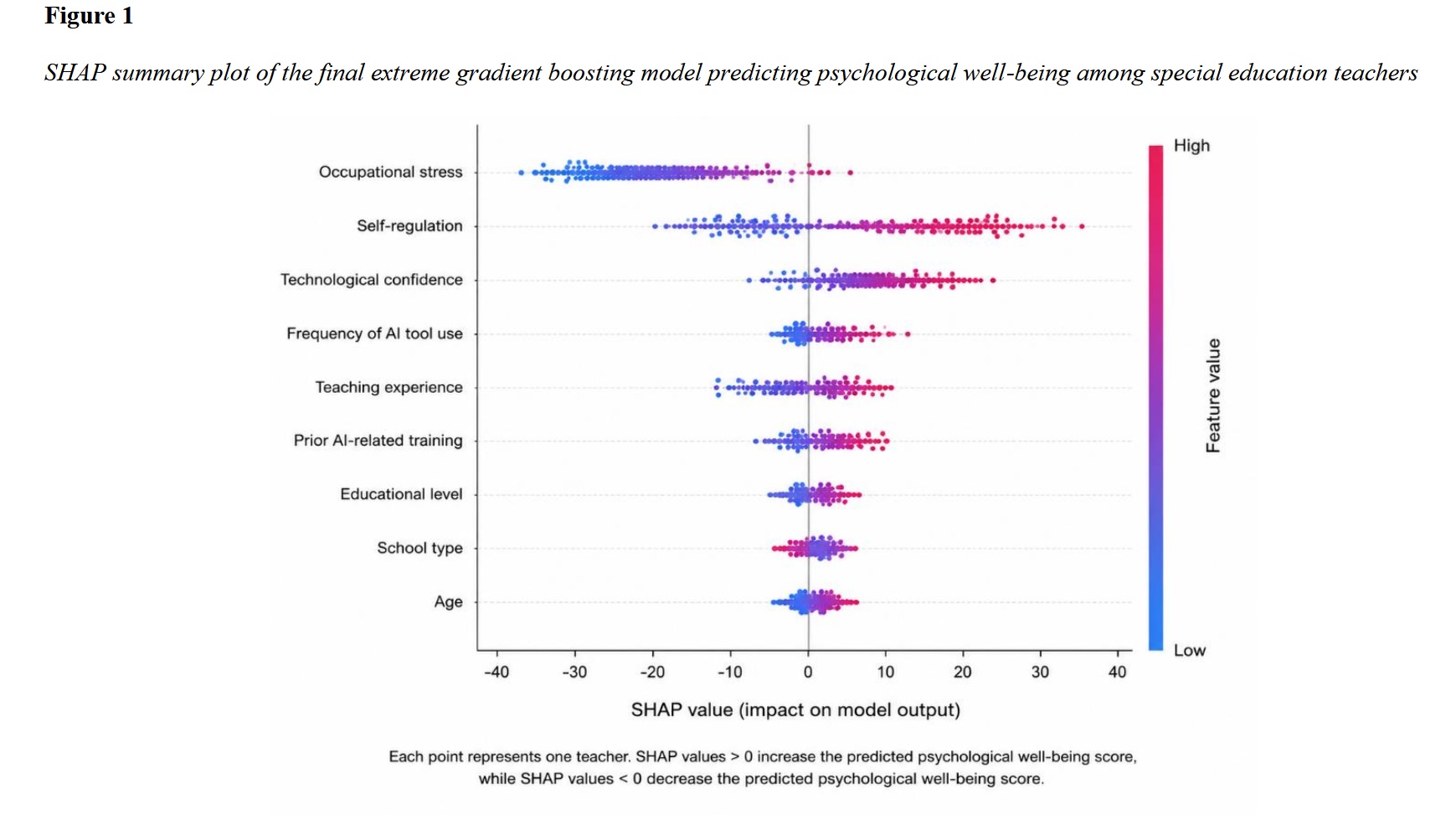
Findings: Psychological well-being was significantly and negatively correlated with occupational stress and significantly and positively correlated with self-regulation and technological confidence. The multiple regression model was significant, F(6, 311) = 73.71, p < 0.001, and explained 58.7% of the variance in psychological well-being. Self-regulation was the strongest positive predictor, followed by occupational stress as a negative predictor and technological confidence as a positive predictor. Frequency of AI-supported tool use also significantly predicted psychological well-being, whereas teaching experience and educational level were not significant predictors. Among the machine-learning models, extreme gradient boosting showed the best performance, with the highest test R² of 0.73 and the lowest prediction error. SHAP analysis identified occupational stress, self-regulation, and technological confidence as the most influential features in the final model.
Conclusion: The findings indicate that special education teachers’ psychological well-being during artificial intelligence integration is primarily shaped by occupational stress, self-regulatory capacity, and technological confidence. Explainable artificial intelligence can provide an interpretable and practical framework for identifying psychological and technological factors that support teacher well-being.
Keywords: Explainable artificial intelligence; psychological well-being; special education teachers; occupational stress; self-regulation; technological confidence; artificial intelligence integration.
Downloads
References
Ang, M., & Spencer, B. (2022). The Role of School Leaders in Promoting Successful Home–School Partnerships in Singapore’s Special Education Schools. International Journal for Leadership in Learning, 22(1), 396-424. https://doi.org/10.29173/ijll16
Basister, M. P., Petersson, J., & Baconguis, R. (2025). Effects of Lesson Study on the Perceived Teaching Competencies of Mathematics and Special Education Teachers. Sage Open, 15(3). https://doi.org/10.1177/21582440251365692
Bongabong, J. M. M., Delicano, M. G. Q., Cagape, W. E., Cerna, R. Q. D., & Magno, C. N. C. (2022). Exploring the Real-Life Issues and Challenges in an Inclusive Classroom Through the Lens of General Education Kindergarten Teachers and Parents: A Qualitative Study. International Journal of Research Publications, 115(1). https://doi.org/10.47119/ijrp10011511220224313
Brunsting, N. C., Gómez, L. R., Jones, B., Bettini, E., Cumming, M. M., Garwood, J. D., & Ruble, L. A. (2025). Burnout and Occupational Wellbeing of Special Education Teachers: Recent Research Synthesized. Review of Educational Research, 96(3), 1049-1095. https://doi.org/10.3102/00346543251332919
Caballero, B. K. F., Catubay, A., Semilla, H. C. P., Pinili, L., Ancheta, R., Manalastas, R. D., Capuno, R. G., Manguilimotan, R. P., Etcuban, J. O., Padillo, G. G., & Espina, R. C. (2023). Teacher’s Use of Arts on Children With Special Needs: Its Prevalence and Importance. International Journal of Science and Management Studies (Ijsms), 191-203. https://doi.org/10.51386/25815946/ijsms-v6i5p112
Camp, A., Zamarro, G., & McGee, J. B. (2024). Looking Back and Moving Forward: COVID-19’s Impact on the Teacher Labor Market and Implications for the Future. Educational Evaluation and Policy Analysis, 47(4), 983-1009. https://doi.org/10.3102/01623737241258184
Ciocon, L. A. (2023). Professional Characteristics and Instructional Leadership of School Heads: Their Relationship to the Implementation of Special Education (SPED) Program. Aide Interdisciplinary Research Journal, 3, 338-360. https://doi.org/10.56648/aide-irj.v3i1.73
Clausen, A. M., Anderson, A., Spooner, F., Walker, V. L., & Hujar, J. (2022). Preparing General Education Teachers to Include Students With Extensive Support Needs: An Analysis of “SPED 101” Courses. Teacher Education and Special Education the Journal of the Teacher Education Division of the Council for Exceptional Children, 46(2), 146-161. https://doi.org/10.1177/08884064221114133
Cruz, J. G. C., & Baguio, J. B. (2024). Exploring the Predictors of Successful Learning Action Cell Practices of Special Education Teachers. Asian Journal of Education and Social Studies, 50(10), 352-361. https://doi.org/10.9734/ajess/2024/v50i101625
Cuadra, J. M. (2023). Uncovering the Complexities of Coping: A Qualitative Study on the Challenges Faced by Special Education Teachers in the Sandwich Generation. Philippine Social Science Journal, 6(1), 41-51. https://doi.org/10.52006/main.v6i1.646
Custodio, Z. U., Rungduin, T. T., Cuevas, E., Cadiz, R. E., Therese Lyra Lyn, L. D. R., Kate Anjelline, F. D. C., Egonia, M. F., & Estole, E. M. H. (2024). Improving Post‐pandemic Environments for Children With Disabilities Through Effective Partnerships. Support for Learning, 40(1), 1-15. https://doi.org/10.1111/1467-9604.12490
Dodur, H. M. S. (2025). Special Education Pre‐Service Teachers' Conscientiousness and Their Attitudes Towards Artificial Intelligence: The Mediating Role Of AI Literacy And AI Anxiety. European Journal of Education, 60(4). https://doi.org/10.1111/ejed.70276
Esternon, C. E. G., Lopres, J. R., Gomez, B. L., Lopres, G. M., Pilapil, G. M. P., Ramirez, W. N., Anjao, R. M., & Apatan, C. F. (2023). Instructional Readiness and Stress Level of Special Education Teachers on Blended Learning Approach During COVID-19: Implications for Post-Pandemic. International Journal of Science and Management Studies (Ijsms), 47-72. https://doi.org/10.51386/25815946/ijsms-v6i6p105
Eunice Tan Meng, Y., & Mark Kuo Cheng, C. (2024). Educator Attitudes of Strength-Based Education for Persons With Special Needs. International Journal for Multidisciplinary Research, 6(3). https://doi.org/10.36948/ijfmr.2024.v06i03.20300
Goldhaber, D., Theobald, R., Choate, K., & Brown, N. (2023). The Front End of the STEM Teacher Pipeline: Early-Career STEM Teachers’ Field Experiences and Perceptions of Preparation. AERA Open, 9. https://doi.org/10.1177/23328584231190372
Gonzaga, N. (2024). Readiness and Challenges of General Education Teachers on the Implementation of Inclusive Education. https://doi.org/10.52783/rlj.v12i1.3534
Howerter, C., Hughes, C. E., Sears, J., & Little, J. A. (2022). Two for One: Challenges and Benefits of Small Elementary and Special Education Dual Certification Programs. Journal of Special Education Preparation, 2(2), 52-59. https://doi.org/10.33043/josep.2.2.52-59
Hugh, M. L., Pullmann, M. D., Joshi, M., Tagavi, D. M., Ahlers, K., Hernandez, A. M., & Locke, J. (2023). Educators’ Perspectives on Training Mechanisms That Facilitate Evidence-Based Practice Use for Autistic Students in General Education Settings: A Mixed-Methods Analysis. Teacher Education and Special Education the Journal of the Teacher Education Division of the Council for Exceptional Children, 46(4), 317-334. https://doi.org/10.1177/08884064231178768
Jose Kim, T. C., Kesna Jhay, T. E., Gabato, C. G., Francelle Henriett, S. P., & Fanny Mae, G. M. (2024). Developing TactiMath Flips for Subtraction and Addition. International Journal for Multidisciplinary Research, 6(3). https://doi.org/10.36948/ijfmr.2024.v06i03.17711
Lariba, F. J. V. (2023). Unsung Heroes: A Phenomenological Study on Experiences and Struggles of Special Education Language Teachers. Asian Journal of Education and Social Studies, 49(1), 79-93. https://doi.org/10.9734/ajess/2023/v49i11102
Luisa, V., & Tuvida, N. (2023). Lived Experiences of Teachers Handling Children With Learning Disabilities. International Research Journal of Modernization in Engineering Technology and Science. https://doi.org/10.56726/irjmets45553
Moon, O. (2023). Teachers’ Readiness and Teaching Performance in Inclusive Education: Their Relationship to the Implementation of Inclusive Education Program. Aide Interdisciplinary Research Journal, 6, 65-110. https://doi.org/10.56648/aide-irj.v6i1.94
Mwamakula, F. (2024). Access to Quality Education Among Students With Special Needs Amidst Covid-19: A Review on Challenges and Prospects. East African Journal of Education Studies, 7(2), 130-140. https://doi.org/10.37284/eajes.7.2.1892
Nah, Y. H., & Neo, H.-M. (2022). Influence of Rigid/Ritualistic Behavioral Profiles of Students With Autism Spectrum Disorder on Special Education Teachers’ Perceptions of Their Readiness for Supported Employment. The Journal of Special Education, 57(2), 73-82. https://doi.org/10.1177/00224669221113805
Omana, R. P., & Dioneda, S. C. (2024). Capacity Development Strategy for Special Education Teachers (Spet) in the Division of Camarines Norte. International Journal of Research Publications, 148(1). https://doi.org/10.47119/ijrp1001481520246391
Ortogero, S. P., Barcarse, T. O., & Ray, A. B. (2022). Developing the Knowledge and Mentoring Skills of Future Special Education Leaders. Rural Special Education Quarterly, 41(4), 211-226. https://doi.org/10.1177/87568705221092765
Robinson, L. E., Clements, G., Drescher, A., Sheikh, A. J. E., Milarsky, T. K., Hanebutt, R., Graves, K. A., Valido, A., Espelage, D. L., & Rose, C. A. (2023). Developing a Multi-Tiered System of Support-Based Plan for Bullying Prevention Among Students With Disabilities: Perspectives From General and Special Education Teachers During Professional Development. School Mental Health, 15(3), 826-838. https://doi.org/10.1007/s12310-023-09589-8
Rose, A., Snyder, M., Murphy-Nugen, A. B., Maddox, G., MacKusic, C. I., & Molefe, B. P. (2021). Cultivating Cross-Cultural Learning and Collaboration Among Special Educators Engaged in International Service-Learning. International Journal of Research on Service-Learning and Community Engagement, 9(1). https://doi.org/10.37333/001c.31307
Sallin, A. (2021). Estimating Returns to Special Education: Combining Machine Learning and Text Analysis to Address Confounding. https://doi.org/10.48550/arxiv.2110.08807
Tenerife, J. J. L., Peteros, E. D. L., Bunghanoy, J. L., Pinili, L., Vera, J. V. D., & Fulgencio, M. (2023). Impact of Parental Involvement on the Communication Skills of Children With Autism. International Journal of Evaluation and Research in Education (Ijere), 12(2), 659. https://doi.org/10.11591/ijere.v12i2.24641
Torregosa, G. (2024). Strategies in Dealing With Disruptive Behavior of Learners With Special Education Needs. https://doi.org/10.52783/jchr.v14.i01.3252
Tundaan, M. D. (2023). Examining the Extent of Implementation of Inclusive Education and Teachers' Essential Practices in Handling Learners With Special Educational Needs. International Journal of Research Publications, 138(1). https://doi.org/10.47119/ijrp10013811220235732
Tyson, K. (2024). “It’s a Battle You Can’t Win”: Domination and Class Differences in Real-World Trust Among Black Families. American Sociological Review, 89(5), 937-969. https://doi.org/10.1177/00031224241278355
Villareal, S. J., Panopio, F. P., Tan, C. S., Bandoy, M. M., & Buenvinida, L. P. (2022). A Phenomenological Studies of Special Education Teachers and Parents Lived Experiences in Upholding Learners With Disability (Lwd) in Transition Program During Pandemic. International Journal of Theory and Application in Elementary and Secondary School Education, 4(2), 219-234. https://doi.org/10.31098/ijtaese.v4i2.1116
Voytecki, K., & Anderson, P. J. (2021). Modeling Conspicuous Collaboration for Preservice Teacher Candidates Enrolled in Higher Education Courses. Theory & Practice in Rural Education, 11(1). https://doi.org/10.3776/tpre.2021.v11n1p113-123
Wilson, J., Zhang, F., Palermo, C., Cordero, T. C., Myers, M. C., Eacker, H., Potter, A., & Coles, J. (2024). Predictors of Middle School Students’ Perceptions of Automated Writing Evaluation. Computers & Education, 211, 104985. https://doi.org/10.1016/j.compedu.2023.104985
Downloads
Publication Timeline
- Submitted
- Revised
- Accepted