Identifying Factors Associated with the Occurrence of Marital Infidelity: A Systematic Review
Keywords:
Marital infidelity, extramarital relationships, marital satisfaction, psychological factors, systematic reviewAbstract
Objective: This study aimed to identify and classify the factors associated with the occurrence of marital infidelity based on a systematic review of national and international studies.
Methods and Materials: The present study was conducted using a documentary research design and a systematic review approach. Relevant studies were identified through systematic searches of national databases, including IranDoc, the Scientific Information Database (SID), and Civilica, as well as international databases, including Scopus, PsycINFO, and Google Scholar. Keywords such as marital infidelity, extramarital relationships, factors affecting infidelity, and their Persian and English equivalents were used in the search process. After screening titles, abstracts, and full texts according to predefined inclusion and exclusion criteria, 46 eligible studies were selected for final analysis. Data were extracted from the included studies and analyzed through coding and qualitative content analysis to identify recurring themes and categories.
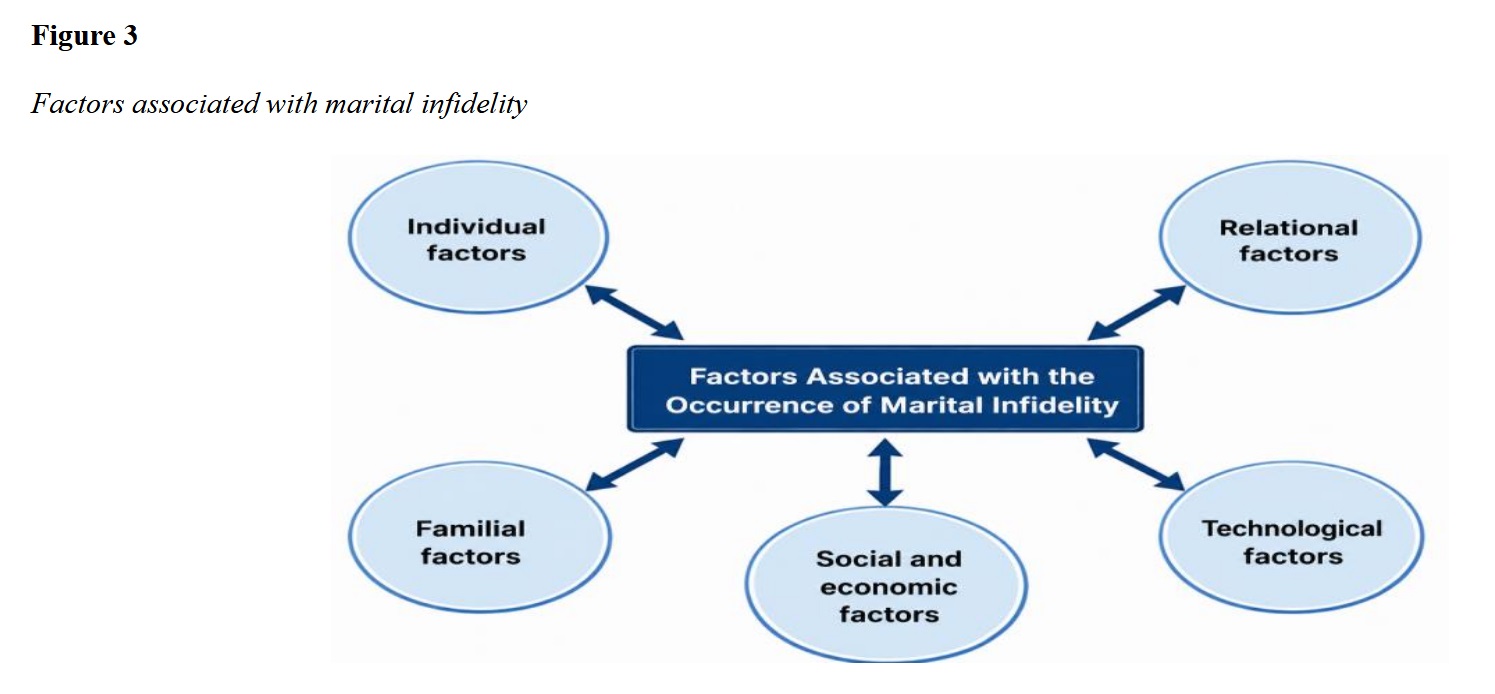
Findings: The qualitative synthesis indicated that the factors associated with marital infidelity could be classified into five main components. Individual factors included personality traits and disorders, psychological and emotional conditions, and personal beliefs and attitudes. Relational factors included emotional and communicative quality, sexual and physical functioning, and the structure and history of the marital relationship. Familial factors included developmental background, family patterns, and kinship relationship networks. Socioeconomic factors included occupational and economic contexts, as well as social and cultural pressures. Technological factors included cyberspace, online interactions, and the role of digital technologies in facilitating extramarital relationships.
Conclusion: Marital infidelity is a multidimensional phenomenon shaped by the interaction of individual vulnerabilities, relational dynamics, family background, socioeconomic pressures, and technological contexts. Therefore, prevention and intervention programs should adopt an integrative perspective that addresses both personal and contextual determinants of marital relationships.
Keywords: Marital infidelity; extramarital relationships; marital satisfaction; psychological factors; systematic review.
Downloads
References
Afsharzada, M. S., Etemadi, O., & Naghavi, A. (2024). Marital infidelity: Cognitive, behavioral, emotional reactions, and coping strategies among Afghan women. Research in cognitive and behavioral sciences, 14(2), 11-18.
Atapour, N., Ahmadi, K., Falsafinejad, M. R., & Khodabakhshi Kolaei, A. (2020). Risk factors for breach of contract in couples with marital infidelity. Islamic lifestyle with a focus on health, 4(3), e188167.
Atapour, N., Falsafinejad, M. R., Ahmadi, K., & Khodabakhshi-Koolaee, A. (2021). A study of the processes and contextual factors of marital infidelity. Practice in Clinical Psychology, 9(3), 211-226. https://doi.org/10.32598/jpcp.9.3.758.2
Badanfiroz, A., Abolghasemi, A., Khosrojavid, M., & Soltani, S. R. (2025). Comparison of the effectiveness of dialectical behavior therapy and emotion-focused therapy on communication patterns and marital intimacy in marital infidelity among women. Journal of Assessment and Research in Applied Counseling, 7(1), 127-137. https://doi.org/10.61838/kman.jarac.7.1.15
Bashirpour, M., & Doukaneifard, F. (2020). Factors affecting the tendency to marital infidelity: A grounded theory study.
Celik, E., Celik, B., Yavas, S., & Suler, M. (2022). Investigation of marital satisfaction in terms of proactive personality, meaning in life, offense-specific forgiveness. International Journal of Psychology and Educational Studies, 9(1), 1-11. https://doi.org/10.52380/ijpes.2022.9.1.348
Chen, F., & Luo, W. (2026). The role of assortative mating in marital infidelity: Insights from China. Social science research, 133, 103280. https://doi.org/10.1016/j.ssresearch.2025.103280
Emami, M. H. D., Nouri, M., & Mahdavi, M. A. (2018). The role of psychosocial factors affecting marital satisfaction in couples after marital infidelity. Researcher Bulletin of Medical Sciences, 23(1), e11-e11.
Ghaem Mohammadi, S. M. R., Rezapoor Mirsaleh, Y., & Arianpoor, H. R. (2023). Identification of predisposing, underlying, and contextual factors, strategies, and consequences of marital infidelity in Yazd City, Iran using a qualitative and grounded approach. MEJDS, 13(69), 1-11.
Ghafoorian, P., Asghari Ebrahim Abad, M. J., Abdekhodaei, M. S., & Kimiaee, S. A. (2018). The role of individual, familial, social and religious factors in extramarital relationships of married women and introducing a treatment model based on the related factors: A qualitative study. Women's Studies Sociological and Psychological, 16(4), 7-42.
Gheybi, M., Karimi Sani, P., & Karimi, Q. (2025). Identification of preventive factors for marital infidelity in cyberspace by examining spiritual factors among women seeking divorce. Journal of Psychological Science, 24(155), 273-291.
Ghiasi, N., Rasoal, D., Haseli, A., & Feli, R. (2024). The interplay of attachment styles and marital infidelity: A systematic review and meta-analysis. Heliyon, 10(1). https://doi.org/10.1016/j.heliyon.2023.e23261
Gonen, L. D., Tavor, T., & Spiegel, U. (2025). Examining marital infidelity via game theory. Mathematics, 13(14), 2235. https://doi.org/10.3390/math13142235
Haseli, A., Shariati, M., Nazari, A. M., Keramat, A., & Emamian, M. H. (2019). Infidelity and its associated factors: A systematic review. The Journal of Sexual Medicine, 16(8), 1155-1169. https://doi.org/10.1016/j.jsxm.2019.04.011
Haziqatuzikra, H. (2025). The effect of emotion regulation on resilience moderated by social support among wives experiencing infidelity Universitas Sumatera Utara].
Honarpisheh, L., & Hashemi, S. (2024). The mediating role of marital frustration in the relationship between dark personality triads and attitudes toward infidelity in women with marital conflict. https://doi.org/10.47176/rjms.30.198
Kalateh Sadati, A., Mirjalili, Z., & Saboohi Golkar, Z. (2025). A qualitative study of the perception and experience of marital infidelity. Sociology of Social Institutions, 12(25), 283-313.
Mohammadi, S., Azemoudeh, M., Shalchi, B., & Mesrabadi, J. (2024). Comparing the effects of mindfulness-based cognitive therapy and acceptance and commitment therapy on depression and anger in Iranian women affected by marital infidelity. Qom University of Medical Sciences Journal, 18(1), 29-45. https://doi.org/10.32598/qums.18.2945.1
Morsali, Z., Mootabi, F., & Sadeghi, M. S. (2018). The experience of forgiveness in betrayed women. Journal of Psychological Science, 17(70), 683-694.
Nazari, A., Hosseinnia, M., & Najafi, E. (2024). Sexual satisfaction and attitude toward marital infidelity among married people in Iran: The role of social media and entertainment preferences. BMC public health, 24(1), 1693. https://doi.org/10.1186/s12889-024-19073-w
Niknam, M. (2024). Structural modeling for determining marital infidelity based on self-compassion with mediating role of emotional maturity. Journal of Psychological Science, 23(133), 95-112.
Ogwuche, C. H., Tyav-Tersoo, K. I., Caleb, O. N. A. H., & Orafa, D. T. (2024). Marital infidelity among married couples: Roles of emotional intelligence and narcissistic personality traits in Makurdi, Benue State. Journal of Innovation in Psychology, Education and Didactics, 28(1), 27-36. https://doi.org/10.29081/JIPED.2024.28.1.03
Rezaei, M. (2024). Exploring factors of marital infidelity in couples: An interpretive phenomenology in Birjand. Strategic Studies of Culture, 4(1), 81-113.
Rezaei, S., Khodabakhsh Pirkalani, R., & Khosravi, Z. (2025). Understanding the causes of gray divorce: A grounded theory study. Social Psychology Research, 14(56), 97-110.
Rokach, A., & Chan, S. H. (2023). Love and infidelity: Causes and consequences. International journal of environmental research and public health, 20, 3904. https://doi.org/10.3390/ijerph20053904
Rolle-Sands, S. Y., Campbell, T., & Fielding, W. J. (2026). Emotional dependency and sweethearting in The Bahamas (I): Marital infidelity. International Journal of Bahamian Studies, 31(2), 49-60.
Roos, L. G., O'Connor, V., Canevello, A., & Bennett, J. M. (2019). Post-traumatic stress and psychological health following infidelity in unmarried young adults. Stress and Health, 35(4), 468-479. https://doi.org/10.1002/smi.2880
Samadi Kashan, S., & Pourghnad, M. (2019). Marital infidelity: Exploring views, factors and consequences. Rooyesh-e-Ravanshenasi Journal, 8(4), 165-176.
Shakiba, M., Nowrozi, R., & Eftekhari, J. (2023). Investigating media factors affecting the increase of students' online cheating. Technology and Scholarship in Education, 3(2), 63-74.
Shoaa Kazemi, M., & Yadollahi, M. (2024). Structural modeling of motivations for forgiveness, returning and durability of marital life in women affected by infidelity in married life. Gender and Family Studies, 10(2), 71-90.
Taheri, E., Didehban, E., Ranjbarmoqadam, A., & Kanaghestani, A. (2024). The mediating role of social-emotional loneliness in the relationship of the quality of marital relationships and dark personality traits with online infidelity.
Warach, B., & Josephs, L. (2019). The aftershocks of infidelity: A review of infidelity-based attachment trauma. Sexual and Relationship Therapy, 36(1), 68-90. https://doi.org/10.1080/14681994.2019.1577961
Xin, M. Y., & Hassan, S. A. (2020). Factors contributing to infidelity in marriage within Asian countries: A systematic review of literature. International Journal of Academic Research in Business and Social Sciences, 10(15), 210-224. https://doi.org/10.6007/IJARBSS/v10-i15/8244
Yaghoubnezhad, S., & Khoshbazan, T. (2025). Investigating the contribution of personality traits and family cohesion indicators in explaining the tendency toward emotional infidelity of young people on the eve of marriage. Journal of Family Research, 21(4), 36-54.
Zhong, L., & Vangelisti, A. L. (2025). Conceptualizing injured partners' relational uncertainty following marital infidelity: A relational turbulence theory perspective. Journal of Family Communication, 25(1), 57-75. https://doi.org/10.1080/15267431.2024.2433206
Downloads
Additional Files
Publication Timeline
- Submitted
- Revised
- Accepted