CatBoost Prediction of Obsessive-Compulsive Symptoms Using Thought Suppression, Cognitive Fusion, Perfectionism, and Anxiety Sensitivity
Keywords:
Obsessive-compulsive symptoms, CatBoost, thought suppression, cognitive fusion, perfectionism, anxiety sensitivity, machine learningAbstract
Objective: This study aimed to develop and interpret a CatBoost machine learning model for predicting obsessive-compulsive symptom severity based on thought suppression, cognitive fusion, perfectionism, and anxiety sensitivity among adults in Spain.
Methods and Materials: This cross-sectional predictive study was conducted on 1,214 adults from Spain. Participants completed standardized self-report measures assessing obsessive-compulsive symptoms, thought suppression, cognitive fusion, perfectionism, and anxiety sensitivity. After data screening, the final dataset was analyzed using descriptive and inferential statistics, Pearson correlation analysis, multicollinearity assessment, and CatBoost regression modeling. The dataset was divided into training and testing subsets, and hyperparameter tuning was performed using five-fold cross-validation. Model performance was evaluated using R², adjusted R², root mean squared error, mean absolute error, mean absolute percentage error, and explained variance. SHAP and permutation importance analyses were used to interpret the relative contribution of each predictor.
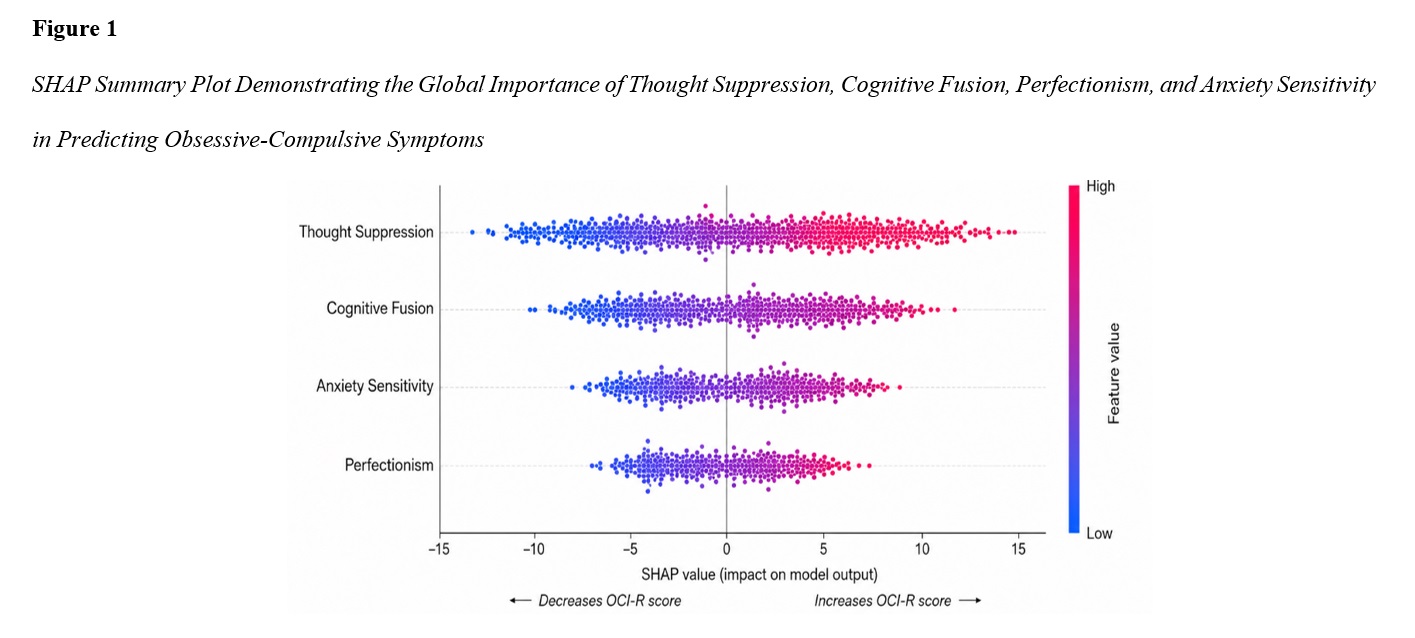
Findings: Obsessive-compulsive symptoms were significantly and positively correlated with thought suppression (r = .71, p < .001), cognitive fusion (r = .67, p < .001), anxiety sensitivity (r = .64, p < .001), and perfectionism (r = .58, p < .001). The optimized CatBoost model demonstrated strong predictive performance, explaining 89.2% of variance in the training dataset and 85.4% of variance in the testing dataset. The testing model showed low prediction error, with RMSE = 4.28, MAE = 3.24, MAPE = 13.18%, and explained variance = .855. Five-fold cross-validation confirmed stable model performance, with a mean R² of .849. SHAP and permutation importance analyses identified thought suppression as the strongest predictor, followed by cognitive fusion, anxiety sensitivity, and perfectionism.
Conclusion: The findings indicate that obsessive-compulsive symptoms can be predicted with high accuracy using a CatBoost model based on key cognitive-affective vulnerability factors. Thought suppression and cognitive fusion showed the strongest predictive influence, suggesting that maladaptive responses to intrusive thoughts are central to obsessive-compulsive symptom severity. The model provides an interpretable framework for identifying psychological mechanisms relevant to assessment, prevention, and intervention.
Downloads
References
Akram, U., Stevenson, J. C., Gardani, M., Allen, S., & Johann, A. F. (2023). Personality and Insomnia: A Systematic Review and Narrative Synthesis. Journal of Sleep Research, 32(6). https://doi.org/10.1111/jsr.14031
Angelo, N. L., Brullo, G., Marsiglia, A., Tirelli, A., Piroddi, E., Viti, C., Aicardi, I., & Pozza, A. (2024). Romantic Relationship Obsessive-Compulsive Doubts, Perfectionism, and DSM-5 Personality Traits in LGB People: A Comparison With Heterosexual Individuals. Frontiers in psychology, 15. https://doi.org/10.3389/fpsyg.2024.1187179
Antuña‐Camblor, C., Péris-Baquero, Ó., Juarros‐Basterretxea, J., Cano‐Vindel, A., & Rodríguez‐Díaz, F. J. (2024). Transdiagnostic Risk Factors of Emotional Disorders in Adults: A Systematic Review. Anales de Psicología, 40(2), 199-218. https://doi.org/10.6018/analesps.561051
Arbinaga, F., & Sierra, M. I. M. (2025). Psychopathological Symptoms in Soccer Referees: The Role of Psychological Inflexibility and Perfectionism. Peerj, 13, e19790. https://doi.org/10.7717/peerj.19790
Borrego-Ruiz, A., & Borrego, J. J. (2025). Biological, Psychosocial, and Microbial Determinants of Childhood-Onset Obsessive–Compulsive Disorder: A Narrative Review. Children, 12(8), 1063. https://doi.org/10.3390/children12081063
Cheli, S., Cavalletti, V., Gazzillo, F., Brüne, M., & Hewitt, P. L. (2024). I Don't Deserve Anything Good: Perfectionistic Self‐Recrimination in a Case of Comorbid Personality and Eating Disorder. Journal of Clinical Psychology, 81(3), 171-181. https://doi.org/10.1002/jclp.23753
Fernández, X. M. C., Castro, Y. R., Ferreira, S., Teixeira, L., Campos, C., & Rocha, N. (2023). Exploring the Associations Between Early Maladaptive Schemas and Impulsive and Compulsive Buying Tendencies. Frontiers in Psychiatry, 14. https://doi.org/10.3389/fpsyt.2023.1157710
Gerdan, G., & Şalcıoğlu, E. (2025). Experiential Avoidance as a Transdiagnostic Mediator in the Relationship Between Intolerance of Uncertainty, Maladaptive Perfectionism, and Psychiatric Symptoms: Structural and Causal Mediation Analyses in a Clinical Sample. Clinical Psychology & Psychotherapy, 32(3). https://doi.org/10.1002/cpp.70102
Hameed, N., & Arzeen, S. (2023). Perfectionism, Self-Esteem and DSM-IV-Based Symptoms of Anxiety Disorders in Adolescents. PJMHS, 17(3), 310-314. https://doi.org/10.53350/pjmhs2023173310
Hu, P., Liang, P., Liu, X., Ouyang, Y., & Wang, J. (2023). Parenting Styles and Obsessive-Compulsive Symptoms in College Students: The Mediating Role of Perfectionism. Frontiers in Psychiatry, 14. https://doi.org/10.3389/fpsyt.2023.1126689
Inoué, K., Yamada, T., & Ohtsuki, T. (2024). Relationships Between Throwing Yips in Baseball, Experiential Avoidance, Cognitive Fusion, Values, and Social Factors. Journal of Clinical Sport Psychology, 18(3), 374-395. https://doi.org/10.1123/jcsp.2022-0057
Laskowski, N. M., Sabel, L., Brandt, G., & Paslakis, G. (2026). Overlapping Phenotypes of Compulsive Buying-Shopping Disorder and Borderline Personality Disorder: An Evidence-Based Model. Addictive Behaviors Reports, 23, 100669. https://doi.org/10.1016/j.abrep.2026.100669
Lin, J., & Guo, W. (2024). The Research on Risk Factors for Adolescents’ Mental Health. Behavioral Sciences, 14(4), 263. https://doi.org/10.3390/bs14040263
Pourebrahimi, M., Sarafraz, M., Hadianfard, H., & Mohammadi, N. (2024). Harm Avoidance and Incompleteness Core Motivations in Obsessive-Compulsive Disorder: Cross-Cultural Adaptation and Validation of the Persian Version of the Obsessive- Compulsive Core Dimensions Questionnaire (OC-CDQ) in Clinical and Nonclinical Samples. https://doi.org/10.21203/rs.3.rs-4347513/v1
Pourshahbaz, A., Moloodi, R., Mohammadkhani, P., Fata, L., Barani, M., Egan, S. J., & Ghaderi, A. (2022). An Etiological and Maintenance Model of Perfectionism. https://doi.org/10.21203/rs.3.rs-1235520/v1
Sand, L., & Shafran, R. (2025). Using CBT‐E in the Treatment of Anorexia Nervosa With Comorbid Obsessive‐Compulsive Personality Disorder and Clinical Perfectionism. Journal of Clinical Psychology, 81(8), 768-776. https://doi.org/10.1002/jclp.23806
Sanseverino, R., Guidotti, S., & Pruneti, C. (2025). Assessing Orthorexia Nervosa Among University Students: An Observational Study Analyzing Prevalence and Psychological Characteristics. Nutrients, 17(13), 2078. https://doi.org/10.3390/nu17132078
Sheikh, M. (2025). Telehealth-Delivered Mindfulness-Based Exposure and Response Prevention for Sexual Obsessive-Compulsive Disorder With Comorbid Depression: Feasibility and Clinical Outcomes. Clinical Case Studies, 25(1), 3-24. https://doi.org/10.1177/15346501251405859
Vand, H. D. A., Hooman, F., Yegaei, P. S., Ahmadi, R., & Habibi, M. (2022). The Contribution of Transdiagnostic Vulnerability Factors in Patients With Chronic Insomnia. https://doi.org/10.21203/rs.3.rs-2241964/v1
Ward, H. (2022). Effects of a Single-Session Intervention Targeting Perfectionism in College Students. Graduate Student Journal of Psychology, 19. https://doi.org/10.52214/gsjp.v19i.10051
Woodrum, J. L., & Kahn, J. H. (2022). Perfectionistic Concerns and Psychological Distress: The Role of Spontaneous Emotion Regulation During College Students’ Experience With Failure. Journal of counseling psychology, 69(2), 246-256. https://doi.org/10.1037/cou0000580
Downloads
Additional Files
Publication Timeline
- Submitted
- Revised
- Accepted