Predicting Life Satisfaction Using Artificial Neural Networks Based on Gratitude, Meaning in Life, Self-Compassion, and Resilience
Keywords:
Life satisfaction, artificial neural network, gratitude, meaning in life, self-compassion, resilience, positive psychologyAbstract
Objective: This study aimed to develop and evaluate an artificial neural network model for predicting life satisfaction among adults in Germany based on gratitude, meaning in life, self-compassion, and resilience.
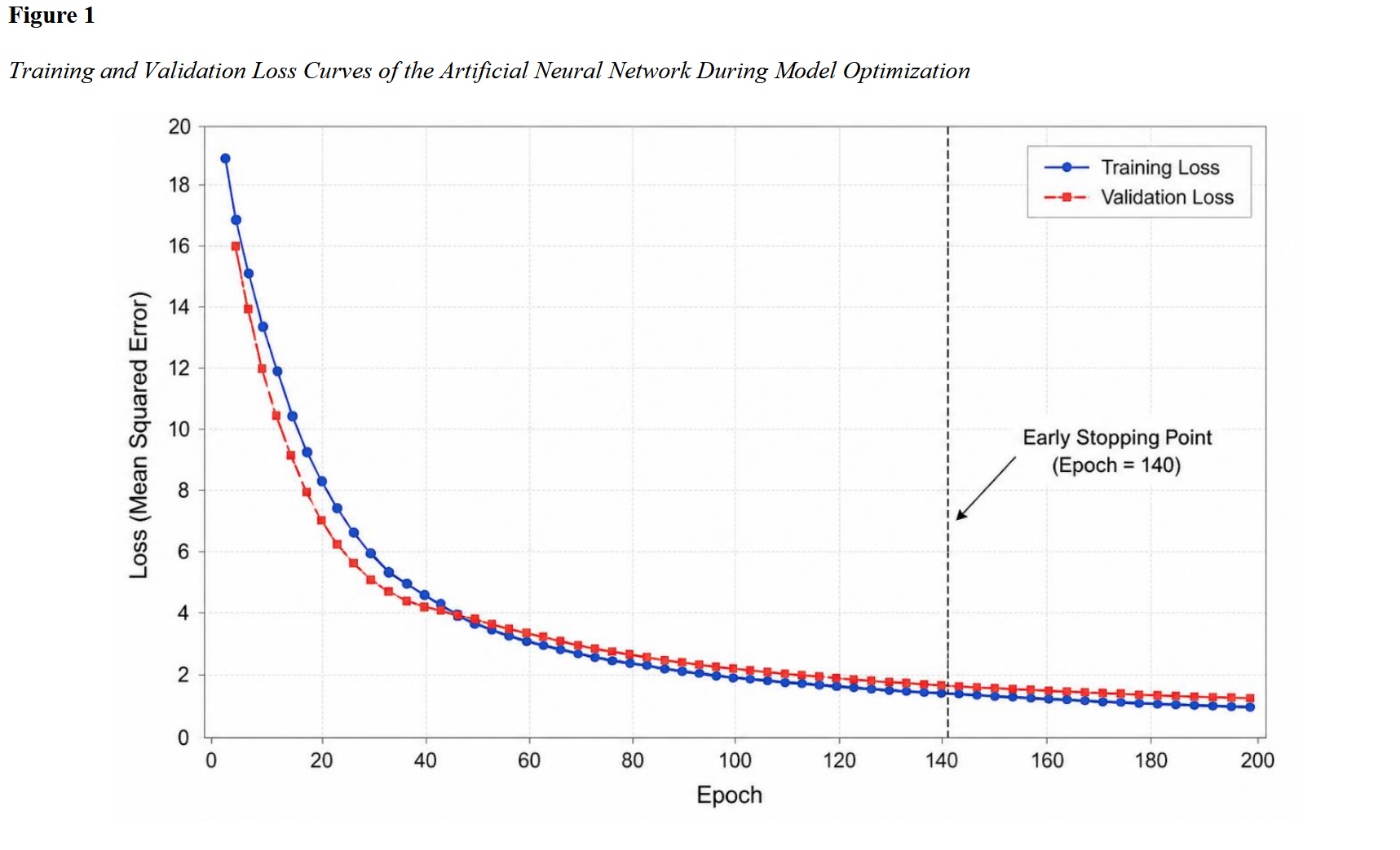
Methods and Materials: This cross-sectional predictive study was conducted on 1,162 adults in Germany. Data were collected using standardized self-report instruments, including the Satisfaction with Life Scale, Gratitude Questionnaire–Six Item Form, Meaning in Life Questionnaire, Self-Compassion Scale–Short Form, and Connor–Davidson Resilience Scale. After data screening, descriptive statistics, reliability analysis, Pearson correlations, and artificial neural network modeling were performed. The dataset was divided into training, validation, and testing subsets. A multilayer feedforward neural network was developed using standardized predictor variables, with model optimization performed through the Adam algorithm, early stopping, and dropout regularization. Model performance was evaluated using MAE, MSE, RMSE, R², explained variance, permutation feature importance, and SHAP analysis.
Findings: Pearson correlation analysis showed that all predictor variables had significant positive associations with life satisfaction. Resilience had the strongest correlation with life satisfaction, followed by self-compassion, meaning in life, and gratitude. The artificial neural network demonstrated strong predictive accuracy, explaining 86.5% of the variance in life satisfaction in the training set, 84.9% in the validation set, and 84.2% in the testing set. Prediction errors remained low across all datasets, indicating stable model performance and limited overfitting. Feature-importance analyses showed that resilience was the most influential predictor of life satisfaction, followed by self-compassion, meaning in life, and gratitude.
Conclusion: The findings indicate that life satisfaction can be predicted with high accuracy using an artificial neural network model based on positive psychological resources. Resilience, self-compassion, meaning in life, and gratitude jointly provide a strong predictive framework for understanding subjective well-being.
Downloads
References
Basurrah, A. A., Baddar, M. K. A., & Blasi, Z. D. (2022). Positive Psychology Interventions as an Opportunity in Arab Countries to Promoting Well-Being. Frontiers in psychology, 12. https://doi.org/10.3389/fpsyg.2021.793608
Basurrah, A. A., Blasi, Z. D., Lambert, L., Murphy, M., Warren, M. A., Setti, A., Baddar, M. K. A., & Shrestha, T. (2022). The Effects of Positive Psychology Interventions in Arab Countries: A Systematic Review. Applied Psychology Health and Well-Being, 15(2), 803-821. https://doi.org/10.1111/aphw.12391
Baysal, M. (2022). Positive Psychology and Spirituality: A Review Study. Spiritual Psychology and Counseling, 7(3), 359-388. https://doi.org/10.37898/spc.2022.7.3.179
Bluth, K., Knox, M. C., Press, A., & Lathren, C. (2023). Feasibility, Acceptability and Preliminary Outcomes of Embracing Your Life: An Online Self-Compassion Program for Emerging Adults. Emerging Adulthood, 11(5), 1281-1291. https://doi.org/10.1177/21676968231189902
Bryan, S., & Hamilton, M. (2024). An Overview of Gratitude as a Mind-Body-Spirit Practice in Optimizing Health and Human Functioning. Obm Integrative and Complementary Medicine, 09(01), 1-19. https://doi.org/10.21926/obm.icm.2401008
Calleja, P., Knight, P. A., McVicar, A., Laker, C., Yu, S., & Roszak-Burton, L. (2024). Gratitude Interventions to Improve Wellbeing and Resilience of Graduate Nurses Transitioning to Practice: A Scoping Review. International Journal of Nursing Studies Advances, 6, 100188. https://doi.org/10.1016/j.ijnsa.2024.100188
Desai, K., O’Malley, P. A., & Culin, E. V. (2024). Impact of Heartfulness Meditation Practice Compared to the Gratitude Practices on Wellbeing and Work Engagement Among Healthcare Professionals: Randomized Trial. PLoS One, 19(6), e0304093. https://doi.org/10.1371/journal.pone.0304093
George, A. J., Romate, J., & Rajkumar, E. (2021). Mindfulness-Based Positive Psychology Interventions: A Systematic Review. BMC psychology, 9(1). https://doi.org/10.1186/s40359-021-00618-2
Gerber, L. R., Reeves‐Blurton, Z., Gueci, N., Iacona, G. D., Beaudette, J. A., & Pipe, T. (2023). Practicing Mindfulness in Addressing the Biodiversity Crisis. Conservation Science and Practice, 5(7). https://doi.org/10.1111/csp2.12945
Hobgood, C., & Jarman, A. F. (2024). Resilience Building Practices for Women Physicians. Journal of Women S Health, 33(4), 532-541. https://doi.org/10.1089/jwh.2022.0502
John, E. S., Armstrong, L. L., & Watt, E. (2024). Meaning as an Early Determinant of Mental Health in Children. The Humanistic Psychologist, 52(2), 186-205. https://doi.org/10.1037/hum0000328
Kumar, S. A., Edwards, M. E., Grandgenett, H. M., Scherer, L. L., DiLillo, D., & Jaffe, A. E. (2022). Does Gratitude Promote Resilience During a Pandemic? An Examination of Mental Health and Positivity at the Onset of COVID-19. Journal of Happiness Studies, 23(7), 3463-3483. https://doi.org/10.1007/s10902-022-00554-x
Lawrence, A., Alkozei, A., Irgens, M. S., Acevedo-Molina, M. C., Brener, S. A., Chandler, A. B., Chau, R. F., Doyle, C., McKinney, A., Price, S. N., Shanholtz, C. E., Etten, E. J. V., Hoeve, E. S. V., Sbarra, D. A., & O’Connor, M.-F. (2021). Think Again: Adaptive Repetitive Thought as a Transdiagnostic Treatment for Individuals Predisposed to Repetitive Thinking Styles. Journal of Psychotherapy Integration, 31(2), 208-222. https://doi.org/10.1037/int0000209
Machlah, J., & Zięba, M. (2021). Prioritizing Positivity Scale: Psychometric Properties of the Polish Adaptation (PPS-PL). Roczniki Psychologiczne, 24(2), 159-172. https://doi.org/10.18290/rpsych21242-2
Mallon, A., Mitchell, G., Carter, G., McLaughlin, D., & Wilson, C. B. (2023). A Rapid Review of Evaluated Interventions to Inform the Development of a Resource to Support the Resilience of Care Home Nurses. BMC Geriatrics, 23(1). https://doi.org/10.1186/s12877-023-03860-y
Maragha, T., Garcia, A. P., Shuler, C. F., & Bergmann, H. v. (2023). The Six‐domain Well‐being Framework in Oral Health Sciences: A Pathway From Theory to Practice. Journal of Dental Education, 88(2), 157-168. https://doi.org/10.1002/jdd.13401
Maumus, M. (2022). Gratitude and Suicide. Ochsner Journal, 22(1), 3-5. https://doi.org/10.31486/toj.22.0010
Merlo, G., Snellman, L., & Sugden, S. G. (2025). Connectedness: The Updated and Expanded Pillar of Lifestyle Psychiatry and Lifestyle Medicine. American Journal of Lifestyle Medicine, 19(8), 1104-1124. https://doi.org/10.1177/15598276251345455
Mogeda El Sayed El, K., & Sarour, E. O. (2024). The Relationships Between Work-Family Conflict and Life Satisfaction and Happiness Among Nurses: A Moderated Mediation Model of Gratitude and Self-Compassion. Frontiers in Public Health, 12. https://doi.org/10.3389/fpubh.2024.1340074
Pagani, L. S., Kazandjian, N., Geoffrion, S., & Barnett, T. A. (2025). Early Adulthood and Care Giving Professions in the 21st Century: Mental Wellness as an Institutional Priority and Reward Strategy. Inquiry the Journal of Health Care Organization Provision and Financing, 62. https://doi.org/10.1177/00469580251399302
Pahwa, S., & Khan, N. (2022). Factors Affecting Emotional Resilience in Adults. Management and Labour Studies, 47(2), 216-232. https://doi.org/10.1177/0258042x211072935
Peterson, N. E., Thomas, M. C., Hunsaker, S., Stewart, T. H. M., & Collett, C. J. (2024). mHealth Gratitude Exercise Mindfulness App for Resiliency Among Neonatal Intensive Care Unit Staff: Three-Arm Pretest-Posttest Interventional Study. Jmir Nursing, 7, e54561. https://doi.org/10.2196/54561
Primasari, A., & Yuniarti, K. W. (2021). Enjoying Every Moment: Improving Adolescent’s Subjective Well-Being Through Adolescent Mindfulness Program. Gadjah Mada Journal of Professional Psychology (Gamajpp), 7(2), 115. https://doi.org/10.22146/gamajpp.65594
Robbins, B. D. (2021). The Joyful Life: An Existential-Humanistic Approach to Positive Psychology in the Time of a Pandemic. Frontiers in psychology, 12. https://doi.org/10.3389/fpsyg.2021.648600
Saboor, S., Medina, A., & Marciano, L. (2024). Application of Positive Psychology in Digital Interventions for Children, Adolescents, and Young Adults: Systematic Review and Meta-Analysis of Controlled Trials. Jmir Mental Health, 11, e56045. https://doi.org/10.2196/56045
Schimmels, J., Schneider, J., Bücher, K., & Coty, M. B. (2024). Stoicism and Cognitive Strategies for Nursing Professional Development. The Journal of Continuing Education in Nursing, 55(8), 378-386. https://doi.org/10.3928/00220124-20240328-02
Wei, H., Hardin, S. R., & Watson, J. (2021). A Unitary Caring Science Resilience-Building Model: Unifying the Human Caring Theory and Research-Informed Psychology and Neuroscience Evidence. International journal of nursing sciences, 8(1), 130-135. https://doi.org/10.1016/j.ijnss.2020.11.003
You, M., & Kim, E.-J. (2025). Effects of Gratitude Journaling on Patients With Breast Cancer: A Randomized Controlled Trial. Current Oncology, 32(7), 400. https://doi.org/10.3390/curroncol32070400
Zhang, H., & Li, Y. (2021). Child Neglect and Life Satisfaction Among Left-Behind Children in Rural China: The Roles of Self-Compassion and Gratitude. Journal of interpersonal violence, 37(17-18), NP15649-NP15669. https://doi.org/10.1177/08862605211016348
Downloads
Additional Files
Publication Timeline
- Submitted
- Revised
- Accepted