An Interpretive Description Study of Clients’ Experiences of Integrating Artificial Intelligence-Based Mental Health Support With Face-to-Face Counseling
Keywords:
Artificial intelligence, mental health support, face-to-face counseling, digital mental health, therapeutic relationship, conversational AI, Interpretive Description, qualitative researchAbstract
Objective: This study aimed to explore and interpret clients’ experiences of integrating artificial intelligence (AI)-based mental health support with face-to-face counseling in England.
Methods and Materials: This qualitative study employed an Interpretive Description design and included 24 adult clients in England who had attended at least four face-to-face counseling sessions and had concurrently used an AI-based mental health support tool for a minimum of four weeks. Participants were recruited purposively to achieve variation in demographic characteristics, counseling experiences, and patterns of AI use. Data were collected through individual semi-structured, in-depth interviews focused on motivations for using AI, perceived benefits and limitations, disclosure, trust, emotional safety, continuity of support, and the relationship between AI use and counseling. Interviews were audio-recorded and transcribed verbatim. Data collection and analysis proceeded concurrently using iterative coding, constant comparison, reflexive memoing, and progressive development of clinically meaningful themes.
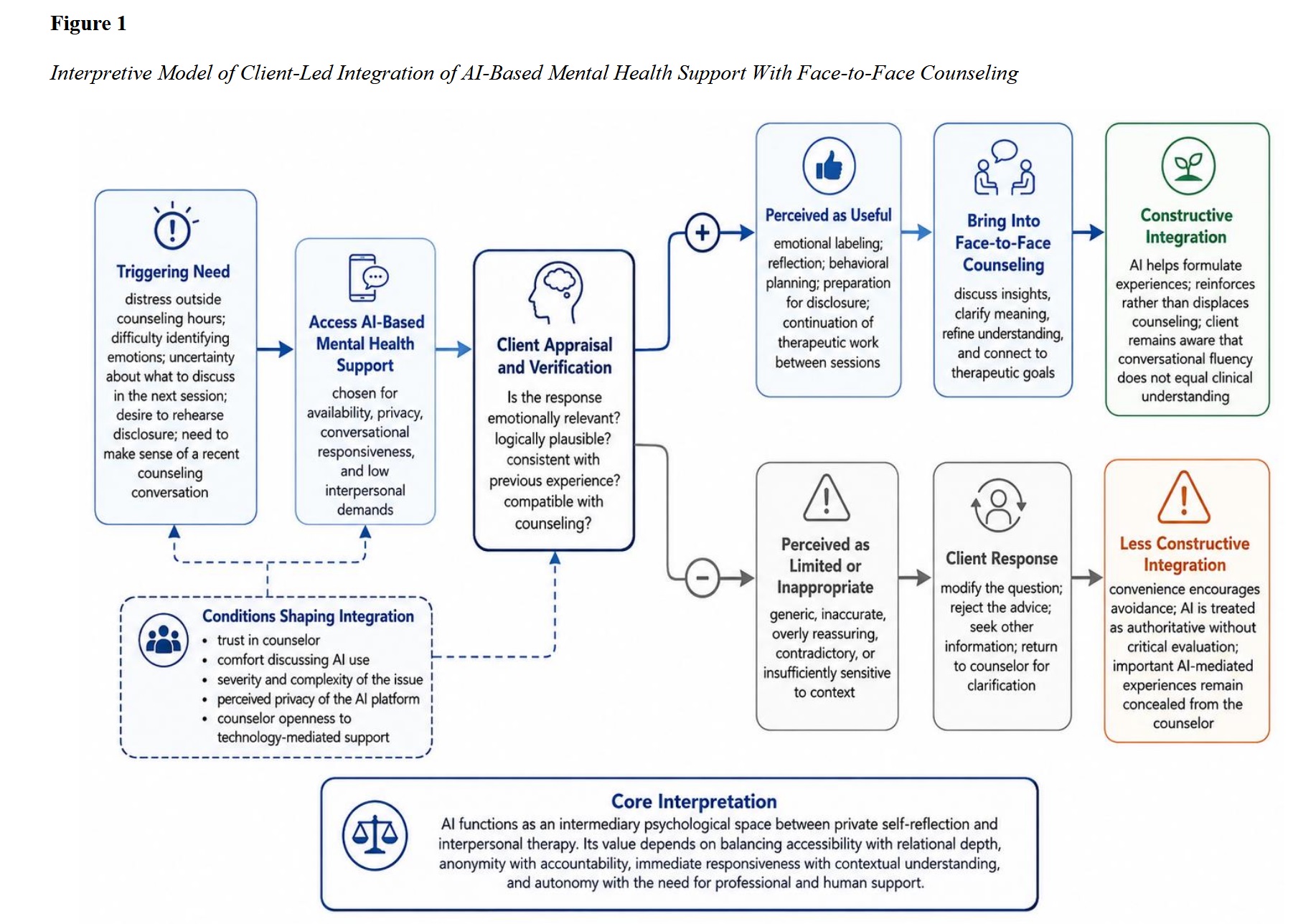
Findings: Analysis generated six interrelated themes: AI as an in-between-session holding space; AI as a rehearsal and translation space for counseling; greater control and reduced interpersonal exposure; recognition of the emotional and contextual limitations of AI; negotiation of trust, accuracy, and safety; and reshaping rather than replacing the therapeutic relationship. Four patterns of integration were also identified: complementary integration, selective parallel use, substitutive drift, and conflict-and-repair. AI was experienced as most beneficial when it supported reflection, preparation, disclosure, and continuity between counseling sessions, whereas less constructive use emerged when convenience facilitated avoidance, AI-generated guidance was accepted uncritically, or important AI-mediated experiences remained disconnected from counseling.
Conclusion: AI-based mental health support may function as a useful intermediary psychological space between private self-reflection and interpersonal therapy, but its therapeutic value depends on critical evaluation, appropriate boundaries, transparency, and continued reliance on human counseling for contextual understanding, relational depth, accountability, and complex clinical judgment.
Downloads
References
Akdag, M. T., & Wahl, N. (2024). Behind the Veil: Exploring Anonymity's Effect in Emerging Metaverse for Mental Health Therapy. https://doi.org/10.24251/hicss.2024.182
Akyazı, K. G., & BaŞTemur, Ş. (2024). Interactive Robots: Therapy Robots. Psikiyatride Guncel Yaklasimlar - Current Approaches in Psychiatry, 16(1), 16-30. https://doi.org/10.18863/pgy.1242958
Al-Mahrouqi, T., Wardy, M. A., Lawati, A. A., Maskari, A. A., Azri, A., Riyami, Q. A., Aufi, H. A., Jose, S., & Sinawi, H. A. (2026). University Students’ Perceptions and Intentions to Use Digital Mental Health Services Including Online Therapy and Mental Health Apps: A Cross-Sectional Study. International journal of environmental research and public health, 23(6), 719. https://doi.org/10.3390/ijerph23060719
Baek, G., Cha, C., & Han, J.-H. (2025). AI Chatbots for Psychological Health for Health Professionals: Scoping Review. JMIR human factors, 12, e67682-e67682. https://doi.org/10.2196/67682
Bao, Y., Song, Z., Weng, D., Liu, Y., Su, M., & Chen, J. (2024). Intelligent Control of Character for AR-Based Remote Psychological Counseling System. https://doi.org/10.3233/faia240162
Békés, V., Bőthe, B., & Doorn, K. A. (2025). Acceptance of Using Artificial Intelligence and Digital Technology for Mental Health Interventions: The Development and Initial Validation of the UTAUT‐AI‐DMHI. Clinical Psychology & Psychotherapy, 32(3). https://doi.org/10.1002/cpp.70085
Deepika, V., Jodalli, P., & Avinash, B. R. (2025). The Role of Chatbots and Virtual Assistants in Enhancing Tobacco Cessation Counselling. Frontiers in Digital Health, 7. https://doi.org/10.3389/fdgth.2025.1503227
Gbollie, E. F., Bantjes, J., Jarvis, L., Swandevelder, S., Plessis, J. D., Shadwell, R., Davids, C., Gerber, R., Holland, N., & Hunt, X. (2023). Intention to Use Digital Mental Health Solutions: A Cross-Sectional Survey of University Students Attitudes and Perceptions Toward Online Therapy, Mental Health Apps, and Chatbots. Digital Health, 9. https://doi.org/10.1177/20552076231216559
Giotakos, O. (2025). Artificial Intelligence-Based Psychotherapy: Focusing on Common Psychotherapeutic Factors. Frontiers in Psychiatry, 16. https://doi.org/10.3389/fpsyt.2025.1710715
Gong, J., Tao, F., Wang, X., Yang, X., & Tang, Y. (2026). Evaluating Text-Based Conversational Agents for Mental Health: A Systematic Review of Metrics, Methods and Usage Contexts. https://doi.org/10.48550/arxiv.2602.17669
Haderlie, T. C., Sewak, S., Sen, S., & Miyazaki, A. D. (2026). How Consumers Evaluate Human, AI , and Hybrid Therapists: Psychological Pathways to Expected Service Satisfaction. Journal of Consumer Affairs, 60(2). https://doi.org/10.1111/joca.70061
Han, G. I., Choi, H., & Son, Y.-J. (2026). Advantages and Challenges for Utilization of Generative Artificial Intelligence in Clinical Nursing Practice: An Integrative Review. BMC Nursing, 25(1). https://doi.org/10.1186/s12912-026-04518-x
Huang, Y., Liu, H., Chi, M., Meng, S., & Wang, W. (2025). How Digital Therapeutic Alliances Influence the Perceived Helpfulness of Online Mental Health Q&A: An Explainable Machine Learning Approach. Digital Health, 11. https://doi.org/10.1177/20552076251333480
Jain, G., Pareek, S., & Carlbring, P. (2024). Revealing the Source: How Awareness Alters Perceptions of AI and Human-Generated Mental Health Responses. Internet Interventions, 36, 100745. https://doi.org/10.1016/j.invent.2024.100745
Kelly, M. M., Moore, P., Zai, A., & Allison, J. J. (2026). Artificial Intelligence Discontinuation Effects (AI-DICE): An Emerging Phenomenon in Mental Health Applications. Jmir Ai, 5, e85419. https://doi.org/10.2196/85419
Koukopoulos, A., & Danias, Ν. (2024). Accessibility in Digital Health. 13-28. https://doi.org/10.4018/979-8-3693-1463-0.ch002
Lamarre, C., Chivinski, J., & Hudon, A. (2026). Informatics-Based Psychotherapeutic and Psychiatric Interventions in Dermatology: Scoping Review of Impacts on Skin Disease Severity and Mental Health Outcomes. JMIR Dermatology, 9, e82096-e82096. https://doi.org/10.2196/82096
Lee, W. R., Anuar, M., & Zainudin, Z. N. (2024). A Review on the Relationship Between Computer Self-Efficacy and Attitude Toward Tele-Mental Health Among School Counselors. International Journal of Academic Research in Business and Social Sciences, 14(7). https://doi.org/10.6007/ijarbss/v14-i7/21987
Ma, J., Tan, J. S., Shi, H., & Bao, Y. (2026). The Role of Digital Mental Health Resources in Encouraging Help-Seeking: A Qualitative Study of University Students’ Experiences. Cambridge Prisms Global Mental Health, 13. https://doi.org/10.1017/gmh.2026.10216
Mamcarz, I., Podleśna, M., Bis, E., Białek, A., Curzytek, K., Wilhelm, K., Majewski, M., Torres, K., & Surowiecka, A. (2025). AI-Based Facial Analysis vs Self-Report: A Pilot Study Using Insights From Pre-Procedural Psychological Tests. Medical Science Monitor, 31. https://doi.org/10.12659/msm.947227
Merino, M., Tornero-Aguilera, J. F., Rubio-Zarapuz, A., Villanueva-Tobaldo, C. V., Martín-Rodríguez, A., & Clemente‐Suárez, V. J. (2024). Body Perceptions and Psychological Well-Being: A Review of the Impact of Social Media and Physical Measurements on Self-Esteem and Mental Health With a Focus on Body Image Satisfaction and Its Relationship With Cultural and Gender Factors. Healthcare, 12(14), 1396. https://doi.org/10.3390/healthcare12141396
Muhammad, R. (2024). A Comprehensive Literature Review: The Effectiveness of Technology to Improve Educational Counseling Services. Inovasi-Jurnal Diklat Keagamaan, 18(2), 137-150. https://doi.org/10.52048/inovasi.v18i2.525
Ni, Y., & Jia, F. (2025). A Scoping Review of AI-Driven Digital Interventions in Mental Health Care: Mapping Applications Across Screening, Support, Monitoring, Prevention, and Clinical Education. Healthcare, 13(10), 1205. https://doi.org/10.3390/healthcare13101205
Ningrum, C. A., Ruji, R., & Ramansyah, F. I. (2024). The Influence Artificial Intelligence on Mental Health in the Digital Era and Virtual Counseling Services. BICC Proceedings, 2, 176-182. https://doi.org/10.30983/bicc.v1i1.124
Ofem, U. J., Anake, P. M., Abuo, C. B., Ukatu, J. O., & Etta, E. O. (2025). Artificial Intelligence Application in Counselling Practices. A Multigroup Analysis of Acceptance and Awareness Using Gender and Professional Rank. Frontiers in Digital Health, 6. https://doi.org/10.3389/fdgth.2024.1414178
Soumerai, T. E., Mulvey, T. M., Jackson, V. A., & Lennes, I. T. (2024). Supportive Care for Cancer Patients via Telehealth. The Cancer Journal, 30(1), 27-30. https://doi.org/10.1097/ppo.0000000000000699
Stiliya, K. J., & Pandey, N. (2022). Influence of Spiritual Intelligence on Happiness and Well Being: A Review. Mind and Society, 11(02), 121-128. https://doi.org/10.56011/mind-mri-112-202214
Wang, L. S., Zang, Y., & Xing, Y. (2026). Platform Shift in Mental Health Support Among Undergraduates: From Campus Counselors to GenAI-based Consultation. Frontiers in Psychiatry, 17. https://doi.org/10.3389/fpsyt.2026.1827394
Yang, H., & Li, W. (2026). Service Quality Optimization of Online Mental Health Communities: A KANO-IPA Model Approach. Digital Health, 12. https://doi.org/10.1177/20552076261437348
Zammitti, A., Russo, A., Ginevra, M. C., & Magnano, P. (2023). “Imagine Your Career After the COVID-19 Pandemic”: An Online Group Career Counseling Training for University Students. Behavioral Sciences, 13(1), 48. https://doi.org/10.3390/bs13010048
Zhang, W., Hu, X., Xiong, K., Pankratova, L., & Zhu, C. (2026). Couples Counseling in Digital Society: The Case of Modern China. Family Relations, 75(2), 1544-1565. https://doi.org/10.1111/fare.70146
Zhang, Y. J., Xiong, W., & Gao, Y. (2026). Utilizing Artificial Intelligence to Optimize Psychological Trauma Intervention in Social Assistances. Frontiers in psychology, 17. https://doi.org/10.3389/fpsyg.2026.1578545
Zhang, Z., & Tan, X. (2026). Enhancing Mental Health Care Through Human-Computer Interaction: AI Holistic Design of a Mental Health APP in China. Digital Health, 12. https://doi.org/10.1177/20552076261443211
Downloads
Additional Files
Publication Timeline
- Submitted
- Revised
- Accepted