From Emotional Suppression to Self-Understanding: A Grounded Theory of Emotion-Regulation Development During Counseling
Keywords:
Emotional suppression, emotion regulation, self-understanding, counseling, grounded theory, emotional awareness, psychological flexibility, MexicoAbstract
Objective: This study aimed to develop a grounded theory explaining how adults receiving counseling in Mexico progress from habitual emotional suppression toward greater emotional awareness, regulation, and self-understanding.
Methods and Materials: This qualitative study employed a grounded theory design. Participants were 26 adults from Mexico City, Guadalajara, and Monterrey who had received at least eight sessions of individual counseling and reported difficulties related to identifying, tolerating, expressing, or regulating emotions. Participants were recruited through purposive and theoretical sampling until theoretical saturation was achieved. Data were collected through in-depth semi-structured interviews lasting approximately 60–90 minutes, accompanied by field notes and analytical memos. Data collection and analysis proceeded concurrently. The constant comparative method was applied through initial coding, focused coding, category development, theoretical coding, memo writing, and continuous comparison within and across participants. Credibility was strengthened through reflexive documentation, peer debriefing, examination of negative cases, participant feedback, and maintenance of an analytical audit trail.
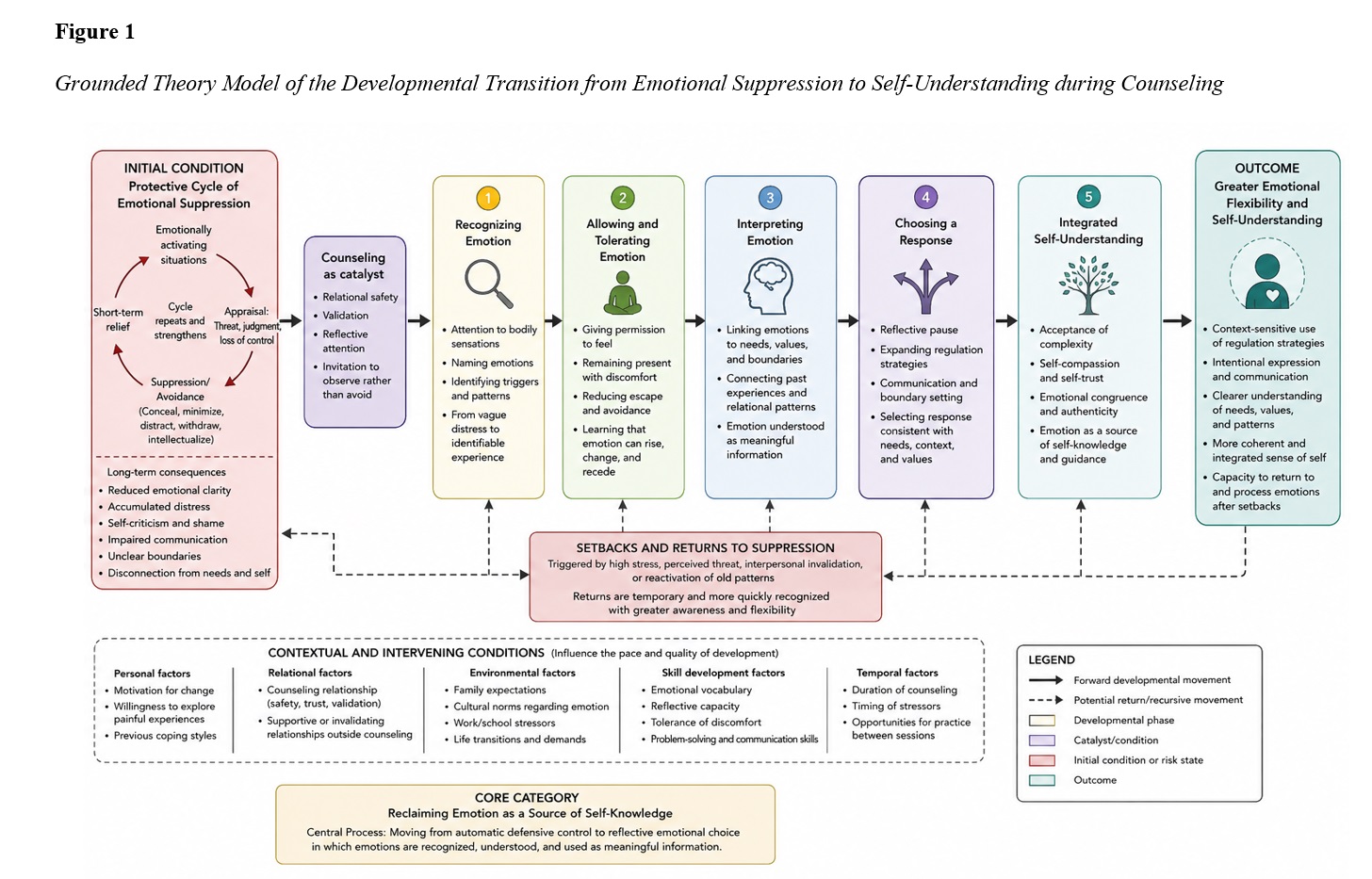
Findings: Analysis generated 487 initial codes, 31 focused concepts, 12 subcategories, and five major categories integrated around the core category of “reclaiming emotion as a source of self-knowledge.” The emerging theory indicated a recursive developmental movement from protective emotional suppression through disruption of habitual avoidance, recognition and tolerance of emotional experience, construction of emotional meaning, deliberate regulation, and integrated self-understanding. Emotional suppression initially functioned as protection from vulnerability, judgment, and interpersonal threat but gradually restricted emotional clarity and self-knowledge. Counseling-related safety, validation, reflective attention, and repeated behavioral experimentation facilitated greater emotional flexibility. Development was non-linear, and temporary returns to suppression occurred particularly during heightened stress or interpersonal invalidation.
Conclusion: Emotion-regulation development during counseling appears to involve a transformation from automatic defensive control toward reflective emotional choice, in which emotions become increasingly recognized, tolerated, interpreted, and incorporated into intentional action and coherent self-understanding.
Downloads
References
Barida, M., Hidayah, N., Ramli, M., & Atmoko, A. (2023). The Level of Awareness of Arabic Language Teachers About the Values of Academic Integrity and Its Relationship to the Motivation to Complete Tasks Among Students of the Third Cycle in the Emirate of Abu Dhabi. Pegegog, 13(02). https://doi.org/10.47750/pegegog.13.02.04
Bate, J., Prout, T. A., Rousmaniere, T., & Vaz, A. F. (2022). Introduction and Overview of Deliberate Practice and Child and Adolescent Psychotherapy. 3-16. https://doi.org/10.1037/0000288-001
Berg, E. L., Feldmann, L. M., Verlaine, J., & Bach-Gorman, A. (2024). An Equine-Assisted Intervention Versus Non-Manualized Psychotherapy for Youth in a Residential Childcare Facility. Journal of Child & Adolescent Trauma, 18(1), 139-149. https://doi.org/10.1007/s40653-024-00666-x
Bhana, A., Kreniske, P., Pather, A., Abas, M., & Mellins, C. A. (2021). Interventions to Address the Mental Health of Adolescents and Young Adults Living With or Affected by HIV: State of the Evidence. Journal of the International AIDS Society, 24(S2). https://doi.org/10.1002/jia2.25713
Boshe, J., Brtek, V., Beima‐Sofie, K., Braitstein, P., Brooks, M. J., Denison, J. A., Donenberg, G. R., Kemigisha, E., Memiah, P., Njuguna, I., Poku, O. B., Roberts, S. T., Shayo, A., & Dow, D. E. (2022). Integrating Adolescent Mental Health Into HIV Prevention and Treatment Programs: Can Implementation Science Pave the Path Forward? AIDS and Behavior, 27(S1), 145-161. https://doi.org/10.1007/s10461-022-03876-2
Bourvis, N., Cohen, D., & Benarous, X. (2023). Therapeutic and Preventive Interventions in Adolescents With Borderline Personality Disorder: Recent Findings, Current Challenges, and Future Directions. Journal of clinical medicine, 12(20), 6668. https://doi.org/10.3390/jcm12206668
Cain, L., Strodl, E., & Howard, G. (2024). Targeting Beliefs About Emotions via Meta-Emotion Therapy for Adolescents With Anxiety: A Case Series Study. Journal of Contemporary Psychotherapy, 54(2), 133-142. https://doi.org/10.1007/s10879-023-09605-7
Cohen, Z. P., Cosgrove, K. T., Akeman, E., Coffey, S., Teague, T. K., Hays, J., Paulus, M. P., Aupperle, R. L., & Kirlić, N. (2021). The Effect of a Mindfulness-Based Stress Intervention on Neurobiological and Symptom Measures in Adolescents With Early Life Stress: A Randomized Feasibility Study. BMC Complementary Medicine and Therapies, 21(1). https://doi.org/10.1186/s12906-021-03295-1
Dambi, J. M., Mavhu, W., Beji‐Chauke, R., Kaiyo-Utete, M., Mills, R., Shumba, R., Muchemwa, S., Musesengwa, R., Verhey, R., Abas, M., Hirsch, C. R., & Chibanda, D. (2023). The Impact of Working Alliance in Managing Youth Anxiety and Depression: A Scoping Review. NPJ Mental Health Research, 2(1). https://doi.org/10.1038/s44184-023-00021-2
Demkowicz, O., & Panayiotou, M. (2025). Current Directions in Child and Adolescent Psychotherapy: Overview and Introduction to the Special Issue. Psychology and Psychotherapy Theory Research and Practice. https://doi.org/10.1111/papt.70032
Durpoix, A., Rolling, J., Coutelle, R., & Lalanne, L. (2023). Psychotherapies in Opioid Use Disorder: Toward a Step-Care Model. Journal of Neural Transmission, 131(5), 437-452. https://doi.org/10.1007/s00702-023-02720-8
Ford, J. D. (2021). Why We Need a Developmentally Appropriate Trauma Diagnosis for Children: A 10-Year Update on Developmental Trauma Disorder. Journal of Child & Adolescent Trauma, 16(2), 403-418. https://doi.org/10.1007/s40653-021-00415-4
Gemeda, T. T., Mohangi, K., & Scherman, V. (2022). The Application of Teret-Teret as a Psychotherapy Technique in the Context of Ethiopia. Alternative an International Journal of Indigenous Peoples, 19(1), 80-90. https://doi.org/10.1177/11771801221131714
Gkintoni, E., Κουρκούτας, Η., Yotsidi, V., Stavrou, P. D., & Prinianaki, D. (2024). Clinical Efficacy of Psychotherapeutic Interventions for Post-Traumatic Stress Disorder in Children and Adolescents: A Systematic Review and Analysis. Children, 11(5), 579. https://doi.org/10.3390/children11050579
Jenkins, J. B. (2023). LPCs’ and State-Certified School Counselors’ Perceptions of Utilizing Play Therapy With Autism Spectrum Disorder. International Journal of Play Therapy, 32(2), 95-106. https://doi.org/10.1037/pla0000197
Kaess, M., & Cavelti, M. (2025). Research Review: What We Have Learned About Early Detection and Intervention of Borderline Personality Disorder. Journal of Child Psychology and Psychiatry, 66(12), 1829-1848. https://doi.org/10.1111/jcpp.70011
Kivlighan, D. M., Wang, L.-F., Wei, M., Hung, Y. L., Koay, E. Y. Y., Sun, A., & Kivlighan, D. M. (2025). Leader and Group Effects for Outcomes in Emotional Cultivation Groups for Youth. Journal of counseling psychology, 72(6), 710-720. https://doi.org/10.1037/cou0000805
Méndez, X., Sánchez-Hernández, Ó., Garber, J., Espada, J. P., & Orgilés, M. (2021). Psychological Treatments for Depression in Adolescents: More Than Three Decades Later. International journal of environmental research and public health, 18(9), 4600. https://doi.org/10.3390/ijerph18094600
Morthorst, B. R., Rubæk, L., Lindschou, J., Jakobsen, J. C., Gluud, C. G. C., Bjurebjerg, J., Hellner, C., Møhl, B., & Pagsberg, A. K. (2021). An Internet-Based Emotion Regulation Intervention Versus No Intervention for Nonsuicidal Self-Injury in Adolescents: Study Protocol for a Feasibility Trial. https://doi.org/10.21203/rs.3.rs-122211/v2
Mucci, C. (2021). Review of Right Brain Psychotherapy. Psychoanalytic Psychology, 38(4), 352-355. https://doi.org/10.1037/pap0000368
Pu, J., Zaidi, M. F., Patel, M., Atluri, L. M., Gonzalez, N. A., Sakhamuri, N., Athiyaman, S., Randhi, B., Gutlapalli, S. D., & Mohammed, L. (2023). The Influence of Family Intervention on the Treatment of Adolescent Patients With Borderline Personality Disorder: A Literature Review. Cureus. https://doi.org/10.7759/cureus.40758
Rosic, T., Lovell, E., MacMillan, H. L., Samaan, Z., & Morgan, R. L. (2023). Components of Outpatient Child and Youth Concurrent Disorders Programs: A Critical Interpretive Synthesis: Composantes Des Programmes De Troubles Concomitants Des Enfants Et Des Jeunes Ambulatoires : Une Synthèse Interprétative Critique. The Canadian Journal of Psychiatry, 69(6), 381-394. https://doi.org/10.1177/07067437231212037
Sammer-Schreckenthaler, S., Lagetto, G., Unterrainer, H. F., & Gelo, O. C. G. (2025). Specific and Common Therapeutic Factors in Psychodynamic Psychotherapy for Children and Adolescents: An Overview. Frontiers in psychology, 16. https://doi.org/10.3389/fpsyg.2025.1525849
Sandage, S. J., Rupert, D., Stavros, G., & Devor, N. G. (2020). Relational Spirituality in Group Therapy. 227-248. https://doi.org/10.1037/0000174-011
Schore, A. N. (2022). Right Brain-to-Right Brain Psychotherapy: Recent Scientific and Clinical Advances. Annals of General Psychiatry, 21(1). https://doi.org/10.1186/s12991-022-00420-3
Spinner, H., Thompson, K. A., Bauman, V., Lavender, J. M., Thorstad, I., Schrag, R., Sbrocco, T., Schvey, N. A., Ford, B., Ford, C. B., Wilfley, D. E., Jorgensen, S., Klein, D. A., Quinlan, J. D., Yanovski, J. A., Haigney, M. C., & Tanofsky‐Kraff, M. (2024). Emotional Dysregulation Moderates the Relation Between Perceived Stress and Emotional Eating in Adolescent Military Dependents. International Journal of Eating Disorders, 57(7), 1609-1615. https://doi.org/10.1002/eat.24217
Spiro, C. M., & Economou, P. (2022). The Future of Psychotherapy for Youth. Advanced Journal of Social Science, 11(1), 52-62. https://doi.org/10.21467/ajss.11.1.52-62
Tattersall, T. C., & Rolli, N. (2025). The Growing Prevalence of Mental Health Needs of Children and Young People and Implications for Integrative Child Psychotherapy. British Journal of Psychotherapy, 42(1), 35-48. https://doi.org/10.1111/bjp.70004
Tempone-Wiltshire, J. (2024). The Role of Mindfulness and Embodiment in Group-Based Trauma Treatment. Psychotherapy and Counselling Journal of Australia, 12(1). https://doi.org/10.59158/001c.94979
Vatne, T. M., Owren, S., Wold, K. F., Zahl, E., & Fjermestad, K. W. (2021). Youth and Clinician Evaluation of Emotional Communication in Short-Term Counseling Groups. Group Dynamics Theory Research and Practice, 25(4), 334-348. https://doi.org/10.1037/gdn0000147
Vaughn, R., & Weisz, J. R. (2021). Leveraging the Developmental Science of Psychosocial Risk to Strengthen Youth Psychotherapy. Development and Psychopathology, 33(2), 670-683. https://doi.org/10.1017/s0954579420002035
Wang, L.-f., Kivlighan, D. M., Wei, M., Tsai, C. L., & Chen, S.-Y. (2026). Heterogeneity of Emotional Cultivation Strategies as a Group Composition Variable Among Taiwanese Youth. Journal of counseling psychology, 73(4), 545-554. https://doi.org/10.1037/cou0000872
Downloads
Additional Files
Publication Timeline
- Submitted
- Revised
- Accepted