The Effect of Positive Psychology on Enhancing Subjective Well-Being (Subjective Happiness/Life Satisfaction) in an Orphaned Adolescent Diagnosed with Comorbid Depression and Anxiety Disorders: A Case Report
Keywords:
positive psychology, subjective well-being, depression, anxiety, orphaned adolescentAbstract
Objective: The present study aimed to investigate the effect of positive psychology on enhancing subjective well-being (subjective happiness/life satisfaction) in an orphaned adolescent diagnosed with comorbid depression and anxiety disorders.
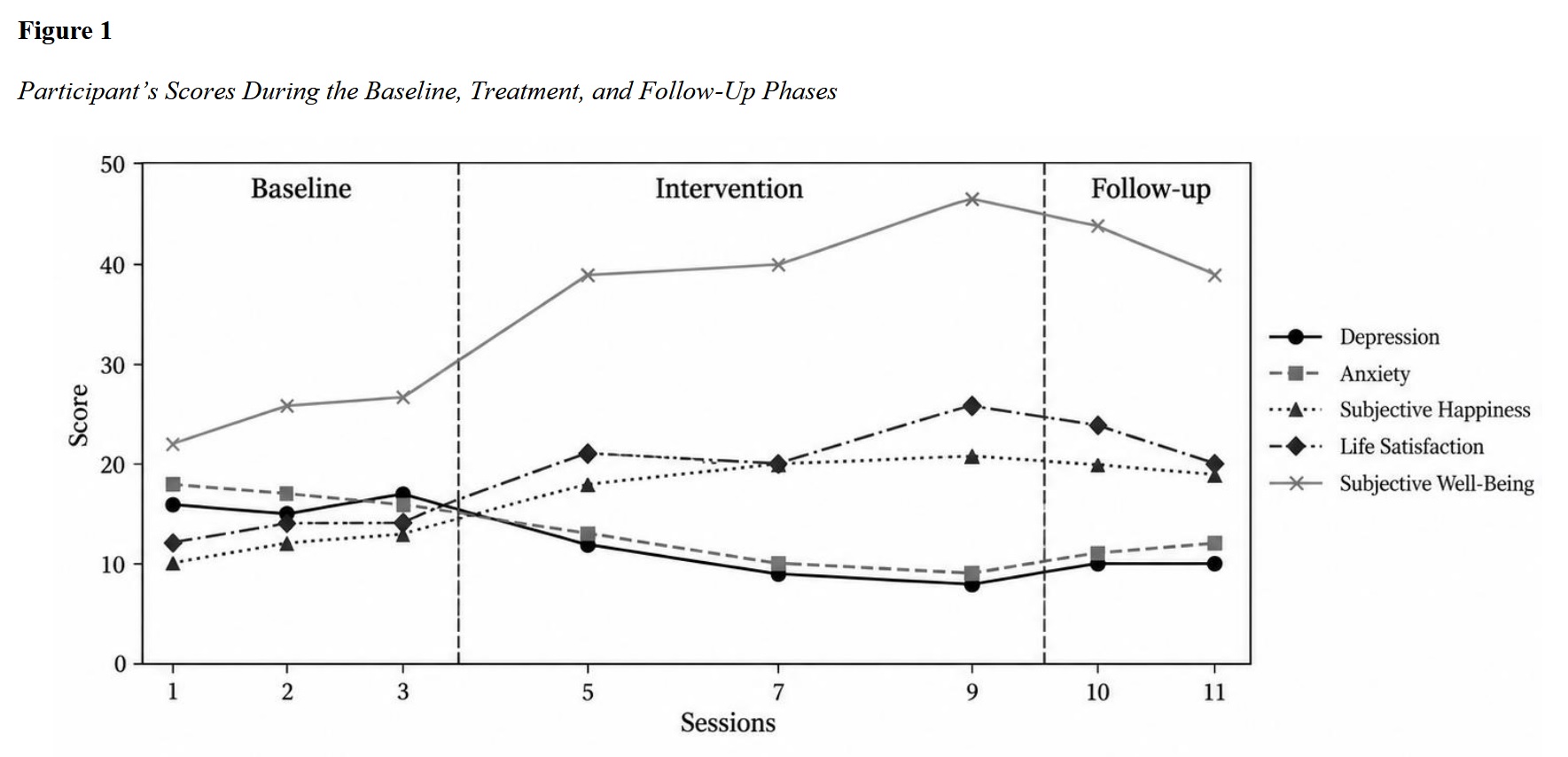
Methods and Materials: The present study was a case report employing a single-subject design with three baseline assessments and a follow-up period. It examined the effects of seven sessions of a manualized positive psychology intervention (one 60-minute session per week) on reducing depression and anxiety and enhancing subjective well-being in a 15-year-old orphaned adolescent boy diagnosed with comorbid depression and anxiety disorders. The Depression-Anxiety Scale (DA-14) and the Subjective Well-Being Scale were used in the present study. The adolescent completed these measures before the intervention, after the seven positive psychology sessions, and one month after completion of the intervention.
Findings: The results indicated that following the initiation of the intervention, the adolescent boy demonstrated a decreasing and improving trend in depression (39.58% reduction) and anxiety (37.25% reduction) scores, as well as an increasing and improving trend in the total subjective well-being score (68%) and its dimensions, including subjective happiness (68.57%) and life satisfaction (67.50%). These improvements were maintained at the one-month follow-up.
Conclusion: Based on the findings, positive psychology may constitute an appropriate and effective intervention for enhancing subjective happiness, life satisfaction, and subjective well-being among orphaned adolescents with comorbid psychological disorders.
Keywords: positive psychology, subjective well-being, depression, anxiety, orphaned adolescent.
Downloads
References
Aazami, Y., Khanjani, M., & Sader, M. M. (2017). Confirmatory Factor Structure of Depression, Anxiety and Stress Scale in Students. Journal of Mazandaran University of Medical Sciences, 27(154), 94-106. http://jmums.mazums.ac.ir/article-1-9617-en.html
Abiri Bonab, F., Alivandi Vafa, M., Khademi, A., & Javanmard, G. (2022). The Comparison of the Effectiveness of Positive Group and Individual Intervention on the Persistent Depressive Disorder in Foster Care/Irresponsible Parenting Adolescent Girls. Women and Family Studies, 15(57), 135-151. https://doi.org/10.30495/jwsf.2022.1926879.1553
Asad Zandi, M., Sayari, R., Ebadi, A., & Sanainasab, H. (2022). Abundance of Depression, Anxiety and Stress in Militant Nurses. Journal of Military Medicine, 13(2), 103-108. https://militarymedj.bmsu.ac.ir/article_1000444_8118526ba601ed0e183bd1b28e11ef4a.pdf
Baghaei, B., & Aghaei, A. (2025). Effectiveness of Positive Psychotherapy on Quality of Life, Happiness, and Meaningfulness in Firefighters. Bi-Monthly Journal of Health Dawn in Yazd, 1(2), 1-16. https://doi.org/10.18502/tbj.v21i2.10337
Bajaj, B., & Pande, N. (2016). Mediating Role of Resilience in the Impact of Mindfulness on Life Satisfaction and Affect as Indices of Subjective Well-Being. Personality and individual differences, 93, 63-67.
Dargie, F. (2021). Prevalence of Depression and Its Associated Factor among Orphan Adolescents in Orphan Centers in Hawassa City Administration, Sidama National Regional State, Ethiopia [Thesis,
Duraisamy, P., Raman, R., Kashyap, R. S., Dm, K., & Tn, M. (2022). A Comparative Study on Depression, Anxiety, Stress, and Psychological Wellbeing among Orphan and Non-Orphan Adolescents. International Journal of Health and Allied Sciences, 11(3), 6.
Eryilmaz, A. (2025). Positive Psychotherapy in action: the "DYNAMICS" method for formulating basic conflicts. The Global Psychotherapist, 5(1), 101–114. https://doi.org/10.52982/lkj263
Hajizadeh Anari, M., & Miri, M. N. (2025). Comparing the Effectiveness of Positive Psychology Training and Mindfulness-Based Cognitive Therapy on Self-Efficacy and Teaching Anxiety of Physics Student-Teachers. Psychological Sciences, 24(152), 81-100.
Hall, M., Dobson, F., Van Ginckel, A., Nelligan, R. K., Collins, N. J., Smith, M. D., Ross, M. H., Smits, E., & Bennell, K. L. (2021). Comparative Effectiveness of Exercise Programs for Psychological Well-Being in Knee Osteoarthritis: A Systematic Review and Network Meta-Analysis Seminars in Arthritis and Rheumatism,
Hendriks, T., Schotanus-Dijkstra, M., Hassankhan, A., de Jong, J., & Bohlmeijer, E. (2020). The Efficacy of Multi-Component Positive Psychology Interventions: A Systematic Review and Meta-Analysis of Randomized Controlled Trials. Journal of Happiness Studies, 21(1), 357-390. https://doi.org/10.1007/s10902-019-00082-1
Honarmand Zadeh, R., & Sajjadian, I. (2016). Effectiveness of Positive Group Intervention on Psychological Wellbeing, Resiliency and Happiness of Foster Care Adolescent Girls. Positive Psychology Research, 2(2), 35-50. https://doi.org/10.22108/ppls.2016.21335
Khanna, P., & Singh, K. (2019). Do All Positive Psychology Exercises Work for Everyone? Replication of Seligman et al.’s (2005) Interventions among Adolescents. Psychological studies, 64, 1-10.
Krause, K. R., Bear, H. A., Edbrooke-Childs, J., & Wolpert, M. (2019). What Outcomes Count? Outcomes Measured for Adolescent Depression between 2007 and 2017. Journal of the American Academy of Child & Adolescent Psychiatry, 58(1), 61-71.
Lee, H., Lee, H., Kim, Y., Lee, M., & Park, C. G. (2022). Reciprocal Relationship between Multicultural Adolescents’ Depression and Life Satisfaction: A Random Intercept Cross-Lagged Panel Model for 3-Wave Panel Data. Applied Research in Quality of Life. https://doi.org/10.1007/s11482-021-10032-w
Mehrsafar, A. H. (2016). Psychometric Properties of the Persian Version of the Revised Competitive State Anxiety Inventory-2. Quarterly of Educational Measurement, 6(23), 189-211. https://doi.org/10.22054/jem.2016.5738
Melton, T. H., Croarkin, P. E., Strawn, J. R., & McClintock, S. M. (2016). Comorbid Anxiety and Depressive Symptoms in Children and Adolescents: A Systematic Review and Analysis. Journal of Psychiatric Practice, 22(2), 84.
Milburn, N. G., Stein, J. A., Lopez, S. A., Hilberg, A. M., Veprinsky, A., Arnold, E. M., Desmond, K. A., Branson, K., Lee, A., & Bath, E. (2019). Trauma, Family Factors and the Mental Health of Homeless Adolescents. Journal of Child & Adolescent Trauma, 12, 37-47.
Mirkamali, F., Khosravi, S. A., Shaygan, M., Karimi Afshar, E., & Karimi, E. (2021). The Effectiveness of Positivist Psychology Training on Cognitive Flexibility and Psychological Hardiness of Nurses. Journal of nursing education, 10(3), 1-10. http://jne.ir/article-1-1202-en.html
Noferesti, A., & Okhovati, F. (2019). The Effectiveness of Positive Thinking Skills Training on Increasing Happiness and Resilience of Orphaned Adolescent Girls. Rooyesh-e-Ravanshenasi Journal (RRJ), 8(10), 71-78. http://frooyesh.ir/article-1-1837-en.html
Pan, S., Ali, K., Kahathuduwa, C., Baronia, R., & Ibrahim, Y. (2022). Meta-Analysis of Positive Psychology Interventions on the Treatment of Depression. Cureus, 14(2).
Plessen, C. Y., Karyotaki, E., & Cuijpers, P. (2022). Exploring the Efficacy of Psychological Treatments for Depression: A Multiverse Meta-Analysis Protocol. BMJ open, 12(1), e050197.
Rafiei, M., Masoudi, S., & Khakpour, M. (2025). The effectiveness of positive psychotherapy on cognitive flexibility, marital frustration, and post-traumatic growth in women with cancer. A New Approach to Child Education, 7(1), 10–21. https://mjms.mums.ac.ir/article_24591.html
Sarı, T., Demirbağ, T., & Çalışkan, S. (2025). Building Resilience Through a Self-Help Psychoeducation Program Based on Positive Psychotherapy: A Pilot Study with Young Adults in Türkiye. Advances in Resilience Science, 6, 179-189. https://doi.org/10.1007/s42844-025-00164-5
Shen, L., Gu, X., Zhang, T., & Lee, J. (2022). Adolescents’ Physical Activity and Depressive Symptoms: A Psychosocial Mechanism. International journal of environmental research and public health, 19(3), 1276. https://www.mdpi.com/1660-4601/19/3/1276
Sohrabi, H. (2023). A Comparison between the Impact of Positive Psychology and Young Adult-Oriented Mindfulness on Anxiety Management of the National Basketball Players with Disabilities. 2(2), 61-76. https://jsports.qom.iau.ir/article_704968_731fc7ed30b3d4629d0b1063a6517a2b.pdf
Tejada-Gallardo, C., Blasco-Belled, A., Torrelles-Nadal, C., & Alsinet, C. (2020). Effects of School-Based Multicomponent Positive Psychology Interventions on Well-Being and Distress in Adolescents: A Systematic Review and Meta-Analysis. Journal of youth and adolescence, 49(10), 1943-1960.
Wang, F., Guo, J., & Yang, G. (2023). Study on Positive Psychology from 1999 to 2021: A Bibliometric Analysis. Frontiers in psychology, 14, 273.
Wang, M., Mou, X., Li, T., Zhang, Y., Xie, Y., Tao, S., Wan, Y., Tao, F., & Wu, X. (2023). Association between Comorbid Anxiety and Depression and Health Risk Behaviors among Chinese Adolescents: Cross-Sectional Questionnaire Study. Jmir Public Health and Surveillance, 9, e46289.
Wu, X., Niu, Z., Zhu, Y., Shi, Y., Qiu, H., Gu, W., Liu, H., Zhao, J., Yang, L., & Wang, Y. (2022). Peripheral Biomarkers to Predict the Diagnosis of Bipolar Disorder from Major Depressive Disorder in Adolescents. European Archives of Psychiatry and Clinical Neuroscience, 272(5), 817-826.
Downloads
Additional Files
Publication Timeline
- Submitted
- Revised
- Accepted