The Relationship of Dispositional Mindfulness, Cognitive Empathy, and Affective Empathy with Depressive Symptoms
Keywords:
Dispositional Mindfulness, Cognitive Empathy, Affective Empathy, Depressive Symptoms, Correlational StudyAbstract
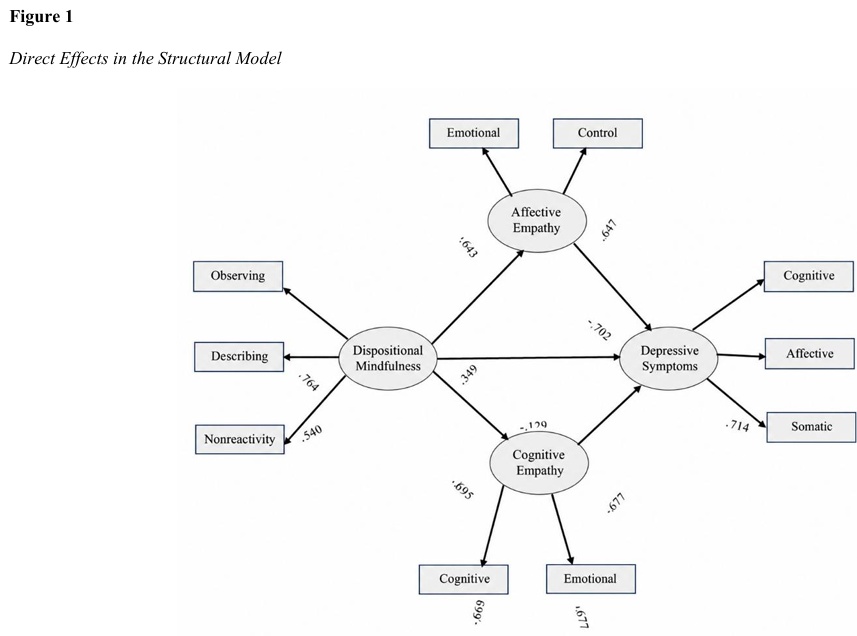
Objective: This study aimed to investigate the relationships of dispositional mindfulness, cognitive empathy, and affective empathy with depressive symptoms among adult women and men residing in Tabriz, Iran.
Methods and Materials: This basic research employed a descriptive-correlational design. The statistical population consisted of adults aged 18–45 years residing in Tabriz who reported at least one depressive symptom. A total of 350 participants were recruited through convenience sampling from healthcare centers, psychological clinics, universities, and online announcements. Data were collected using the Five Facet Mindfulness Questionnaire developed by Baer et al., the Beck Depression Inventory, a Cognitive Empathy Questionnaire, and the Emotional Empathy Scale developed by Mehrabian and Epstein. After participants received information about the study and provided informed consent, the questionnaires were administered either in person or online. Data were analyzed using SPSS software, with correlation analysis employed to examine the relationships among the study variables.
Findings: Inferential analyses indicated that dispositional mindfulness was positively and significantly associated with both cognitive empathy and affective empathy, indicating that higher levels of mindfulness were accompanied by higher levels of both dimensions of empathy. However, the relationships of dispositional mindfulness, cognitive empathy, and affective empathy with depressive symptoms were not statistically significant. Thus, although mindfulness demonstrated significant associations with the cognitive and emotional dimensions of empathy, none of the three principal psychological variables showed a significant direct relationship with depressive symptoms in the studied sample.
Conclusion: Dispositional mindfulness appears to be meaningfully associated with individuals’ empathic capacities, particularly both cognitive understanding and affective responsiveness to others. Nevertheless, dispositional mindfulness and the two dimensions of empathy were not significantly related to depressive symptoms in this sample.
Downloads
Downloads
Additional Files
Publication Timeline
- Submitted
- Revised
- Accepted