Social Media Addiction and Psychological Distress in Adolescents: The Serial Mediating Roles of Fear of Missing Out and Social Comparison
Keywords:
social media addiction, psychological distress, fear of missing out, social comparison, adolescents, serial mediationAbstract
Objective: This study aimed to examine the relationship between social media addiction and psychological distress among Canadian adolescents and to test the serial mediating roles of fear of missing out and social comparison in this association.
Methods and Materials: The study employed a cross-sectional correlational design with a serial mediation approach. Participants were 428 Canadian adolescents aged 13–18 years recruited from secondary schools. Data were collected using the Bergen Social Media Addiction Scale, Fear of Missing Out Scale, Iowa-Netherlands Comparison Orientation Measure, and Kessler Psychological Distress Scale. Pearson correlation coefficients were calculated to examine associations among the study variables. Serial mediation analysis was conducted using PROCESS Model 6 with 5,000 bootstrap resamples to estimate direct, indirect, and sequential indirect effects.
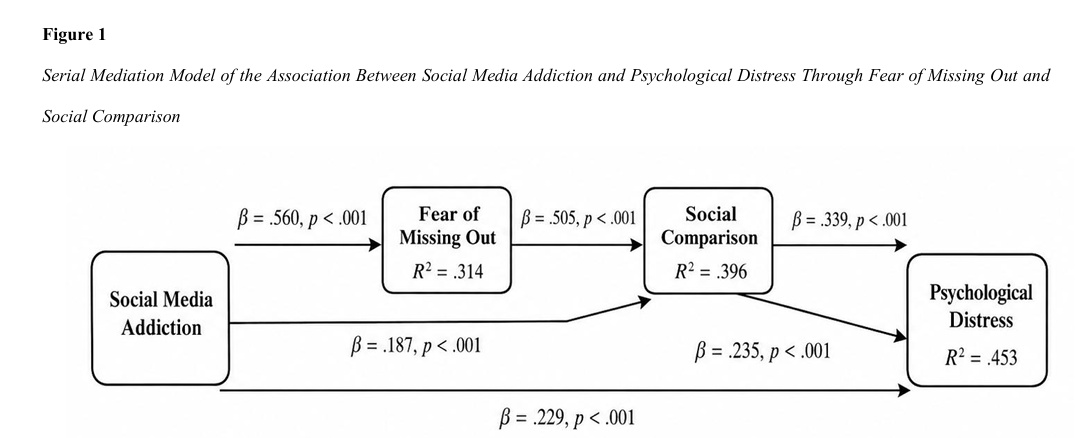
Findings: Social media addiction was positively associated with fear of missing out (r = .56, p < .001), social comparison (r = .47, p < .001), and psychological distress (r = .52, p < .001). Fear of missing out was positively associated with social comparison (r = .61, p < .001) and psychological distress (r = .57, p < .001), while social comparison was positively related to psychological distress (r = .59, p < .001). The total effect of social media addiction on psychological distress was significant (B = .711, p < .001), and the direct effect remained significant after inclusion of the mediators (B = .313, p < .001). Significant indirect effects were observed through fear of missing out (B = .180, 95% CI [.112, .261]), social comparison (B = .087, 95% CI [.046, .139]), and the serial pathway through both mediators (B = .131, 95% CI [.081, .190]).
Conclusion: Social media addiction was associated with greater psychological distress among adolescents both directly and indirectly through fear of missing out and social comparison, indicating that these two psychological processes may represent important mechanisms linking problematic social media engagement to poorer adolescent mental health.
Downloads
References
Alassaf, U. F., Ghoneim, N. M., & Sotouhi, S. A. (2024). A Selective Counseling Program for Reducing Fear of Missing Out (FoMO) and Its Impact on Decreasing Social Anxiety and Internet Gaming Disorder Among Adolescent Girls in Bisha Governorate. International Journal of Religion, 5(3), 52-67. https://doi.org/10.61707/34q82e47
Anjani, S., & Widyatama, R. (2023). Influence of Frequency Social Media Use on the Level FOMO Teenagers in Social Media Era. Commicast, 4(3), 45-57. https://doi.org/10.12928/commicast.v4i3.9646
Bajwa, R. S., Abdullah, H., Zaremohzzabieh, Z., Jaafar, W. M. W., & Samah, A. A. (2023). Smartphone Addiction and Phubbing Behavior Among University Students: A Moderated Mediation Model by Fear of Missing Out, Social Comparison, and Loneliness. Frontiers in psychology, 13. https://doi.org/10.3389/fpsyg.2022.1072551
Bakshi, K., & Gait, P. (2026). Fear of Missing Out (FoMO) and Compulsive Social Media Use: A Systematic Review and Meta-Analysis of the Association and Moderating Effects of Age and Gender. https://doi.org/10.21203/rs.3.rs-9952939/v1
Burgess, K. (2025). The Decline in Adolescents’ Mental Health With the Rise of Social Media: A Narrative Review. Creative Nursing, 31(2), 119-126. https://doi.org/10.1177/10784535251328925
Dania, I. A., Sastra, E. Y., Susanti, M., Diba, F., Novziransyah, N., & Pangestuti, D. C. (2023). Intensity of Instagram Related Fear of Missing Out in Medical Student Community. International Journal of Public Health Excellence (Ijphe), 3(1), 265-271. https://doi.org/10.55299/ijphe.v3i1.499
Ediati, A., Kaloeti, D. V. S., Martono, K. T., & Ardhiani, L. N. (2024). Resilience and Symptoms of Depression and Anxiety in Adolescents: The Mediating Role of Fear of Missing Out. Current Issues in Personality Psychology. https://doi.org/10.5114/cipp/174520
Fu, Y., Wang, Y., Chang, Y., Liu, Y., Chao, T., Wang, R., & Xiao, T. (2026). Problematic Social Media Use Effects Social Emotional Competence in Adolescents Through Internalizing Problems and Fear of Missing Out. https://doi.org/10.21203/rs.3.rs-8993913/v1
Gumelar, G. (2023). FOMO-Fueled Instagram Addiction in Adolescents of Jakarta: An Exploration of the Fear of Missing Out Phenomenon. Psychology and Psychotherapy Research Study, 6(3). https://doi.org/10.31031/pprs.2023.06.000640
Hendrawan, A. Y., Wenas, M. L., & Gunawan, G. (2023). Integration of Christ’s Love in Family Discipleship to Overcome Fear of Missing Out (FOMO) in Generation Z. Evangelikal Jurnal Teologi Injili Dan Pembinaan Warga Jemaat, 7(2), 101. https://doi.org/10.46445/ejti.v7i2.443
Hu, S. (2024). The Psychological Impact of Social Media on Gen Z. Interdisciplinary Humanities and Communication Studies, 1(5). https://doi.org/10.61173/4aqek196
Ikbal, T. (2023). A Comprehensive Evaluation of the Impact of Social Media on Mental Health Reveals Noteworthy Effects. Praxis International Journal of Social Science and Literature, 6(8), 64-72. https://doi.org/10.51879/pijssl/060807
Jin, Y., Xiong, W., Liu, X., & An, J. (2023). Trait Mindfulness and Problematic Smartphone Use in Chinese Early Adolescent: The Multiple Mediating Roles of Negative Affectivity and Fear of Missing Out. Behavioral Sciences, 13(3), 222. https://doi.org/10.3390/bs13030222
Koç, H., Gökalp, Z. Ş., & Seki, T. (2023). The Relationships Between Self-Control and Distress Among Emerging Adults: A Serial Mediating Roles of Fear of Missing Out and Social Media Addiction. Emerging Adulthood, 11(3), 626-638. https://doi.org/10.1177/21676968231151776
Lu, Y., Chang, H., Meng, X., Li, Y., Liu, J., Yuan, W., Ni, J., Li, C., Li, L., Liu, L., Niu, Z., Zhong, H., Mei, S., Griffiths, M. D., Yang, T., He, Y., He, C., Yang, Y., Wu, L., . . . Rahardjo, W. (2024). Addictive Behaviors Among Youth and Adolescents in the Digital Age. https://doi.org/10.3389/978-2-8325-4853-0
Mahanani, F. K., & Arifiani, Z. N. (2023). The Relationship Between Loneliness and Fear of Missing Out on Students of the State University of Semarang. Nusantara Journal of Behavioral and Social Sciences, 2(4), 117-126. https://doi.org/10.47679/202342
Meradaputhi, K., Nadhirah, N. A., & Saripah, I. (2023). Analysis of Fear of Missing Out Phenomena in Adolescent Social Interaction in the Digital Era. Journal of Education and Counseling (Jeco). https://doi.org/10.32627/jeco.v3i1.654
Ndayambaje, E., & Udohchukwu, O. P. (2025). The Psychopathology of Problematic Smartphone Use (PSU): A Narrative Review of Burden, Mediating Factors, and Prevention. Health Science Reports, 8(5). https://doi.org/10.1002/hsr2.70843
Ngo, T. T. A., Nguyen, N. T. A., La, U. N., Truong, D. N., & Nguyen, H. Q. B. (2024). Impacts of Social Media Experiences on Academically Related Peer Influence and Fear of Missing Out of Secondary and High School Students. International Journal of Engineering Pedagogy (Ijep), 14(2), 112-129. https://doi.org/10.3991/ijep.v14i2.43567
Ntumi, S., Amos, P. M., Danquah, S. A., Amoako, B. M., & Amezugbe, C. (2025). From Likes to Lows: A Serial Mediation Analysis of How Social Media Addiction, Fear of Missing Out (FoMO), Emotional Regulation, Assessment Engagement, and Assessment Anxiety Influence Depression Among Adolescents in Ghana. https://doi.org/10.21203/rs.3.rs-6916786/v1
Pacocha, N., & Gugała, O. (2024). The Influence of Social Media on Mental Wellbeing – A Review of Literature. International Journal of Innovative Technologies in Social Science(2(42)). https://doi.org/10.31435/rsglobal_ijitss/30062024/8151
Prasetyo, H., Arsana, I. P. A., Utami, M. D. T., & Indiastuti, D. N. (2022). Knowledge Level of the Society About Fear of Missing Out Through Webinar in COVID-19 Pandemic. Kesans International Journal of Health and Science, 1(5), 488-497. https://doi.org/10.54543/kesans.v1i5.44
Rathod, A., Ingole, A., Gaidhane, A., & Choudhari, S. G. (2022). Psychological Morbidities Associated With Excessive Usage of Smartphones Among Adolescents and Young Adults: A Review. Cureus. https://doi.org/10.7759/cureus.30756
Ruckwongpatr, K., Paratthakonkun, C., Ghavifekr, S., Gan, W. Y., Tung, S. E. H., Nurmala, I., Nadhiroh, S. R., Pramukti, I., & Lin, C. Y. (2022). Problematic Internet Use (PIU) in Youth: A Brief Literature Review of Selected Topics. Current Opinion in Behavioral Sciences, 46, 101150. https://doi.org/10.1016/j.cobeha.2022.101150
Setyaningsih, N. R., Sarjana, W., & Wardani, N. D. (2023). The Correlation Between Fear of Missing Out (FoMO) and Internet Addiction in Vocational High School Students. Jurnal Psikiatri Surabaya, 12(1), 44-55. https://doi.org/10.20473/jps.v12i1.30653
Wang, Z., Yang, C., Li, W., Li, X., Zheng, W., & Zhao, Y. (2025). Exploring the Relationship Between Boredom Proneness and Short-Form Videos Addiction Among Chinese College Students Through a Moderated Mediation Model. Scientific reports, 15(1). https://doi.org/10.1038/s41598-025-22313-7
Yao, F., Cao, P., & Guo, S. (2025). Which Symptoms of Nomophobia, Social Networking Site Addiction, and Fear of Missing Out ( FoMO ) Directly Affect Mental Health? A Symptom Network and Flow Analysis Study. PsyCh Journal, 15(1). https://doi.org/10.1002/pchj.70068
Zhang, Y. (2023). Analysis of Coping Mechanisms and the Effects of Social Media on Teenagers. Lecture Notes in Education Psychology and Public Media, 4(1), 1006-1013. https://doi.org/10.54254/2753-7048/4/2022722
Zhang, Y., Shang, S., Tian, L., Zhu, L. J., & Zhang, W. (2023). The Association Between Fear of Missing Out and Mobile Phone Addiction: A Meta-Analysis. BMC psychology, 11(1). https://doi.org/10.1186/s40359-023-01376-z
Downloads
Additional Files
Publication Timeline
- Submitted
- Revised
- Accepted