Impact of Narrative Therapy on Identity Reconstruction and Motivation in Clients with Acquired Brain Injury
DOI:
https://doi.org/10.61838/kman.rc.psynexus.3.5Keywords:
Narrative therapy, identity reconstruction, motivation, acquired brain injury, randomized controlled trial, psychological rehabilitationAbstract
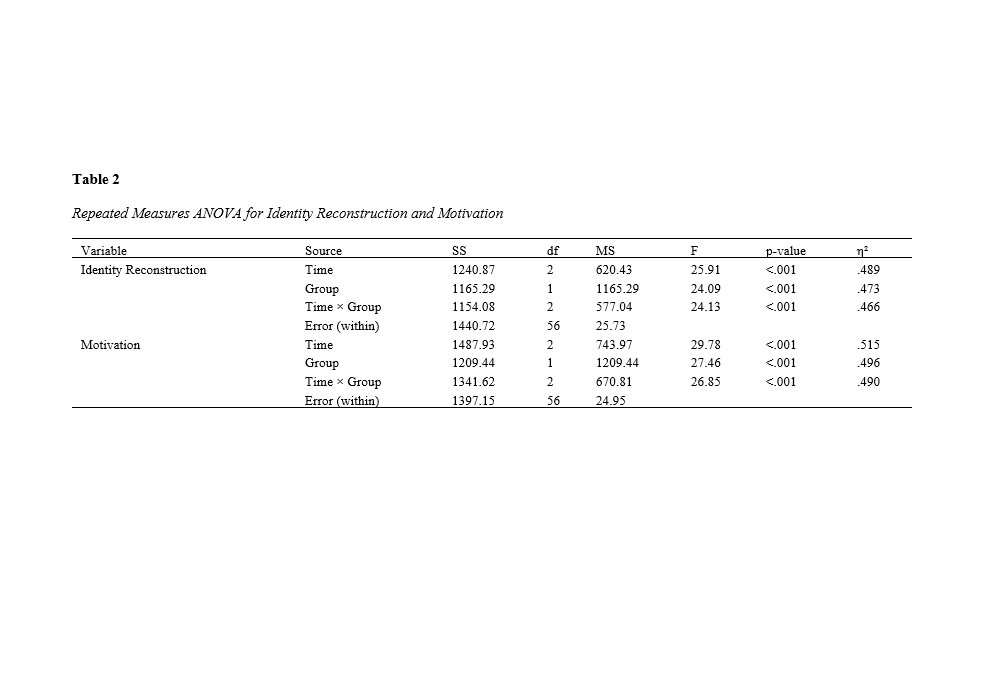
This study aimed to evaluate the effectiveness of narrative therapy in enhancing identity reconstruction and motivation among individuals with acquired brain injury (ABI). A randomized controlled trial was conducted involving 30 participants with ABI recruited from rehabilitation centers in Bangladesh. Participants were randomly assigned to either an intervention group (n = 15), which received nine weekly sessions of narrative therapy, or a control group (n = 15), which received standard care. Data were collected at three time points: pre-test, post-test, and five-month follow-up. Identity reconstruction was measured using the Self-Concept and Identity Measure (SCIM), and motivation was assessed using the Motivation for Traumatic Brain Injury Rehabilitation Questionnaire (MOT-Q). Data were analyzed using repeated measures analysis of variance (ANOVA) and Bonferroni post-hoc tests with SPSS-27. The results showed a significant improvement in identity reconstruction and motivation scores in the intervention group compared to the control group across time. The intervention group’s identity scores increased from a pre-test mean of 71.43 (SD = 6.28) to 82.67 (SD = 5.19) at post-test and were sustained at follow-up (M = 81.74, SD = 5.44). Similarly, motivation scores rose from 98.21 (SD = 7.03) to 110.36 (SD = 6.45), remaining stable at follow-up (M = 109.87, SD = 6.33). Repeated measures ANOVA confirmed significant time × group interactions for both variables (p < .001), and Bonferroni post-hoc tests indicated that the observed improvements were statistically significant and maintained over time. Narrative therapy proved effective in promoting identity reconstruction and increasing motivation in individuals with ABI, with sustained benefits observed at five-month follow-up. These findings highlight the therapeutic value of narrative-based interventions in neurorehabilitation settings.
Downloads
References
Alderman, N., & Worthington, A. (2023). Outcomes From Acquired Brain Injury. 3-19. https://doi.org/10.4324/9781003083290-2
Alqahtani, A. (2022). The Influence of Cultural and Psychological Factors on Mental Health Status During COVID-19 in Saudi Arabia. The Open Psychology Journal, 15(1). https://doi.org/10.2174/18743501-v15-e2201060
Athiraman, U., & Zipfel, G. J. (2021). Role of Anesthetics and Their Adjuvants in Neurovascular Protection in Secondary Brain Injury After Aneurysmal Subarachnoid Hemorrhage. International Journal of Molecular Sciences, 22(12), 6550. https://doi.org/10.3390/ijms22126550
Bower, J., Magee, W. L., Catroppa, C., & Baker, F. A. (2021). The Neurophysiological Processing of Music in Children: A Systematic Review With Narrative Synthesis and Considerations for Clinical Practice in Music Therapy. Frontiers in psychology, 12. https://doi.org/10.3389/fpsyg.2021.615209
Casault, C., Couillard, P., Kromm, J., Rosenthal, E. S., Kramer, A. H., & Brindley, P. G. (2020). Multimodal Brain Monitoring Following Traumatic Brain Injury: A Primer for Intensive Care Practitioners. Journal of the Intensive Care Society, 23(2), 191-202. https://doi.org/10.1177/1751143720980273
Christensen, R., Vries, L. S. d., & Çizmeci, M. N. (2023). Neuroimaging to Guide Neuroprognostication in the Neonatal Intensive Care Unit. Current opinion in pediatrics, 36(2), 190-197. https://doi.org/10.1097/mop.0000000000001299
D’Cruz, K., Douglas, J., & Serry, T. (2021). Researching Narrative Storytelling With Adults With Acquired Brain Injury. 1-16. https://doi.org/10.1007/978-3-030-48277-0_59-1
Darries, Z., & Soeker, M. S. (2023). Exploring the Experiences of Women With Acquired Brain Injury on Return to Work and Entrepreneurial Skills Development in the Western Cape Metropolitan, South Africa. Work, 76(1), 381-391. https://doi.org/10.3233/wor-220576
Dekker, K., Benjamins, J. S., Maksimovic, T., Filardi, M., Hofman, W. F., Straten, A. v., & Someren, E. J. V. (2019). Combined Internet-Based Cognitive-Behavioral and Chronobiological Intervention for Insomnia: A Randomized Controlled Trial. Psychotherapy and psychosomatics, 89(2), 117-118. https://doi.org/10.1159/000503570
Ford, M. E., Geurtsen, G. J., Groet, E., Bennekom, C. v., & Someren, E. J. V. (2020). A Blended eHealth Intervention for Insomnia Following Acquired Brain Injury: Study Protocol for a Randomized Controlled Trial. https://doi.org/10.21203/rs.2.12680/v4
Ford, M. E., Geurtsen, G. J., Groet, E., Mishre, R. D. R., Bennekom, C. v., & Someren, E. J. V. (2022). A Blended eHealth Intervention for Insomnia Following Acquired Brain Injury: A Randomised Controlled Trial. Journal of Sleep Research, 32(1). https://doi.org/10.1111/jsr.13629
Ford, M. E., Verkaik, F., Bouwmeester, S., & Geurtsen, G. J. (2024). Do Changes in Beliefs and Behaviours Moderate Improvement in Insomnia After Acquired Brain Injury? Journal of Sleep Research, 33(6). https://doi.org/10.1111/jsr.14221
Guo, R., Zhang, Y., Zemmelman, S., & Li, X. (2022). The Evolution of Narrative Identity in a “Returning Home” Man: The Psychological and Cultural Place of Farming in the Chinese Psyche. Journal of personality, 91(2), 497-518. https://doi.org/10.1111/jopy.12750
Kerr, D. J. R., Deane, F. P., & Crowe, T. P. (2019). Narrative Identity Reconstruction as Adaptive Growth During Mental Health Recovery: A Narrative Coaching Boardgame Approach. Frontiers in psychology, 10. https://doi.org/10.3389/fpsyg.2019.00994
Kossakowski, R., Witecka-Wiese, M., & Mańkowski, D. (2021). Identity Reconstruction Among People With Physical Disabilities Practising Race Running. Physical Culture and Sport Studies and Research, 93(1), 49-61. https://doi.org/10.2478/pcssr-2021-0030
Mohammadi, H., Afshar-Zanjani, H., Goli, F., Hasanzadeh Kashtli, A., & Abolmaali, K. (2022). Role of Traumatic Events and Motivational Structure in Ambiguity Tolerance of Irritable Bowel Syndrome. Middle East Journal of Digestive Diseases, 14(4), 452-461. https://doi.org/10.34172/mejdd.2022.307
Mohapatra, S., & Kulnik, S. T. (2020). Kitchen-Related Tasks Used in Occupational Therapy During Rehabilitation of Adults With Acquired Brain Injury: A Systematic Review. British Journal of Occupational Therapy, 84(1), 22-41. https://doi.org/10.1177/0308022620950975
Norwood, M. F., Lakhani, A., Watling, D. P., Marsh, C. H., & Zeeman, H. (2022). Efficacy of Multimodal Sensory Therapy in Adult Acquired Brain Injury: A Systematic Review. Neuropsychology Review, 33(4), 693-713. https://doi.org/10.1007/s11065-022-09560-5
Nunez, C., Heavens, B., Tchienga, I., Stafford, C., Herndon, H., & Golden, C. J. (2022). A-300 Differences in MMPI-2 Scores for Individuals With and Without Acquired Brain Injuries. Archives of Clinical Neuropsychology, 37(6), 1454-1454. https://doi.org/10.1093/arclin/acac060.300
Perkins, A. (2019). Structured Narrative Therapy for Children With Acquired Brain Injury and Severe Communication Difficulties. 110-121. https://doi.org/10.4324/9780429296932-8
Pilon, L., Frankenmolen, N., & Bertens, D. (2021). Treatments for Sleep Disturbances in Individuals With Acquired Brain Injury: A Systematic Review. Clinical Rehabilitation, 35(11), 1518-1529. https://doi.org/10.1177/02692155211014827
Rauwenhoff, J., Bol, Y., Heugten, C. v., Batink, T., Geusgens, C., Anja, J. H. C. v. d. H., Smits, P., Verwegen, C. R., Visser, A., & Peeters, F. (2023). Acceptance and Commitment Therapy for People With Acquired Brain Injury: Rationale and Description of the BrainACT Treatment. Clinical Rehabilitation, 37(8), 1011-1025. https://doi.org/10.1177/02692155231154124
Rauwenhoff, J., Peeters, F., Bol, Y., & Heugten, C. v. (2019). The BrainACT Study: Acceptance and Commitment Therapy for Depressive and Anxiety Symptoms Following Acquired Brain Injury: Study Protocol for a Randomized Controlled Trial. Trials, 20(1). https://doi.org/10.1186/s13063-019-3952-9
Rezapour Mirsaleh, Y., Bahjat Manesh, A., & Tolayi, S. V. (2015). The Role of Secondary Post-Traumatic Stress Disorder and Resilience in the Motivation and Academic Achievement of Children of Veterans. Scientific-Research Journal of War Medicine, 8(4), 225-233. https://ijwph.ir/article-1-588-en.html
Schow, T., Wehling, E., Falkenberg, H. K., Norup, A., & Kristensen, K. S. (2024). Assessment of Visual Problems After Acquired Brain Injury: A Survey of Current Practice in Danish Hospitals. Journal of Rehabilitation Medicine, 56, jrm28793. https://doi.org/10.2340/jrm.v56.28793
Shefer, T. (2018). Narrative Career Therapy: From the Problem-Saturated Story to a Preferred Story and Career Path. Australian Journal of Career Development, 27(2), 99-107. https://doi.org/10.1177/1038416218785175
Weindl, D., Knefel, M., Glück, T., Tran, U. S., & Lueger‐Schuster, B. (2018). Motivational Capacities After Prolonged Interpersonal Childhood Trauma in Institutional Settings in a Sample of Austrian Adult Survivors. Child abuse & neglect, 76, 194-203. https://doi.org/10.1016/j.chiabu.2017.11.001
White, B. P. (2020). Exploring Participant Perceptions of a Community-Based Program for People With Brain Injury. Otjr Occupational Therapy Journal of Research, 40(4), 245-252. https://doi.org/10.1177/1539449220915853
Yeates, G., & Ashworth, F. (2019). Psychological Therapies in Acquired Brain Injury. https://doi.org/10.4324/9780429506796
Downloads
Additional Files
Publication Timeline
- Submitted
- Revised
- Accepted
Issue
Section
Categories
License

This work is licensed under a Creative Commons Attribution-NonCommercial 4.0 International License.