Modeling the Relationship Between Psychological Capital and Alexithymia with Emotional Divorce Through the Mediation of Spiritual Intelligence in Couples Seeking Divorce
DOI:
https://doi.org/10.61838/kman.cp.psynexus.3.14Keywords:
psychological capital, alexithymia, emotional divorce, spiritual intelligenceAbstract
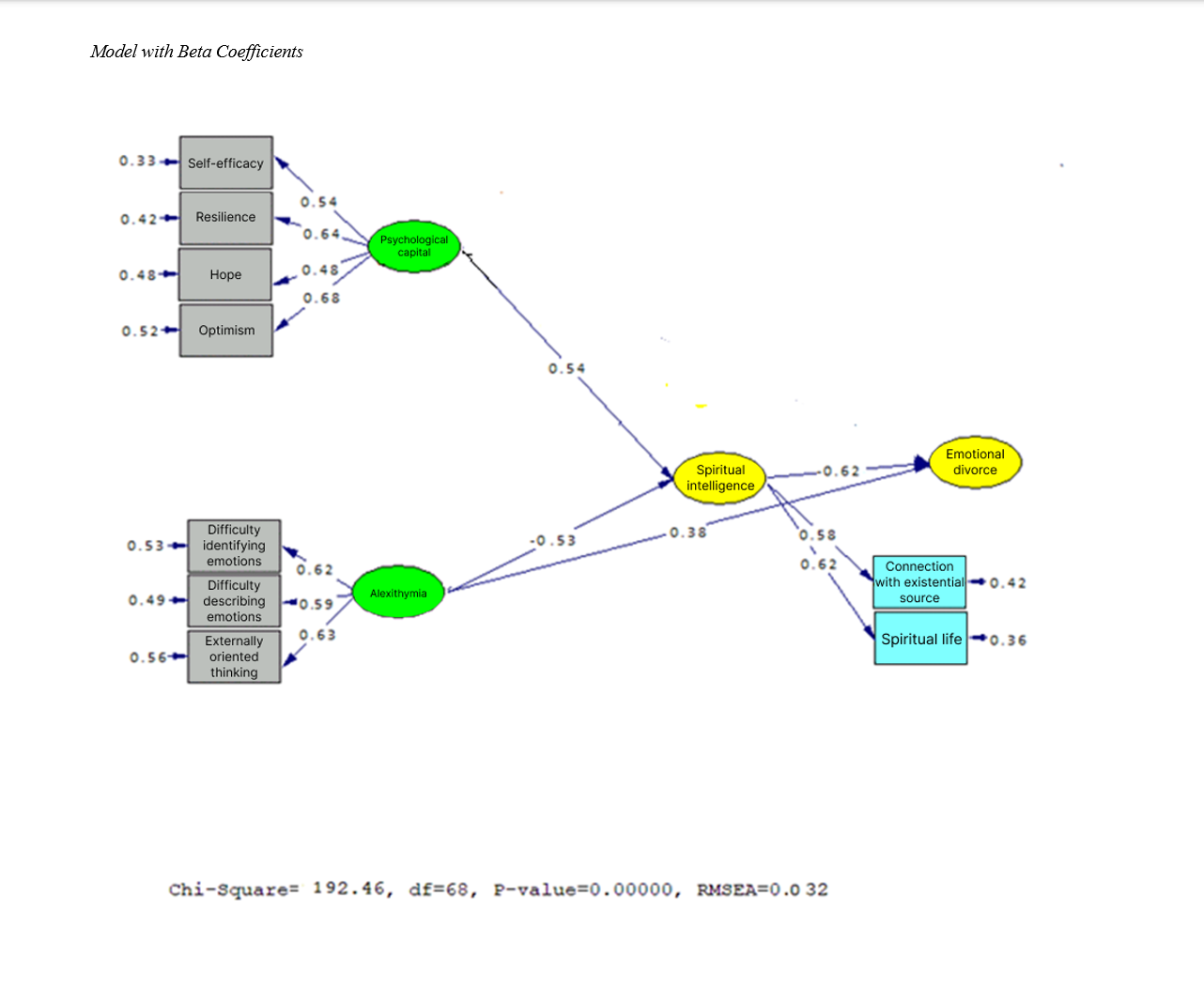
The present study aimed to determine the fit of the model examining the relationship between psychological capital and alexithymia with emotional divorce through the mediation of spiritual intelligence in couples seeking divorce. This research employed a descriptive-correlational design. The statistical population included all couples seeking divorce who referred to counseling centers in Babol in 2023 (N = 780). Using a simple random sampling method, 271 women were selected (n = 271) and responded to the following instruments: the Psychological Capital Questionnaire by Luthans et al. (2007), the Toronto Alexithymia Scale by Bagby et al. (1994), the Emotional Divorce Scale by Gottman et al. (1995), and the Spiritual Intelligence Questionnaire by Abdollahzadeh et al. (2008). Data were analyzed using structural equation modeling and path analysis. The findings revealed a significant negative correlation between psychological capital and emotional divorce (r = -0.476; p < .01), and a significant positive correlation between alexithymia and emotional divorce (r = 0.380; p < .01). Psychological capital had an indirect and negative effect on emotional divorce through the mediation of spiritual intelligence (β = -0.460; p < .01), and alexithymia had an indirect and negative effect on emotional divorce through the mediation of spiritual intelligence (β = -0.461; p < .01). The model of the relationship between psychological capital and alexithymia with emotional divorce mediated by spiritual intelligence demonstrated an adequate fit. From a theoretical perspective, this study contributes to the enrichment of psychological concepts and marital relationships. From a practical standpoint, it may serve as an effective tool for family counselors, couple therapists, and social policymakers to reduce emotional divorce and enhance the quality of family life.
Downloads
References
Amram, Y. J. (2022). The intelligence of spiritual intelligence: Making the case. Religions, 13(12), 1140. https://doi.org/10.3390/rel13121140
Anhange, S., Iortsughun, S., Kwaghgbah, A., Aondona, A., & Iorwuese, P. (2017). Emotional intelligence, happiness, hope and marital satisfaction among married people in Makurdi metropolis, Nigeria. Gender and Behaviour, 15(3), 9752-9766. https://www.academia.edu/71773747/Emotional_intelligence_happiness_hope_and_marital_satisfaction_among_married_people_in_Makurdi_metropolis
Bagby, R. M., Parker, J. D., & Taylor, G. J. (1994). The twenty-item Toronto Alexithymia Scale-I. Item selection and cross-validation of the factor structure. Journal of psychosomatic research, 38(1), 23-32. https://doi.org/10.1016/0022-3999(94)90005-1
Bagby, R. M., & Taylor, G. J. (1997). Affect dysregulation and alexithymia. https://karger.com/pps/article-abstract/73/2/68/282084
Bakhshizadeh, F., Samani, S., Khair, M., & Sohrabi, N. (2019). Testing the Causal Model of Differentiation and Marital Satisfaction. Journal of Women and Society, 10(39), 31-46. https://sid.ir/paper/169113/fa
Baysan-Arslan, S., Cebeci, S., Kaya, M., & Canbal, M. (2016). Relationship between internet addiction and alexithymia among university students. Clinical and Investigative Medicine, S111-S115. https://doi.org/10.25011/cim.v39i6.27513
Danesh, A., Amin al-Ra'ayaei, P., & Nouripour Liyavoli, R. (2017). The Relationship Between Resilience Levels, Psychological Well-Being, and Marital Satisfaction in Infertile Couples Undergoing IVF Treatment. Social Health, 4(3), 174-166. https://journals.sbmu.ac.ir/ch/index.php/ch/article/view/13681
Deckers, L. (2018). Motivation: Biological, psychological, and environmental. Routledge. https://www.routledge.com/Motivation-Biological-Psychological-and-Environmental/Deckers/p/book/9781032065199?srsltid=AfmBOorr69GuuD3F4jWOKy76Hl6Sw-BLDYRb2DqIF0swPttEm7hCevY1
Dianat Nasab, M., Javidi, H. H., & Bagooli, H. (2014). The Mediating Role of Occupational Stress in the Relationship Between Psychological Capital and Job Performance of Employees. Psychological Methods and Models, 4(15), 89-75. https://www.sid.ir/paper/227454/fa
Fitzpatrick, K. E., & Vacha-Haase, T. (2010). Marital satisfaction and resilience in caregivers of spouses with dementia. Clinical Gerontologist, 33(3), 165-180. https://doi.org/10.1080/07317111003776547
Greenwood, J., Guner, N., Kocharkov, G., & Santos, C. (2016). Technology and the changing family: A unified model of marriage, divorce, educational attainment, and married female labor-force participation. American Economic Journal: Macroeconomics, 8(1), 1-41. https://doi.org/10.1257/mac.20130156
Guvensel, K., Dixon, A., Chang, C., & Dew, B. (2018). The relationship among gender role conflict, normative male alexithymia, men's friendship discords with other men, and psychological well-being. The Journal of Men's Studies, 26(1), 56-76. https://doi.org/10.1177/1060826517719543
Hashemi, S. F., & Asghari Ebrahimi Abad, M. J. (2016). The Role of Emotional Literacy in Predicting Emotional Divorce Mediated by Conflict Resolution. Education, Counseling, and Psychotherapy, 5(17), 72-59. https://ensani.ir/fa/article/438043/
Kahraman, S., & Özbay, A. (2025). Examining Mindfulness’s Mediating Role in the Relationship Between Infidelity Tendency and Divorce Anxiety. Psychological Reports. https://doi.org/10.1177/00332941241313436
Kaur, G., & Singh, A. (2013). Relationship among emotional intelligence, social intelligence, spiritual intelligence and life satisfaction of the cher traines. International Journal of Teaching and Education Research, 2(7), 23-29.
Khatami, S. M. H., Bahadorkhan, A., Bandarkhaki, Z., & Bayanfir, F. (2019). Predicting Emotional Divorce Based on Components of Dysfunctional Sexual Beliefs in Married Women. Journal of the Faculty of Medicine, Mashhad University of Medical Sciences, 62(Special Issue on Psychology), 797-786. https://mjms.mums.ac.ir/article_15644.html
Kim, M., Kim, A. C. H., Newman, J. I., Ferris, G. R., & Perrewé, P. L. (2019). The antecedents and consequences of positive organizational behavior: The role of psychological capital for promoting employee well-being in sport organizations. Sport Management Review, 22(1), 108-125. https://doi.org/10.1016/j.smr.2018.04.003
Lee, V. E. (2010). The impact of alexithymia, emotional intelligence, marital values, and culture on relationship satisfaction Doctoral dissertation, Howard University]. https://www.researchgate.net/publication/365915112_alalyksythymya_fy_dw_mtghyry_alnw_waltkhss_ldy_tlab_jamt_alfywm
Luthans, F., Avolio, B. J., Avey, J. B., & Norman, S. M. (2007). Positive psychological capital: Measurement and relationship with performance and satisfaction. Personnel psychology, 60(3), 541-572. https://doi.org/10.1111/j.1744-6570.2007.00083.x
Mahasneh, A. M., Shammout, N. A., Alkhazaleh, Z. M., Al-Alwan, A. F., & Abu-Eita, J. D. (2015). The relationship between spiritual intelligence and personality traits among Jordanian university students. Psychology research and behavior management, 8, 89. https://doi.org/10.2147/PRBM.S76352
Malmir, T., Hassan Zadeh, R., & Heydari, J. (2016). Predicting Life Satisfaction Based on Spiritual Intelligence and Self-Esteem. Religion and Health, 4(1), 35-29. https://www.sid.ir/paper/262710/fa
Marashi, S. A., Moharabian, T., & Mosalman, M. (2016). Investigating the Relationship Between Personality Traits and Spiritual Intelligence with Life Satisfaction in Employees of an Industrial Company in Ilam Province. Military Health Sciences, 3(1), 54-48. https://doi.org/10.18869/acadpub.mcs.3.1.48
Masruroh, A. I., Dewanti, R., Maryam, E. W., Inomjon, A., & Ugli, A. (2024). Adolescent Emotional Maturity Amidst Parental Divorce.
Mohamadjani, D., & Fazeli, A. (2024). Factors contributing to the rising divorce rate in society and strategies for strengthening family bonds. Modern Advances in Psychology, Educational Sciences, and Teaching, 77(7), 1-9. https://jonapte.ir/fa/showart-3dfcd69acb3fa2ae22c9a91b75d90ecc
Mohammadi, B., Zahra Kar, K., Davarnia, R., & Shakeri, M. (2014). Investigating the Role of Religiosity and Its Dimensions in Predicting Marital Commitment of Employees in the Welfare Organization of North Khorasan. Journal of religion and health, 2(1), 15-23. https://jrh.mazums.ac.ir/browse.php?a_id=102&sid=1&slc_lang=en
Mousavi Moghadam, S. R. H., Ismail Changi, M., & Ashrafi Hafez, A. (2015). Investigating the Relationship Between Spiritual Health and Marital Satisfaction and Demographic Characteristics (Age, Duration of Marriage, and Duration of Employment) in Nurses at the Military Hospital in Shush. Research Journal in Religion and Health, 4(1), 38-44. https://ensani.ir/fa/article/491201
Mousavi, S. F., & Rahiminajad, A. (2015). Comparing Interpersonal Identity Statuses Between Men and Women in Marriage Considering Emotional Divorce. Applied Psychological Research, 6(1), 24-11. https://www.noormags.ir/view/fa/articlepage/1127452/
Naeij Bandpey, A., & Dalir, E. (2024). Designing and analyzing factors affecting divorce in Nowshahr using factor analysis. Geography and Human Relations Quarterly, 6(4), 209-226. https://www.gahr.ir/article_193645.html?lang=en
Narimani, M., Parzour, P., Atadokht, A., & Abbasi, M. (2015). The Role of Spiritual Well-Being and Religious Commitment in Predicting Marital Satisfaction of Nurses. Clinical Nursing and Midwifery Journal, 2(4), 1-10. https://www.researchgate.net/profile/Mohammad-Narimani-4/publication/327163526_nqsh_bhzysty_mnwy_w_paybndy_mdhhby_dr_pysh_byny_rdamndy_znashwyy_prstaran/links/5b7da1304585151fd127c1fd/nqsh-bhzysty-mnwy-w-paybndy-mdhhby-dr-pysh-byny-rdamndy-znashwyy-prstaran.pdf
Nosrat Talab Haghi, A., & Bakhshipur, A. (2022). Predicting Emotional Divorce Based on Attribution Styles and Emotional Expression in Married Women. Applied Research Journal in Counseling, 5(2), 78-59. https://www.jarci.ir/article_704288.html?lang=en
Purnomo, T., & Suprihandari, M. D. (2025). Social dynamics of marriage (divorce) in banyuwangi city: economic and cultural perspectives in banyuwangi. Jurnal Bina Bangsa Ekonomika, 18(1), 480-489. https://jbbe.lppmbinabangsa.id/index.php/jbbe/article/view/720
Rock, E. E., Steiner, J. L., Rand, K. L., & Bigatti, S. M. (2014). Dyadic influence of hope and optimism on patient marital satisfaction among couples with advanced breast cancer. Supportive Care in Cancer, 22, 2351-2359. https://doi.org/10.1007/s00520-014-2209-0
Sabaqi, F., Salehi, K., & Moghaddam Zadeh, A. (2017). Perceptions and Lived Experiences of Couples Regarding the Causes of Emotional Separation: A Phenomenological Study. Counseling Research, 16(62), 4-31. https://irancounseling.ir/journal/article-1-196-en.html
Sadeghi, A., Zareh Zareh, S., Mohibi, S., & Shahsiah, M. (2014). Investigating the Relationship Between Religious Orientation and Marital Adjustment Among Couples. Journal of religion and health, 1(2), 49-56. https://jrh.mazums.ac.ir/browse.php?a_code=A-10-471-2&slc_lang=fa&sid=1s
Santisi, G., Lodi, E., Magnano, P., Zarbo, R., & Zammitti, A. (2020). Relationship between psychological capital and quality of life: The role of courage. Sustainability, 12(13), 5238. https://doi.org/10.3390/su12135238
Semalpour Babaahmadi, M., Heydari, A., Asgari, P., & Makvandi, B. (2021). Modeling the Relationship Between Spiritual Intelligence and Maladaptive Schemas with Emotional Divorce Mediated by Attitudes Toward Extramarital Relationships in Women Visiting Psychological Centers in Ahvaz. Disability Studies, 11(19), 182-172. https://sid.ir/paper/1029147/fa
Sepahrian Azar, F., Mohammadi, N., Badalpour, Z., & Nourouzadeh, V. (2016). The Relationship Between Hope and Happiness with Marital Satisfaction. Health and Care, 18(1), 37-44. https://doi.org/10.5812/ircmj.23839
Sheikh Zeyn al-Din, H., Farokhi, N. A., & Abbaspour Azar, Z. (2018). The Mediating Role of Psychological Capital in the Relationship Between Personality Traits and Marital Adjustment in Students. Journal of Applied Psychology, 12(3), 462-439. https://apsy.sbu.ac.ir/article/view/5685/article_96705.html?lang=en
Vulpe, A., & Dafinoiu, I. (2012). Positive emotions, coping strategies and ego-resiliency: A mediation model. Procedia-Social and Behavioral Sciences, 33, 308-312. https://doi.org/10.1016/j.sbspro.2012.01.133
Wells, R., Rehman, U. S., & Sutherland, S. (2016). Alexithymia and social support in romantic relationships. Personality and individual differences, 90, 371-376. https://doi.org/10.1016/j.paid.2015.11.029
Yelsma, P., & Marrow, S. (2003). An examination of couples' difficulties with emotional expressiveness and their marital satisfaction. The Journal of Family Communication, 3(1), 41-62. https://doi.org/10.1207/S15327698JFC0301_03
Zahedi, F. (2021). Emotional Divorce: Signs, Causes, and Solutions. Journal of Islamic Studies on Gender and Family, 4(7), 104-183. https://ensani.ir/fa/article/501652/
Downloads
Additional Files
Publication Timeline
- Submitted
- Revised
- Accepted
License
Copyright (c) 2025 Hedieh Sabaghpour Sabzehmeidani (Author); Masoumeh Azmoodeh (Corresponding Author); Reza Abdi, Amir Panahali, Javad Mesrabadi (Author)

This work is licensed under a Creative Commons Attribution-NonCommercial 4.0 International License.