Effectiveness of Mindfulness-Based Cognitive Therapy on Distress Tolerance and Dysfunctional Attitudes in Incompatible Couples
DOI:
https://doi.org/10.61838/kman.psynexus.2.1.31Keywords:
Mindfulness-Based Cognitive Therapy, Distress Tolerance, Dysfunctional Attitudes, Incompatible Couples, Marital Conflict.Abstract
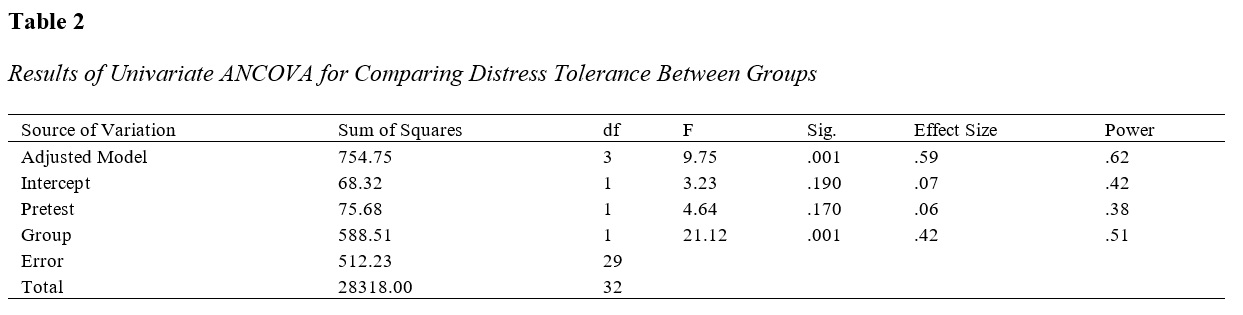
The objective of this study was to examine the effectiveness of Mindfulness-Based Cognitive Therapy (MBCT) on distress tolerance and dysfunctional attitudes in incompatible couples. This research employed a quasi-experimental design with a pretest-posttest structure and a control group. The statistical population consisted of incompatible couples who sought counseling services in Tehran in 2023. Thirty-two participants were selected through convenience sampling and randomly assigned to an experimental group (n = 16) and a control group (n = 16). The experimental group received MBCT over eight weeks in weekly 90-minute sessions, while the control group did not receive any intervention. Data were collected using the Distress Tolerance Scale (Simons & Gaher, 2005) and the Dysfunctional Attitudes Scale (Weissman & Beck, 1978). The normality of data was verified using the Kolmogorov–Smirnov test. Univariate analysis of covariance (ANCOVA) was used to analyze the differences between groups, controlling for pretest scores. Descriptive statistics indicated increased posttest scores in distress tolerance and decreased scores in dysfunctional attitudes among participants in the experimental group. Results of ANCOVA revealed that, after controlling for pretest scores, the difference in distress tolerance between the experimental and control groups was statistically significant (F = 21.12, p = .001, η² = .42). Similarly, a significant difference was found in dysfunctional attitudes between the two groups (F = 25.14, p = .001, η² = .48), with the experimental group showing a notable reduction in maladaptive beliefs. The findings suggest that Mindfulness-Based Cognitive Therapy is effective in enhancing distress tolerance and reducing dysfunctional attitudes among incompatible couples. MBCT facilitates cognitive and emotional self-regulation through present-moment awareness and nonjudgmental attention, offering a beneficial intervention for improving marital dynamics
Downloads
References
Abbasi, M., Ghadampour, E., Bahrami, E., & Mousaei, M. A. (2024). The Effectiveness of Acceptance and Commitment Therapy (ACT) on Dysfunctional Attitudes, Quitting Self-Efficacy, and Psychological Well-being in Drug-Dependent Individuals. Quarterly Journal of Addiction Research, 18(73), 181-204. https://doi.org/10.61186/etiadpajohi.18.73.181
Abela, R. Z., & Skitch, S. A. (2007). Dysfunctional attitudes, self-esteem, and hassles: cognitive vulnerability to depression in children of affectively ill parent. Behavior Research and Therapy, 45, 1127-1140. https://doi.org/10.1016/j.brat.2006.09.011
Aguirre Velasco, A., Cruz, I. S. S. o. A., Rezaei, R., Hasani Estalkhi, F., & Mirbalook Bozorgi, A. (2020). Mindfulness-Based Cognitive Therapy (MBCT). Journal of Psychology Growth, 9(4), 133-144.
Barghi Irani, Z., & Dehghan Saber, L. (2021). The Comparison of the Effectiveness of Mindfulness Based Therapy and Spiritual Therapy on Irrational Beliefs and Anxiety in the Older Women. Aging Psychology, 6(4), 339-321. https://doi.org/10.22126/jap.2021.5945.1492
Daughters, S. B., Ross, T. J. A. U. B. R. P., Yi, J. Y., Ryan, J., & Stein, E. A. (2017). Distress tolerance among substance users is associated with functional connectivity between prefrontal regions during a distress tolerance task. Addiction Biology, 22(5), 1378-1390. https://doi.org/10.1111/adb.12396
Deldadeh, M., & Moa'in Islami, S. (2020). The Effectiveness of Reality Therapy Interventions on Improving Marital Adjustment Among Couples Experiencing Emotional Divorce. Quarterly Journal of New Ideas in Psychology, 5(9), 1-10ER -. https://jnip.ir/article-1-318-fa.html
Esmaeili, F., Zamardi, S., & Vatankhah, H. R. (2023). The Effectiveness of Schema Therapy on Distress Tolerance, Emotional Divorce, and Marital Intimacy Among Couples. Tenth International Conference on Knowledge and Technology in Educational Sciences, Social Studies, and Psychology in Iran. https://civilica.com/doc/1966663/
Keough, M. E., Riccardi, C. J., Timpano, K. R., Mitchell, M. A., & Schmidt, N. B. (2010). Anxiety Symptomatology: The Association with Distress Tolerance and Anxiety Sensitivity. Behavior therapy, 41(4), 567-574. https://doi.org/10.1016/j.beth.2010.04.002
Khoshkerdar, P., & Raeisi, Z. (2020). The Effect of Mindfulness‐based Stress Reduction on Body Image Concerns of Adolescent Girls With Dysfunctional Eating Attitudes. Australian Journal of Psychology, 72(1), 11-19. https://doi.org/10.1111/ajpy.12265
Kyung, C., Lee, H.-J., & Lim, S. (2020). Path Model of Mindfulness-Based Self-Efficacy on Rumination in Meditation Fields: Dual Mediating Effects of Self-Compassion and Dysfunctional Attitudes. International Journal of Social Welfare Promotion and Management, 7(2), 9-16. https://doi.org/10.21742/ijswpm.2020.7.2.02
Li, Y., He, M., Wang, Z., Hofmann, S. G., & Liu, X. (2024). Distress tolerance as a mediator of mindfulness-based intervention for anxiety and depression: Evidence from two randomized controlled trials. International Journal of Clinical and Health Psychology, 24(2), 100445. https://doi.org/10.1016/j.ijchp.2024.100445
Liu, J. L., Peh, C. X., & Mahendran, R. (2017). Body image and emotional distress in newly diagnosed cancer patients: The mediating role of dysfunctional attitudes and rumination. Body Image, 20(3), 58-64. https://doi.org/10.1016/j.bodyim.2016.11.001
Mohsenabadi, H., Pirmoradi, M. R., Tajrishi, K. Z., & Gharraee, B. (2025). A Transdiagnostic Approach to Investigate of the Relationships Between Anxiety Sensitivity and Health Anxiety: The Mediated Roles of Distress Tolerance and Emotion Regulation. Frontiers in Psychiatry, 16. https://doi.org/10.3389/fpsyt.2025.1478442
Namvaran Germi, K., Moradi, A., Farzad, V., & Zahrakar, K. (2017). Identifying the dimensions of marital adjustment in Iranian couples: a qualitative study. Journal of Health and Care, 19(3), 182-194. https://www.sid.ir/FileServer/JF/3006913960308.pdf
Nguyen, M. H., Le, T. T., Nguyen, H. K. T., Ho, M. T., Nguyen, H. T. T., & Vuong, Q. H. (2021). Alice in Suicideland: Exploring the suicidal ideation mechanism through the sense of connectedness and help-seeking behaviors. International journal of environmental research and public health, 18(7), 3681. https://doi.org/10.3390/ijerph18073681
Qarib-Bolook, M., Mikaeili, N., & Basharpour, S. (2022). The mediating role of mindfulness in the relationship between dysfunctional attitudes and anxiety sensitivity with sleep quality in high school students. Journal of psychiatric nursing, 10(2), 61-72. https://ijpn.ir/article-1-2015-fa.html
Ragheni, U., & Soltanzadeh, F. (2023). The Effectiveness of Acceptance and Commitment Therapy on Dysfunctional Attitudes of Discordant Couples The Effectiveness of Group Reality Therapy on Self-Efficacy Beliefs, Happiness, and Reducing Marital Conflicts in Married Women. Eighteenth International Conference on Psychology, Counseling, and Educational Sciences,
Sadeghi, E., Sajjadian, I., & Nadi, M. A. (2020). Comparison of the effectiveness of mindfulness based compassion and mindfulness-based cognitive therapy on students' dysfunctional attitude, self-control, and mental health. Positive Psychology Research, 6(1), 31-48. https://doi.org/10.22108/ppls.2020.120851.1861
Segal, Z. V., Williams, J. M. G., Teasdale, J. D., Scott, E. K., Edin, K., London, A. S., & Mazelis, J. M. (2013). Mindfulness-based cognitive therapy for depression My children come first: Welfare-reliant women's post-TANF views of work-family trade-offs and marriage For better and for worse: Welfare reform and the well-being of children and families. The Guilford Press. https://pubmed.ncbi.nlm.nih.gov/26575299/
Seyed Ali Tabar, S. H., & Zadhasn, Z. (2023). Effectiveness of Mindfulness-Based Cognitive Therapy on Mental Pain, Distress Tolerance and Psychological Hardiness in Breast Cancer Patients. Health Nexus, 1(1), 56-63. https://doi.org/10.61838/hn.1.1.9
Shiri, T., Golmohammadian, M., & Hojiatkhah, S. M. (2016). The Effectiveness of Schema Therapy on Dysfunctional Attitudes Toward Spouse Selection in Female Students. Quarterly Journal of Counseling Culture and Psychotherapy, 7(27), 171-188. https://qccpc.atu.ac.ir/article_6737.html
Shoghi, B., Mohammadi, A., & Pirkhaefi, A. (2023). The Mediating Role of Mindfulness in the Relationship between Cognitive Abilities and Wisdom in Students. Sociology of Education, 8(2), 262-273. https://doi.org/10.22034/ijes.2023.707076
Sohrabnejad, S., Mehrabaninasab, M., Nazari, H., Sohrabnejad, A., & Nazari, G. (2025). The Effectiveness of Acceptance and Commitment Therapy on Suicidal Thoughts, Sensation Seeking and, Distress Tolerance among Substance Users. Journal of Basic Research in Medical Sciences, 12(2), 1-10. https://doi.org/10.61186/jbrms.12.2.1
Yanjuan, L., Ruilin, J., Stefan, G. H., Wingsze, C., Ye, G., Yu, L., & Xinghua, L. (2023). Distress tolerance as a mechanism of mindfulness for depression and anxiety: Cross-sectional and diary evidence. International Journal of Clinical and Health Psychology, 23(4), 100392. https://doi.org/10.1016/j.ijchp.2023.100392
Downloads
Additional Files
Publication Timeline
- Submitted
- Revised
- Accepted
License
Copyright (c) 2024 Keihaneh Chehrazi (Corresponding Author); Somayeh Hashempoor Malakshah, Somayeh Pilehvar Zavareh, Maryam Dadashi Omali, Soheyla Moghtader (Author)

This work is licensed under a Creative Commons Attribution-NonCommercial 4.0 International License.