Comparison of the Effectiveness of Acceptance and Commitment Therapy and Unified Transdiagnostic Treatment on Cognitive Flexibility in Nurses with Post-Traumatic Stress Symptoms (PTSD) Caused by COVID-19 Infection
DOI:
https://doi.org/10.61838/kman.cp.psynexus.3.18Keywords:
Acceptance and Commitment Therapy, Unified Protocol, Cognitive Flexibility, PTSD, Nurses, COVID-19Abstract
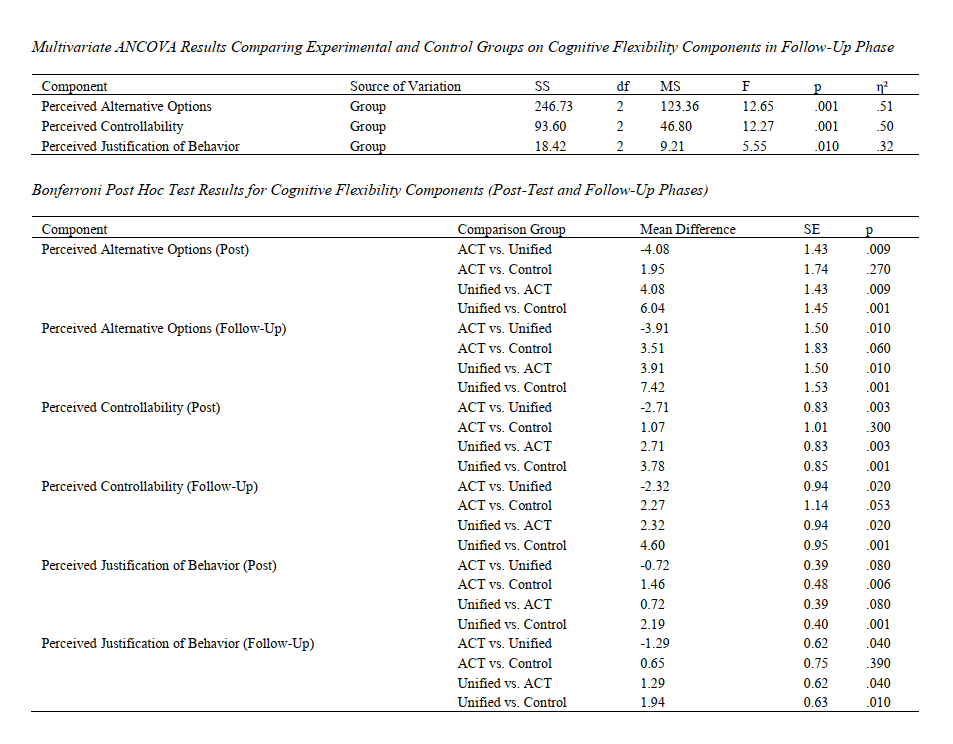
This study aimed to compare the effectiveness of Acceptance and Commitment Therapy (ACT) and Unified Transdiagnostic Treatment (UP) on cognitive flexibility in nurses with PTSD symptoms following COVID-19 infection. A quasi-experimental design with pre-test, post-test, and two-month follow-up was used on 30 nurses with PTSD symptoms based on the Keane PTSD questionnaire (cut-off score 107) working at Shahid Seyed Mostafa Khomeini Hospital in Tabas. Participants were randomly assigned to ACT, UP, or control groups (10 per group). The ACT and UP interventions consisted of eight weekly sessions following validated protocols. Cognitive flexibility was assessed using the Dennis and Vander Wal (2010) questionnaire, measuring perceived controllability, perceived justification of behavior, and alternative option generation. PTSD symptoms were measured by the Keane et al. (1988) questionnaire. Data analysis included descriptive statistics, ANCOVA, MANCOVA, and Bonferroni post hoc tests using SPSS-22. Results indicated significant differences among groups in all cognitive flexibility components at post-test and follow-up stages after controlling for pre-test scores (p < .01). The UP group showed significantly higher improvements than the ACT group in perceived controllability and generation of alternative options at both post-test and follow-up (p < .01). ACT also significantly outperformed the control group in all cognitive flexibility components (p < .05). Effect sizes ranged from moderate to large (η² = .32–.55), indicating clinically meaningful differences. Both ACT and UP effectively improved cognitive flexibility among nurses with PTSD symptoms, but UP demonstrated greater efficacy in enhancing perceived controllability and generation of alternative options. These findings support the use of UP as a robust transdiagnostic intervention to improve trauma recovery and adaptive functioning in professionals exposed to high occupational stress.
Downloads
References
Ahmadi, V., & Valizadeh, H. (2021). The Effectiveness of Acceptance and Commitment-Based Therapy on the Quality of Life and Death Anxiety in the Elderly. Aging Psychology, 7(2), 166-153. https://doi.org/10.22126/jap.2021.6370.1528
Alizadeh, P., Kooshki, S., & Tarvirdizadeh, H. (2023). The Effectiveness of Acceptance and Commitment Therapy and on Pain Intensity, Childhood Trauma, Perfectionism and Psychological Flexibility in Patients with Chronic Pain. Journal of Assessment and Research in Applied Counseling (JARAC), 5(2), 123-136. https://doi.org/10.61838/kman.jarac.5.2.15
Ashoori, N., Rafiepoor, A., & Sabet, M. (2024). Comparison of the Effectiveness of Cognitive-Behavioral Therapy and Acceptance and Commitment Therapy on Job Burnout and Psychological Well-being of Nurses. Psychology of Woman Journal, 5(3), 106-115. https://doi.org/10.61838/kman.pwj.5.3.13
Azadmanesh, N., Shahabizadeh, F., Shahraki, E., & Asadi Yoonesi, M. R. (2021). Comparison of the effectiveness of Acceptance and Commitment Therapy (ACT) and Unified Transdiagnostic on anxiety and physical symptoms in patients with systemic lupus erythematosus. medical journal of mashhad university of medical sciences, 64(1), 2643-2657. https://mjms.mums.ac.ir/article_19623_en.html
Enayati Shabkolai, M., Enayati Shabkalai, M., & Bagheri Dadokolai, M. (2023). The Effectiveness of Treatment based on Acceptance and Commitment on Social Adaptation, Academic Self-Regulation and Cognitive Flexibility of Students with Specific Learning Disorders. International Journal of Education and Cognitive Sciences, 4(1), 33-41. https://doi.org/10.61838/kman.ijecs.4.1.5
Faghih, S., & Manshaee, G. (2024). The Effectiveness of Acceptance and Commitment Therapy on Health Anxiety, Emotional Exhaustion, and Psychological Flexibility in Forensic Medicine Physicians. Knowledge and research in applied psychology. https://journals.iau.ir/article_709908.html?lang=en
Faustino, B. (2020). Transdiagnostic Perspective on Psychological Inflexibility and Emotional Dysregulation. Behavioural and Cognitive Psychotherapy, 49(2), 233-246. https://doi.org/10.1017/s1352465820000600
Flujas-Contreras, J. M., García-Palacios, A., Castilla, D., & et al. (2024). Internet-based versus face-to-face Acceptance and Commitment Therapy for parental psychological flexibility. Current Psychology, 43, 9854-9866. https://doi.org/10.1007/s12144-023-05052-8
Grossman, R. A., & Ehrenreich-May, J. (2020). Using the Unified Protocol for Transdiagnostic Treatment of Emotional Disorders With Youth Exhibiting Anger and Irritability. Cognitive and Behavioral Practice, 27(2), 184-201. https://doi.org/10.1016/j.cbpra.2019.05.004
Jalilian, M., Karami, J., & Parhoon, H. (2024). The effectiveness of acceptance and commitment-based parenting training on parent-child interaction, self-efficacy, and psychological flexibility in mothers of children with Attention Deficit/Hyperactivity Disorder (ADHD). Family Research, 20(3), 107-127. https://doi.org/10.48308/jfr.2024.233926.1669
Kabusi, M., Nasab, S. A. R., Saber, E., Ivanbagha, R., Khedri, B., Khezerlou, Z., Bardsiri, T. I., Shafiei, Z., Roodposhti, M. E., Zandi, A., Hoseyni, H., Torbati, A. G., Eshaghzadeh, M., & Eshaghzadeh, S. (2023). Assessing the Effects of Acceptance-Commitment and Psychodrama Therapies in Nurses With Social Anxiety Disorder. Iranian Rehabilitation Journal, 21(2), 223-230. https://doi.org/10.32598/irj.21.1.763.3
Kazemipour, A., Mirderikvand, F., & Amraei, K. (2021). Effectiveness of Acceptance and Commitment Therapy on the Acceptance and Post-Traumatic Growth in Colorectal Cancer Patients Comorbid with Stress. Research-in-Medicine, 45(3), 38-43. http://pejouhesh.sbmu.ac.ir/article-1-2518-en.html
Kent, L., Nelson, B., & Northoff, G. (2023). Can disorders of subjective time inform the differential diagnosis of psychiatric disorders? A transdiagnostic taxonomy of time. Early Intervention in Psychiatry, 17(3), 231-243. https://doi.org/10.1111/eip.13333
Levin, M. E., Krafft, J., & Twohig, M. P. (2024). An Overview of Research on Acceptance and Commitment Therapy. Psychiatric Clinics of North America. https://doi.org/10.1016/j.psc.2024.02.007
Macri, J. A., & Rogge, R. D. (2024). Examining domains of psychological flexibility and inflexibility as treatment mechanisms in acceptance and commitment therapy: A comprehensive systematic and meta-analytic review. Clinical psychology review, 102432. https://doi.org/10.1016/j.cpr.2024.102432
Miller-Mendes, M., Castilho, P., Clara, M. I., Clemente, V., & Gomes, A. A. (2023). Cognitive behavioral therapy and acceptance and commitment therapy for insomnia: Exploring the potential benefit of psychological flexibility and self-compassion combined with behavioral strategies. New Ideas in Psychology, 69, 101013. https://doi.org/10.1016/j.newideapsych.2023.101013
Mohajerin, B., Lynn, S. J., & Cassiello-Robbins, C. (2023). Unified Protocol vs Trauma-Focused Cognitive Behavioral Therapy Among Adolescents With PTSD. Behavior therapy, 54(5), 823-838. https://doi.org/10.1016/j.beth.2023.03.003
Omidbeygi, M., Hassanabadi, H., Hatami, M., & Vaezi, A. A. (2020). The Effectiveness of Acceptance and Commitment Therapy on Psychological Flexibility, Post Traumatic Growth and Quality of Life in Women with Breast Cancer. Journal of Clinical Psychology, 12(3), 47-58. https://doi.org/10.22075/jcp.2020.18211.1701
Sierra, M. A., & Ortiz, E. (2023). Feasibility and effect of a self-help online acceptance and commitment therapy program focused on repetitive negative thinking for Colombian young women. Journal of Contextual Behavioral Science, 28, 127-138. https://doi.org/10.1016/j.jcbs.2023.03.010
Thompson, E. M., Destree, L., Albertella, L., & Fontenelle, L. F. (2021). Internet-Based Acceptance and Commitment Therapy: A Transdiagnostic Systematic Review and Meta-Analysis for Mental Health Outcomes. Behavior therapy, 52(2), 492-507. https://doi.org/10.1016/j.beth.2020.07.002
Wharton, E., Edwards, K. S., Juhasz, K., & Walser, R. D. (2019). Acceptance-based interventions in the treatment of PTSD: Group and individual pilot data using Acceptance and Commitment Therapy. Journal of Contextual Behavioral Science, 14, 55-64. https://doi.org/10.1016/j.jcbs.2019.09.006
Zhang, Y., Ding, Y., Chen, X., Li, Y., Li, J., & Hu, X. (2023). Effectiveness of acceptance and commitment therapy on psychological flexibility, fatigue, sleep disturbance, and quality of life of patients with cancer: A meta-analysis of randomized controlled trials. Worldviews on Evidence-Based Nursing, 00, 1-11. https://doi.org/10.1111/wvn.12652
Downloads
Additional Files
Publication Timeline
- Submitted
- Revised
- Accepted
License
Copyright (c) 2025 Nafiseh Hosseinzadeh Moghadam (Author); Fatemeh Shahabizadeh (Corresponding Author); Qasem Ahi (Author)

This work is licensed under a Creative Commons Attribution-NonCommercial 4.0 International License.