The Effectiveness of Acceptance and Commitment-Based Training on Reducing Occupational Stress and its Components among Administrative Employees
DOI:
https://doi.org/10.61838/kman.fct.psynexus.3.17Keywords:
Acceptance and Commitment Therapy, Occupational Stress, Administrative EmployeesAbstract
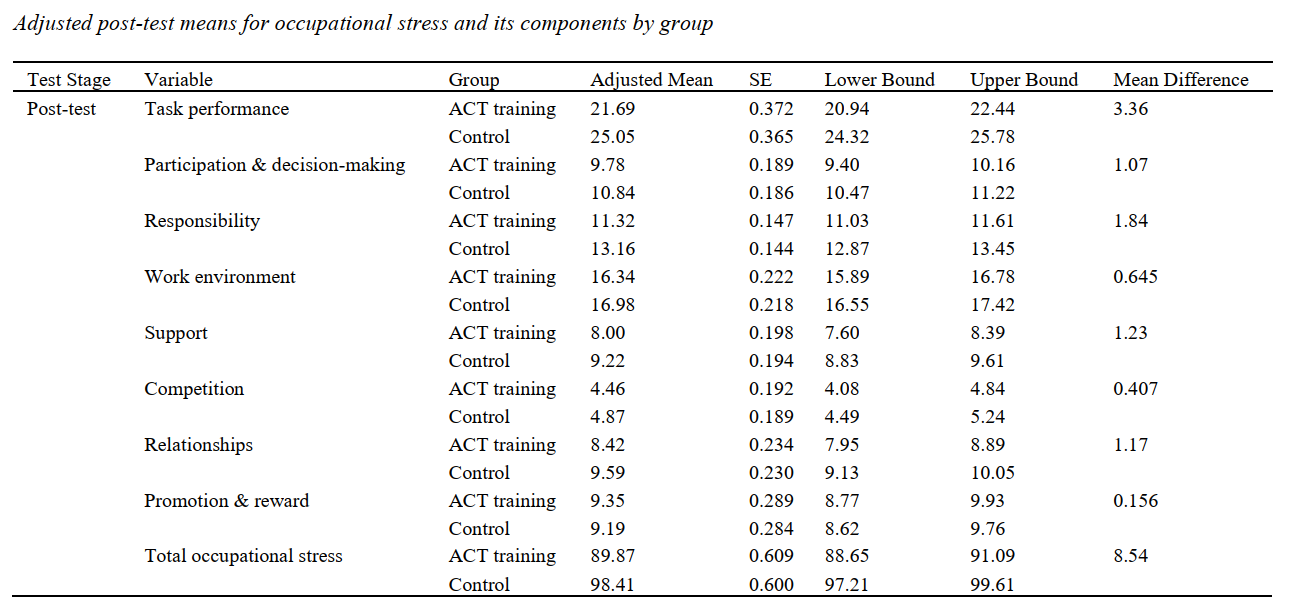
This study aimed to investigate the effectiveness of acceptance and commitment-based training on reducing occupational stress and its components among administrative employees of Shiraz University of Medical Sciences. The research employed an applied, quantitative, semi-experimental design with a pre-test–post-test control group and a two-month follow-up. The statistical population comprised all administrative employees of Shiraz University of Medical Sciences in 2024, from which 66 participants were selected through convenience sampling and randomly assigned to experimental (n = 33) and control (n = 33) groups. The experimental group received eight sessions of acceptance and commitment-based training based on Steven Hayes’ protocol, while the control group received no psychological intervention during the study period. Data were collected using the Occupational Stress Questionnaire developed by Turnic and Spielberger (1991), whose validity and reliability had been previously confirmed (Cronbach’s alpha = 0.87). Data analysis was conducted using univariate and multivariate analysis of covariance (ANCOVA, MANCOVA) in SPSS 28, after verifying parametric assumptions. The results revealed that, after controlling for pre-test scores, the experimental group showed significantly lower post-test mean scores compared to the control group in total occupational stress (F = 99.30, p < 0.001, η² = 0.623) and in several subcomponents, including task performance (F = 38.55, p < 0.001, η² = 0.421), participation and decision-making (F = 14.99, p < 0.001, η² = 0.220), responsibility (F = 74.22, p < 0.001, η² = 0.583), support (F = 18.11, p < 0.001, η² = 0.255), and relationships (F = 11.89, p = 0.001, η² = 0.183). No significant differences were observed for work environment, competition, or promotion/reward. These effects persisted at follow-up, indicating sustained intervention benefits. Acceptance and commitment-based training effectively reduced occupational stress and improved key stress-related components in administrative healthcare employees, with effects maintained over two months.
Downloads
References
Ahmadi, V., & Valizadeh, H. (2021). The Effectiveness of Acceptance and Commitment-Based Therapy on the Quality of Life and Death Anxiety in the Elderly. Aging Psychology, 7(2), 166-153. https://doi.org/10.22126/jap.2021.6370.1528
Ashoori, N., Rafiepoor, A., & Sabet, M. (2024). Comparison of the Effectiveness of Cognitive-Behavioral Therapy and Acceptance and Commitment Therapy on Job Burnout and Psychological Well-being of Nurses. Psychology of Woman Journal, 5(3), 106-115. https://doi.org/10.61838/kman.pwj.5.3.13
Ataie, Z. (2020). The Effectiveness of Cognitive-Behavioral Therapy on Job Stress and Marital Satisfaction. Industrial and Organizational Psychology Studies, 7(2), 367-378. https://doi.org/10.22055/jiops.2020.35996.1211
Bamber, M. R. (2012). Schema Therapy for Occupational Stress, translation Hasan Hamid Pour, Hasan Zirak. Tehran: Arjmand.(Persian). https://journal.nkums.ac.ir/article-1-1528-fa.pdf
Barrett, K., & Stewart, I. (2021). A preliminary comparison of the efficacy of online Acceptance and Commitment Therapy (ACT) and Cognitive Behavioural Therapy (CBT) stress management interventions for social and healthcare workers. Health & Social Care in the Community, 29(1), 113-126. https://doi.org/10.1111/hsc.13074
Buselli, R., Corsi, M., Veltri, A., Marino, R., Caldi, F., Guerra, P. D., Guglielmi, G., Tanca, C., Paoli, M., Calabretta, V. M., Perretta, S., Foddis, R., & Carrozzino, M. (2023). Comparison Between Standard Expository Cognitive Behavioral Therapy (CBT-E) and Immersive Virtual Reality CBT (CBT-VR) for Rehabilitation of Patients Affected by Occupational Stress Disorders: Study Protocol. International journal of environmental research and public health, 20(9), 5735. https://doi.org/10.3390/ijerph20095735
Caletti, E., Massimo, C., Magliocca, S., Moltrasio, C., Brambilla, P., & Delvecchio, G. (2022). The role of the acceptance and commitment therapy in the treatment of social anxiety: An updated scoping review. Journal of affective disorders, 310, 174-182. https://doi.org/10.1016/j.jad.2022.05.008
Chong, S. M., & Yazdani, K. (2020). Factors affecting the affective organizational commitment, job satisfaction and job acceptance intention of interns: A conceptual framework. International Journal of Social Science and Humanity, 10(2), 68-72. https://doi.org/10.18178/ijssh.2020.V10.1016
Farhangian, S., Mihandoust, Z., & Ahmadi, V. (2021). Comparative effects of cognitive-behavioral therapy and emotion regulation-based therapy on general health, aggression reduction, and occupational stress in nurses. Ibn Sina Journal of Nursing and Midwifery Care, 30(1), 62-52. http://nmj.umsha.ac.ir/browse.php?a_id=2327&slc_lang=en&sid=1&ftxt=1&html=1
Goudarzi, M., Mehdad, A., & Golparvar, M. (2022). Comparison of the effectiveness of coping with job stress training with mindfulness-based cognitive therapy on perception of work-family conflict and life satisfaction of employed retirees. Occupational Medicine, 14. https://doi.org/10.18502/tkj.v14i2.10665
Hasani, H., Zarei, B., Danaei, Z., & Mahmoudirad, G. (2022). Comparing the effect of resilience skills training and metacognitive therapy on job stress in nurses: An experimental study. Iranian Journal of Nursing and Midwifery Research, 27(5), 377-384. https://doi.org/10.4103/ijnmr.ijnmr_59_21
Masoudi Hemmatabadi, F., Haji Hosseini Mesgar, M., Azad Yekta, M., & Nasrollahi, B. (2022). Investigating the Relationship between Work-Family Conflict and Job Stress with Emotional Exhaustion with Mediation of Personnel Capabilities in Male and Female Employees of The Islamic Republic of Iran Airlines (HOMA). Applied Family Therapy Journal (AFTJ), 3(4), 585-601. https://doi.org/10.61838/kman.aftj.3.4.32
Mohammadi, M. (2022). The effectiveness of acceptance and commitment therapy on mental health and job satisfaction among nurses working in intensive care units of Farshian Hospital in Hamadan. New Ideas in Psychology Quarterly, 12(16), 14-11. https://jnip.ir/article-1-680-fa.html
Navidi Poshtiri, S., Hassanzadeh, R., & Olia Emadian, S. (2022). The effectiveness of acceptance and commitment therapy on tolerance failure and health anxiety in nursing and midwifery students with health anxiety. Journal of Adolescent and Youth Psychological Studies (JAYPS), 3(1), 222-231. https://doi.org/10.61838/kman.jayps.3.1.18
Omeje, H. O., Ede, M. O., Okereke, G. K. O., Ede, A. O., Amaeze, F. E., Ike, J. O., & Igbokwe, I. C. (2022). Efficacy of Rational Emotive Career Counselling Programme on Occupational Stress Management in Industrial Hazard Victims: Safety Practice Implications. Journal of Rational-Emotive Cognitive-Behavior Therapy, 41(3), 644-662. https://doi.org/10.1007/s10942-022-00476-w
Salehi, S. (2020). Comparison of the effectiveness of group schema therapy and Acceptance and Commitment Therapy (ACT) on job burnout, marital resilience, and family resilience in married nurses https://jwfs.alzahra.ac.ir/article_2970_en.html
Taghilo, L., Azizi Ziabari, L. S., Khajevand Khoshli, A., & Damghani Mirmahaleh, M. (2023). Comparing the effectiveness of acceptance and commitment therapy(ACT) and paradoxical time table therapy (PTC) on the psychological well-being of nurses. EBNESINA, 25(3), 14. https://doi.org/10.22034/25.3.14
Toit, D. d. Understanding Occupational Therapists' Use of Acceptance and Commitment Therapy in New Zealand. https://doi.org/10.34074/thes.6515
Zarei, S., & Arshad Hosseini, A. (2018). The effectiveness of mindfulness-based therapy on occupational stress and occupational self-efficacy of physical education coaches. Studies in Sport Psychology, 7(26), 45-60. https://spsyj.ssrc.ac.ir/article_1381.html
Downloads
Additional Files
Publication Timeline
- Submitted
- Revised
- Accepted
Issue
Section
Categories
License
Copyright (c) 2025 Maryam Parsaei (Author); Ali Naseri (Corresponding Author)

This work is licensed under a Creative Commons Attribution-NonCommercial 4.0 International License.