The Effectiveness of Paradoxical Psychotherapy on Trichotillomania Disorder
DOI:
https://doi.org/10.61838/kman.cp.psynexus.4607Keywords:
Trichotillomania, Hair-Pulling Disorder , Paradoxical Psychotherapy, Prescribing the symptom, paradoxical interventionAbstract
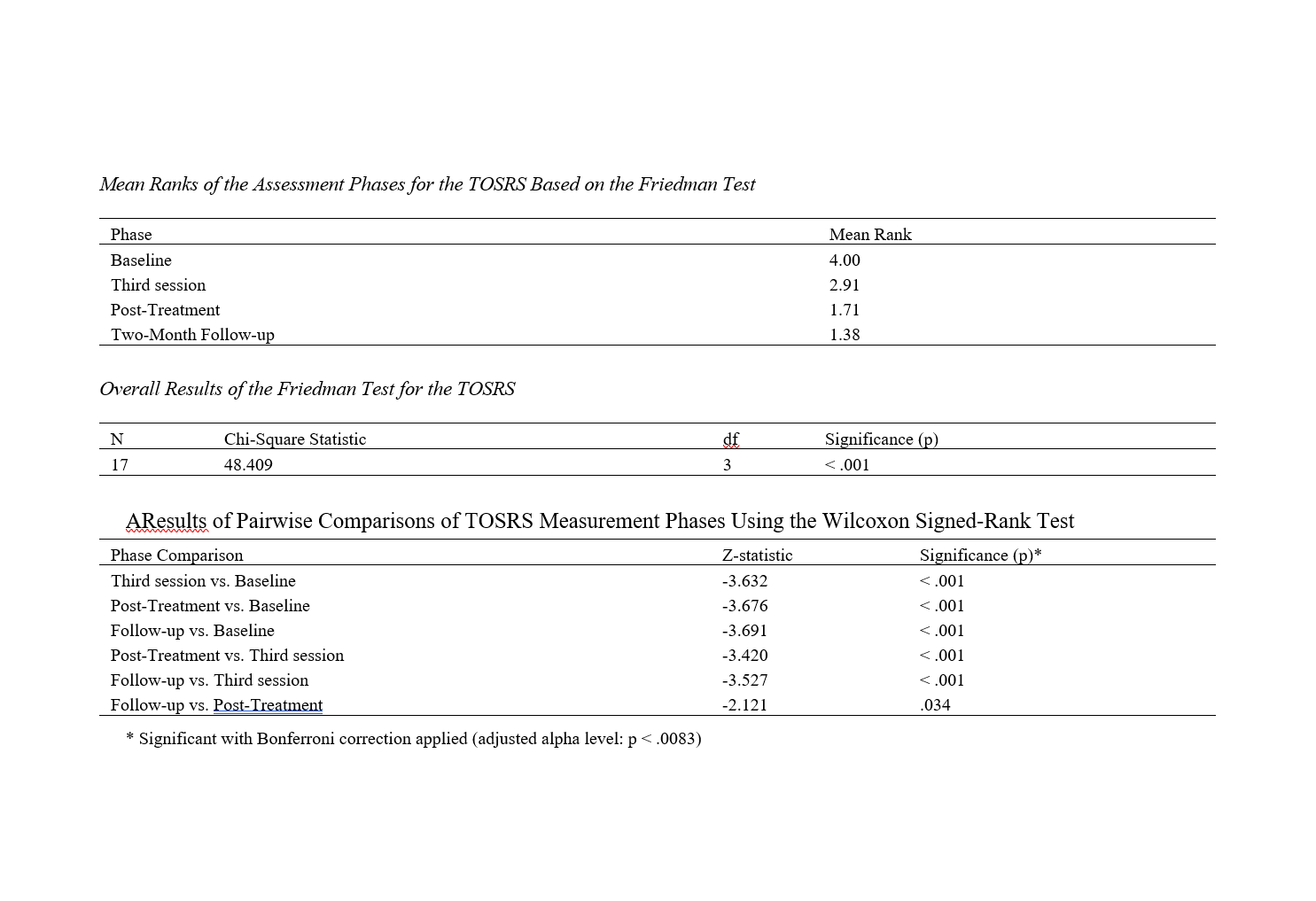
Trichotillomania is a subtype of obsessive-compulsive related disorders characterized by recurrent hair pulling and inability to control the behavior, leading to various physical and psychological consequences. Considering the limited effectiveness of current treatments and the need for innovative approaches, the present study aimed to evaluate the effectiveness of Paradoxical Psychotherapy like PTC model in reducing symptoms of trichotillomania. In In this single-group quasi-experimental time-series, 17 women with symptoms of trichotillomania were selected through purposive sampling. The intervention consisted of five sessions based on the PTC model, and assessments were conducted at four stages (baseline, Third session, post-treatment, and two-month follow-up) using the Massachusetts General Hospital Hairpulling Scale (MGH-HS) and the Treatment Outcome Subjective Rating Scale (TOSRS). Data were analyzed using repeated measures ANOVA and Friedman test. Findings showed that Paradoxical psychotherapy significantly reduced trichotillomania symptoms over time (η²=0.85, p<0.001), with the greatest changes observed between baseline and follow-up. TOSRS results also indicated significant improvement in participants’ condition and the persistence of therapeutic effects during follow-up Paradoxical psychotherapy, by altering the individual’s relationship with the symptom, reducing performance anxiety, and strengthening ego functions, can effectively reduce trichotillomania symptoms both rapidly and sustainably. Therefore, Paradoxical psychotherapy can be recommended as a short-term and targeted intervention for trichotillomania, especially in cases resistant to direct treatment approaches.
Downloads
References
Adler, A. (1924). The practice and theory of individual psychology, 2nd ed. rev. Humanities Press. https://psycnet.apa.org/record/1924-15018-000
Ahmed, S. K. (2024). How to choose a sampling technique and determine sample size for research: A simplified guide for researchers. Oral Oncology Reports, 12, 100662. https://doi.org/https://doi.org/10.1016/j.oor.2024.100662
Ali, A., Ioannidis, K., Grant, J. E., & Chamberlain, S. R. (2024). Cognition in trichotillomania: a meta-analysis. CNS Spectr, 29(3), 158-165. https://doi.org/10.1017/s1092852924000129
American Psychiatric Association. (2022). Diagnostic and statistical manual of mental disorders (5th ed., text rev.) (fifth edition ed.). American Psychiatric Association. https://doi.org/https://doi.org/10.1176/appi.books.9780890425787
Andreeva, Y. (2024). PEDAGOGICAL ASPECTS OF V. FRANKL’S PARADOXICAL INTENTION: A METHOD FOR RELIEVING THE FEAR OF FAILURE. International Journal of Advanced Studies in Education and Sociology, 7(2), 53-62. https://doi.org/10.12731/iJASES206
Asayesh, M. H., & Parsakia, K. (2025). Paradoxical Timetable Therapy and Psychological Problems: Mechanisms of Change and Implications. Mental Health and Lifestyle Journal, 3(3), 1-21. https://doi.org/10.61838/mhlj.3.3.11
Asplund, M., Rück, C., Lenhard, F., Gunnarsson, T., Bellander, M., Delby, H., & Ivanov, V. Z. (2021). ACT-enhanced group behavior therapy for trichotillomania and skin-picking disorder: A feasibility study. J Clin Psychol, 77(7), 1537-1555. https://doi.org/10.1002/jclp.23147
Aukerman, E. L., Nakell, S., & Jafferany, M. (2022). Psychodynamic approach in the treatment of trichotillomania. Dermatol Ther, 35(2), e15218. https://doi.org/10.1111/dth.15218
Aydın, E. P., Kenar, J. G., Tutan, A., Akil Özer, Ö., & Oğuz Karamustafalıoğlu, K. (2020). Repetitive Transcranial Magnetic Stimulation for Treatment of Trichotillomania: Case Series. Clin Psychopharmacol Neurosci, 18(4), 631-635. https://doi.org/10.9758/cpn.2020.18.4.631
Besharat, M. A. (2003). Development of the Treatment Outcome Subjective Rating Scale (TOSRS). [Research Report].
Besharat, M. A. (2016). Psychometric properties of the Treatment Outcome Subjective Rating Scale (TOSRS) [Research Report].
Besharat, M. A. (2019a). Evaluating the effectiveness of paradox therapy for the treatment of obsessive-compulsive disorder: A case study. Journal of Psychological Studies, 14(4), 7-36. https://doi.org/10.22051/psy.2019.23631.1801
Besharat, M. A. (2019b). Evaluating the effectiveness of paradox therapy for the treatment of social anxiety disorder: A case study [Research]. Journal of Psychological Science, 18(76), 383-396. http://psychologicalscience.ir/article-1-383-en.html
Besharat, M. A. (2020). The application of paradox therapy for the treatment of body dysmorphic disorder: a case report [Research]. Journal of Psychological Science, 19(95), 1371-1387. http://psychologicalscience.ir/article-1-1025-en.html
Besharat, M. A. (2023). Paradoxical psychotherapy: A practitioner’s guide [doi:10.1007/978-3-031-27717-7]. Springer Nature Switzerland AG. https://doi.org/10.1007/978-3-031-27717-7
Blanca, M. J., Arnau, J., García-Castro, F. J., Alarcón, R., & Bono, R. (2023). Repeated measures ANOVA and adjusted F-tests when sphericity is violated: which procedure is best? Front Psychol, 14, 1192453. https://doi.org/10.3389/fpsyg.2023.1192453
Bottesi, G., Ouimet, A. J., Cerea, S., Granziol, U., Carraro, E., Sica, C., & Ghisi, M. (2020). Comprehensive Behavioral Therapy of Trichotillomania: A Multiple-Baseline Single-Case Experimental Design. Front Psychol, 11, 1210. https://doi.org/10.3389/fpsyg.2020.01210
Brauer, L., & Grant, J. E. (2017). Exposure and Ritual Prevention Therapy for Trichotillomania: Two Case Reports. J Clin Psychiatry, 78(8), e1057. https://doi.org/10.4088/JCP.17cr11603
Christensen, R. E., Schambach, M., & Jafferany, M. (2022). Microneedling as an adjunctive treatment for trichotillomania. Dermatol Ther, 35(11), e15824. https://doi.org/10.1111/dth.15824
Christensen, R. E., Tan, I., & Jafferany, M. (2023). Recent advances in trichotillomania: a narrative review. Acta Dermatovenerol Alp Pannonica Adriat, 32(4), 151-157.
Collins, M., & Grant, J. E. (2025). Rates and Clinical Correlates of Cannabis Use in Trichotillomania and Skin Picking Disorder. J Nerv Ment Dis, 213(6), 145-149. https://doi.org/10.1097/nmd.0000000000001832
Crisp, Z. C., & Grant, J. E. (2025). Dissociation in skin picking disorder and trichotillomania. Front Psychiatry, 16, 1490785. https://doi.org/10.3389/fpsyt.2025.1490785
DuBois, M. C., Feler, B. M., Flessner, C. A., & Franklin, M. E. (2025). Trichotillomania and its treatment: an updated review and recommendations. Expert Review of Neurotherapeutics, 1-11. https://doi.org/10.1080/14737175.2025.2557395
Duke, D. C., Keeley, M. L., Geffken, G. R., & Storch, E. A. (2010). Trichotillomania: A current review. Clinical Psychology Review, 30(2), 181-193. https://doi.org/https://doi.org/10.1016/j.cpr.2009.10.008
Eatesamipour, R., & Moghadam, K. R. (2023). The Effectiveness of Paradox Therapy on Anger Rumination in People with Anxiety Caused by Corona Disease. Biannual Peer Review Journal of Clinical Psychology & Personality, 21(2), 105-116. https://www.magiran.com/paper/2670950
Everett, G. J., Jafferany, M., & Skurya, J. (2020). Recent advances in the treatment of trichotillomania (hair-pulling disorder). Dermatologic Therapy, 33(6), e13818. https://doi.org/https://doi.org/10.1111/dth.13818
Farhat, L. C., Olfson, E., Nasir, M., Levine, J. L. S., Li, F., Miguel, E. C., & Bloch, M. H. (2020). Pharmacological and behavioral treatment for trichotillomania: An updated systematic review with meta-analysis. Depress Anxiety, 37(8), 715-727. https://doi.org/10.1002/da.23028
Faroughi, P., khanjani, Z., Hashemi, T., & Mahmoud- Aliloo, M. (2017). Effectiveness of Acceptance enhanced behavior therapy on Body Focused Repetitive Behavior Disorders (Trichotillomania, Skin Picking, Nail biting): A multiple baseline design with three month follow up [case report]. Research in psychological health, 11(3), 13-27. https://doi.org/10.29252/rph.11.3.13
Frankl, V. E. (1960). Paradoxical Intention. American Journal of Psychotherapy, 14(3), 520-535. https://doi.org/10.1176/appi.psychotherapy.1960.14.3.520
Frankl, V. E. (1975). Paradoxical intention and dereflection. Psychotherapy: Theory, Research & Practice, 12(3), 226-237. https://doi.org/10.1037/h0086434
Freud, S. (1961). The ego and the id. W W Norton & Co.
Grant, J. E. (2019). Trichotillomania (hair pulling disorder). Indian Journal of Psychiatry, 61(Suppl 1), S136-S139. https://doi.org/10.4103/psychiatry.IndianJPsychiatry_529_18
Grant, J. E., Dougherty, D. D., & Chamberlain, S. R. (2020). Prevalence, gender correlates, and co-morbidity of trichotillomania. Psychiatry Research, 288, 112948. https://doi.org/https://doi.org/10.1016/j.psychres.2020.112948
Grant, J. E., Peris, T. S., Ricketts, E. J., Lochner, C., Stein, D. J., Stochl, J., Chamberlain, S. R., Scharf, J. M., Dougherty, D. D., Woods, D. W., Piacentini, J., & Keuthen, N. J. (2021). Identifying subtypes of trichotillomania (hair pulling disorder) and excoriation (skin picking) disorder using mixture modeling in a multicenter sample. J Psychiatr Res, 137, 603-612. https://doi.org/10.1016/j.jpsychires.2020.11.001
Gundersen, S. (2022). Mechanisms and fundamental principles in Freudian explanations. The Scandinavian Psychoanalytic Review, 45(2), 87-95. https://doi.org/10.1080/01062301.2023.2274145
Habsy, B. A., Mufidha, N., Shelomita, C., Rahayu, I. F., & Muckorobin, M. I. (2023). Filsafat Dasar dalam Konseling Psikoanalisis : Studi Literatur. Indonesian Journal of Educational Counseling.
Hameiri, B., Porat, R., Bar-Tal, D., & Halperin, E. (2016). Moderating attitudes in times of violence through paradoxical thinking intervention. Proc Natl Acad Sci U S A, 113(43), 12105-12110. https://doi.org/10.1073/pnas.1606182113
Hariri, M., Manshaei, G., Neshat-Doost, H. T., & Abedi, M. (2017). A Comparative Study of Cognitive Behavioral Therapy, Acceptance and Commitment Therapy, and Pharmacotherapy on Trichotillomania Symptoms Severity: A Single-Subject Research. Journal of Research in Behavioural Sciences, 14(4), 486-493. https://www.magiran.com/paper/1680748
Himle, J. A., Bybee, D., O'Donnell, L. A., Weaver, A., Vlnka, S., DeSena, D. T., & Rimer, J. M. (2018). Awareness Enhancing and Monitoring Device plus Habit Reversal in the Treatment of Trichotillomania: An Open Feasibility Trial. J Obsessive Compuls Relat Disord, 16, 14-20. https://doi.org/10.1016/j.jocrd.2017.10.007
Houghton, D. C., Alexander, J. R., Bauer, C. C., & Woods, D. W. (2018). Body-focused repetitive behaviors: More prevalent than once thought? Psychiatry Res, 270, 389-393. https://doi.org/10.1016/j.psychres.2018.10.002
Jansson-Fröjmark, M., Alfonsson, S., Bohman, B., Rozental, A., & Norell-Clarke, A. (2022). Paradoxical intention for insomnia: A systematic review and meta-analysis. Journal of Sleep Research, 31(2), e13464. https://doi.org/https://doi.org/10.1111/jsr.13464
Keuthen, N. J., O’Sullivan, R. L., Ricciardi, J. N., Shera, D., Savage, C. R., Borgmann, A. S., Jenike, M. A., & Baer, L. (1995). The Massachusetts General Hospital (MGH) Hairpulling Scale: 1. Development and Factor Analyses. Psychotherapy and Psychosomatics, 64(3-4), 141-145. https://doi.org/10.1159/000289003
Keuthen, N. J., Rothbaum, B. O., Fama, J., Altenburger, E., Falkenstein, M. J., Sprich, S. E., Kearns, M., Meunier, S., Jenike, M. A., & Welch, S. S. (2012). DBT-enhanced cognitive-behavioral treatment for trichotillomania: A randomized controlled trial. Journal of Behavioral Addictions, 1(3), 106-114. https://doi.org/https://doi.org/10.1556/jba.1.2012.003
Kim, H. Y. (2014). Statistical notes for clinical researchers: Nonparametric statistical methods: 2. Nonparametric methods for comparing three or more groups and repeated measures. Restor Dent Endod, 39(4), 329-332. https://doi.org/10.5395/rde.2014.39.4.329
Kontopantelis, E., Doran, T., Springate, D. A., Buchan, I., & Reeves, D. (2015). Regression based quasi-experimental approach when randomisation is not an option: interrupted time series analysis. Bmj, 350, h2750. https://doi.org/10.1136/bmj.h2750
Lapsley, D. K., & Stey, P. C. (2012). Id, Ego, and Superego. In V. S. Ramachandran (Ed.), Encyclopedia of Human Behavior (Second Edition) (pp. 393-399). Academic Press. https://doi.org/https://doi.org/10.1016/B978-0-12-375000-6.00199-3
McGuire, J. F., Ung, D., Selles, R. R., Rahman, O., Lewin, A. B., Murphy, T. K., & Storch, E. A. (2014). Treating trichotillomania: A meta-analysis of treatment effects and moderators for behavior therapy and serotonin reuptake inhibitors. Journal of Psychiatric Research, 58, 76-83. https://doi.org/https://doi.org/10.1016/j.jpsychires.2014.07.015
Mohammadi, Z., Soleimani, A., Ashtiani, A. F., Ashrafi, E., & Mokhberi, K. (2019). Comparison of the effectiveness of Paradoxical Time Table Therapy, Exposure and Response Prevention and pharmacotherapy on Reducing Symptoms in Patients with Obsessive-Compulsive Disorder. Middle Eastern Journal of Disability Studies, 9(1), 63-. https://www.magiran.com/paper/2088128
Nianogo, R. A., Benmarhnia, T., & O'Neill, S. (2023). A comparison of quasi-experimental methods with data before and after an intervention: an introduction for epidemiologists and a simulation study. Int J Epidemiol, 52(5), 1522-1533. https://doi.org/10.1093/ije/dyad032
Nikan, A., Kashani, F. L., Vaziri, S., & Mojtabaie, M. (2021). Comparison of group therapy of paradoxical timetable and cognitive behavioral therapy on defense mechanisms and symptoms of individual with social anxiety. Rooyesh-e-Ravanshenasi, 10(4), 143-154. https://www.magiran.com/paper/2306558
Oguchi, T., & Miura, S. (1977). Trichotillomania: Its psychopathological aspect. Comprehensive Psychiatry, 18(2), 177-182. https://doi.org/https://doi.org/10.1016/0010-440X(77)90061-X
Palarani, Y., & Hadiyanto, H. (2022). Psychoanalytical Conflict, Anxiety, and Ego Defense Mechanism of Aza Holmes in John Green’s Turtles All the Way Down. 2022, 6(1), 6. https://doi.org/10.14710/culturalistics.v6i1.14757
Peluso, P. R. (2022). Advanced Principles of Counseling and Psychotherapy: Learning, Integrating, and Consolidating the Nonlinear Thinking of Master Practitioners (2nd ed.). Routledge. ( https://doi.org/10.4324/9781003088400)
Peluso, P. R., & Freund, R. (2023). Paradoxical interventions: A meta-analysis. Psychotherapy, 60(3), 283-294. https://doi.org/10.1037/pst0000481
Peris, T. S., Piacentini, J., Vreeland, A., Salgari, G., Levitt, J. G., Alger, J. R., Posse, S., McCracken, J. T., & O'Neill, J. (2020). Neurochemical correlates of behavioral treatment of pediatric trichotillomania. Journal of Affective Disorders, 273, 552-561. https://doi.org/https://doi.org/10.1016/j.jad.2020.04.061
Roosdy, I. S. C., & Ngantung, E. (2025). TREATMENT CHALLENGES IN MANAGEMENT OF ADOLESCENT TRICHOTILLOMANIA WITH COMORBIDITY: EVIDENCE-BASED CASE PER CASE APPROACH. International Journal of Neuropsychopharmacology, 28(Supplement_1), i338-i339. https://doi.org/10.1093/ijnp/pyae059.603
Schweizer, M. L., Braun, B. I., & Milstone, A. M. (2016). Research Methods in Healthcare Epidemiology and Antimicrobial Stewardship-Quasi-Experimental Designs. Infect Control Hosp Epidemiol, 37(10), 1135-1140. https://doi.org/10.1017/ice.2016.117
Shafaei, J., Narimani, M., Abolghasemi, A., & Taklavi, S. (2022). Comparing the Effect of Habit Reversal and Hypnotherapy on Increasing the Self-Esteem of Students with Trichotillomania (Hair Pulling Disorder) and Reducing Their Symptoms. Middle Eastern Journal of Disability Studies, 12(1), 30-. https://www.magiran.com/paper/2463544
Sharifipour, S., Dvazdahemami, M. H., Bakhtiari, M., Mohamadi, A., & Saberi, M. (2017). The efficacy of emotion regulation therapy on symptom's severity, anxiety, depression, stress and quality of life in individuals with trichotillomania. Journal of Dermatology and Cosmetics, 8(2), 100-. https://www.magiran.com/paper/1752190
Skurya, J., Jafferany, M., & Everett, G. J. (2020). Habit reversal therapy in the management of body focused repetitive behavior disorders. Dermatol Ther, 33(6), e13811. https://doi.org/10.1111/dth.13811
Subki, A. H., Khatib, H. A., Butt, N. S., Jamjoom, M. A., Alharbi, R. S., Shaikhoon, B. M., Alharbi, M. W., Shaikhoon, S. M., Al-Zaben, F., Alghamdi, W. A., & Koenig, H. G. (2022). Trichotillomania Prevalence in an Arab Middle Eastern Population. Journal of Family Medicine and Primary Care, 11(7), 3961-3966. https://doi.org/10.4103/jfmpc.jfmpc_1955_20
Swedo, S. E., & Rapoport, J. L. (1991). Annotation: trichotillomania. J Child Psychol Psychiatry, 32(3), 401-409. https://doi.org/10.1111/j.1469-7610.1991.tb00319.x
Viguer, J., Díaz Martinez, A., & Martín, M. (2024). Paradoxical Interventions in Psychotherapy: A Scoping Review on ‘How’ and ‘When’ They Should Be Employed. Psychiatry International, 5, 1011-1025. https://doi.org/10.3390/psychiatryint5040069
Wallerstein, R. S. (2002). The growth and transformation of American ego psychology. Journal of the American Psychoanalytic Association, 50(1), 135-169. https://doi.org/10.1177/00030651020500011401
Wang, X. (2024). Use of proper sampling techniques to research studies. Applied and Computational Engineering, 57, 141-145. https://doi.org/10.54254/2755-2721/57/20241324
Wetterneck, C. T., Woods, D. W., Norberg, M. M., & Begotka, A. M. (2006). The social and economic impact of trichotillomania: Results from two nonreferred samples. Behavioral Interventions, 21(2), 97-109. https://doi.org/10.1002/bin.211
Downloads
Additional Files
Publication Timeline
- Submitted
- Revised
- Accepted