A Comparative Study of Acceptance and Commitment–Based Couple Therapy and Integrative Behavioral Couple Therapy on Marital Adjustment and Altruism in Couples with a Child with a Disability
DOI:
https://doi.org/10.61838/kman.fct.psynexus.5003Keywords:
Acceptance and Commitment Therapy, Integrative Behavioral Couple Therapy, altruism, marital adjustment, couple therapyAbstract
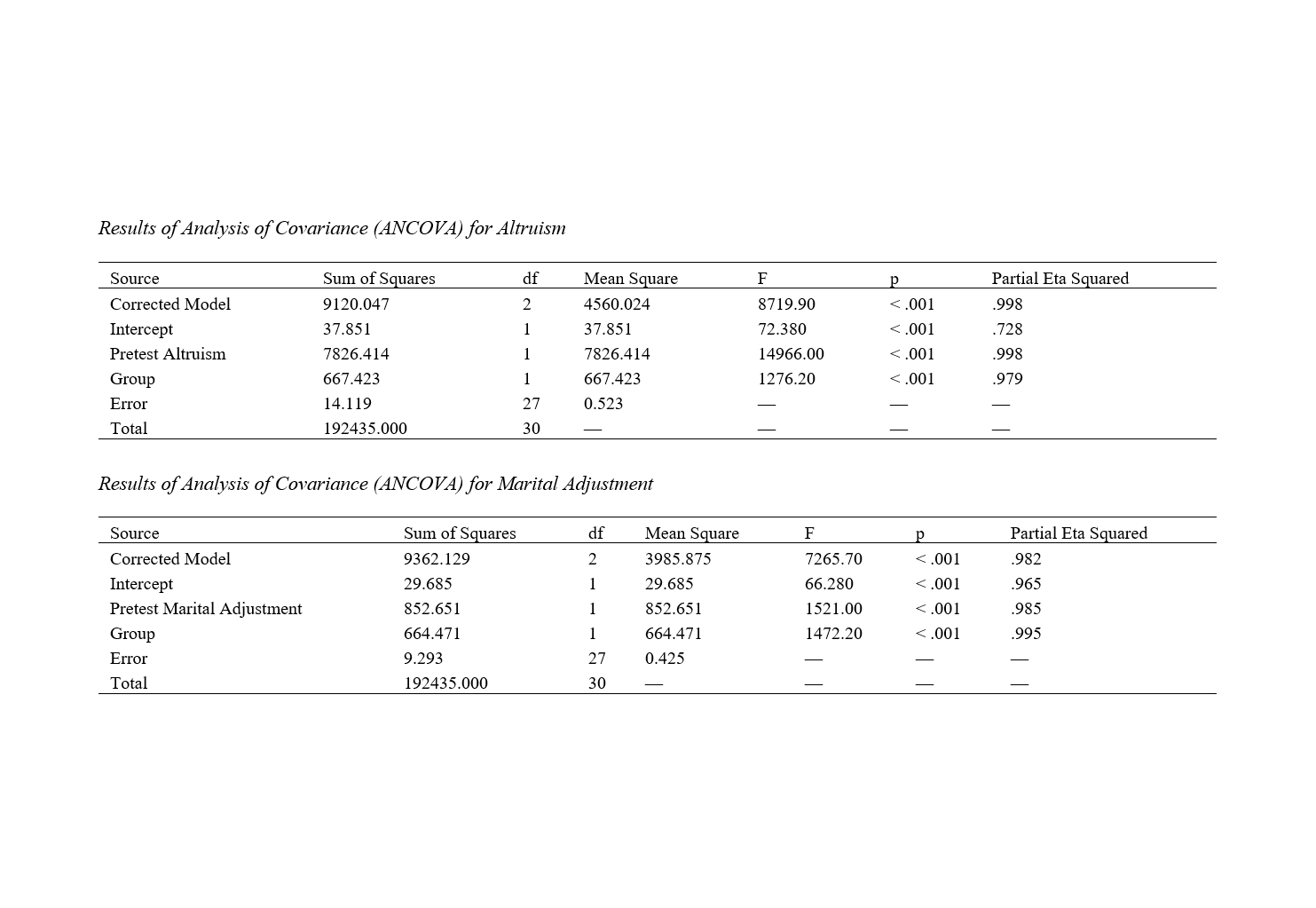
The objective of the present study was to compare the effectiveness of Acceptance and Commitment–Based Couple Therapy and Integrative Behavioral Couple Therapy on altruistic behavior and marital adjustment in couples. This study was applied in nature and employed a quasi-experimental pretest–posttest design with a control group. The statistical population consisted of married couples who met the study inclusion criteria, from whom 30 couples were selected using convenience sampling and randomly assigned to two experimental groups and one control group. The experimental groups received Acceptance and Commitment–Based Couple Therapy or Integrative Behavioral Couple Therapy according to structured intervention protocols, while the control group received no intervention. Data were collected using standardized measures of altruistic behavior and marital adjustment at pretest and posttest stages. Data analysis was conducted using analysis of covariance (ANCOVA) to compare posttest outcomes while controlling for pretest scores. The inferential results of the ANCOVA indicated that both Acceptance and Commitment–Based Couple Therapy and Integrative Behavioral Couple Therapy led to statistically significant improvements in altruistic behavior and marital adjustment compared with the control group (p < .001). After controlling for baseline scores, group membership had a significant effect on posttest altruism and marital adjustment, with very large effect sizes. However, no statistically significant difference was found between the two experimental groups, indicating that both therapeutic approaches were similarly effective in enhancing altruism and marital adjustment. The findings suggest that both Acceptance and Commitment–Based Couple Therapy and Integrative Behavioral Couple Therapy are effective interventions for improving altruistic behavior and marital adjustment, and either approach can be confidently used in clinical couple therapy settings to promote relational functioning.
Downloads
References
Abolhasani, S., Shiroudi, S. G., & Bahri, M. Z. (2023). The Effectiveness of Integrated Systemic Couple Therapy on Marital Differentiation and Marital Burnout of Couples Affected by Extramarital Affairs. Aftj, 4(2), 546-561. https://doi.org/10.61838/kman.aftj.4.2.32
Akrami, S. (2022). Evaluation of the Effectiveness of Acceptance and Commitment-based Education on Emotional Self-disclosure and Marital Commitment of Women Referring to Gonbad Kavous Clinics. International Journal of Education and Cognitive Sciences, 3(2), 23-29. https://doi.org/10.22034/injoeas.2022.160610
Bakkan, S., & Safarzadeh, S. (2023). The Effectiveness of Emotion-Based Marital Life Enrichment Training During Pregnancy on Love, Altruistic Behaviors, and Sexual Health Literacy in Young Couples. Scientific, Cultural, and Educational Journal of Women and Family, 18(62), 121-141. https://www.sid.ir/paper/1070282/en
Barraca, J., & Polanski, T. X. (2021). Infidelity treatment from an integrative behavioral couple therapy perspective: Explanatory model and intervention strategies. Journal of marital and family therapy, 1(2), 128-136. https://onlinelibrary.wiley.com/doi/abs/10.1111/jmft.12483
Danlian Namagardi, H., Farzad, V., & Nooranipoor, R. (2022). Comparing the effectiveness of Integrative Behavioral Couple Therapy (IBCT) and Affective Reconstructive Couple Therapy (ARCT) on couples marital conventionalization and global distress. Journal of Fundamentals of Mental Health, 24(1), 39-46. https://doi.org/10.22038/jfmh.2022.19522
Ghorbani, M., Salehabadi, R., Mahdavifar, N., & Rad, M. (2021). Factors Related to Nurses’ Attitudes Toward the Elderly Care: The Predictive Roles of Altruism, Moral Intelligence, Life Satisfaction and General Health [Research]. Salmand: Iranian Journal of Ageing, 16(2), 248-259. https://doi.org/10.32598/sija.16.2.2767.1
Golpayegani, F., Bayat, B., Majidian, V., & Aghabzorge, S. (2018). Effectiveness of acceptance and commitment therapy on the quality of attachment and altruism in children with externalizing behavioral problems. Quarterly Journal of Exceptional Children, 18(4), 77-88. https://en.civilica.com/doc/1616493/
Hashemizadeh, F. s., Atashpour, H., & Farhadi, H. (2025). Comparison of the Effectiveness of Paradox TimeTable Cure and Acceptance and Commitment Therapy Matrix on Family Adaptability and Mental Well-Being in Women with Marital Conflicts. Shenakht, 11(6), 106. https://doi.org/10.32598/shenakht.11.6.106
Jalalvand, D., Goodarzi, K., Karimi, J., & Yaghubi, A. (2023). The effectiveness of integrative behavioral couple therapy and Gottman couple therapy on marital quality and intimacy. Family Research Journal, 19(1), 107-124. https://jfr.sbu.ac.ir/article_103200.html
Jolazadeh Esmaili, A. A., Karimi, J., Gudarzi, K., & Asgari, M. (2021). Comparison of the Effectiveness of Acceptance and Commitment Therapy and Emotion-Focused Therapy on Depression and Marital Adjustment. Journal of Clinical Psychology, 13(1), 47-64. https://doi.org/10.22075/jcp.2021.21189.1986
Kamali, M., & Mahdian, H. (2023). Effectiveness of Realistic Acceptance and Commitment Therapy on Marital Adjustment and Satisfaction in Couples on the Brink of Divorce. Psychological Dynamics in Mood Disorders, 2(2), 10-20. https://www.sid.ir/paper/1363742/en
Lin, L., Wang, J., Liu, Y., & Zhang, H. (2022). Marital commitment, altruistic behavior, and marital quality among military couples. Frontiers in psychology, 13, 964167. https://doi.org/10.3389/fpsyg.2022.964167
Mousavi Diva, S. R., Heydari, S., & Ghanadzadegan, H. A. (2023). Comparing the effectiveness of integrative couple therapy and reality therapy on the quality of marital relationships and dysfunctional attitudes in incompatible couples. Journal of Adolescent and Youth Psychological Studies (JAYPS), 4(4), 81-92. https://doi.org/10.61838/kman.jayps.4.4.9
Najafi, Y., Ahmadi, S., & Zahrakar, K. (2020). The effectiveness of integrative behavioral couple therapy-based training on cognitive emotion regulation and marital intimacy in married women. Woman and family studies, 13(5), 49-62. https://www.magiran.com/paper/2549843/the-effect-of-educating-integrative-behavioral-couple-therapy-on-the-cognitive-emotion-regulation-and-marital-intimacy-of-married-women?lang=en
Najafi, Y., Ahmadi, S., & Zahrakar, K. (2021). The effect of educating integrative behavioral couple therapy On the cognitive emotion regulation and marital intimacy of married women. Journal of Woman and Study of Family, 13(50), 49-62. https://www.magiran.com/paper/2549843
Nallepalli, V., & Murugesan, S. (2025). Enhancing Marital Resilience Through Psychological Flexibility: An Acceptance and Commitment Therapy-Based Case Study. 3(1), 25-32. https://doi.org/10.4103/ijpmh.ijpmh_6_25
Nazari, H. (2024). The Effectiveness of Integrative Behavioral Couple Therapy (IBCT) on Intimacy and Marital Adjustment in Order to Improve Family Functioning in Couples Experiencing Emotional Divorce Khatam University, Faculty of Humanities].
Nezamalmolki, M. (2024). Effectiveness of integrative couple therapy on sexual function, marital intimacy, and impulsivity in women affected by marital infidelity. Jarac, 6(2), 19-26. https://doi.org/10.61838/kman.jarac.6.2.3
Saadati, N., Rostami, M., & Darbani, S. A. (2021). Comparing the effectiveness of Acceptance and Commitment Therapy (ACT) and Compassion Focused Therapy (CFT) on improving self-esteem and post-divorce adaptation in women. Journal of Family Psychology, 3(2), 45-58. https://www.ijfpjournal.ir/article_245517_28641af9cbb5eb6ff44fe78cdd2d5de8.pdf
Salehi, M., Abkenar, B. N., & Sarajari, M. Y. (2023). Effectiveness of Integrated Couples Therapy on Intimacy and Marital Forgiveness Among Women Affected by Extramarital Relationships. PWJ, 4(3), 69-76. https://doi.org/10.61838/kman.pwj.4.3.9
Yadolahi, S., Mirzaei, S. H., & Soleimianian, A. A. (2025). Comparing the efficacy of counseling based on acceptance commitment approach and the compassion approach in a group way on emotion regulation and the quality of marital relationship in infertile women. Journal of Psychological Science, 24(149), 287-305. https://psychologicalscience.ir/article-1-2488-en.html
Yousefpouri, M., Zomorodi, S., & Bazzāziān, S. (2024). Effectiveness of Acceptance and Commitment-Based Couples Therapy on Attitudes Towards Marital Infidelity and Emotional Regulation in Married Women. Aftj, 5(2), 103-111. https://doi.org/10.61838/kman.aftj.5.2.12
Downloads
Additional Files
Publication Timeline
- Submitted
- Revised
- Accepted