Deep Learning Analysis of Family Communication Networks and Adolescent Risk Behavior Prediction
DOI:
https://doi.org/10.61838/kman.aftj.4949Keywords:
Adolescent risk behavior, family communication, deep learning, graph neural networks, parental monitoring, predictive modeling; preventionAbstract
Objective: The objective of this study was to develop and evaluate a deep learning model capable of predicting adolescent risk behavior based on the structural and relational characteristics of family communication networks.
Methods and Materials: This applied, predictive study employed a mixed-methods design with a dominant quantitative approach and was conducted among 782 high school students aged 14–18 years in Georgia, United States. Multi-stage cluster sampling was used to ensure demographic representation. Data were collected using standardized instruments assessing family communication quality, parental monitoring, emotional expressiveness, conflict resolution, and adolescent risk behaviors. Family interactions were transformed into weighted communication networks and analyzed using a hybrid deep learning architecture integrating graph neural networks and long short-term memory models. Model performance was evaluated using accuracy, precision, recall, F1-score, and area under the receiver operating characteristic curve, with comparative analysis against traditional machine learning models.
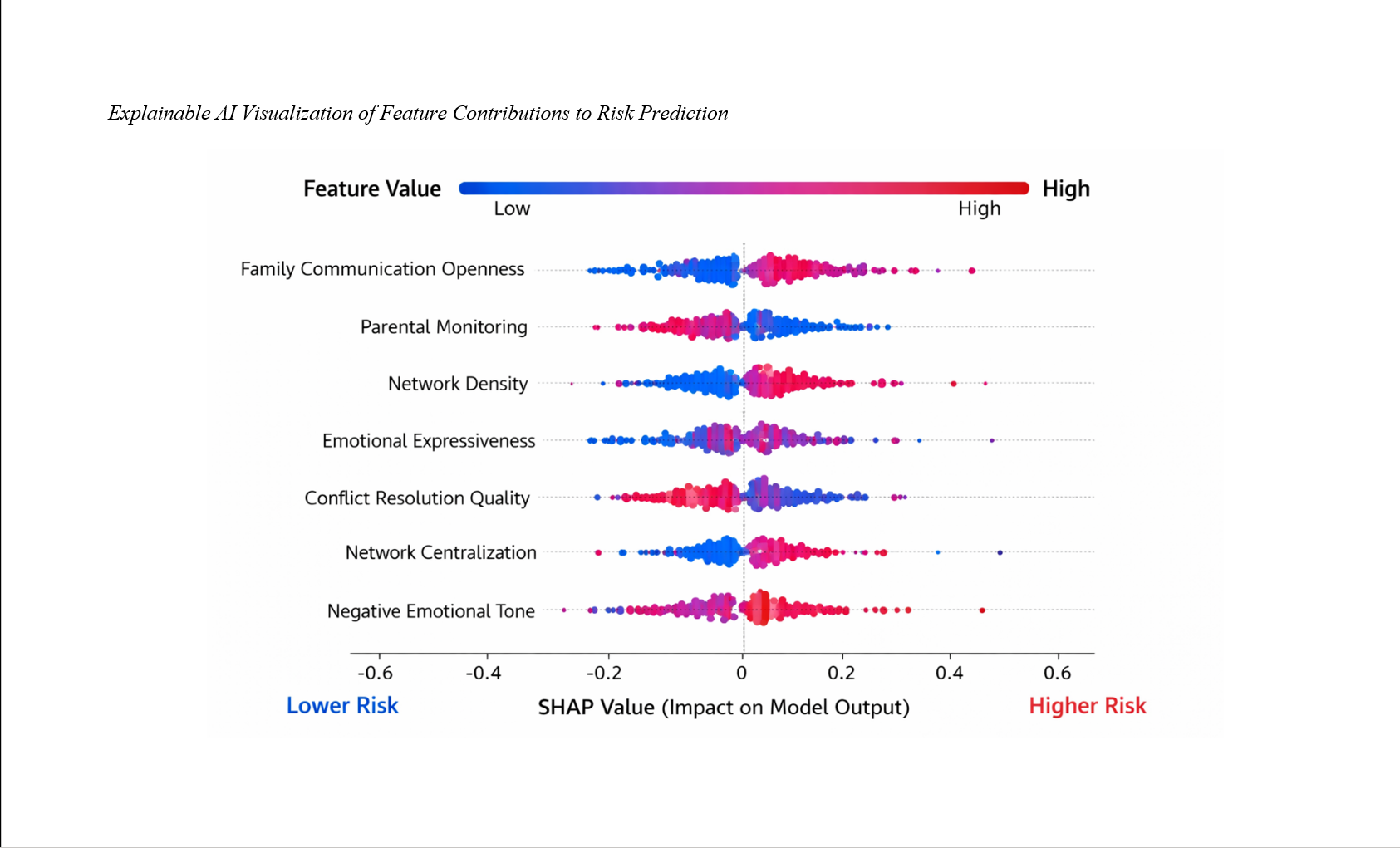
Findings: The deep learning model achieved high predictive performance (test accuracy = 0.87; AUC = 0.90), significantly outperforming random forest, support vector machine, and logistic regression models. Communication openness, network density, and parental monitoring emerged as the strongest predictors of adolescent risk behavior. Explainable AI analysis confirmed that fragmented communication networks and negative emotional tone substantially increased predicted risk levels.
Conclusion: The findings demonstrate that adolescent risk behavior can be accurately predicted through deep learning analysis of family communication networks, highlighting the critical importance of relational structure and communication quality in prevention and early intervention strategies.
Downloads
References
Astuti, T. P., Hıdayatı, N., Tsanifiandi, F., & Tristiana, R. D. (2024). Risk and Protective Factors of Self-Harm and Suicide in Adolescents in the Era of Society 5.0: A Systematic Review. Fundamental and Management Nursing Journal, 7(2), 77-88. https://doi.org/10.20473/fmnj.v7i2.55677
Aziz, S., Ajib, M., Razak, A., Nen, S., Manap, J., Hoesni, S. M., & Nasir, M. K. M. (2023). Impact of Parental Monitoring and Communication Factors on Deviant Behavior Among Teenagers in Malaysia. Journal of Southwest Jiaotong University, 58(6). https://doi.org/10.35741/issn.0258-2724.58.6.26
Brincks, A. M., Perrino, T., Estrada, Y., & Prado, G. (2023). Preventing Alcohol Use Among Hispanic Adolescents Through a Family-Based Intervention: The Role of Parent Alcohol Misuse. Journal of Family Psychology, 37(1), 105-109. https://doi.org/10.1037/fam0001038
Bulycheva, E. V. (2023). Adolescents’ Relationships With the Social Environment as a Factor of Protection Against Risky Behaviours. National Psychological Journal, 49(1), 88-101. https://doi.org/10.11621/npj.2023.0108
Chen, M., Yang, Z., Luo, D., Yan, S., Liu, M., Wang, M., Li, X., Yang, B. X., Li, Y., & Liu, L. Z. (2023). Association of Family Function and Suicide Risk in Teenagers With a History of Self-Harm Behaviors: Mediating Role of Subjective Wellbeing and Depression. Frontiers in Public Health, 11. https://doi.org/10.3389/fpubh.2023.1164999
Estrada, Y., Lozano, A., Terán, A. M. Q., Eckembrecher, D. G., Rojas, L. M., Tamayo, C. C., Lee, T. K., Velázquez, M. R., Tapia, M. I., Martín, J. C., & Prado, G. (2023). Longitudinal Findings of a U.S. Preventive Evidence-Based Family Intervention Tested Among Youth in Ecuador: Familias Unidas. Plos Global Public Health, 3(5), e0000694. https://doi.org/10.1371/journal.pgph.0000694
Hodgson, C., Decker, D., O’Connor, T. M., Hingle, M., & Gachupin, F. C. (2023). A Qualitative Study on Parenting Practices to Sustain Adolescent Health Behaviors in American Indian Families. International journal of environmental research and public health, 20(21), 7015. https://doi.org/10.3390/ijerph20217015
Hogue, A., Porter, N., Ozechowski, T. J., Becker, S. J., O’Grady, M. A., Bobek, M., Cerniglia, M., Ambrose, K., MacLean, A., Hadland, S. E., Cunningham, H., Bagley, S. M., Sherritt, L., O’Connell, M., Shrier, L. A., & Harris, S. K. (2024). Standard Versus Family-Based Screening, Brief Intervention, and Referral to Treatment for Adolescent Substance Use in Primary Care: Protocol for a Multisite Randomized Effectiveness Trial. Jmir Research Protocols, 13, e54486. https://doi.org/10.2196/54486
Huang, Y. (2023). Family Factors to Predict Adolescents’ Emotional Health by Decision Tree Model: A Comparison Between Normally Developed Group and Chronic-Condition Group. Frontiers in Public Health, 11. https://doi.org/10.3389/fpubh.2023.1087547
Imron, A., Marzuqi, M. I., & Pradana, G. W. (2024). Humblebrag of Rural Youth: Reorientation of Youth Towards Technology and Its Impact on Family Resilience. Jurnal Biometrika Dan Kependudukan, 13(2), 134-143. https://doi.org/10.20473/jbk.v13i2.2024.134-143
Kombech, E. R., Mathai, M., & Khasakhala, L. (2024). Sexual Initiation Age and Related Risk-Taking Behaviours Among Adolescents in Urban Secondary Schools in Nairobi County. Pan Africa Science Journal. https://doi.org/10.47787/pasj.v4i03.75
Kupchenko, V. E. (2025). Family Relationships and Social Network Addiction as Factors of Suicidal Behavior in Adolescents. Psychology and Law, 15(3), 54-65. https://doi.org/10.17759/psylaw.2025150304
Li, Z., Xie, S., & Chen, W. (2025). The Influence of Environment on Adolescents’ Physical Exercise Behavior Based on Family Community and School Micro-Systems. Scientific reports, 15(1). https://doi.org/10.1038/s41598-025-91387-0
Liu, S., Xia, X., Lachman, J. M., & Zhang, H. (2024). A Feasibility Study of Parenting for Lifelong Health for Adolescents in China. Research on Social Work Practice, 34(6), 687-700. https://doi.org/10.1177/10497315241238964
Lozano, A., Scott, D., Lopez, A., Barbosa, K. C., Goldbach, J. T., Behar‐Zusman, V., & Prado, G. (2025). Development of a Measure of Family Functioning for Hispanic Sexual Minority Adolescents: A Study Protocol for Measure Development. International Journal of Qualitative Methods, 24. https://doi.org/10.1177/16094069251332785
Mahmud, S., Kasim, A. M., & Nuwa, G. (2023). The Role of Parents in Overcoming Adolescent Moral Crisis in Wairbleler Village, Waigete District, Sikka Regency. Eductum Journal Research, 2(1), 35-39. https://doi.org/10.56495/ejr.v2i1.320
Nguyen, M. T., Nguyen, N. N. T., & Nguyen, P. (2024). Family and Friends: Key Influences on Teenage Traits and Behaviors. Social Science and Humanities Journal, 8(10), 5711-5723. https://doi.org/10.18535/sshj.v8i10.1430
Ochoa, L. G., Fernández, A., Lee, T. K., Estrada, Y., & Prado, G. (2021). The Intergenerational Impact of Adverse Childhood Experiences on Hispanic Families: The Mediational Roles of Parental Depression and Parent–Adolescent Communication. Family Process, 61(1), 422-435. https://doi.org/10.1111/famp.12652
Parra‐Cardona, J. R., Vanderziel, A., & Fuentes‐Balderrama, J. (2023). The Impact of a Parent‐based Prevention Intervention on Mexican‐descent Youths' Perceptions of Harm Associated With Drug Use: Differential Intervention Effects for Male and Female Youths. Journal of marital and family therapy, 49(2), 370-393. https://doi.org/10.1111/jmft.12627
Putra, R., & Junaidi, J. (2023). Peran Orang Tua Dalam Membentuk Etika Komunikasi Remaja Putus Sekolah Di Jorong Sungai Rotan Nagari Batu Taba Kabupaten Agam. Koloni, 2(3), 82-93. https://doi.org/10.31004/koloni.v2i3.511
Safrotulloh, M., & Alauddin, D. (2025). The Role of Stakeholders in Guidance for Overcoming Juvenile Delinquency in Cirebon Regency. Eduprof Islamic Education Journal, 7(1), 20-41. https://doi.org/10.47453/eduprof.v7i1.285
Soliha, A. R., Alamsyah, W. A. B., Sari, N. M. W., & Qomaruddin, M. B. (2023). Peran Komunikasi Orang Tua Terhadap Kesehatan Reproduksi Pada Remaja. Journal of Telenursing (Joting), 5(1), 1004-1012. https://doi.org/10.31539/joting.v5i1.5250
Sonia, B. M., Ngangue, P., Bationo, N., Soubeiga, D., Adnette, A., Leonel, P., & Ly, B. A. (2023). Socioecological Analysis of Determinants of Early Adolescent Sexuality in Benin: A Qualitative Study. Pan African Medical Journal, 44. https://doi.org/10.11604/pamj.2023.44.137.35978
Taggart, T., Milburn, N. G., Nyhan, K., & Ritchwood, T. D. (2020). Utilizing a Life Course Approach to Examine HI v Risk for Black Adolescent Girls and Young Adult Women in the United States: A Systematic Review of Recent Literature. Ethnicity & Disease, 30(2), 277-286. https://doi.org/10.18865/ed.30.2.277
Tse, S. (2025). The Influence of Family Ecosystem on Youth Violence. Lecture Notes in Education Psychology and Public Media, 107(1), 117-125. https://doi.org/10.54254/2753-7048/2025.ld27618
Usonwu, I., Ahmad, R., & Curtis, K. (2021). Parent–adolescent Communication on Adolescent Sexual and Reproductive Health in Sub-Saharan Africa: A Qualitative Review and Thematic Synthesis. Reproductive Health, 18(1). https://doi.org/10.1186/s12978-021-01246-0
Utami, F. P., Nurfita, D., Syam, N. S., Ramadhani, K., & Matahari, R. (2024). Preventing Teen Pregnancy and Delinquency: The Role of Parental Supervision, Communication, and Education. Jurnal Cakrawala Promkes, 6(2), 64-74. https://doi.org/10.12928/jcp.v6i2.10327
Ventanilla, V. M., & Ventanilla, J. P. V. (2022). Family Communication Patterns and Teenage Pregnancies Among Filipino Youth. Asean Social Work Journal, 35-46. https://doi.org/10.58671/aswj.v10i1.10
Walsh, S. D., Getahune, S., & Kogan, S. M. (2023). Risk, Resilience and Family Relationships Among At‐risk Ethiopian Immigrant Youth in Israel: A Focus Group Investigation. Family Process, 63(2), 711-730. https://doi.org/10.1111/famp.12915
Wilhelm, A. K., Allen, M., & Pratt, R. (2022). Belonging to Three Worlds: Somali Adolescent–Parent Relationships in the United States and Implications for Tobacco Prevention. International journal of environmental research and public health, 19(6), 3653. https://doi.org/10.3390/ijerph19063653
Downloads
Additional Files
Publication Timeline
- Submitted
- Revised
- Accepted