The Effectiveness of Systemic-Behavioral Couples Therapy (SBCT) in Enhancing Relationship Outcomes Among Spouses of Individuals with Parkinson’s Disease
Keywords:
Systemic-Behavioral Couples Therapy, Marital satisfaction, Sexual intimacy, Family emotional climate, Parkinson’s disease, Clinical significanceAbstract
Objective: This study evaluated the efficacy of Systemic-Behavioral Couples Therapy (SBCT) in improving relational outcomes among spouses of PD patients.
Methods and Materials: Employing a quasi-experimental pretest–posttest–follow-up design with a control group, 40 spouses attending the Neurology Specialty Department of Firouzgar Hospital, Tehran (2024) were recruited via purposive sampling and randomly allocated to experimental and control conditions (final N = 24; 12 per group). The experimental group underwent six weekly 45-minute SBCT sessions targeting communication enhancement, cognitive restructuring, and interaction pattern modification. Outcome measures included marital satisfaction (Hudson, 1982), sexual intimacy (Batalani et al., 2010), and family emotional climate (Hillburn, 1964). Data were analyzed using ANCOVA, paired t-tests, and repeated measures ANOVA in SPSS 24, with α = .05.
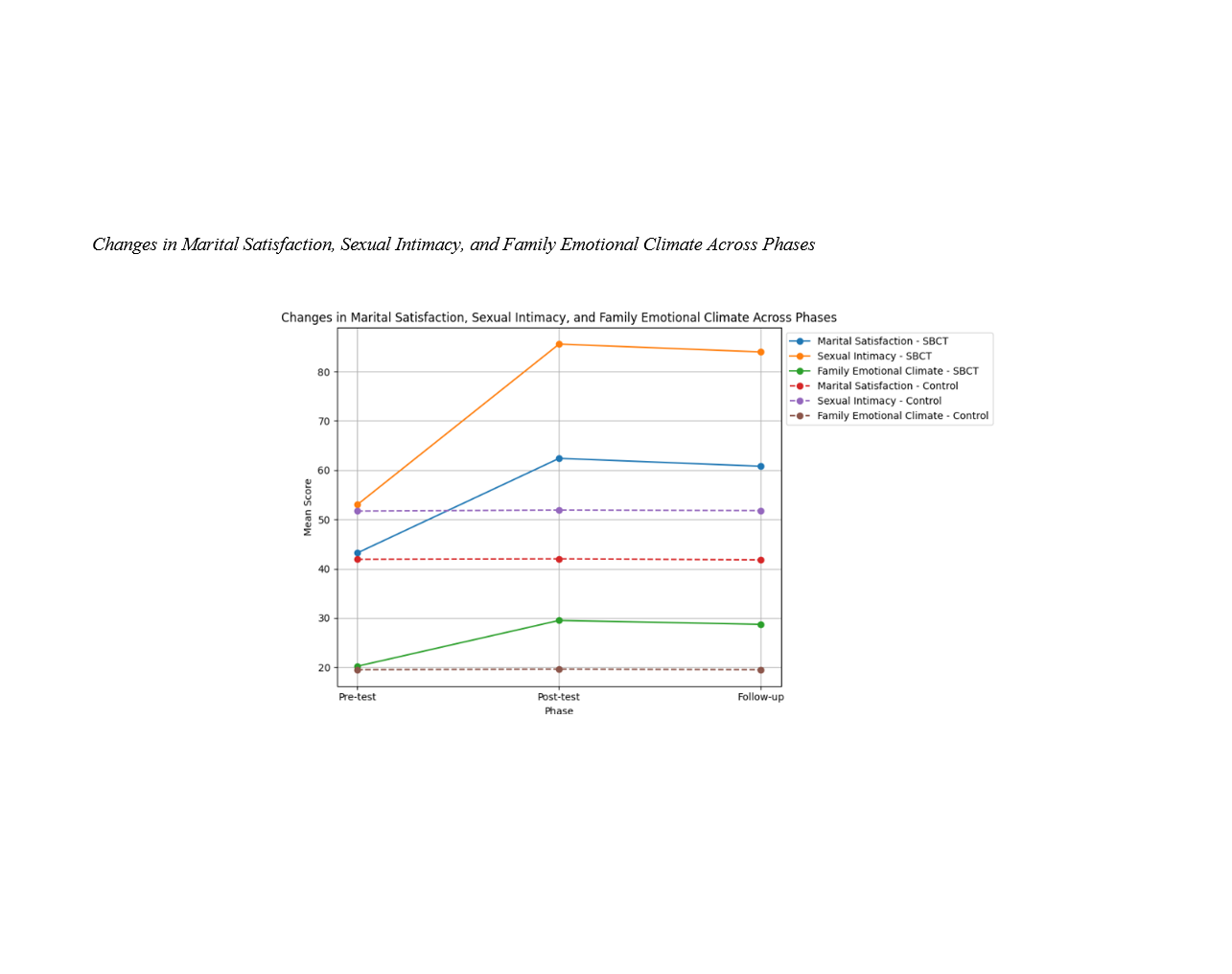
Findings: The SBCT group demonstrated significant improvements across all outcomes compared to the control group (p < .001). Effect sizes were large (η² = .68–.70), and Cohen’s d values were very large to extremely large (2.47–4.33). Reliable Change Index (RCI > 1.96) confirmed clinically meaningful change. Follow-up assessment showed slight attenuation, but post-intervention gains remained substantially higher than baseline.
Conclusion: SBCT represents a robust, clinically meaningful intervention to enhance marital satisfaction, sexual intimacy, and family emotional climate in spouses of PD patients. These findings support integrating SBCT into psychosocial support frameworks for families affected by chronic neurodegenerative disorders.
Downloads
References
Adeli, M. (2024). Effectiveness of paradoxical therapy on sexual desire disorder (A case study). https://civilica.com/doc/2140091
Bagarozzi, D. A. (2014). Enhancing intimacy in marriage: A clinician’s guide. Routledge. https://doi.org/10.4324/9781315787053
Barraca, J., Polanski, T., Duarte-Díaz, A., & Perestelo-Pérez, L. (2025). Acceptance and commitment therapy for couples: A systematic review and meta-analysisJO - Journal of Contextual Behavioral Science. 35, 100867. https://doi.org/10.1016/j.jcbs.2024.100867
Batalani, S., Shahsiah, M., Padash, Z., Ahmadi, A., & Bahrami, F. (2012). The effect of attachment-based couple therapy on couples attachment style, sexual intimacy and sexual satisfaction. Interdisciplinary Journal of Contemporary Research in Business, 3(12), 375-390. https://sid.ir/paper/453816/fa
Baucom, D. H., Epstein, N. B., Kirby, J. S., & LaTaillade, J. J. (2019). Cognitive-behavioral couple therapy. In A. S. Gurman, J. L. Lebow, & D. K. Snyder (Eds.), Clinical Handbook of Couple Therapy. The Guilford Press. https://doi.org/10.1037/0000101-016 10.1007/978-3-319-49425-8_106
Besharat, M. A. (2020). Assessing the effectiveness of paradoxical couple therapy on couples’ problems: A case study. Family Psychology, 7(1), 1-18. https://sid.ir/paper/385073/fa
Carr, A. (2025). Couple therapy and systemic interventions for adult‐focused problems: The evidence base. Journal of Family Therapy, 47(1), e12481. https://doi.org/10.1111/1467-6427.12481
Eslahi, N., Arefi, M., Hosseini, S. S., & Amiri, H. (2022). Comparison of the effectiveness of emotion-focused couple therapy and Gottman’s cognitive-systemic couple therapy on emotional balance in conflicted couples. Disability Studies, 12(0), 0-0. https://sid.ir/paper/1124633/fa
Fayyazbakhsh, F., Ezzati, A., & Malekirad, A. A. (2015). Sexual functioning and quality of life in women and men with chronic kidney diseases. Journal of Psychological Health Research, 9(2). https://ensani.ir/fa/article/363914/
Firouzi, M., Golparvar, M., & Aghaie, A. (2022). Comparison of the effectiveness of emotion-focused couple therapy, cognitive-behavioral couple therapy, and Gottman’s cognitive-systemic couple therapy on emotional balance and dysfunctional expectations in women with sexual dysfunction symptoms. Iranian Journal of Psychiatric Nursing, 10(1), 1-17. https://sid.ir/paper/986229/fa
French, J. E., Altgelt, E. E., & Meltzer, A. L. (2019). The implications of sociosexuality for marital satisfaction and dissolution. Psychological Science, 30(10), 1460-1472. https://doi.org/10.1177/0956797619868997
Gao, T., Meng, X., Qin, Z., Zhang, H., Gao, J., Kong, Y., & Mei, G. (2018). Association between parental marital conflict and Internet addiction: A moderated mediation analysis. Journal of affective disorders, 240, 27-32. https://doi.org/10.1016/j.jad.2018.07.005
Ghaemi, M., Zomorodi, S., & Bazzazian, S. (2022). Predicting marital satisfaction based on mental health and psychological capital of working women. Journal of Applied Family Therapy, 3(2), 531-548. https://doi.org/10.61838/kman.aftj.3.2.28
Greenwell, K., Gray, W. K., Van Wersch, A., Van Schaik, P., & Walker, R. (2015). Predictors of the psychosocial impact of being a carer of people living with Parkinson's disease: a systematic review. Parkinsonism & Related Disorders, 21(1), 1-11. https://doi.org/10.1016/j.parkreldis.2014.10.013
Hosseini, M. (2022). The relationship between family emotional climate and the development of social skills and academic achievement. Journal of Behavioral Sciences Studies, 14(51). https://journals.iau.ir/article_700691.html
Karney, B. R., & Bradbury, T. N. (2020). Research on marital satisfaction and stability in the 2010s: Challenging conventional wisdom. Journal of marriage and family, 82(1), 100-116. https://doi.org/10.1111/jomf.12635
Lebow, J., & Snyder, D. K. (2021). Clinical Handbook of Couple Therapy. The Guilford Press. https://www.guilford.com/books/Clinical-Handbook-of-Couple-Therapy/Lebow-Snyder/9781462550128?srsltid=AfmBOooTd8o0lvZ8O3fXazz7p8UtI4I9aWYwnOhB7a3SNhhAxd-JTYVW
Lou, J. S., Dimitrova, D. M., Hammerschlag, R., Nutt, J., Hunt, E. A., Eaton, R. W., & Oken, A. B. S. (2013). Effect of expectancy and personality on cortical excitability in Parkinson's disease. Movement Disorders, 28(9), 1257-1262. https://doi.org/10.1002/mds.25471
Mahmoudi, B., Moradi, O., Goodarzi, S. A., & Asrin. (2021). Effectiveness of group couple therapy on sexual intimacy and marital burnout in couples with marital conflicts. Iranian Journal of Psychiatric Nursing, 9(3), 73-82. https://ijpn.ir/article-1-1650-en.html
Manceau, C., Constant, E., Brugallé, E., Wawrziczny, E., Sokolowski, C., Flinois, B., & Antoine, P. (2023). Couples facing the “honeymoon period” of Parkinson's disease: A qualitative study of dyadic functioning. British Journal of Health Psychology, 28(2), 366-382. https://doi.org/10.1111/bjhp.12629
Martínez-Martín, P., Forjaz, M. J., Frades-Payo, B., Rusinol, A. B., Fernández-García, J. M., Benito-León, J., & Catalán, M. J. (2007). Caregiver burden in Parkinson's disease. Movement Disorders, 22(7), 924-931. https://doi.org/10.1002/mds.21355
Mesbah, I., & Sadri Damirchi, E. (2023). Predicting marital commitment based on communication patterns and family's emotional atmosphere of the family of origin with the mediation of emotional maturity. Rooyesh, 12(8), 45-56. https://frooyesh.ir/article-1-4453-fa.html
Navroodi, S. O. S., Tavana, S. E., Roodbardeh, F. P., & Farokhi, N. (2025). The Effectiveness of Emotion-Focused Couple Therapy on Marital Harmony and Communication Patterns in Incompatible Couples. Journal of Behavior Modification Studies (JBMS), 1(2). https://jbms.guilan.ac.ir/article_8585_49755ea73d3e8caa290dd3de657fa11c.pdf
Pashaei, S. (2023). Investigating the effectiveness of systemic-behavioral couple therapy on couples' relationships and prevention and treatment methods. https://civilica.com/doc/1728783
Shiri, F., & Goodarzi, M. (2020). Comparison of the effectiveness of self-regulation-attachment couple therapy and systemic-behavioral couple therapy on sexual functioning in women with extramarital relationships. Family Research, 16(63), 395-412. https://sid.ir/paper/392031/fa
Shiri, F., Goodarzi, M., Moradi, O., & Ahmadian, H. (2020). Comparison of the effectiveness of self-regulation-attachment couple therapy and systemic-behavioral couple therapy on family functioning in women with substance-dependent spouses. Addiction Research, 14(56), 247-266. https://doi.org/10.29252/etiadpajohi.14.56.247
Shirin Kam, M. S., Hamzeh Pour Haghighi, T., & Pirkhayefi, A. (2025). The effectiveness of cognitive-behavioral couples therapy on ineffective communication patterns and communication beliefs in conflicting couples. Ruyesh Psychology Journal, 14(6), 200-191. https://frooyesh.ir/article-1-6218-fa.html
Sodani, M., Nazarifard, M., & Honarmand, M. M. (2010). Effectiveness of behavioral communication Bernstein Marital Therapy on marital conflict. Journal of Clinical Psychology, 2(4), 1-8. https://jcp.semnan.ac.ir/article_2033.html
Yousefzadeh, P., Farzad, V., Navabinezhad, S., & Nouranipour, R. (2017). The effectiveness of systemic-behavioral couple therapy training on psychological well-being of maladapted couples. Consulting Research, 16(63), 50-66. https://journal.irancounseling.ir/article-1-609-fa.html
Zamanifar, M., Keshkooli Arshadi, F., Hasani, F., & Emamipour, S. (2021). Investigating the effectiveness of systemic-behavioral couple therapy on intimacy in couples with marital conflicts. https://civilica.com/doc/1345811
Downloads
Additional Files
Publication Timeline
- Submitted
- Revised
- Accepted