Identifying Factors of Marital Commitment During Economic Stress: A Qualitative Study
DOI:
https://doi.org/10.61838/kman.aftj.6.2.20Keywords:
Marital commitment, economic stress, resilience, communication, coping strategiesAbstract
Objective: This study aimed to explore and identify the psychological, relational, and cultural factors that sustain marital commitment among Hungarian couples experiencing significant financial adversity.
Methods and Materials: A qualitative exploratory design was employed to capture the lived experiences of couples facing economic strain. Using purposive sampling, 21 married individuals from Hungary who had encountered major financial challenges in the past five years were recruited. Data were collected through in-depth semi-structured interviews, lasting between 45 and 75 minutes, focusing on participants’ coping strategies, communication patterns, and sources of resilience. Interviews continued until theoretical saturation was reached. All sessions were transcribed verbatim, translated from Hungarian into English when necessary, and analyzed using thematic analysis with the aid of NVivo 14 software. Rigorous strategies, including independent coding and reflective memoing, enhanced credibility and trustworthiness.
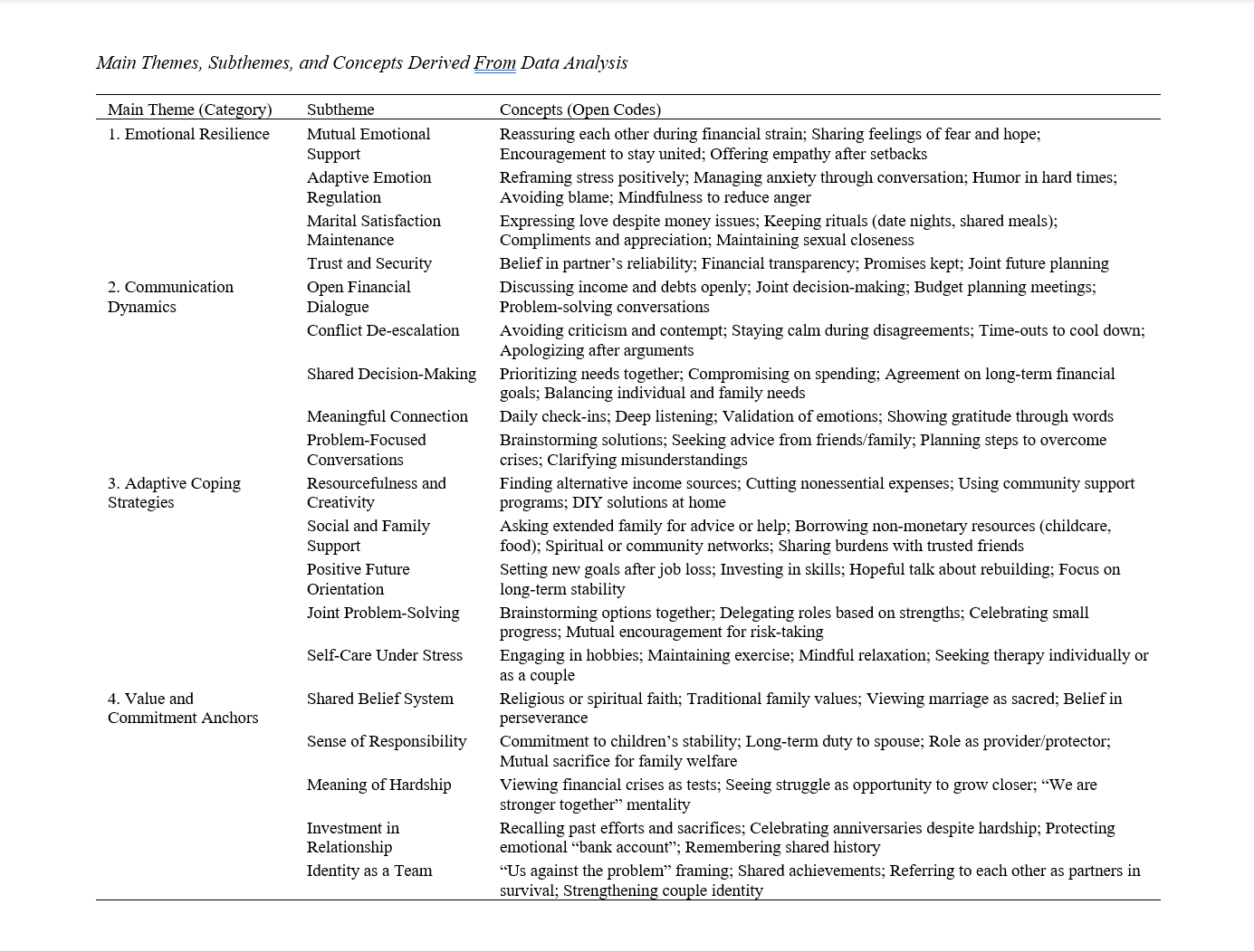
Findings: Four overarching themes emerged from the analysis: emotional resilience, communication dynamics, adaptive coping strategies, and value and commitment anchors. Couples reported that trust, mutual reassurance, and emotional regulation were essential for enduring financial distress. Open financial dialogue and conflict de-escalation prevented misunderstandings and fostered teamwork. Adaptive coping included creative income generation, resourcefulness, and reliance on extended family and community networks. Cultural and moral anchors — such as shared belief systems, family responsibility, and a collective “us against the problem” mindset — provided a deeper sense of purpose and stability. These interconnected processes collectively explained how couples sustained long-term commitment despite economic challenges.
Conclusion: Marital commitment during economic stress arises from a dynamic interplay of emotional, relational, and cultural resources. Understanding these protective processes can guide counseling, community interventions, and policy initiatives aimed at strengthening families facing financial hardship.
Downloads
References
Baudiyarova, K., & Meirmanova, G. (2023). Problems of Family and Marriage Relations of Kazakh People (Based on Ethnographic Materials of Southern Kazakhstan). Journal of History, 109(2). https://doi.org/10.26577/jh.2023.v109.i2.012
Dai, H. (2022). Changes in the Conception of Marriage in China. Szociális Szemle, 15(1), 14-23. https://doi.org/10.15170/socrev.2022.15.01.03
Gupta, R. (2024). The Impact of Macroeconomic Factors on Recessions: A Comparative Analysis of the Us and Uk. International Journal of Social Science and Economic Research, 09(01), 101-106. https://doi.org/10.46609/ijsser.2024.v09i01.006
Harsono, I., Sutanto, H., Zuhroh, S., Arisanti, I., & Erliana, Y. D. (2024). The Influence of Socio-Economic Factors on Marriage Patterns in Indonesia: A Quantitative Analysis of the Relationship Between Social Status and Marriage Decisions. SNHSS, 1(01), 33-39. https://doi.org/10.58812/snhss.v1i1.5
Herlambang, R. S. (2024). The Influential Factors of Marital Endurance: A Systematic Literature Review. Asian Journal of Healthy and Science, 3(6), 120-128. https://doi.org/10.58631/ajhs.v3i6.106
Huwae, G. H. (2025). Literatur Review: Komitmen Dan Kepuasan Hidup Perkawinan. Jurnal Riset Rumpun Ilmu Kesehatan, 4(2), 380-391. https://doi.org/10.55606/jurrikes.v4i2.5586
Jung, H. Y. (2024). Constitutional Proposal to Respond to Population Extinction Crisis: Focusing on the Diversity of Family Communities and Children’s Basic Rights. National Public Law Review, 20(1), 1-34. https://doi.org/10.46751/nplak.2024.20.1.1
Kotzamanis, B., & Kostaki, A. (2024). Repercussions of the Recent Economic Downturn on Birth Rates in Greece. Ijle, 13(1), 120-136. https://doi.org/10.62693/304gib46
Macedo, S. (2022). Marriage, Monogamy, and Moral Psychology. 798-837. https://doi.org/10.1093/oxfordhb/9780198871712.013.40
Misrulina, M., Ahmal, A., & Yuliantoro, Y. (2024). Shifting Marriage Customs in the Clans of the Kenegerian Air Tiris Community, Kampar Regency. Jetish Journal of Education Technology Information Social Sciences and Health, 3(2), 902-907. https://doi.org/10.57235/jetish.v3i2.2687
Nazemi, M., Majd, M. A., Ghamari, M., & Asadi, M. (2023). Qualitative Comparison of Satisfactory Stable Marriages and Marriages With Dissatisfaction in Infertile Couples. Jayps, 4(7), 1-13. https://doi.org/10.61838/kman.jayps.4.7.1
Okenwe, I., Essi, I. D., & Wegbom, A. I. (2025). The Impact of Marriage Contract Type on Divorce Likelihood: Evidence From Rivers State, Nigeria. African Journal of Mathematics and Statistics Studies, 8(1), 60-69. https://doi.org/10.52589/ajmss-kmjnnvt0
Okoiye, E., Anyanwu, C. J., & Agbajor, h. (2025). Marriage Counselling, Self-Disclosure and Commitment as Correlates of Marital Stability Among Married Female Guidance and Counselling Post-Graduate Students in South-East Nigeria. Djerd, 22(1), 169-178. https://doi.org/10.61448/djerd22115
Rahman, T. A., Sutjipto, V. W., & Putri, K. Y. (2024). The Impact of Exposure to Online Mass Media on People's Attitudes in Marriage Decisions in Indonesia. Momat, 1(4), 12-23. https://doi.org/10.62951/momat.v1i4.65
Rashid, S., & Islam, M. Z. A. (2023). Unraveling the Socio-Cultural Insecurities Behind Early Marriages: Exploring the Resulting Divorce. International Journal of Research and Innovation in Social Science, VII(IX), 657-662. https://doi.org/10.47772/ijriss.2023.70955
Regnerus, M. (2020). The Future of Christian Marriage. 191-216. https://doi.org/10.1093/oso/9780190064938.003.0007
Salvati, L. (2019). Differential Responses to Expansion and Crisis? The Role of Urban‐rural Divides in Long‐term Demographic Dynamics. International Social Science Journal, 69(233-234), 213-230. https://doi.org/10.1111/issj.12237
Sawai, J. P., Sawai, R. P., Masdin, M., & Aziz, A. R. (2023). Sustaining Long-Distance Relationship Through Love, Trust, and Dedication Among Married Couples. Manu Jurnal Pusat Penataran Ilmu Dan Bahasa (Ppib), 34(1), 63-80. https://doi.org/10.51200/manu.v34i1.4475
Sidqi, I., & Rasidin, M. (2023). Sexual Recession in Urban Muslim Societies: A Review of Maqashid Sharia and Its Implications. Akademika Jurnal Pemikiran Islam, 28(2), 231. https://doi.org/10.32332/akademika.v28i2.7616
Umamy, A., & Siregar, M. H. (2025). Living Beyond Norms: A Qualitative Study on Public Perception and Lived Realities of Unmarried Middle-Aged Women in Medan. Journal of General Education and Humanities, 4(3), 1327-1338. https://doi.org/10.58421/gehu.v4i3.664
Utami, R. A., Pradityo, R., Karo, L. B., & Karinda, R. (2023). Rethinking Early Marriages in Indonesia: Advocating for Reform to Tackle Domestic Conflict, Violence, and Rights Infringements. Indonesian Journal of Advocacy and Legal Services, 5(1), 35-64. https://doi.org/10.15294/ijals.v5i1.66569
Downloads
Additional Files
Publication Timeline
- Submitted
- Revised
- Accepted
Issue
Section
License

This work is licensed under a Creative Commons Attribution-NonCommercial 4.0 International License.