Comparison of the Effectiveness of Acceptance and Commitment–Based Couple Therapy and Cognitive–Behavioral Couple Therapy on Cognitive Distortions, Emotion Regulation, and Emotional Intimacy in Couples Experiencing Marital Disenchantment
DOI:
https://doi.org/10.61838/kman.aftj.5039Keywords:
couple therapy, acceptance and commitment, cognitive–behavioral, cognitive distortions, emotion regulation, emotional intimacy, marital disenchantmentAbstract
Objective: This study aimed to compare the effectiveness of acceptance and commitment–based couple therapy and cognitive–behavioral couple therapy on interpersonal cognitive distortions, emotion regulation strategies, and emotional intimacy in couples experiencing marital disenchantment.
Methods and Materials: The study employed a quasi-experimental design with pretest, posttest, and three-month follow-up assessments and a control group. The statistical population consisted of couples aged 20–40 years who sought counseling for marital disenchantment in Tehran in 2023. Using purposive sampling and based on inclusion and exclusion criteria, 45 couples were selected and randomly assigned to two experimental groups and one control group. The first experimental group received acceptance and commitment–based couple therapy, and the second experimental group received cognitive–behavioral couple therapy, each delivered in 12 sessions of 90 minutes over three months, while the control group remained on a waiting list. Data were collected using standardized questionnaires measuring interpersonal cognitive distortions, emotion regulation strategies (cognitive reappraisal and suppression), and emotional intimacy at three time points. Data analysis was conducted using repeated-measures analysis of variance and Bonferroni post hoc tests.
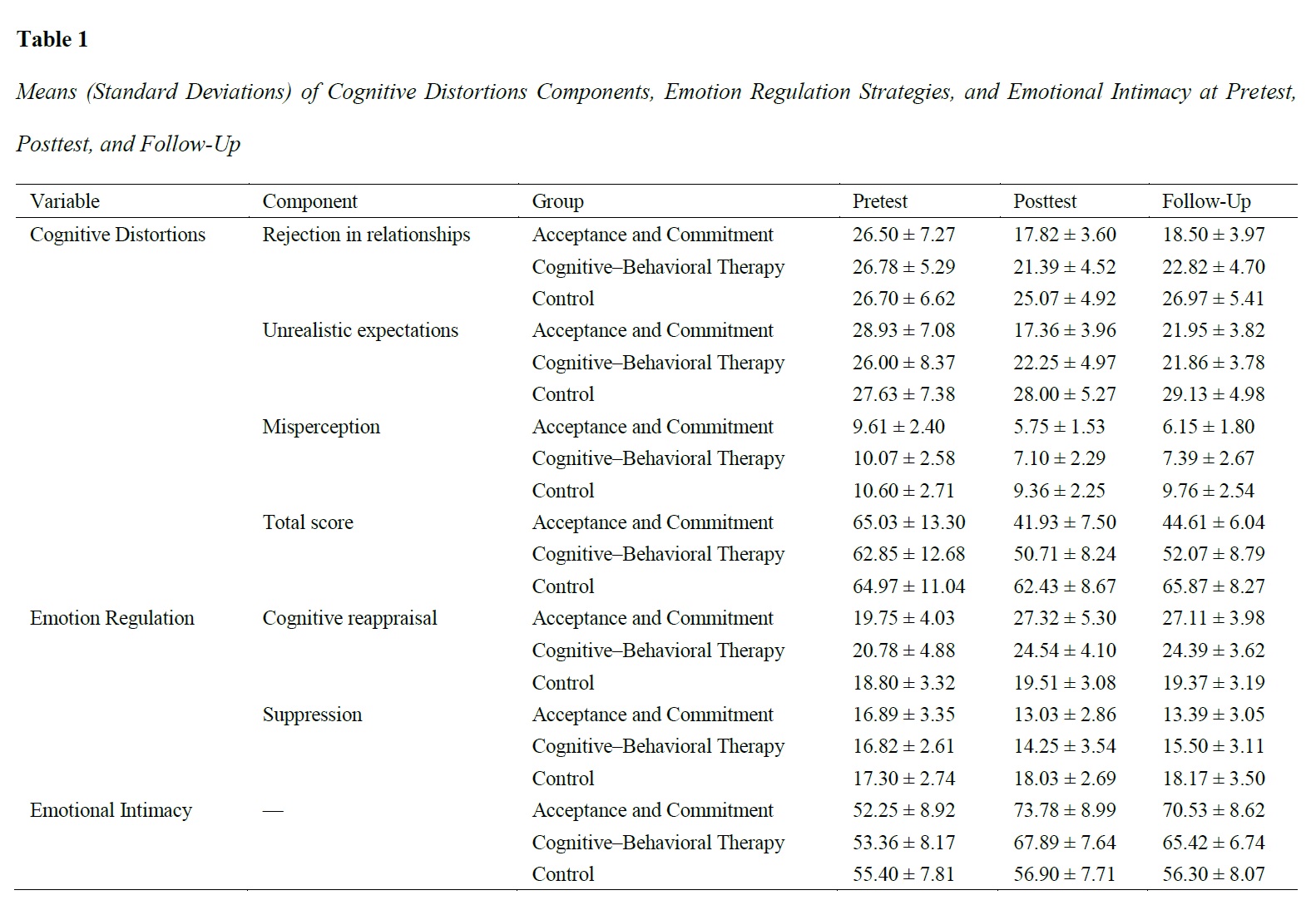
Findings: The results of repeated-measures analysis of variance indicated significant group × time interaction effects for all components and the total score of cognitive distortions, emotion regulation strategies, and emotional intimacy. Acceptance and commitment–based couple therapy produced significantly greater reductions in rejection in relationships, misperception, and total cognitive distortions compared with cognitive–behavioral couple therapy. Additionally, acceptance and commitment–based couple therapy led to a significantly greater increase in cognitive reappraisal and a greater reduction in emotion suppression. Emotional intimacy increased significantly in both experimental groups compared with the control group; however, the increase was significantly greater in the acceptance and commitment–based couple therapy group. These effects remained stable at the three-month follow-up.
Conclusion: Acceptance and commitment–based couple therapy was more effective than cognitive–behavioral couple therapy in reducing interpersonal cognitive distortions, improving emotion regulation strategies, and enhancing emotional intimacy in couples experiencing marital disenchantment, suggesting its particular suitability for interventions targeting emotional disengagement and cognitive rigidity in distressed marital relationships.
Downloads
References
Adabi, H., Azmoudeh, M., Misserabadi, J., & Hosseini Nasab, S. D. (2022). Determining the effectiveness of cognitive-behavioral couple therapy on marital conflicts, marital boredom, and emotional self-regulation in couples at risk of divorce in Baneh County. Journal of Disability Studies, 12(5), 2019-2207. https://jdisabilstud.org/browse.php?a_id=2777&slc_lang=en&sid=1&printcase=1&hbnr=1&hmb=1
Ali, M. A., & Saleem, S. (2022). Family communication and marital satisfaction: A mediating role of emotion regulation. Rawal Medical Journal, 47(3), 677-680. https://www.rmj.org.pk/?mno=98407
Alizadeh, S., Haroon Rashidi, H., & Kazemian Moghadam, K. (2021). The effectiveness of Acceptance and Commitment-based couple therapy on rumination and cognitive distortions in couples involved in infidelity. Quarterly Journal of Social Work, 10(2), 35-43. https://socialworkmag.ir/browse.php?a_id=662&sid=1&slc_lang=en
Amini, R., & Eshghi Nogoorani, R. (2024). The effectiveness of cognitive-behavioral couple therapy on marital satisfaction, cognitive distortions in interpersonal relationships, and emotional orientation towards sexual relations in married women experiencing marital boredom. https://civilica.com/doc/2120911/
Aydın, A., & Malak Akgün, B. (2022). Interpersonal cognitive distortions and family role performances in spouses during COVID-19 pandemic process in Turkey. Perspectives in psychiatric care, 58(1), 189-196. https://doi.org/10.1111/ppc.12795
Bagheri, S., Pasha, R., Eftekhari Saadi, Z., Hafezi, F., & Naderi, F. (2022). The effectiveness of integrative behavioral couple therapy on marital conflicts, couple intimacy, and family functioning in couples visiting counseling centers. Psychological Methods and Models, 13(47), 1-14. https://www.sid.ir/paper/999639/fa
Baucom, D. H., Fischer, M. S., Hahlweg, K., & Epstein, N. B. (2019). Cognitive behavioral couple therapy BOOKTITLE - APA handbook of contemporary family psychology: Family therapy and training. https://doi.org/10.1037/0000101-016
Bodenmann, G., Kessler, M., Kuhn, R., Hocker, L., & Randall, A. K. (2020). Cognitive-Behavioral and Emotion-Focused Couple Therapy: Similarities and Differences. Clin Psychol Eur, 2(3). https://doi.org/10.32872/cpe.v2i3.2741
Carasso, E., & Segel-Karpas, D. (2024). Marital strain and emotional intimacy in midlife couples: The moderating role of empathy. Personal Relationships, 31(3), 648-663. https://doi.org/10.1111/pere.12559
Chavira Trujillo, G., Gallego Tomás, M., & López-Pérez, B. (2022). The link between cognitive and affective empathy and interpersonal emotion regulation direction and strategies. Scandinavian journal of psychology, 63(6), 594-600. https://doi.org/10.1111/sjop.12847
Dattilio, F. M., & Epstein, N. B. (2021). Cognitive behavioral couple and family therapy. https://doi.org/10.1037/0000219-016
De Oliveira, L., Carvalho, J., & Nobre, P. (2021). A systematic review on sexual boredom. The Journal of Sexual Medicine, 18(3), 565-581. https://doi.org/10.1016/j.jsxm.2020.12.019
Ebrahimi, S., Moheb, N., & Alivani Vafa, M. (2024). Comparison of the Effectiveness of Cognitive-behavioral Therapy and Acceptance and Commitment Therapy on Cognitive Distortions and Rumination in Adolescents With Social Anxiety Disorder. Practice in Clinical Psychology, 12(1), 81-94. https://doi.org/10.32598/jpcp.12.1.922.1
Epstein, N. B., & Baucom, D. H. (2024). Advanced cognitive-behavioral couple therapy: A contextual approach. https://journals.kmanpub.com/index.php/psychnexus/article/view/4816
Epstein, N. B., Baucom, D. H., Kirby, J. S., & LaTaillade, J. J. (2019). Cognitive-behavioral couple therapy BOOKTITLE - Handbook of cognitive-behavioral therapies. The Guilford Press. https://pubmed.ncbi.nlm.nih.gov/28813285/
Fang, S., & Ding, D. (2023). The differences between acceptance and commitment therapy (ACT) and cognitive behavioral therapy: A three-level meta-analysis. Journal of Contextual Behavioral Science, 28, 149-168. https://doi.org/10.1016/j.jcbs.2023.03.015
Ghasemi Varnyab, B., Rahmani, M. A., Zarbakhs Bahri, M. R., & Abolghasemi, S. (2020). Presenting a structural model of marital commitment based on emotional maturity with the mediation of intimacy and interpersonal cognitive distortions. Islamic lifestyle with a focus on health, 4(1), 124-133. https://www.islamiilife.com/article_188521_en.html
Graziani, F., Mastrokoukou, S., Cattelino, E., Rollè, L., & Calandri, E. (2024). Conflict and Intimacy in Emerging Adults' Romantic Relationships and Depressive Symptoms: The Mediating Role of Identity and Couple Satisfaction. Behavioral Sciences, 14(11). https://doi.org/10.3390/bs14110977
Gross, J. J., & John, O. P. (2003). Individual differences in two emotion regulation processes: implications for affect, relationships, and well-being. Journal of personality and social psychology, 85(2), 348-362. https://doi.org/10.1037/0022-3514.85.2.348
Hamamci, Z., & Buyukozturk, S. (2004). The interpersonal cognitive distortions scale: Development and psychometric characteristics. Psychological Reports, 95, 291-303. https://doi.org/10.2466/pr0.95.1.291-303 10.2466/PR0.95.5.291-303
Hayes, S. C., & King, G. A. (2024). Acceptance and commitment therapy: What the history of ACT and the first 1,000 randomized controlled trials reveal. Journal of Contextual Behavioral Science, 33. https://doi.org/10.1016/j.jcbs.2024.100809
Jarnecke, A. M., Ridings, L. E., Teves, J. B., Petty, K., Bhatia, V., & Libet, J. (2020). The path to couples therapy: A descriptive analysis on a Veteran sample. Couple & Family Psychology, 9(2), 73-89. https://doi.org/10.1037/cfp0000135
Khodadadi Jokar, F., Panahi Far, S., & Yazdanbakhsh, K. (2022). Comparing the impact of couple therapy with Imago and Acceptance and Commitment models on the emotional regulation strategies of couples requesting divorce. Family Counseling and Psychotherapy, 12(2), 177-206. https://fcp.uok.ac.ir/m/article_62737.html?lang=en
Kibilahi, T., Karaskian, M., Adis, Havasis, S., Nahid, Mansoubi, F., Mohsen, & Tari Moradi, A. (2022). A meta-analysis and comparison of the effectiveness of Acceptance and Commitment-based therapy and integrative behavioral couple therapy on the components of marital quality in couples. Psychological Methods and Models, 13(47), 29-52. https://www.sid.ir/fa/VEWSSID/J_pdf/6010914014703.pdf
Kim, J., Falconier, M. K., & Conway, C. A. (2023). Relationships Among Emotion Regulation, Financial Self-Efficacy, and Financial Management Behaviors of Couples. J Fam Econ Iss, 44, 342-355. https://doi.org/10.1007/s10834-022-09827-2
Kohensal Nalkiyashari, S., Asadi Majreh, S., & Akbari, B. (2022). Presenting a structural model of the relationship between perceived parenting styles and risky behaviors through the mediation of resilience and emotion regulation in adolescents. Psychological Methods and Models, 13(47), 101-116. https://sid.ir/paper/1000041/en
Lebow, J., & Snyder, D. K. (2022). Couple therapy in the 2020s: Current status and emerging developments. Family Process, 61(4), 1359-1385. https://doi.org/10.1111/famp.12824 10.1111/famp.12615
Liu, H., Liu, N., Chong, S. T., Yau, E. K. B., & Badayai, A. R. A. (2023). Effects of acceptance and commitment therapy on cognitive function: A systematic review. Heliyon, 9(3). https://doi.org/10.1016/j.heliyon.2023.e14057
Lou, O., & McKee, M. (2021). Acceptance and Commitment Therapy for Couples: A Therapist's Guide. Arjomand Publishing. https://www.amazon.com/Acceptance-Commitment-Therapy-Couples-Relationships/dp/162625480X
Masuda, A., Morgan, L., Spencer, S. D., Qinaʻau, J., & Jo, D. (2021). Cultural adaptations of acceptance and commitment therapy. https://doi.org/10.1093/oxfordhb/9780197550076.013.30
Masumoto, K., Harada, K., & Shiozaki, M. (2022). Effect of emotion regulation on mental health of couples in long‐term marriages: One‐year follow‐up study. Japanese Psychological Research, 64(3), 360-368. https://doi.org/10.1111/jpr.12325
Mir Kazem, N. S., Shariatmadar, A., & Farahbakhsh, K. (2025). Comparing attitudes towards emotional expression in spouses among women with high and low emotional intimacy. Journal of Counseling and Psychotherapy Culture, 16(61), 1-32. https://qccpc.atu.ac.ir/article_18875.html
Moghim, F., Asadi, J. S., & Khvajavand Khoshli, A. (2022). Comparing the effectiveness of Acceptance and Commitment-based therapy and schema therapy on marital boredom and conflicts in clients visiting counseling centers in Gorgan. Journal of Cognitive Psychology and Psychiatry, 9(2), 16-34. https://doi.org/10.32598/shenakht.9.2.16
Parvizi, M., Askari, M., & Yousefi, E. (2025). Investigating the effectiveness of cognitive-behavioral therapy on marital boredom in women with marital conflict. Journal of Fundamentals of Mental Health, 27(2), 101-107. https://jfmh.mums.ac.ir/article_26087.html
Paul, H. A. (2018). Process-Based CBT: The Science and Core Clinical Competencies of Cognitive Behavior Therapy. https://doi.org/10.1080/07317107.2018.1522153
Pines, A. (2013). Couple burnout: Causes and cures. Routledge. https://doi.org/10.4324/9781315022291
Pines, A. M., & Nunes, R. (1996). The relationship between career and couple burnout: Implications for career and couple counseling. Journal of employment counseling, 40(2), 50-64. https://doi.org/10.1002/j.2161-1920.2003.tb00856.x
Qobadi Kohanmoei, N., Azmoudeh, M., Ismailpour, K., & Saken Azari, R. (2024). Comparing the effectiveness of cognitive-behavioral couple therapy and emotion-focused couple therapy on marital boredom in couples with emotional divorce. Quarterly Journal of Medical Sciences, Islamic Azad University of Tehran, 34(1), 64-72. https://doi.org/10.61186/iau.34.1.7
Rahimi, A., Amiri, H., Afsharnia, K., & Arefi, M. (2022). Comparing the effectiveness of cognitive-behavioral therapy with Acceptance and Commitment therapy on increasing marital satisfaction and reducing anxiety in couples visiting counseling centers. Disability Studies, 12, 0-0. https://www.sid.ir/paper/1121735/en
Ruiz, F. J. (2012). Acceptance and commitment therapy versus traditional cognitive behavioral therapy: A systematic review and meta-analysis of current empirical evidence. International journal of psychology and psychological therapy, 12(3), 333-358. https://www.ijpsy.com/volumen12/num3/334/acceptance-and-commitment-therapy-versus-EN.pdf
Salehi, H., Jahangiri, A., & Bakhshipour, A. (2021). Comparing the effectiveness of cognitive-behavioral couple therapy and Acceptance and Commitment-based couple therapy on reducing marital boredom in couples. Community Health, 15(1), 19-29. https://chj.rums.ac.ir/article_131129.html
Savaei Tiri, V., Haj Ali Abasi, R., Sarlak, N., Qudsi, M., & Rajani, A. A. (2021). The effectiveness of Acceptance and Commitment-based couple therapy on marital satisfaction and psychological flexibility in couples seeking divorce. Studies in Psychology and Educational Sciences, 7(1), 355-368. https://www.noormags.ir/view/fa/articlepage/1797296/
Sedaghatkhah, A., Kajbafnejad, H., Chinaveh, M., & Aminimanesh, S. (2022). Predicting Marital Conflicts Based on Dysfunctional Attitudes Mediated by Emotion Regulation. Iranian Evolutionary and Educational Psychology, 4(2), 352-363. https://doi.org/10.52547/ieepj.4.2.352
Shahbazfar, R., Zarei, I., Hajializadeh, K., & Dartaj, F. (2020). Comparing the effectiveness of cognitive-behavioral couple therapy and Acceptance and Commitment-based couple therapy on emotional-sexual needs. Behavioral Sciences Research, 18(3), 403-415. https://doi.org/10.52547/rbs.18.3.403
Shahbazfar, R., Zarei, I., Hajializadeh, K., & Dartaj, F. (2021). Comparing the effectiveness of cognitive-behavioral couple therapy and Acceptance and Commitment-based couple therapy on improving the marital quality of non-clinical couples. Psychological Methods and Models, 12(43), 100-113. https://www.sid.ir/fa/VEWSSID/J_pdf/6010914004311.pdf
Shakib, S. M. M., Tousi, M. S., & Fariborzi, E. (2020). Investigating the effectiveness of integrative-behavioral and acceptance and commitment couple therapies on improving marital intimacy and reducing irrational beliefs of couples. Archives of Pharmacy Practice, 11(1-2020), 117-124. https://archivepp.com/article/investigating-the-effectiveness-of-integrative-behavioral-and-acceptance-and-commitment-couple-therapies-on-improving-marital-intimacy-and-reducing-irrational-beliefs-of-couples
Stockton, D., Kellett, S., Berrios, R., Sirois, F., Wilkinson, N., & Miles, G. (2019). Identifying the underlying mechanisms of change during acceptance and commitment therapy (ACT): A systematic review of contemporary mediation studies. Behavioural and Cognitive Psychotherapy, 47(3), 332-362. https://doi.org/10.1017/S1352465818000553
Vaseghi, Z., Ahadi, H., Bigdeli, H., & Khalatbari, J. (2024). Predicting Marital Satisfaction Based on Cognitive Emotion Regulation Strategies with the Mediating Role of Resilience in Married Women. Applied Family Therapy Journal (AFTJ), 5(4), 21-29. https://doi.org/10.61838/kman.aftj.5.4.4
Walker, A. J., & Thompson, L. (1983). Intimacy and intergenerational aid and contact among mothers and daughters. Journal of Marriage and the Family, 45(4), 841-849. https://doi.org/10.2307/351796
Walser, R. D., & O'Connell, M. (2023). Alliance rupture and repair in acceptance and commitment therapy BOOKTITLE - Rupture and repair in psychotherapy: A critical process for change. https://doi.org/10.1037/0000306-008
Downloads
Additional Files
Publication Timeline
- Submitted
- Revised
- Accepted