Comparison of the Effectiveness of Acceptance and Commitment–Based Couple Therapy and Cognitive-Behavioral Couple Therapy on Emotion Regulation in Couples with Marital Burnout
DOI:
https://doi.org/10.61838/kman.fct.psynexus.4816Keywords:
couple therapy, acceptance and commitment, cognitive-behavioral, emotion regulation, marital burnoutAbstract
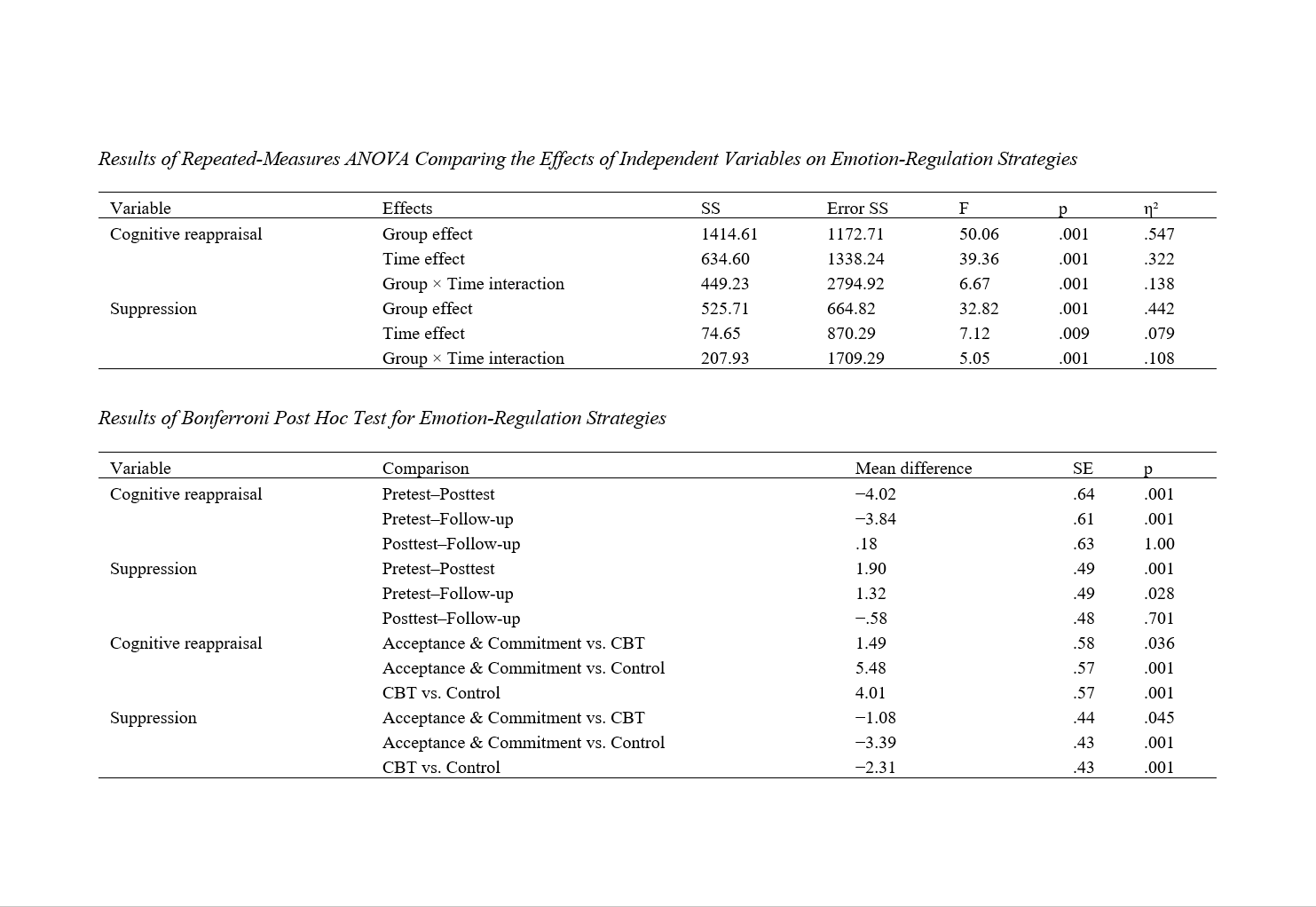
The present study was conducted to determine the difference in the effectiveness of Acceptance and Commitment–Based Couple Therapy and Cognitive-Behavioral Couple Therapy on emotion regulation in couples experiencing marital burnout. The research employed a quasi-experimental design with a pretest–posttest structure and a control group. The statistical population consisted of all couples aged 20–40 years who sought counseling and psychotherapy services with complaints of marital burnout at counseling and psychological treatment centers across Tehran in 2023. A purposive sampling method was used to select the participants. Forty-five couples were selected through purposive sampling and were randomly assigned to two experimental groups and one control group (15 couples each group). After completing the research procedures and based on the exclusion criteria, one couple from the Acceptance and Commitment–Based Couple Therapy group was removed, and the data of 14 couples were analyzed. In addition, one couple from the Cognitive-Behavioral Couple Therapy group was excluded due to absence from more than two sessions, and the data of 14 couples were analyzed, while all 15 couples in the control group participated in all stages. Data analysis was performed using repeated-measures analysis of variance. The results indicated that the difference between the effects of the two couple-therapy approaches—Acceptance and Commitment–Based Couple Therapy and Cognitive-Behavioral Couple Therapy—on the emotion-regulation strategies of reappraisal (p = .036) and suppression (p = .045) was statistically significant. Acceptance and Commitment–Based Couple Therapy, compared with Cognitive-Behavioral Couple Therapy, resulted in increased use of the reappraisal strategy and decreased use of the suppression strategy in emotion regulation.
Downloads
References
Adabi, H., Azmodeh, M., Mesrabadi, J., & Hosseininasab, S. D. (2022). Determining the Effectiveness of Cognitive-Behavioral Couple Therapy on Marital Conflicts, Marital Burnout, and Emotional Self-Regulation of Couples at Risk of Divorce in Baneh County. Journal of Disability Studies, 12(5), 2019-2027. https://jdisabilstud.org/browse.php?a_id=2777&slc_lang=en&sid=1&printcase=1&hbnr=1&hmb=1
Amini, R., & Eshghi Nogoorani, R. (2024). The Effectiveness of Cognitive-Behavioral Couple Therapy on Marital Satisfaction, Interpersonal Cognitive Distortions, and Emotional Orientation towards Sex in Married Women with Marital Burnout. The Second National Conference on Healthy Family, Healthy Society, Qayenat,
Ashouri, J. (2022). The Effectiveness of Reality-Guided Acceptance and Commitment Therapy on Emotion Regulation and Happiness of Couples. Psychological Dynamics in Mood Disorders, 1(1), 12-23. https://doi.org/10.61838/kman.pdmd.1.1.2
Aydin Sayilan, A., Kulakaç, N., & Uzun, S. (2021). Burnout levels and sleep quality of COVID-19 heroes. Perspectives in psychiatric care, 57(3), 1231-1236. https://doi.org/10.1111/ppc.12678
Baher Talari, M., Mikaeli, N., Aghajani, S., & Habibi, N. (2024). Predicting Marital Disappointment Based on Cognitive Distortions, Interpersonal Forgiveness, and Emotion Regulation Strategies in Married Individuals. Social Psychology Research, 14(53), 1-16. https://www.socialpsychology.ir/article_198039_en.html
Barbosa, C., Santos, S., & Pedro, J. (2024). Mapping acceptance and commitment therapy outcomes in the context of infertility: a systematic review. Curr Psychol, 43, 14634-14644. https://doi.org/10.1007/s12144-023-05294-6
Baucom, D. H., Fischer, M. S., Hahlweg, K., & Epstein, N. B. (2019). Cognitive behavioral couple therapy. In B. H. Fiese, M. Celano, K. Deater-Deckard, E. N. Jouriles, & M. A. Whisman (Eds.), APA handbook of contemporary family psychology: Family therapy and training (pp. 257-273). American Psychological Association. https://doi.org/10.1037/0000101-016
Bodenmann, G., Kessler, M., Kuhn, R., Hocker, L., & Randall, A. K. (2020). Cognitive-Behavioral and Emotion-Focused Couple Therapy: Similarities and Differences. Clin Psychol Eur, 2, e2741. https://doi.org/10.32872/cpe.v2i3.2741
Epstein, N. B., & Baucom, D. H. (2024). Advanced Cognitive-Behavioral Couple Therapy: A Contextual Approach. Arjmand Publications. https://books.google.com/books/about/Enhanced_Cognitive_behavioral_Therapy_fo.html?id=H_lfQgAACAAJ
Ghobadi Kohanmoui, N., Azmodeh, M., Ismailpour, K., & Saken Azari, R. (2024). Comparing the Effectiveness of Cognitive-Behavioral Couple Therapy and Emotion-Focused Couple Therapy on Marital Burnout in Couples with Emotional Divorce. Medical Journal of Islamic Azad University, Tehran, 34(1), 64-72. https://doi.org/10.61186/iau.34.1.7
Ghorbani, A. H. A., Moradi, O., Arefi, M., & Ahmadian, H. (2020). The Effectiveness of Cognitive-Behavioral Components Training on Cognitive Emotion Regulation Strategies, Resilience, and Self-Control in Divorced Women. Social Health, 7(2), 166-174. https://www.sid.ir/paper/383250/en
Goldin, P. R., Moodie, C. A., & Gross, J. J. (2019). Acceptance versus reappraisal: Behavioral, autonomic, and neural effects. Cognitive, Affective, & Behavioral Neuroscience, 19, 927-944. https://doi.org/10.3758/s13415-019-00690-7
Hayes, S. C., & King, G. A. (2024). Acceptance and commitment therapy: What the history of ACT and the first 1,000 randomized controlled trials reveal. Journal of Contextual Behavioral Science, 33, 100809. https://doi.org/10.1016/j.jcbs.2024.100809
Khodadadi Jokar, F., Panahifar, S., & Yazdanbakhsh, K. (2022). Comparing the Impact of Couple Therapy Using Imago and Acceptance and Commitment Models on the Emotion Regulation Strategies of Divorce-Seeking Couples. Family Counseling and Psychotherapy, 12(2), 177-206. https://fcp.uok.ac.ir/article_62737.html
Kim, J., Falconier, M. K., & Conway, C. A. (2023). Relationships Among Emotion Regulation, Financial Self-Efficacy, and Financial Management Behaviors of Couples. J Fam Econ Iss, 44, 342-355. https://doi.org/10.1007/s10834-022-09827-2
Kohansal Nalkiashari, S., Asadi Majreh, S., & Akbari, B. (2022). Presenting a Structural Model of the Relationship Between Perceived Parenting Styles and High-Risk Behaviors Through the Mediation of Resilience and Emotion Regulation in Adolescents. Psychological Methods and Models, 13(47), 101-116. https://sid.ir/paper/1000041/en
Lebow, J., & Snyder, D. K. (2022). Couple therapy in the 2020s: Current status and emerging developments. Family Process, 61(4), 1359-1385. https://doi.org/10.1111/famp.12824
Luoma, J. B., & McKay, M. (2021). Learning ACT for Couples: A Therapist's Guide. Arjmand Publications.
Mardani, F., Yousefi, S. A., Ghorbani, E., & Mirzaei, Z. (2023). The Effectiveness of Reality-Guided Acceptance and Commitment Therapy (RACT) on Marital Burnout and Alexithymia in Couples. Measurement and Research in Applied Counseling, 5(1), 10-20. https://doi.org/10.61838/kman.jarac.5.1.2
Mirzaei Jahed, A., & Saberi, H. (2019). Predicting Marital Burnout in Women Based on Their Sexual Attitudes and Their Husbands' Tendency towards Dark Personality Traits. Applied Psychology Journal, 13(3), 371-389. https://apsy.sbu.ac.ir/article_97235.html?lang=en
Miu, A. C., Szentágotai-Tătar, A., Balazsi, R., Nechita, D., Bunea, I., & Pollak, S. D. (2022). Emotion regulation as mediator between childhood adversity and psychopathology: A meta-analysis. Clinical psychology review, 93, 102141. https://doi.org/10.1016/j.cpr.2022.102141
Najarnasab, S., Dasht Bozorgi, Z., Safarzadeh, S., & Talebzadeh Shoushtari, M. (2024). The Efficacy of Acceptance and Commitment Therapy (ACT)-Based Couples Therapy on Marital Quality of Life and Emotion Regulation in Distressed Couples. Avicenna Journal of Neuro Psycho Physiology. https://ajnpp.umsha.ac.ir/article-1-500-fa.html
Navidi, F. (2005). Investigation and Comparison of the Relationship Between Marital Burnout and Organizational Climate Factors Among Employees of Education Departments and Nurses in Tehran City Hospitals https://elmnet.ir/doc/10761296-20823
Odebunmi, O., & Сабіна, Н. Ю. (2025). Emotional Regulation as a Mediator of Personality Traits and Marital Satisfaction Among Academic Staff in Colleges of Education in Oyo State. Mejaee. https://doi.org/10.70382/mejaee.v7i8.028
Ong, C. W., Levin, M. E., & Twohig, M. P. (2020). Beyond acceptance and commitment therapy: Process-based therapy. The Psychological Record, 70, 637-648. https://doi.org/10.1007/s40732-020-00397-z
Parvizi, M., Askari, M., & Yousefi, E. (2025). Comparison of the Effectiveness of Cognitive-Behavioral Therapy and Metaphor Therapy on Marital Burnout in Women With Marital Conflicts. Aftj, 6(1), 141-148. https://doi.org/10.61838/kman.aftj.6.1.14
Pouya, F. H., Gharamaleki, N. S., & Mirzahosseini, H. (2025). The Structural Model for Predicting Marital Burnout Based on Attachment Styles With the Mediating Role of Marital Self-Regulation and Marital Intimacy in Married Individuals. Aftj, 6(1), 29-36. https://doi.org/10.61838/kman.aftj.6.1.4
Razzaghi, M., Zemestani, M., & Mashhadi, A. (2025). Effectiveness of Emotional Schema Therapy on Anxiety Symptoms, Emotion Regulation, and Marital Satisfaction in Women with Anxiety Disorders: A Preliminary Study. International Journal of Cognitive Behavioral Therapy. https://link.springer.com/article/10.1007/s41811-025-00238-3
Salehi, H., Jahangiri, A., & Bakhshipour, A. (2021). Comparing the Effectiveness of Cognitive-Behavioral Couple Therapy and Acceptance and Commitment-Based Couple Therapy on Reducing Marital Burnout in Couples. Community Health, 15(1), 19-29. https://chj.rums.ac.ir/article_131129_en.html
Spidel, A., Lecomte, T., Kealy, D., & Daigneault, I. (2018). Acceptance and commitment therapy for psychosis and trauma: Improvement in psychiatric symptoms, emotion regulation, and treatment compliance following a brief group intervention. Psychology and Psychotherapy: Theory, Research and Practice, 91(2), 248-261. https://doi.org/10.1111/papt.12159
Thomas, R., Shelley-Tremblay, J., & Joanning, H. (2020). Anxiety Explains Self-Differentiation: Implications for Bowenian Approaches to Marriage and Family Therapy. The American Journal of Family Therapy, 1-16. https://doi.org/10.1080/01926187.2020.1841586
Walser, R. D., & O'Connell, M. (2023). Alliance rupture and repair in acceptance and commitment therapy. In C. F. Eubanks, L. W. Samstag, & J. C. Muran (Eds.), Rupture and repair in psychotherapy: A critical process for change (pp. 165-186). American Psychological Association. https://doi.org/10.1037/0000306-008
Yadolahi, S., Mirzaei, S. H., & Soleimianian, A. A. (2025). Comparing the efficacy of counseling based on acceptance commitment approach and the compassion approach in a group way on emotion regulation and the quality of marital relationship in infertile women. Journal of Psychological Science, 24(149), 287-305. https://psychologicalscience.ir/article-1-2488-en.html
Yarmohammadi Vasel, M., Yazdi Panah, M., & Mohagheghi, H. (2023). The Relationship Between Marital Burnout and Marital Expectations and Cognitive Fusion in Married Women: The Mediating Role of Emotional Cutoff. Modern Psychological Research Journal, 18(69), 267-276. https://psychologyj.tabrizu.ac.ir/article_16241.html?lang=en
Yu, K. R. (2021). Why do we resolve marital conflicts the way we do? Self‐construals, marital conflict resolution strategies, and marital satisfaction in Japan and South Korea. Asian Journal of Social Psychology, 24(1), 59-68. https://doi.org/10.1111/ajsp.12424
Downloads
Additional Files
Publication Timeline
- Submitted
- Revised
- Accepted