Conceptualizing Communicative Citizenship in the Fragmented Public Sphere of the Media City: A Meta-Synthesis Approach
Keywords:
communicative citizenship, media city, fragmented public sphere, meta-synthesis, communicative action, platform governanceAbstract
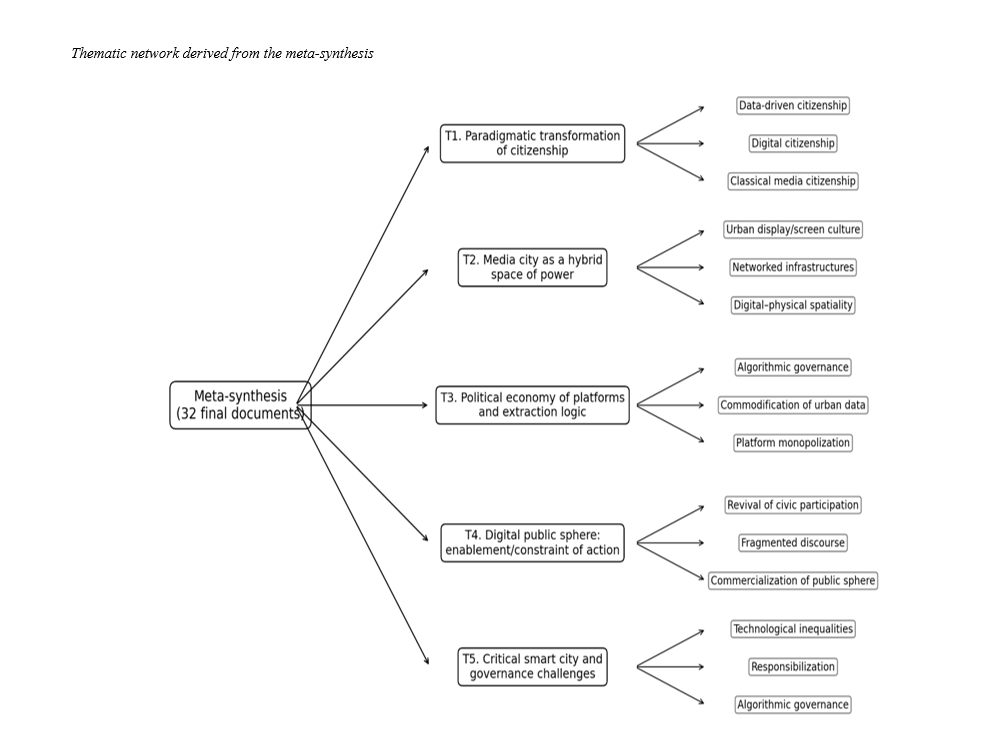
This study conceptualizes communicative citizenship within the fragmented public sphere of the media city. As urban life becomes deeply entangled with platforms, data infrastructures, and algorithmic systems, classical citizenship—primarily defined through legal rights, duties, and institutional participation—has become insufficient for explaining contemporary forms of civic agency. Using a qualitative meta-synthesis, 32 scholarly documents selected through a PRISMA-guided screening process were critically interpreted across communication studies, urban sociology, platform studies, and critical smart-city research. The synthesis identifies five interrelated themes: the paradigmatic transformation of citizenship; the media city as a hybrid space of power; the political economy of platforms and extraction; the digital public sphere as a simultaneous site of enablement and constraint; and critical smart-city governance. Across these themes, communicative citizenship emerges as a dynamic position generated through the interaction of structure, agency, and context. It ranges from the passive citizen-as-data, whose everyday activity is converted into economic value, to the active citizen-as-network or communicative citizen, capable of dialogue, mobilization, meaning-making, and participatory regulation. The findings suggest that communicative citizenship is not a fixed legal status but a contested process shaped by unequal infrastructures, platform monopolization, algorithmic governance, and citizens’ capacity for critical engagement. Equitable access to communication infrastructures, critical media literacy, and protection of urban-media spaces for dialogue are therefore central conditions for strengthening communicative citizenship.
Downloads
References
Amin, A., & Thrift, N. (2002). Cities: Reimagining the urban. Polity. Amin, A. and N. Thrift (2002). Cities: Reimagining the urban, Polity.
Couldry, N., & Mejias, U. A. (2019). The costs of connection: How data is colonizing human life and appropriating it for capitalism. Stanford University Press. https://doi.org/10.1515/9781503609754
Creswell, J. W., & Poth, C. N. (2018). Qualitative inquiry and research design: Choosing among five approaches (4th ed.). SAGE. https://cir.nii.ac.jp/crid/1571980074750071040
Dahlgren, P. (2005). The Internet, public spheres, and political communication: Dispersion and deliberation. Political Communication, 22(2), 147-162. https://doi.org/10.1080/10584600590933160
Fuchs, C. (2020). Communication and capitalism: A critical theory. University of Westminster Press. https://doi.org/10.16997/book45
Graham, S., & Marvin, S. (2001). Splintering urbanism: Networked infrastructures, technological mobilities and the urban condition. Routledge. https://doi.org/10.4324/9780203452202
Habermas, J. (1984). The theory of communicative action: Vol. 1. Reason and the rationalization of society. Beacon Press. http://www.unm.edu/~rlwood/Richard_Wood/TEACHING_files/Soc514syl.Spring2009.final.pdf
Habermas, J. (1987). The theory of communicative action: Vol. 2. Lifeworld and system: A critique of functionalist reason. Beacon Press. https://books.google.com/books?hl=en&lr=&id=uQv2VH-wmHwC&oi=fnd&pg=PP7&dq=Habermas,+J.+(1987).+The+theory+of+communicative+action:+Vol.+2.+Lifeworld+and+system:+A+critique+of+functionalist+reason,+Beacon+Press.+%09&ots=SAboxISN2t&sig=iQhWQUu5XovGNyzFjpk6RRQfc0o
Habermas, J. (1989). The structural transformation of the public sphere: An inquiry into a category of bourgeois society. MIT Press. https://www.academia.edu/download/73747464/632c3f986c8c699fd73ab75298be033b161f.pdf
Habermas, J. (1996). Between Facts and Norms: Contributions to a Discourse Theory of Law and Democracy. MIT Press.
Isin, E. F., & Nielsen, G. M. (2008). Acts of citizenship. Zed Books. https://books.google.com/books?hl=en&lr=&id=-TpOEAAAQBAJ&oi=fnd&pg=PR5&dq=Isin,+E.+F.+and+G.+M.+Nielsen+(2008).+Acts+of+citizenship,+Zed+Books.+%09&ots=zeIJw5J4MW&sig=SnzEipzY8h5xPxcvvfRqW3w7kxo
McQuire, S. (2008). The media city: Media, architecture and urban space. SAGE. https://doi.org/10.4135/9781446269572
Papacharissi, Z. (2010). A private sphere: Democracy in a digital age. Polity. https://books.google.com/books?hl=en&lr=&id=cNMhtalEJDUC&oi=fnd&pg=PR1&dq=Papacharissi,+Z.+(2010).+A+private+sphere:+Democracy+in+a+digital+age,+Polity.+%09&ots=DjJqo9q6Nr&sig=v0nPGESuhrahTBQp5tvqZrG01E0
Pariser, E. (2011). The filter bubble: What the Internet is hiding from you. Penguin Press. https://doi.org/10.3139/9783446431164
Sandelowski, M., & Barroso, J. (2006). Handbook for synthesizing qualitative research. Springer Publishing Company.
van Dijck, J. (2014). Datafication, dataism and dataveillance: Big Data between scientific paradigm and ideology. Surveillance & Society, 12(2), 197-208. https://doi.org/10.24908/ss.v12i2.4776
van Dijck, J., Poell, T., & de Waal, M. (2018). The platform society: Public values in a connective world. Oxford University Press. https://doi.org/10.1093/oso/9780190889760.001.0001
Zuboff, S. (2019). The age of surveillance capitalism: The fight for a human future at the new frontier of power. PublicAffairs.
Downloads
Publication Timeline
- Submitted
- Revised
- Accepted