Transformer-Based Multi-Horizon Traffic Forecasting in Bulk Port Environments
Keywords:
Transformer-Based Traffic Forecasting, Port Traffic Forecasting, Multi-Horizon Time Series, Discrete-Event SimulationAbstract
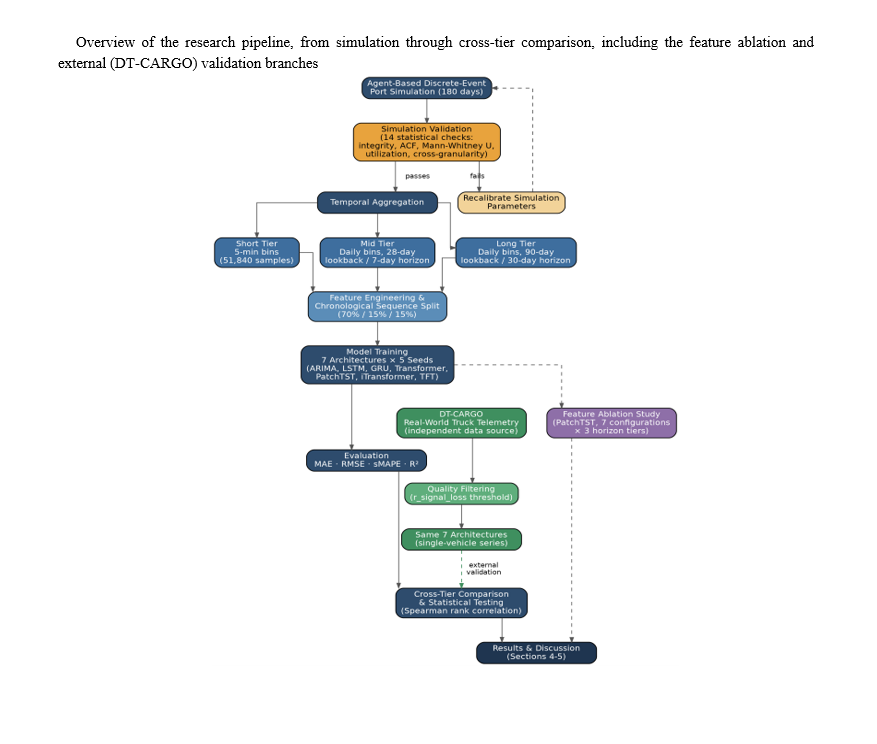
Reliable multi-horizon traffic forecasts can improve operational planning at bulk ports, but the performance of data-intensive forecasting models depends on training-set size and forecast horizon. This study compares seven architectures—ARIMA, LSTM, GRU, a standard Transformer, PatchTST, iTransformer, and the Temporal Fusion Transformer—using aggregate vehicle counts and mean speeds generated by a statistically checked agent-based discrete-event simulation. Forecasts cover short (15–30-minute), medium (seven-day), and long (30-day) horizons. A preliminary 569-observation short-horizon experiment favored ARIMA; after expanding the simulated short-horizon series to 51,840 observations, all six deep models outperformed that baseline. For 15-minute vehicle-count prediction, PatchTST achieved R² = 0.4921 compared with ARIMA's R² = 0.3632. Mean R² varied non-monotonically across short, medium, and long horizon tiers (0.290, 0.517, and 0.325, respectively). The greatest transformer advantages emerged in longer-horizon speed forecasts, where PatchTST attained R² values of 0.9821 and 0.9741 at the medium and long tiers. Feature-ablation results suggested that the value of additional predictors depended on sample availability. A supplementary evaluation using independent DT-CARGO truck telemetry supported the advantage of deep approaches over ARIMA, although recurrent models slightly surpassed transformer variants on that external series. These findings support horizon- and data-aware model selection rather than a universal architectural ranking. Results based on simulation require validation in operational bulk-port settings.
Downloads
References
Balke, G., & Adenaw, L. (2023). Heavy commercial vehicles' mobility: Dataset of trucks' anonymized recorded driving and operation (DT-CARGO). Data in Brief, 48, 109246. https://doi.org/10.1016/j.dib.2023.109246
Chan, K. C. (2022). Generation of synthetic manufacturing datasets for machine learning using discrete-event simulation. Production & Manufacturing Research, 10, 337-353. https://doi.org/10.1080/21693277.2022.2086642
Dos Santos, R. P., Matos-Carvalho, J. P., & Leithardt, V. R. Q. (2025). Deep learning in time series forecasting with transformer models and RNNs. PeerJ Computer Science, 11, e3001. https://doi.org/10.7717/peerj-cs.3001
Kambale, W. V. (2023). Transformers in Time Series Forecasting: A Brief Transfer Learning Performance Analysis 2023 27th International Conference on Circuits, Systems, Communications and Computers (CSCC),
Lamdjad, B. (2025). Comparative forecasting of container throughput for maritime logistics using statistical, machine learning and explainable AI models. Maritime Business Review, 11(3), 202-218. https://doi.org/10.1108/MABR-08-2025-0086
Li, H., Zhao, J., Jia, P., Ou, H., & Zhao, W. (2025). Optimization of Bulk Cargo Terminal Unloading and Outbound Operations Based on a Deep Reinforcement Learning Framework. Journal of Marine Science and Engineering, 13(1), 105. https://doi.org/10.3390/jmse13010105
Lim, B., Arık, S. Ö., Loeff, N., & Pfister, T. (2021). Temporal Fusion Transformers for Interpretable Multi-Horizon Time Series Forecasting. International Journal of Forecasting, 37(4), 1748-1764. https://doi.org/10.1016/j.ijforecast.2021.03.012
Liu, W., Xu, B., & Li, J. (2025). Data-Driven Carbon Emission Dynamics Under Ship In-Port Congestion. Journal of Marine Science and Engineering, 13(4), 812. https://doi.org/10.3390/jmse13040812
Miño Calero, A., Rasheed, A., & Lekkas, A. M. (2026). Unveiling the limitations of transformer models in time series forecasting. Progress in Artificial Intelligence, 15, 1179-1200. https://doi.org/10.1007/s13748-026-00450-y
Nie, Y., Nguyen, N. H., Sinthong, P., & Kalagnanam, J. (2023). A time series is worth 64 words: Long-term forecasting with transformers International Conference on Learning Representations (ICLR), https://arxiv.org/abs/2211.14730
Okamoto, Y. (2026). Transformers for time-series forecasting: A comprehensive survey through 2024. Nonlinear Theory and Its Applications, IEICE, 17(1), 260-278. https://doi.org/10.1587/nolta.17.260
Shah, A. B. A., Xu, X., Yongren, Z., & Guo, Z. (2025). A Custom Deep Learning Approach for Traffic Flow Prediction in Port Environments: Integrating RCNN for Spatial and Temporal Analysis. International journal of advanced computer science and applications, 16(2). https://doi.org/10.14569/IJACSA.2025.0160266
Vaswani, A. (2017). Attention is all you need Advances in Neural Information Processing Systems,
Wang, M., Guo, X., She, Y., Zhou, Y., Liang, M., & Chen, Z. S. (2024). Advancements in Deep Learning Techniques for Time Series Forecasting in Maritime Applications: A Comprehensive Review. Information, 15(8), 507. https://doi.org/10.3390/info15080507
Zhou, H. (2020). Informer: Beyond Efficient Transformer for Long Sequence Time-Series Forecasting. arXiv, abs/2012.07436. https://doi.org/10.1609/aaai.v35i12.17325
Zhu, Y. (2023). DRCNN: decomposing residual convolutional neural networks for time series forecasting. Scientific Reports, 13. https://doi.org/10.1038/s41598-023-42815-6
Downloads
Publication Timeline
- Submitted
- Revised
- Accepted