Complementary Analysis of Self-Report Instruments in Enhancing the Accuracy of Electroencephalography (EEG) Results in Marketing
DOI:
https://doi.org/10.61838/kman.aitech.5588Keywords:
Neuromarketing, Electroencephalography (EEG), Self-Report Instruments, Consumer Decision-Making, Systematic Review.Abstract
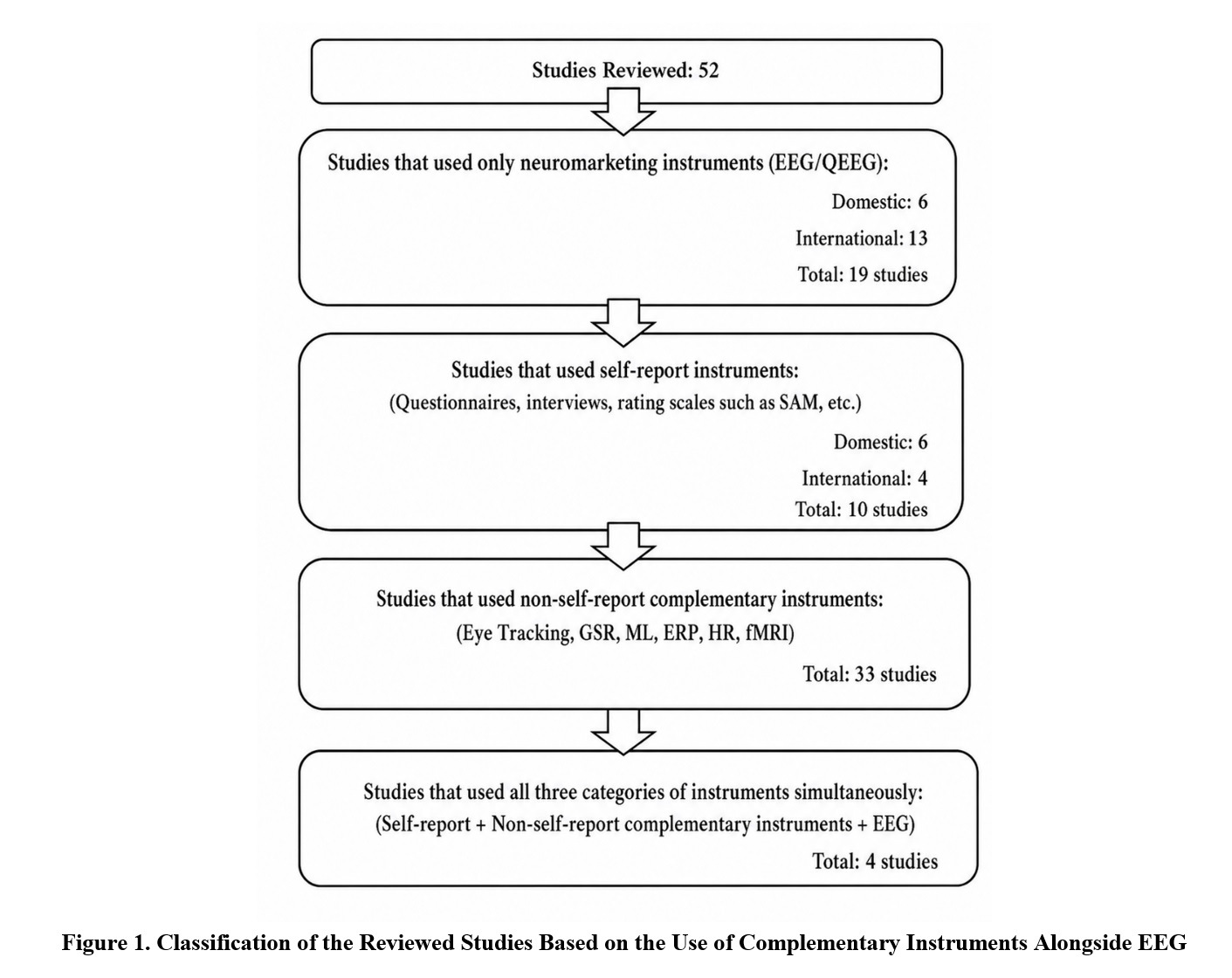
Neuromarketing employs tools such as electroencephalography (EEG) to uncover the unconscious layers of consumer decision-making. However, exclusive reliance on neural data may lead to incomplete and, in some cases, misleading interpretations. Using a systematic review approach, this study identified and analyzed 52 domestic and international studies in which EEG and complementary instruments were applied in the field of marketing. The studies were classified into four categories based on the types of instruments used: exclusive use of EEG/QEEG, self-report instruments, non-self-report complementary instruments, and integrated approaches. The findings indicate that although EEG possesses a strong capability for capturing unconscious responses, its integration with questionnaires, interviews, eye-tracking, physiological indicators, and machine-learning algorithms significantly enhances data interpretation accuracy and the predictive power of consumer behavior models. Furthermore, a considerable gap was observed between domestic and international studies regarding the adoption of multimodal approaches. Accordingly, the present study emphasizes the necessity of developing integrated models and designing standardized protocols to improve the accuracy and validity of neuromarketing findings.
Downloads
References
Adalarasu, T., Kumar, D., & Lee, J. (2025). Neural Signaling Techniques in Advertising Validation: Detecting Consumer Responses and Behavioral Trends. Journal of Consumer Psychology, 35(1), 102-115. https://doi.org/10.1002/jcpy.1400
Ariely, D., & Berns, G. S. (2010). Neuromarketing: The Hope and Hype of Neuroimaging in Business. Nature Reviews Neuroscience, 11(4), 284-292. https://doi.org/10.1038/nrn2795
Artenzio, A., Gallo, V., & Mariotti, S. (2022). Investigating Physiological Brain Responses During Coffee Consumption: An EEG Study. Journal of Sensory Studies, 37(2), e12812. https://doi.org/10.1111/joss.12812
Cohen, M. X. (2023). Analyzing Neural Time Series Data: The Fundamentals of EEG and MEG. MIT Press. https://doi.org/10.7551/mitpress/14426.001.0001
Cook, I. A., & Warren, C. (2011). EEG Signal Applications in Neuromarketing. Journal of Advertising Research, 51(2), 1-10.
García-Madariga, J., Rojas, F., & Artacho, M. (2019). Attention and Declared Preferences in Consumer Behavior: An EEG and Eye-Tracking Study on Packaging Features. Journal of Consumer Research, 46(2), 215-231. https://doi.org/10.1093/jcr/ucy068
Garcia-Marques, T., Almeida, T., & Esteves, F. (2024). Psychophysiological Correlates of Emotional Engagement in Marketing Stimuli. Journal of Consumer Psychology, 34(2), 317-332. https://doi.org/10.1002/jcpy.1352
Ghazvini, N. S., Nazari, E., Salleh, N. Z. M., & Baharun, R. (2024). The Role and Application of Artificial Intelligence in Neuromarketing Research Based on Electroencephalography (EEG). International Journal of Academic Research in Business and Social Sciences, 14(12), 1556-1567. https://doi.org/10.6007/IJARBSS/v14-i12/24111
Grimmond, J., Brown, S. D., & Hawkins, G. E. (2024). A Solution to the Pervasive Problem of Response Bias in Self-Reports. Proceedings of the National Academy of Sciences, 121(52). https://doi.org/10.1073/pnas.2412739121
Guo, Y., Zhao, W., & Zhang, T. (2025). Advances in Neuromarketing Research: A Systematic Review of EEG and fMRI Applications in Consumer Decision-Making. Frontiers in psychology, 16, 1543212. https://doi.org/10.3389/fpsyg.2025.1543212
Gupta, R. (2025). Neuro-Insights: A Systematic Review of Neuromarketing and Proposed Typologies. Frontiers in psychology, 16, 1457321.
Hakim, A. (2021). Consumer Preference Prediction Using EEG and Machine Learning Techniques. Neuroscience Informatics.
Hakim, A., Levy, D. J., & Plassmann, H. (2023). Decoding Consumer Valuation Using EEG and Machine Learning. NeuroImage, 275, 120210. https://doi.org/10.1016/j.neuroimage.2023.120210
Hakim, A., Levy, D. J., & Uzunoglu, E. (2021). Neuromarketing and Consumer Neuroscience: Contributions to Marketing Research. Journal of Business Research, 132, 724-735. https://doi.org/10.1016/j.jbusres.2020.10.050
Hakim, J., Alhassan, F., & Jahan, S. (2021). Enhancing Preference Prediction with EEG Metrics and Machine Learning in Food Product Advertisements. Journal of Consumer Psychology, 31(4), 862-877. https://doi.org/10.1002/jcpy.1312
Hsu, M., & Yoon, C. (2021). The Neuroscience of Consumer Choice: Challenges and Opportunities. Journal of Consumer Psychology, 31(2), 270-276. https://doi.org/10.1002/jcpy.1223
Huo, Y., Zhang, Y., & Liu, J. (2023). Examining Brand Personality Images and Physiological Responses Using EEG and GSR: Insights from Executive Functions. Journal of Consumer Psychology, 33(2), 305-318. https://doi.org/10.1002/jcpy.1380
Khondakar, M. F., Sarowar, M. H., Chowdhury, M. H., Majumder, S., Hossain, M. A., Dewan, M. A. A., & Hossain, Q. D. (2024). A Systematic Review on EEG-Based Neuromarketing: Recent Trends and Analyzing Techniques. Brain Informatics, 11(1), 17. https://doi.org/10.1186/s40708-024-00229-8
Lee, N., Broderick, A. J., & Chamberlain, L. (2007). What Is Neuromarketing? A Discussion and Agenda for Future Research. International Journal of Psychophysiology, 63(2), 199-204. https://doi.org/10.1016/j.ijpsycho.2006.03.007
Ma, Y., Li, Z., & Cheng, W. (2024). EEG-Based Prediction of Brand Preference Using Multiband Neural Signatures. Neuroscience & Biobehavioral Reviews, 154, 105572. https://doi.org/10.1016/j.neubiorev.2023.105572
Malhotra, N. K. (2019). Marketing Research: An Applied Orientation (7th ed.). Pearson.
Mashrur, F. R. (2023). An EEG-Based Intelligent Neuromarketing System for Predicting Consumers’ Choice. In The Fourth Industrial Revolution and Beyond. Springer Nature Singapore.
Mashrur, F. R., Rahman, K. M., Miya, M. T. I., Vaidyanathan, R., Anwar, S. F., Sarker, F., & Mamun, K. A. (2022). An Intelligent Neuromarketing System for Predicting Consumers’ Future Choices from Electroencephalography Signals. Physiology & Behavior, 253, 113847. https://doi.org/10.1016/j.physbeh.2022.113847
Nazari Ghazvini, S., Vakil Alroaia, Y., & Baharon, R. B. (2023). The Study of Electroencephalography in Neuromarketing Research, Consumer Behavior and Performance Method: A Systematic Analysis. Journal of System Management, 9(4), 185-204.
Nazari Ghazvini, S., Vakil Alroaia, Y., & Bin Baharun, R. (2025). EEG-Based Analysis of Consumer Neurological Responses to Energy Drink Brands: A Cross-Cultural Study in Iran and Malaysia. International Journal of Body, Mind and Culture, 12(4), 54-63. https://doi.org/10.61838/ijbmc.v12i4.881
Nor, N. F. M., Iqbal, N., & Shaari, A. H. (2025). The Role of False Self-Presentation and Social Comparison in Excessive Social Media Use. Behavioral Sciences, 15(5), 675. https://doi.org/10.3390/bs15050675
Othman, A., Jamal, A., & Alhassan, F. (2025). Multimodal Prediction of Consumer Choice Using EEG Signals and Eye Tracking. Journal of Advertising, 54(1), 128-145. https://doi.org/10.1080/00913367.2024.0011234
Ozair, A., Wang, Y., & Jahan, S. (2024). Neuromarketing and Decision Making: Classifying Consumer Preferences Based on Analysis of EEG Signal Changes in Brain Regions. Journal of Consumer Research, 51(2), 284-299. https://doi.org/10.1093/jcr/ucad003
Panda, S., Kumar, R., & Bansal, A. (2023). A Neuro-Based Recommender System Using EEG to Enhance Consumer Shopping Experience. Journal of Retailing and Consumer Services, 72, 102161. https://doi.org/10.1016/j.jretconser.2023.102161
Pasoorani, A., Jahan, S., & Alhassan, F. (2024). Understanding Consumer Perceptions of Factors Influencing Online Purchase Decisions: Evidence from EEG and Eye Tracking. Journal of Marketing Research, 61(1), 45-60. https://doi.org/10.1177/00222437221100233
Paulhus, D. L., & Vazire, S. (2007). The Self-Report Method. In Handbook of Research Methods in Personality Psychology (pp. 224-239). Guilford Press.
Pereira, A., & Oliveira, M. (2021). Consumer Behavior Study Using EEG and ERP: Insights from Price Perception in Sneaker Models. Journal of Consumer Behaviour, 20(5), 868-876. https://doi.org/10.1002/cb.1894
Plassmann, H., Ambler, T., Braeutigam, S., & Kenning, P. (2012). What Can Advertisers Learn from Neuroscience? International Journal of Advertising, 31(3), 673-684. https://doi.org/10.2501/IJA-31-3-673-684
Plassmann, H., Venkatraman, V., Huettel, S., & Yoon, C. (2012). Consumer Neuroscience: Applications, Challenges, and Possible Solutions. Journal of Marketing Research, 49(4), 427-435. https://doi.org/10.1509/jmr.09.0394
Semunova, Y., Drozdova, Y., & Odintsova, S. (2023). Evaluating Consumers’ Willingness to Pay for Chocolate Products Using EEG: Insights from Packaging Features. Journal of Consumer Research, 50(1), 112-123. https://doi.org/10.1093/jcr/ucad005
Tabak Kızgın, K., & Alp, S. (2024). Studying the Impact of Changing Consumer Behavior During Crisis Periods Through Store Classification. International Journal of Computational Intelligence Systems, 17, 288. https://doi.org/10.1007/s44196-024-00694-3
Venkatraman, V., Dimoka, A., Pavlou, P. A., Vo, K., Hampton, W., Bollinger, B., Hershfield, H. E., Ishihara, M., & Winer, R. S. (2015). Predicting Advertising Success Beyond Traditional Measures: New Insights from Neurophysiological Methods and Market Response Modeling. Journal of Marketing Research, 52(4), 436-452. https://doi.org/10.1509/jmr.13.0593
Yin, Y., Li, J., & Wang, Q. (2021). The Impact of Online Advertising on Human Responses Using Eye Tracking, EEG, and MRI. Journal of Advertising, 50(3), 344-358. https://doi.org/10.1080/00913367.2020.1749250
Zurawicki, L. (2010). Neuromarketing: Exploring the Brain of the Consumer. Springer.
Downloads
Publication Timeline
- Submitted
- Revised
- Accepted