Explaining and Structuring a Smart Supply Chain Resilience Model in the Face of Global Market Turbulence: A Case Study of the Carpet Industry
Keywords:
smart resilience; supply chain resilience; artificial intelligence; global market turbulence; carpet industry; interpretive structural modeling; grounded theoryAbstract
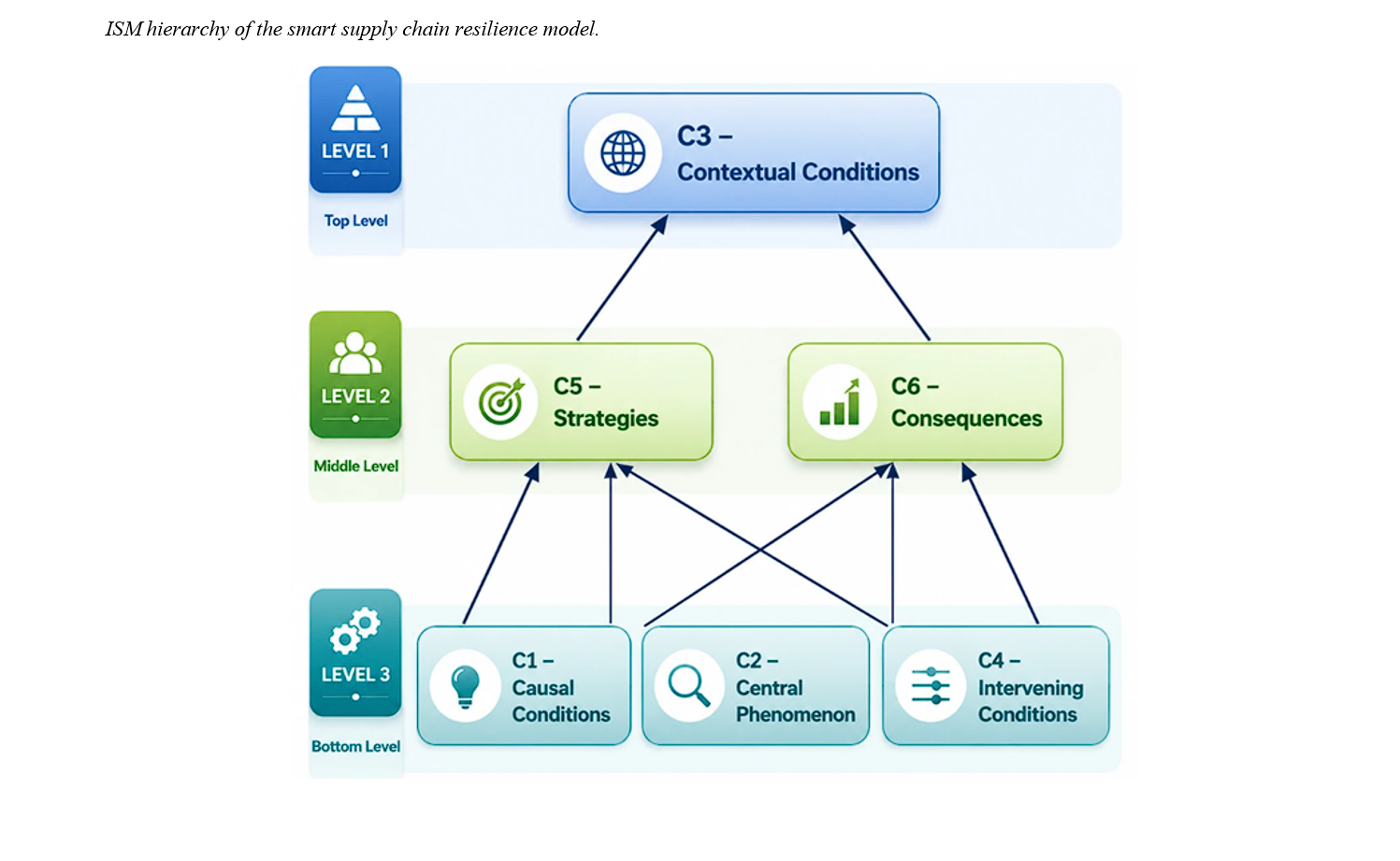
Global market turbulence, technological change, and competitive pressure have exposed the Iranian carpet industry's supply chain to significant structural and operational vulnerabilities. In this context, a smart resilience model is needed to preserve competitiveness, improve adaptability, and support data-driven decision-making. This study aimed to explain and structure a localized model of smart supply chain resilience in the carpet industry. The study used an applied, exploratory mixed-methods design combining grounded theory and interpretive structural modeling (ISM). In the qualitative phase, data were collected through 15 semi-structured interviews with experts in the carpet industry, supply chain management, production management, and digital technologies. The interviews were analyzed through open, axial, and selective coding using MAXQDA. The qualitative analysis identified six main dimensions: causal conditions, core phenomenon, contextual conditions, intervening conditions, strategies, and consequences. In the structural phase, ISM and MICMAC analysis were used to determine hierarchical relationships and driving-dependence patterns among the extracted dimensions. The findings show that AI-enabled smart supply chain resilience in the carpet industry is shaped by global market turbulence, weak traditional structures, data limitations, digital maturity, technological acceptance, and coordinated data-driven strategies. The ISM results indicate a three-level structure in which causal conditions, the core phenomenon, and intervening conditions form the foundational level; strategies and consequences form the intermediate level; and contextual conditions emerge as the dependent outcome layer. MICMAC analysis shows that most dimensions operate as linkage variables with high driving power and medium dependence, while contextual conditions are highly dependent. The findings suggest that digitalization, predictive analytics, data governance, digital networking, supplier intelligence, and human-skill upgrading can strengthen resilience, agility, transparency, and sustainable competitive advantage in the carpet industry.
Downloads
References
Alkhatib, S. F., & Momani, R. A. (2023). Supply chain resilience and operational performance: The role of digital technologies in Jordanian manufacturing firms. Administrative Sciences, 13(2), 40. https://doi.org/10.3390/admsci13020040
Atieh, A. A., Sharabati, A. A., Allahham, M., & Nasereddin, A. Y. (2024). The relationship between supply chain resilience and digital supply chain and the impact on sustainability: Supply chain dynamism as a moderator. Sustainability, 16(7), 3082. https://doi.org/10.3390/su16073082
Culot, G., Podrecca, M., Orzes, G., & Nassimbeni, G. (2024). Artificial intelligence in supply chain management: A systematic literature review of empirical studies and research directions. Computers in Industry, 162, 104132. https://doi.org/10.1016/j.compind.2024.104132
Daios, A., Kladovasilakis, N., Kelemis, A., & Kostavelis, I. (2025). AI applications in supply chain management: A survey. Applied Sciences, 15(5), 2775. https://doi.org/10.3390/app15052775
Gaudenzi, B., Pellegrino, R., & Confente, I. (2023). Achieving supply chain resilience in an era of disruptions: A configuration approach of capacities and strategies. Supply Chain Management: An International Journal, 28(7), 97-111. https://doi.org/10.1108/SCM-09-2022-0383
Glaser, B. G., & Strauss, A. L. (1967). The discovery of grounded theory: Strategies for qualitative research. Aldine. https://doi.org/10.1097/00006199-196807000-00014
Ivanov, D. (2024). Transformation of supply chain resilience research through the COVID-19 pandemic. International Journal of Production Research, 62(23), 8217-8238. https://doi.org/10.1080/00207543.2024.2334420
Piprani, A. Z., Jaafar, N. I., Ali, S. M., Mubarik, M. S., & Shahbaz, M. (2022). Multi-dimensional supply chain flexibility and supply chain resilience: The role of supply chain risks exposure. Operations Management Research, 15, 307-325. https://doi.org/10.1007/s12063-022-00258-9
Rahman, T., Paul, S. K., Shukla, N., Agarwal, R., & Taghikhah, F. (2022). Supply chain resilience initiatives and strategies: A systematic review. Computers & Industrial Engineering, 170, 108317. https://doi.org/10.1016/j.cie.2022.108317
Samuels, A. (2025). Examining the integration of artificial intelligence in supply chain management from Industry 4.0 to 6.0: A systematic literature review. Frontiers in Artificial Intelligence, 7, 1477044. https://doi.org/10.3389/frai.2024.1477044
Shen, Z. M., & Sun, Y. (2021). Strengthening supply chain resilience during COVID-19: A case study of JD.com. Journal of Operations Management, 67(3), 359-383. https://doi.org/10.1002/joom.1161
Shishodia, A., Sharma, R., Rajesh, R., & Munim, Z. H. (2023). Supply chain resilience: A review, conceptual framework and future research. The International Journal of Logistics Management, 34(4), 879-908. https://doi.org/10.1108/IJLM-03-2021-0169
Strauss, A., & Corbin, J. (1998). Basics of qualitative research: Techniques and procedures for developing grounded theory (2nd ed.). Sage. https://moodle.znu.edu.ua/pluginfile.php/196150/mod_resource/content/1/
Walter, A., Ahsan, K., & Rahman, S. (2025). Application of artificial intelligence in demand planning for supply chains: A systematic literature review. The International Journal of Logistics Management, 36(3), 672-719. https://doi.org/10.1108/IJLM-02-2024-0120
Warfield, J. N. (1974). Developing interconnected matrices in structural modeling. IEEE Transactions on Systems, Man, and Cybernetics, SMC-4(1), 51-81. https://doi.org/10.1109/TSMC.1974.5408524
Downloads
Publication Timeline
- Submitted
- Revised
- Accepted