Modeling Marketing Strategies for Small and Medium-Sized Enterprises in the Food Industry Using Reinforcement Learning and Natural Language Processing
Keywords:
Artificial intelligence, Marketing strategy, Small and medium-sized enterprises, Food industry, Deep Q-Network, DistilBERTAbstract
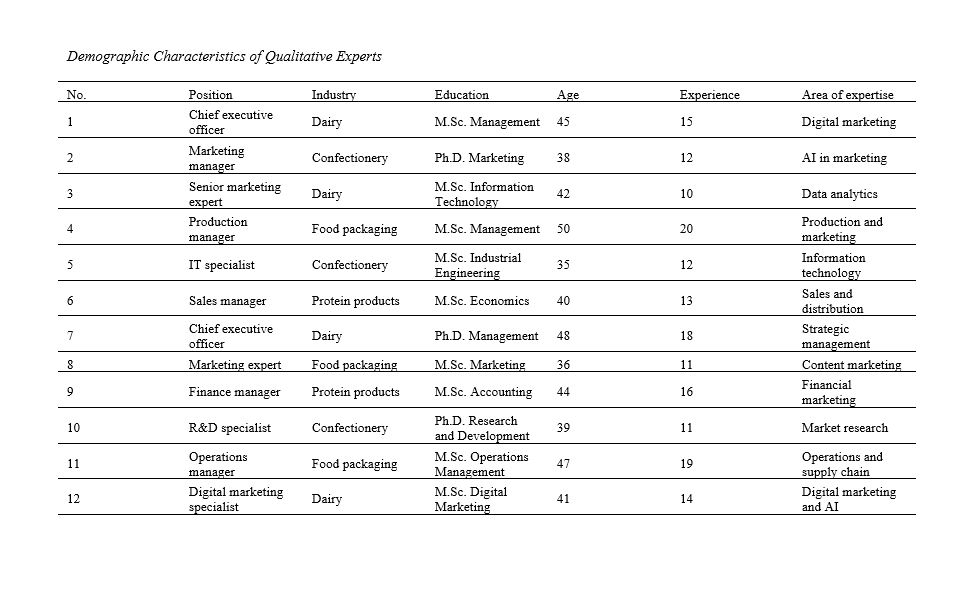
Artificial intelligence (AI) has become a strategic enabler for redesigning marketing practices, particularly for small and medium-sized enterprises (SMEs) in the food industry, where firms face intense competition, resource constraints, heterogeneous customer preferences, and infrastructural limitations. This study developed a context-specific model for improving marketing strategies in food-sector SMEs by integrating Deep Q-Network (DQN) and DistilBERT algorithms. A mixed-methods design was used. In the qualitative phase, semi-structured interviews were conducted with 12 experts and analyzed through thematic network analysis. In the quantitative phase, a questionnaire developed from 25 organizing themes was administered to 384 managers and specialists. Reliability was acceptable to excellent (Cronbach's alpha = 0.78-0.88), and normality was confirmed using the Kolmogorov-Smirnov test (Sig. = 0.08-0.19). The highest mean scores were found for senior management technology adoption (4.25) and marketing-strategy personalization capability (4.25). DQN achieved accuracy of 0.94, MSE of 0.15, F1-score of 0.92, and mean cumulative reward of 98.5. DistilBERT achieved accuracy of 0.91, cross-entropy loss of 0.12, precision of 0.89, and recall of 0.90. The findings suggest that DQN is better suited to dynamic marketing optimization, whereas DistilBERT is more appropriate for text-based customer analytics. The proposed framework provides a practical AI-driven model tailored to Iranian food-industry SMEs. The algorithmic analyses were based on structured questionnaire-derived features and coded textual materials from expert and managerial narratives; therefore, the reported performance should be interpreted as internal model validation rather than evidence from deployed real-time marketing campaigns.
Downloads
References
Attride-Stirling, J. (2001). Thematic networks: An analytic tool for qualitative research. Qualitative Research, 1(3), 385-405. https://doi.org/10.1177/146879410100100307
Cochran, W. G. (1977). Sampling techniques. Wiley. https://www.scirp.org/reference/ReferencesPapers?ReferenceID=1390266
Creswell, J. W., & Creswell, J. D. (2023). Research design: Qualitative, quantitative, and mixed methods approaches. SAGE. https://www.researchgate.net/profile/Daliborka-Luketic/publication/320521456_Nacrt_istrazivanja_kvalitativni_kvantitativni_i_mjesoviti_pristupi/links/5a8ad103aca272017e62aa7a/Nacrt-istrazivanja-kvalitativni-kvantitativni-i-mjesoviti-pristupi.pdf
Creswell, J. W., & Poth, C. N. (2018). Qualitative inquiry and research design: Choosing among five approaches. SAGE. https://www.academia.edu/download/55010759/creswell_Qualitative_In%20quiry_2nd_edition.pdf
Davenport, T. H., Guha, A., Grewal, D., & Bressgott, T. (2020). How artificial intelligence will change the future of marketing. Journal of the Academy of Marketing Science, 48, 24-42. https://doi.org/10.1007/s11747-019-00696-0
Devlin, J., Chang, M. W., Lee, K., & Toutanova, K. (2019). BERT: Pre-training of deep bidirectional transformers for language understanding. Proceedings of NAACL-HLT 2019,
Goodfellow, I., Bengio, Y., & Courville, A. (2016). Deep learning. MIT Press. https://synapse.koreamed.org/pdf/10.4258/hir.2016.22.4.351
Hair, J. F., Black, W. C., Babin, B. J., & Anderson, R. E. (2019). Multivariate data analysis. Cengage. https://books.google.com/books/about/Multivariate_Data_Analysis.html?id=0R9ZswEACAAJ
Huang, M. H., & Rust, R. T. (2021). A strategic framework for artificial intelligence in marketing. Journal of the Academy of Marketing Science, 49, 30-50. https://doi.org/10.1007/s11747-020-00749-9
Kshetri, N., Dwivedi, Y. K., Davenport, T. H., & Panteli, N. (2024). Generative Artificial Intelligence in Marketing: Applications, Opportunities, Challenges, and Research Agenda. International Journal of Information Management, 75, 102716. https://doi.org/10.1016/j.ijinfomgt.2023.102716
Magableh, I. K., Mahrouq, M. H., Ta'Amnha, M. A., & Riyadh, H. A. (2024). The role of marketing artificial intelligence in enhancing sustainable financial performance of medium-sized enterprises through customer engagement and data-driven decision-making. Sustainability, 16(24), 11279. https://doi.org/10.3390/su162411279
Mnih, V., Kavukcuoglu, K., Silver, D., Rusu, A. A., Veness, J., Bellemare, M. G., Graves, A., Riedmiller, M., Fidjeland, A. K., Ostrovski, G., Petersen, S., Beattie, C., Sadik, A., Antonoglou, I., King, H., Kumaran, D., Wierstra, D., Legg, S., & Hassabis, D. (2015). Human-level control through deep reinforcement learning. Nature, 518, 529-533. https://doi.org/10.1038/nature14236
Nunnally, J. C., & Bernstein, I. H. (1994). Psychometric theory. McGraw-Hill. https://www.scirp.org/reference/referencespapers?referenceid=1017362
Oecd. (2021). The digital transformation of SMEs (OECD Studies on SMEs and Entrepreneurship, Issue.
Sanh, V., Debut, L., Chaumond, J., & Wolf, T. (2019). DistilBERT, a distilled version of BERT: Smaller, faster, cheaper and lighter (arXiv, Issue. https://arxiv.org/abs/1910.01108
Sharabati, A. A. A., Ali, A. A. A., Allahham, M. I., Hussein, A. A., Alheet, A. F., & Mohammad, A. S. (2024). The impact of digital marketing on the performance of SMEs: An analytical study in light of modern digital transformations. Sustainability, 16(19), 8667. https://doi.org/10.3390/su16198667
Sutton, R. S., & Barto, A. G. (2018). Reinforcement learning: An introduction. MIT Press. https://web.stanford.edu/class/psych209/Readings/SuttonBartoIPRLBook2ndEd.pdf
Van Hasselt, H., Guez, A., & Silver, D. (2016). Deep reinforcement learning with double Q-learning. Proceedings of the Aaai Conference on Artificial Intelligence,
Varian, H. R. (2014). Big data: New tricks for econometrics. Journal of Economic Perspectives, 28(2), 3-28. https://doi.org/10.1257/jep.28.2.3
Vaswani, A., Shazeer, N., Parmar, N., Uszkoreit, J., Jones, L., Gomez, A. N., Kaiser, L., & Polosukhin, I. (2017). Attention is all you need. Advances in Neural Information Processing Systems,
Downloads
Publication Timeline
- Submitted
- Revised
- Accepted