Comparison of the Effectiveness of Short-Term Psychodynamic Therapy and an Integrated Acceptance and Commitment–Based Therapy with Schema Therapy on Improving Interpersonal Relationships and Controlling Explosive Anger in Insecurely Attached Nurses with Anxiety Symptoms
DOI:
https://doi.org/10.61838/kman.jarac.4979Keywords:
short-term psychodynamic therapy, acceptance and commitment therapy, schema therapy, interpersonal relationships, explosive anger, insecure attachment, nursesAbstract
Objective: The objective of this study was to compare the effectiveness of short-term psychodynamic therapy and an integrated acceptance and commitment–based therapy with schema therapy on improving interpersonal relationships and controlling explosive anger in insecurely attached nurses with anxiety symptoms.
Methods and Materials: This study employed a quasi-experimental design with pretest, posttest, and one-month follow-up, including a control group. The statistical population consisted of nurses working in intensive care, coronary care, emergency, and oncology wards of Imam Reza Hospital in Mashhad during the second half of 2024. Following a multistage screening process based on the Kian-Zadeh Adult Attachment Styles Questionnaire and the anxiety subscale of the DASS-21, 30 nurses with insecure attachment styles and elevated anxiety symptoms were selected and randomly assigned to three groups: short-term psychodynamic therapy, integrated acceptance and commitment–based therapy with schema therapy, and a wait-list control group (n = 10 per group). Each intervention was delivered in eight 70-minute sessions over four weeks. Data were collected using validated measures of interpersonal relationships and explosive anger at pretest, posttest, and follow-up. Data analysis was conducted using univariate and multivariate analyses of covariance and Bonferroni post hoc tests in SPSS-V22.
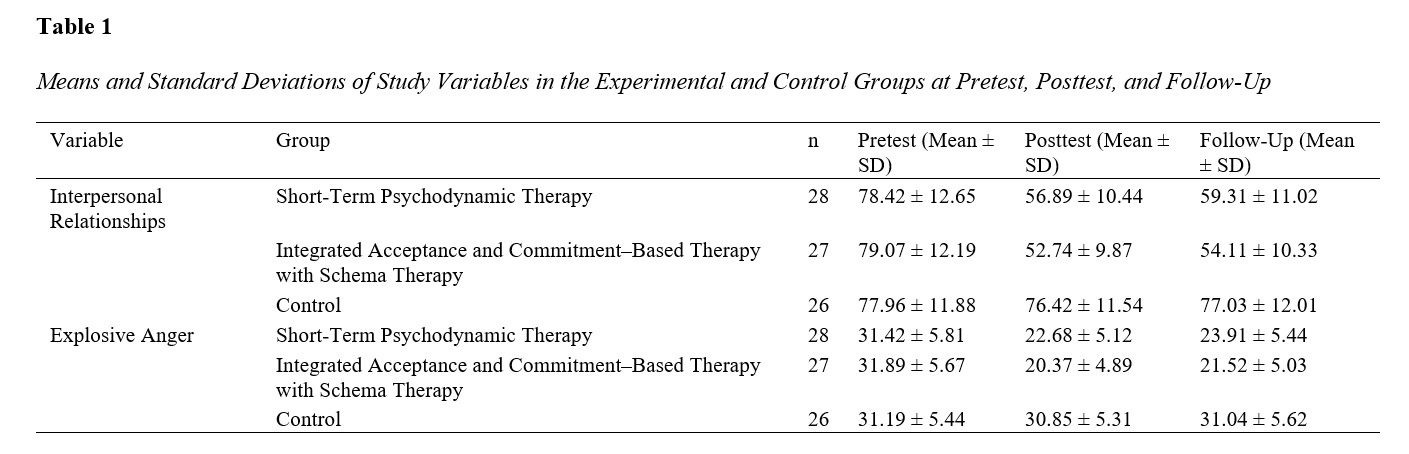
Findings: Multivariate analysis of covariance revealed significant group effects for both interpersonal relationships and explosive anger at posttest and follow-up (p < .01). Bonferroni comparisons showed that both intervention groups significantly outperformed the control group on all outcomes. Short-term psychodynamic therapy demonstrated a significantly greater reduction in explosive anger at posttest compared to the integrated intervention (p < .05), while the integrated acceptance and commitment–based therapy with schema therapy showed a stronger effect on interpersonal relationships at posttest (p < .01). Differences between the two intervention groups were no longer significant at follow-up.
Conclusion: Both short-term psychodynamic therapy and integrated acceptance and commitment–based therapy with schema therapy are effective interventions for improving interpersonal relationships and reducing explosive anger in insecurely attached nurses with anxiety symptoms, with differential short-term advantages across outcome domains.
Downloads
References
Akrami, S. (2022). Evaluation of the Effectiveness of Acceptance and Commitment-based Education on Emotional Self-disclosure and Marital Commitment of Women Referring to Gonbad Kavous Clinics. International Journal of Education and Cognitive Sciences, 3(2), 23-29. https://doi.org/10.22034/injoeas.2022.160610
Alizadeh, N., Mirzaian, B., & Abbasi, G. (2022). Comparison of the Effectiveness of Schema Therapy and Short-Term Psychodynamic Therapy on Psychological Capital in Females with Breast Cancer. frooyesh, 10(11), 229-240. http://frooyesh.ir/article-1-3094-en.html
Bektaş-Aydın, C., & Yüksel-Şahin, F. (2025). Effectiveness of Acceptance and Commitment Therapy on Post-Traumatic Stress Symptoms, Psychological Inflexibility, and Self-Compassion in IPV Survivor University Women. Journal of interpersonal violence. https://doi.org/10.1177/08862605251318283
Byrne, G., & Cullen, C. (2024). Acceptance and commitment therapy for anger, irritability, and aggression in children, adolescents, and young adults: a systematic review of intervention studies. Trauma, Violence, & Abuse, 25(2), 935-946. https://doi.org/10.1177/15248380231167393
Eftekari, A., & Bakhtiari, M. (2022). Comparing the effectiveness of schema therapy with acceptance and commitment therapy on cognitive avoidance in patients with generalized anxiety disorder. Practice in Clinical Psychology, 10(1), 11-22. https://doi.org/10.32598/jpcp.10.1.593.1
GÜLer, K. (2024). The Mediating Role of Sexual Satisfaction and Anger in the Relationship Between Partner-Related Obsessive Compulsive Symptoms and Sexual Self-Schema. İstanbul Gelişim Üniversitesi Sağlık Bilimleri Dergisi(23), 522-537. https://doi.org/10.38079/igusabder.1492251
Hadian, S., Khayatan, F., & Golparvar, M. (2024). Investigating the Effectiveness of Emotional Schema Therapy on Hidden Anger and Assertiveness in Women Victims of Domestic Violence. Behavioral Sciences Research, 22(1), 90-103. https://rbs.mui.ac.ir/article-1-1748-fa.html
Hassanzadeh, M., & Mansouri, A. (2022). The effectiveness of schema therapy on anger rumination and aggression in men with binge eating disorder. Health Psychology, 20(1), 1-8. https://doi.org/10.52547/rbs.20.1.1
Jafari, S., Kazemian Moghadam, K., & Gholavand, F. (2024). The Effectiveness of Intensive Short-Term Dynamic Psychotherapy (ISTDP) on Depression, Health Anxiety, and Physical Symptoms in Patients with Coronary Artery Bypass. Research in Clinical Psychology and Counseling, 14(1), 223-242. https://tpccp.um.ac.ir/article_45804.html
Janovsky, T., Rock, A. J., Thorsteinsson, E. B., Clark, G. I., Polad, V., & Cosh, S. (2023). Assessing the relationship between early maladaptive schemas and interpersonal problems using interpersonal scenarios depicting rejection. PLoS One, 18(10), e0288543. https://journals.plos.org/plosone/article?id=10.1371/journal.pone.0288543
Khandehjam, S., & Valizadeh, S. (2025). The Effectiveness of Intensive Short-Term Dynamic Psychotherapy on Shyness and Psychological Distress in 16-18-Year-Old Girls with Anxiety Disorder. Psychiatric Nursing, 13(2), 90-100. https://ijpn.ir/article-1-2559-en.html
Mokhles Abadi Farahani, M. (2020). The effect of acceptance and commitment therapy on anger rumination and learned helplessness in substance-dependent individuals Faculty of Economic and Social Sciences]. https://www.google.com/url?sa=t&source=web&rct=j&opi=89978449&url=https://www.jmbs.ir/article_200554.html&ved=2ahUKEwiexrLC7PqJAxWAhv0HHYFbLJMQFnoECBkQAQ&usg=AOvVaw2uGXmS2HZHNrHdfzMLNmXp
Nakhaei Moghadam, R., Bahrainian, S. A., & Nasri, M. (2024). The effectiveness of intensive and short-term dynamic psychotherapy on attachment styles, somatization and health anxiety in patients with chronic pain. Journal of Assessment and Research in Applied Counseling (JARAC), 6(1). https://journals.kmanpub.com/index.php/jarac/article/view/1287
Navidi Poshtiri, S., Hassanzadeh, R., & Olia Emadian, S. (2022). The effectiveness of acceptance and commitment therapy on tolerance failure and health anxiety in nursing and midwifery students with health anxiety. Journal of Adolescent and Youth Psychological Studies (JAYPS), 3(1), 222-231. https://doi.org/10.61838/kman.jayps.3.1.18
O’Driscoll, D., Percy, A., & McAleese, M. (2020). An Acceptance and Commitment Therapy (ACT)-based Intervention for an Adolescent Experiencing Anger Difficulties. Decp Debate, 1(175), 32-38. https://doi.org/10.53841/bpsdeb.2020.1.175.32
Polat, H., & Karakaş, S. A. (2021). The Effect of Acceptance and Commitment Therapy orientated Anger Management Training on Anger Ruminations and Impulsivity Levels in Forensic Psychiatric Patients: A Randomized Controlled Trial. Perspectives in psychiatric care, 57(4), 1616-1627. https://doi.org/10.1111/ppc.12726
Rahmani, F., Gowhari, H., Jolfai Fotouhi, M., & Saedi, S. (2024). The effectiveness of treatment based on acceptance and commitment on empathy and interpersonal relationships in obsessive-compulsive patients. Iranian Evolutionary Educational Psychology Journal, 6(1), 94-104. https://ieepj.hormozgan.ac.ir/article-1-825-en.pdf
Rahmati, R., Taklavi, S., & Mousazadeh, T. (2021). The effects of emotional schema therapy on anger and suicidal ideation in men with extramarital relations. MEJDS, 11, 128-128. https://doi.org/10.29252/mejds.0.0.213
Sarlaki, A., Farokhzad, M., Khanzadeh, F., Younesi Sinaki, M., Razavi Mahdian, S. Z., & Tayyar Parvin, M. (2024). Effectiveness of Intensive Short-Term Dynamic Psychotherapy on Object Relations, Anger, and Guilt in Women with Major Depressive Disorder. Psychological Achievements, 30(1), 89-102. https://psychac.scu.ac.ir/article_18967.html
Shute, R., Maud, M., & McLachlan, A. (2019). The relationship of recalled adverse parenting styles with maladaptive schemas, trait anger, and symptoms of depression and anxiety. Journal of affective disorders, 259, 337-348. https://doi.org/10.1016/j.jad.2019.08.048
Uluyol, H., & Özen-Çıplak, A. (2024). Dyadic relationship of adult attachment patterns and interpersonal schemas in marital adjustment: Actor–partner effect model. J Couple Relatsh Ther, 23(1), 55-72. https://doi.org/10.1080/15332691.2024.2298773
Vafadar, A., Mirzamani Bafghi, S. M., & Jafari Roshan, M. (2021). A comparison of the effectiveness of acceptance and commitment therapy and emotional schema therapy on attentional bias, indecision, and cognitive avoidance in adolescents with generalized anxiety disorder. Journal of Disability Studies, 11(194), 1-8. https://www.sid.ir/paper/1031071/en
Downloads
Additional Files
Publication Timeline
- Submitted
- Revised
- Accepted