Stacked Generalization Model for Predicting Happiness: Positive Affect, Gratitude, Social Connectedness, and Psychological Flexibility
Keywords:
Happiness, Stacked Generalization, Positive Affect, Gratitude, Social Connectedness, Psychological FlexibilityAbstract
Objective: The present study aimed to develop and evaluate a stacked generalization machine learning model to predict happiness based on positive affect, gratitude, social connectedness, and psychological flexibility.
Methods and Materials: This cross-sectional predictive study was conducted on a sample of 742 adults recruited from Canada using stratified online sampling to ensure demographic diversity. Participants completed validated self-report instruments including the Subjective Happiness Scale (SHS), the Positive Affect subscale of the Positive and Negative Affect Schedule (PANAS), the Gratitude Questionnaire-6 (GQ-6), the Social Connectedness Scale-Revised (SCS-R), and the Acceptance and Action Questionnaire-II (AAQ-II). Data preprocessing involved handling missing values via multiple imputation, outlier adjustment using robust scaling, and feature standardization. The dataset was split into training (80%) and testing (20%) sets, and model training utilized 10-fold cross-validation. A stacked generalization model was constructed using base learners including linear regression, support vector regression, random forest, and gradient boosting, with a Ridge regression meta-learner. Model performance was evaluated using mean squared error (MSE), root mean squared error (RMSE), and coefficient of determination (R²), and interpretability was enhanced באמצעות SHapley Additive exPlanations (SHAP) analysis.
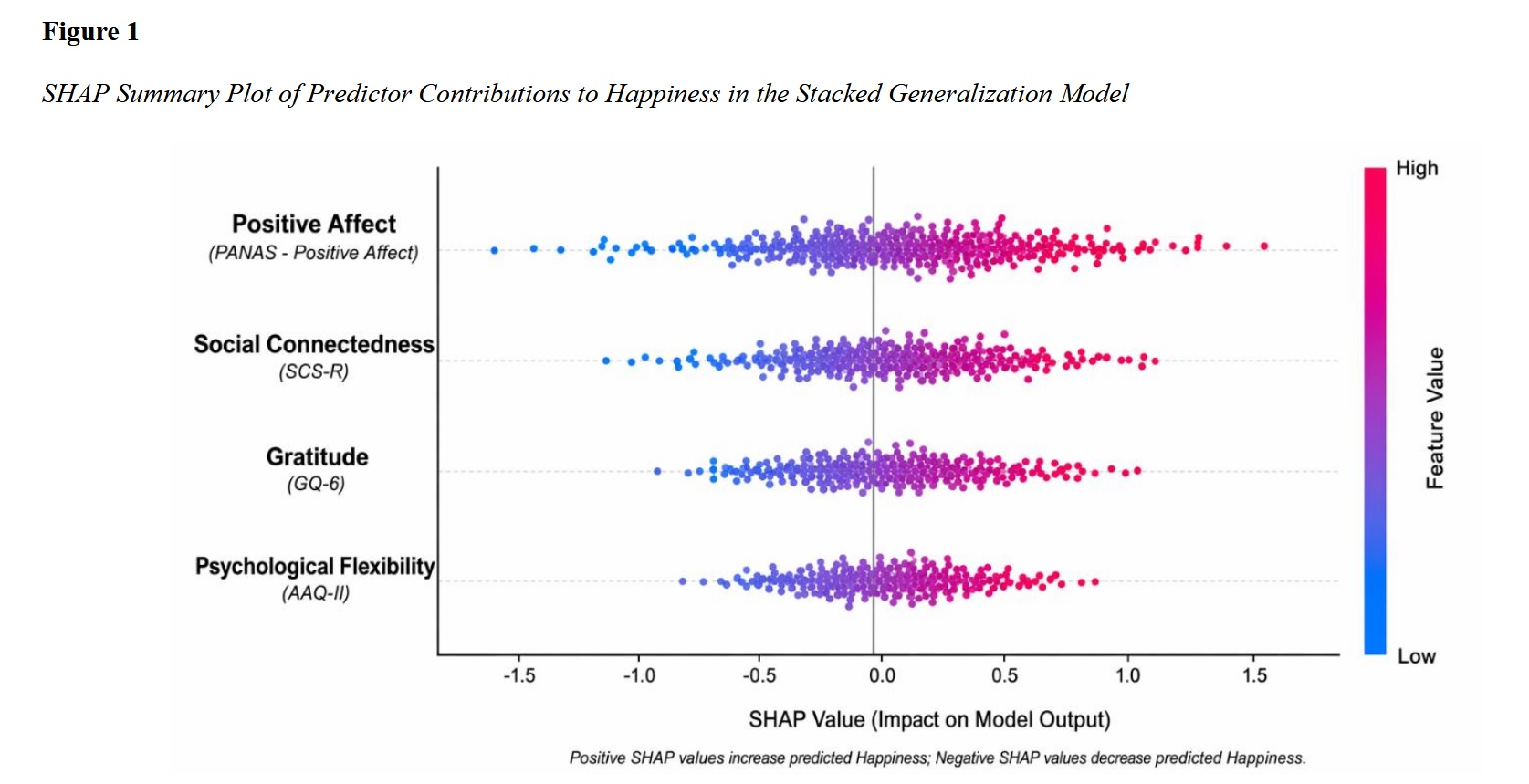
Findings: The stacked generalization model demonstrated superior predictive performance compared to all base models, achieving the highest explained variance (R² = 0.74) and the lowest prediction error (RMSE = 0.52). Among the predictors, positive affect exhibited the strongest contribution to happiness, followed by social connectedness, gratitude, and psychological flexibility. SHAP analysis revealed significant nonlinear and interaction effects among predictors, indicating that the combined influence of these variables enhances predictive accuracy beyond additive models.
Conclusion: The findings highlight the effectiveness of stacked generalization in modeling complex psychological constructs and underscore the central role of positive affect, gratitude, social connectedness, and psychological flexibility in predicting happiness, supporting the integration of machine learning approaches in psychological research and intervention design.
Downloads
References
Armenta, C. N., Fritz, M. M., Walsh, L. C., & Lyubomirsky, S. (2022). Satisfied Yet Striving: Gratitude Fosters Life Satisfaction and Improvement Motivation in Youth. Emotion, 22(5), 1004-1016. https://doi.org/10.1037/emo0000896
Arnstein, K. B., Desmet, O. A., Seward, K., Traynor, A., & Olenchak, F. R. (2023). Underrepresented Students in Gifted and Talented Education: Using Positive Psychology to Identify and Serve. Education Sciences, 13(9), 955. https://doi.org/10.3390/educsci13090955
Asghar, M., Minichiello, A., & Iqbal, A. (2022). Perceived Factors Contributing to the Subjective Wellbeing of Undergraduate Engineering Students: An Exploratory Study. International journal of environmental research and public health, 19(23), 16284. https://doi.org/10.3390/ijerph192316284
Bhatt, K., & Weissman, C. R. (2024). The Effect of Psilocybin on Empathy and Prosocial Behavior: A Proposed Mechanism for Enduring Antidepressant Effects. NPJ Mental Health Research, 3(1). https://doi.org/10.1038/s44184-023-00053-8
Chen, L., Liu, J., Fu, L., Guo, C., & Chen, Y. (2022). The Impact of Gratitude on Connection With Nature: The Mediating Role of Positive Emotions of Self-Transcendence. Frontiers in psychology, 13. https://doi.org/10.3389/fpsyg.2022.908138
Chhajer, R., & Hira, N. (2024). Exploring Positive Psychology Intervention and Mindfulness-Based Intervention in Nature: Impact on Well-Being of School Students in India. Frontiers in Public Health, 12. https://doi.org/10.3389/fpubh.2024.1297610
Dalal, S., & Singh, S. K. (2025). Gratitude in Action: Effect of Gratitude on Mental Health. Journal of Health Management, 27(1), 100-107. https://doi.org/10.1177/09720634241304985
Dennis, A., & Ogden, J. (2022). Nostalgia, Gratitude, or Optimism: The Impact of a Two-Week Intervention on Well-Being During COVID-19. Journal of Happiness Studies, 23(6), 2613-2634. https://doi.org/10.1007/s10902-022-00513-6
Garg, N., Mahipalan, M., Poulose, S., & Burgess, J. (2022). Does Gratitude Ensure Workplace Happiness Among University Teachers? Examining the Role of Social and Psychological Capital and Spiritual Climate. Frontiers in psychology, 13. https://doi.org/10.3389/fpsyg.2022.849412
Kesenheimer, J. S., Kastenmüller, A., Kinkel, L. S., Fidan, B., & Greitemeyer, T. (2023). When Do I Feel Good When I Am Nice? A Diary Study About the Relationship Between Prosocial Behavior and Well‐being. Journal of Applied Social Psychology, 53(9), 892-905. https://doi.org/10.1111/jasp.12975
Layous, K., Kurtz, J. L., Wildschut, T., & Sedikides, C. (2022). The Effect of a Multi-Week Nostalgia Intervention on Well-Being: Mechanisms and Moderation. Emotion, 22(8), 1952-1968. https://doi.org/10.1037/emo0000817
Liao, K. Y., & Wei, M. (2022). Intolerance of Uncertainty, Acculturative Stress, Gratitude, and Distress: A Moderated Mediation Model. The counseling psychologist, 51(2), 270-294. https://doi.org/10.1177/00110000221138803
Mahasneh, A. M. (2022). The Relationship Between Subjective Well-Being and Social Support Among Jordanian University Students. Psychology in Russia State of Art(2), 53-64. https://doi.org/10.11621/pir.2022.0204
Maragha, T., Garcia, A. P., Shuler, C. F., & Bergmann, H. v. (2023). The Six‐domain Well‐being Framework in Oral Health Sciences: A Pathway From Theory to Practice. Journal of Dental Education, 88(2), 157-168. https://doi.org/10.1002/jdd.13401
Merlo, G., Pereira-Sánchez, V., Lee, W., Wong, W. Y., & Morales, M. J. (2025). Connectedness as a Mental Health Pillar: To Self, Others, and the World. Psychiatric Annals, 55(7). https://doi.org/10.3928/00485713-20250613-03
Merlo, G., Snellman, L., & Sugden, S. G. (2025). Connectedness: The Updated and Expanded Pillar of Lifestyle Psychiatry and Lifestyle Medicine. American Journal of Lifestyle Medicine, 19(8), 1104-1124. https://doi.org/10.1177/15598276251345455
Nadal, C. T., Ros‐Morente, A., & Quesada‐Pallarès, C. (2024). Trait Emotional Intelligence Mediates the Dispositional Gratitude and Subjective Well-Being in Young Adults. Frontiers in psychology, 15. https://doi.org/10.3389/fpsyg.2024.1414867
Nelson, S. K., & Coffey, J. K. (2024). Gratitude Improves Parents’ Well-Being and Family Functioning. Emotion, 24(2), 357-369. https://doi.org/10.1037/emo0001283
Osborn, T. L., Brenda, Johnson, N., Venturo‐Conerly, K. E., Rusch, T., Weisz, J. R., & Wasanga, C. (2022). Depression and Anxiety Symptoms Among Kenyan Adolescents: Prevalence Rates and Associations With Socio-Demographic and Psycho-Social Factors During the COVID-19 Pandemic. https://doi.org/10.31234/osf.io/tvbpy
Regan, A., Radošić, N., & Lyubomirsky, S. (2022). Experimental Effects of Social Behavior on Well-Being. Trends in Cognitive Sciences, 26(11), 987-998. https://doi.org/10.1016/j.tics.2022.08.006
Sahar, N. u., Baranovich, D. L., & Tharbe, I. H. A. (2022). Does Gratitude Work at School? Piloting the Modified Interventions for Managing Academic Stress in Pakistani High Schools. Journal of Muslim Mental Health, 16(2). https://doi.org/10.3998/jmmh.430
Samus, A., Dickinson, K. J. M., Freeman, C., & Heezik, Y. v. (2024). How to Increase Nature Connectedness? Effectiveness and Mechanisms of a Gratitude Journal Intervention. People and Nature, 6(6), 2399-2417. https://doi.org/10.1002/pan3.10735
Tee, E. Y. J., & Raja Intan Arifah Binti Raja Reza, S. (2022). Self‐transcendent Emotions and Their Influence on Organizational Effectiveness: A Literature Review and Synthesis. Asian Journal of Social Psychology, 26(1), 146-163. https://doi.org/10.1111/ajsp.12550
Thompson, J. (2022). Enhancing Resilience: An Interpretative Phenomenological Analysis of the Awe Project. Journal of Community Safety and Well-Being, 7(3), 93-110. https://doi.org/10.35502/jcswb.265
Thompson, J. (2023). Narrative Health: Examining the Relationship Between the Phenomenon of Awe and Resilience and Well-Being. Journal of Community Safety and Well-Being, 8(2), 85-98. https://doi.org/10.35502/jcswb.321
Walsh, L. C., Regan, A., Twenge, J. M., & Lyubomirsky, S. (2022). What Is the Optimal Way to Give Thanks? Comparing the Effects of Gratitude Expressed Privately, One-to-One via Text, or Publicly on Social Media. Affective science, 4(1), 82-91. https://doi.org/10.1007/s42761-022-00150-5
Wang, L., Gonzalez, P. D., Lau, P. L., Vaughan, E. L., & Costa, M. F. (2023). “Dando Gracias”: Gratitude, Social Connectedness, and Subjective Happiness Among Bilingual Latinx College Students. Journal of Latinx Psychology, 11(3), 203-219. https://doi.org/10.1037/lat0000227
Winkelmair, A., Siebertz, M., Jost, L., Schroter, F. A., Bartenschlager, C. T. J., & Jansen, P. (2023). Explicit and Implicit Affective Attitudes Toward Sustainability: The Role of Mindfulness, Heartfulness, Connectedness to Nature and Prosocialness. International Journal of Applied Positive Psychology, 8(3), 571-598. https://doi.org/10.1007/s41042-023-00107-4
Zare, J., Delavar, K. A., & Derakhshan, A. (2023). The Impact of Altruism on the Emotions and English Summary Writing Skills of L2 Learners: An Intervention Study in Light of Positive Psychology. Language Teaching Research, 30(1), 343-364. https://doi.org/10.1177/13621688231151632
Zhang, Y., & Carciofo, R. (2021). Assessing the Wellbeing of Chinese University Students: Validation of a Chinese Version of the College Student Subjective Wellbeing Questionnaire. BMC psychology, 9(1). https://doi.org/10.1186/s40359-021-00569-8
Downloads
Additional Files
Publication Timeline
- Submitted
- Revised
- Accepted