Analyzing the Experiences, Consequences, and Preventive Strategies of Online Sexual Abuse from the Perspective of Parents: A Grounded Theory Study
DOI:
https://doi.org/10.61838/kman.jarac.2183Keywords:
online sexual abuse, experiences, consequences and preventive strategies, grounded theory.Abstract
Objective: The present study aimed to analyze the experiences, consequences, and preventive strategies of online sexual abuse from the perspective of parents.
Methods and Materials: This study was conducted using a qualitative grounded-theory approach in 2023. The data were collected through semi-structured interviews with 12 parents who were selected via snowball sampling. Data analysis revealed 3 main categories: online abuse as a traumatic experience, awareness as the key to overcoming problems, and traumatic environment and consequences.
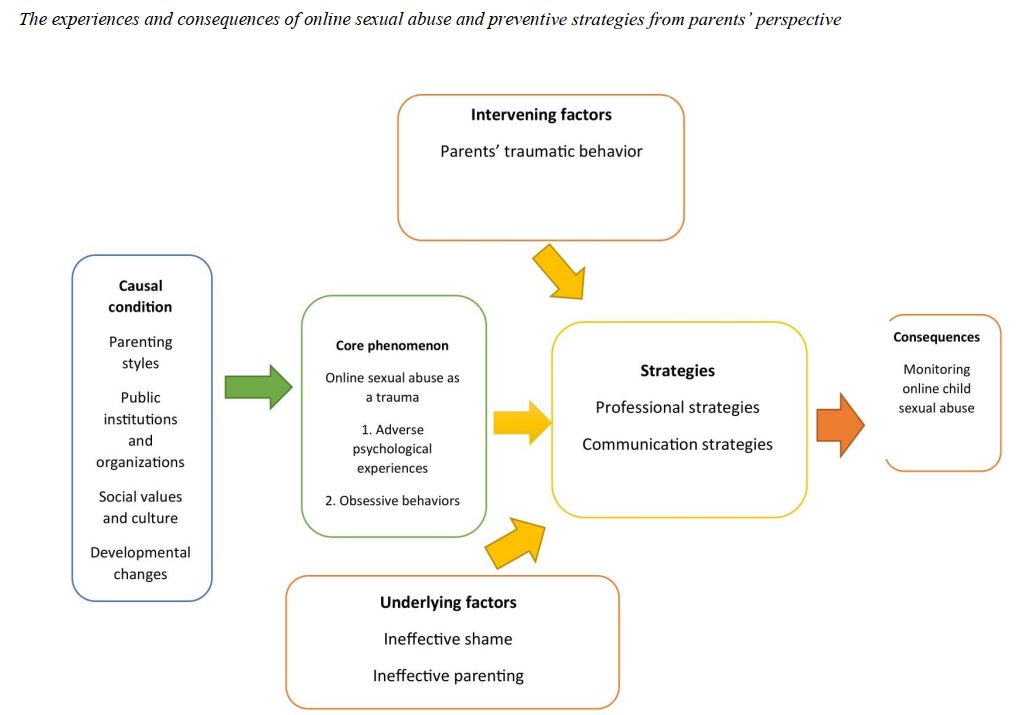
Findings: The data revealed 7 axial codes (34 open codes): causal conditions (parenting style, public institutions and organizations, social customs and culture, and developmental changes); contextual conditions (ineffective shame and ineffective parenting); intervening conditions (parents’ traumatic behaviors); strategies (professional and communication strategies); consequences (taking care of child abuse), and the core phenomenon (online abuse as trauma; unpleasant psychological experiences and obsessive behaviors). The findings of the present study indicated that the most important consequences of online child sexual abuse include premature puberty, isolation, experiencing anxiety and panic, aggression, academic failure, posting photos and videos, masturbation, sex chatting, satisfying sexual curiosity, focusing on sexual issues in life, and seeking attention and approval.
Conclusion: The interviews with parents showed that the most important strategies for preventing online child sexual abuse include raising parents’ awareness of children’s developmental changes, teaching sexual issues, teaching life skills, updating information, consulting with experts, empathy with the child, monitoring the child, being an active listener, and setting limits on internet use. The insights from this study can help parents, school counselors, and families develop effective strategies to prevent online child sexual abuse.
Downloads
References
Abrazgah, M. A., Bostansara, M., & Ravan, F. A. (2024). The Model for Predicting Self-Harming Behaviors Based on Cognitive Emotion Regulation Strategies and Emotional Distress Tolerance in Adolescents Visiting Harm Reduction Centers in Tehran: The Mediating Role of Internalized Shame. Aftj, 5(5), 164-172. https://doi.org/10.61838/kman.aftj.5.5.19
Anderson, M., & Jiang, J. (2018). Teens, social media & technology 2018. Pew Research Center, 31, 1673-1689. http://publicservicesalliance.org/wp-content/uploads/2018/06/Teens-Social-Media-Technology-2018-PEW.pdf
Assink, M., van der Put, C. E., Meeuwsen, M. W. C. M., de Jong, N. M., Oort, F. J., Stams, G. J. J. M., & Hoeve, M. (2019). Risk factors for child sexual abuse victimization: A meta-analytic review. Psychological Bulletin, 145(5), 459-489. https://doi.org/10.1037/bul0000188
Babad, S., Zwilling, A., Carson, K. W., Fairchild, V. P., & Nikulina, V. (2020). Childhood Environmental Instability and Social-Emotional Outcomes in Emerging Adults. Journal of interpersonal violence, 37(7-8), NP3875-NP3904. https://doi.org/10.1177/0886260520948147
Carr, A., Duff, H., & Craddock, F. (2020). A systematic review of reviews of the outcome of noninstitutional child maltreatment. Trauma, Violence, & Abuse, 21(4), 828-843. https://doi.org/10.1177/1524838018801334
Carvalho, C. B., Cabral, J., Pereira, C., Cordeiro, F., Costa, R., & Arroz, A. M. M. (2023). Emotion Regulation Weakens the Associations Between Parental Antipathy and Neglect and Self-Harm. Journal of Applied Developmental Psychology, 89, 101597. https://doi.org/10.1016/j.appdev.2023.101597
Cox, J. (2017). Australian Dark Web Hacking Campaign Unmasked Hundreds Globally. www.vice.com/en/article/4xezgg/australian-dark-web-hacking-campaign-unmasked-hundreds-globally
DeSantisteban, P., & Gámez-Guadix, M. (2018). Prevalence and Risk Factors Among Minors for Online Sexual Solicitations and Interactions with Adults. The Journal of Sex Research, 55(7), 939-950. https://doi.org/10.1080/00224499.2017.1386763
Dimitropoulos, G., Lindenbach, D., Dwvoe, D., Cullen, O., Bhattarari, A., Kuntz, J., Binford, W., Patten, S., & Arnold, P. (2022). Experiences of Canadian mental health providers in identifying and responding to online and in-person sexual abuse and exploitation of their child and adolescent clients. Child Abuse & Neglect, 124, 105448. https://doi.org/10.1016/j.chiabu.2021.105448
Edet, B., Essien, E. A., Eleazu, F. I., Atu, G. E. E., & Ogunkola, I. O. (2022). Childhood Adversity as a Predictor of Depression and Suicidality Among Adolescents in Calabar, Nigeria. Journal of Global Health Neurology and Psychiatry. https://doi.org/10.52872/001c.33811
Gámez-Guadix, M., Mateos-Pérez, E., Wachs, S., Wright, M., Martínez, J., & Íncera, D. (2022). Assessing image-based sexual abuse: Measurement, prevalence, and temporal stability of sextortion and nonconsensual sexting ("revenge porn") among adolescents. Journal of Adolescence, 94, 789-799. https://doi.org/10.1002/jad.12064
Gemara, N., Cohen, N., & Katz, C. (2022). "I do not remember… You are reminding me now!": Children's difficult experiences during forensic interviews about online sexual solicitation. Child Abuse & Neglect, 134, 105913. https://doi.org/10.1016/j.chiabu.2022.105913
Hailes, H. P., Yu, R., Danese, A., & Fazel, S. (2019). Long-term outcomes of childhood sexual abuse: An umbrella review. The Lancet Psychiatry, 6(10), 830-839. https://doi.org/10.1016/S2215-0366(19)30286-X
Janiri, D., Luzio, M. D., Montanari, S., Hirsch, D., Simonetti, A., Moccia, L., Conte, E., Contaldo, I., Veredice, C., Mercuri, E., & Sani, G. (2024). Childhood Trauma and Self-Harm in Youths With Bipolar Disorders. Current Neuropharmacology, 22(1), 152-158. https://doi.org/10.2174/1570159x21666230213155249
Jonsson, L. S., Fredlund, C., Priebe, G., Wadsby, M., & Svedin, C. G. (2019). Online sexual abuse of adolescents by a perpetrator met online: a cross-sectional study. Child and Adolescent Psychiatry and Mental Health, 13(1), 32. https://doi.org/10.1186/s13034-019-0292-1
Jonsson, L. S., Svedin, C. G., & Hydén, M. (2015). Young women selling sex online - narratives on regulating feelings. Adolescent Health, Medicine and Therapeutics, 6, 17. https://doi.org/10.2147/AHMT.S77324
Kang, Y.-S., & Jo, Y. (2023). The Effects of Adult Attachment on the Satisfaction of Romantic Relationship: The Mediating Effects of Internalized Shame and Perfectionism of Romantic Relationship. Korean Association for Learner-Centered Curriculum and Instruction, 23(2), 345-361. https://doi.org/10.22251/jlcci.2023.23.2.345
Kapatais, A., Williams, A. J., & Townsend, E. (2022). The Mediating Role of Emotion Regulation on Self-Harm Among Gender Identity and Sexual Orientation Minority (LGBTQ+) Individuals. Archives of Suicide Research, 27(2), 165-178. https://doi.org/10.1080/13811118.2022.2064254
Kloess, J. A., Beech, A. R., & Harkins, L. (2014). Online child sexual exploitation: Prevalence, process, and offender characteristics. Trauma, Violence, & Abuse, 15(2), 126-139. https://doi.org/10.1177/1524838013511543
Kowalski, R. M., Giumetti, G. W., Schroeder, A. N., & Lattanner, M. R. (2014). Bullying in the digital age: A critical review and meta-analysis of cyberbullying research among youth. Psychological Bulletin, 140, 1073-1137. https://doi.org/10.1037/a0035618
Leach, C., Stewart, A., & Smallbone, S. (2015). Testing the sexually abused-sexual abuser hypothesis: a prospective longitudinal birth cohort study. Child Abuse and Neglect, 51, 144-153. https://doi.org/10.1016/j.chiabu.2015.10.024
Leavitt, K. (2021). Should Canada block websites that post terrorist content and child porn? Ottawa is considering it. www.thestar.com/politics/federal/2021/04/20/should-canada-block-websites-that-post-terrorist-content-and-child-porn-ottawa-is-considering-it.html
Marriott, C., Hamilton-Giachritsis, C., & Harrop, C. (2014). Factors promoting resilience following childhood sexual abuse: A structured, narrative review. Child Abuse & Neglect, 38, 14-24. https://doi.org/10.1002/car.2258
Montiel, I., Carbonell, E., & Pereda, N. (2016). Multiple online victimization of Spanish adolescents: Results from a community sample. Child Abuse & Neglect, 52, 123-134. https://doi.org/10.1016/j.chiabu.2015.12.005
Mousavian, E. (2020). Examining the role of internalized shame in psychopathology and effective psychotherapies. Journal of Rooyesh Psychology, 9(7), 96. https://frooyesh.ir/article-1-1989-fa.html
Navarro, R., Yubero, S., & Larrañaga, E. (2018). Cyberbullying victimization and fatalism in adolescence: Resilience as a moderator. Children and Youth Services Review, 84, 215-221. https://doi.org/10.1016/j.childyouth.2017.12.011
Ngo, V., McKeever, S., & Thorpe, C. (2023). Identifying Online Child Sexual Texts in the Dark Web through Machine Learning and Deep Learning Algorithms. Advances in Cybersecurity, 1-6.
Nocentini, A., Fiorentini, G., Di Paola, L., & Menesini, E. (2018). Parents, family characteristics and bullying behavior: A systematic review. Aggression and Violent Behavior, 45, 41-50. https://doi.org/10.1016/j.avb.2018.07.010
Noll, J. G., Shenk, C. E., Barnes, J. E., & Haralson, K. J. (2013). Association of maltreatment with high-risk internet behaviors and offline encounters. Pediatrics, 131(2), e510-e517. https://doi.org/10.1542/peds.2012-1281
Oecd. (2020). Strengthening online learning when schools are closed: The role of families and teachers in supporting students during the COVID-19 crisis.
Özçalık, C. K., & Atakoğlu, R. (2021). Online child sexual abuse: Prevalence and characteristics of the victims and offenders. Journal of Psychiatric Nursing, 12(1), 76. https://jag.journalagent.com/z4/download_fulltext.asp?pdir=phd&ppdf=2&plng=tur&un=PHD-30643
Pedersen, W., Bakken, A., Stefansen, K., & von Soest, T. (2022). Sexual victimization. Journal of Interpersonal Violence. https://www.tandfonline.com/doi/abs/10.1080/10926771.2022.2061880
Quadara, A., Nagy, V., Higgins, D., & Siegel, N. (2015). Conceptualizing the prevention of child sexual abuse: Final report. https://acuresearchbank.acu.edu.au/item/8q1wv/conceptualising-the-prevention-of-child-sexual-abuse
Safety, U. K. C. f. C. I. (2013). Victims' voices: the impact of online grooming and sexual abuse. The Impact of Online Grooming and Sexual Abuse. http://www.leeds.ac.uk/disability-studies/archiveuk/UPIAS/fundamental%20principles.pdf
Scott, A., Mainwaring, C., Flynn, A., Powell, A., & Henry, N. (2022). Image-based sexual abuse among Australian youths: The experiences and perspectives of victims, perpetrators and bystanders In - Interpersonal violence against children and youth. Rowman & Littlefield. https://doi.org/10.5040/9781666995855.ch-4
Sethi, D., & Ghatak, S. (2018). Mitigating cyber sexual harassment: An Insight from India. Asian Themes in Social Science Research, 1(2), 34-43. https://doi.org/10.33094/journal.139.2018.12.34.43
Skoog, T., & Bayram Özdemir, S. (2016). Explaining why early-maturing girls are more exposed to sexual harassment in early adolescence. The Journal of Early Adolescence, 36(4), 490-509. https://doi.org/10.1177/0272431614568198
Solon, O. (2020). Inside the surveillance software tracking child porn offenders across the globe. www.nbcnews.com/tech/internet/inside-surveillance-software-tracking-child-porn-offenders-across-globe-n1234019
Steel, C. M. S. (2015). Web-based child pornography: The global impact of deterrence efforts and its consumption on mobile platforms. Child Abuse and Neglect, 44, 150-158. https://doi.org/10.1016/j.chiabu.2014.12.009
Struss, A., & Corbin, J. (1998). Basics of Qualitative Research: Grounded Theory Procedures and Techniques. Newbury Park, London: Sage. https://www.academia.edu/download/63418658/Basics_of_Qualitative_Research20200525-48749-xole4d.pdf
TaŞÖRen, A. B., & GÜL, İ. Ş. (2022). The Role of Childhood Abuse and Psychological Symptoms in Discriminating Frequency of Drug Use and Self-Harm in Incarcerated Men Convicted of Robbery. Psikiyatride Guncel Yaklasimlar - Current Approaches in Psychiatry, 14(Ek 1), 83-91. https://doi.org/10.18863/pgy.1083683
Turner, H. A., Finkelhor, D., & Colburn, D. (2023). Predictors of online child sexual abuse in a US national sample. Journal of Interpersonal Violence, 38(11-12), 7780-7803. https://doi.org/10.1177/08862605221149090
Vedelago, C. (2020). More than 7.4 million images of child abuse circulating in Victoria. www.theage.com.au/national/victoria/more-than-7-4-million-images-of-child-abuse-circulating-in-victoria-20200619-p554dy.html
Ventus, D., Antfolk, J., & Salo, B. (2017). The associations between abuse characteristics in child sexual abuse: a meta-analysis. Journal of Sexual Aggression, 23(2), 167-180. https://doi.org/10.1080/13552600.2017.1318963
Westlake, B. (2020). The past, present, and future of online child sexual exploitation: Summarizing the evolution of production, distribution, and detection In - The Palgrave Handbook of International Cybercrime and Cyber Deviance. Cham: Palgrave Macmillan. https://doi.org/10.1007/978-3-319-78440-3_52
Who. (2022). Violence against children
Downloads
Additional Files
Publication Timeline
- Submitted
- Revised
- Accepted
Issue
Section
License
Copyright (c) 2026 Hadi Gholamrezaei, Mohammad Reza Falsafinejad, Anahita Khodabakhshi-Koolaee (Author)

This work is licensed under a Creative Commons Attribution-NonCommercial 4.0 International License.