Identifying Components of Positive Youth Development in Multicultural Contexts
DOI:
https://doi.org/10.61838/kman.jarac.4496Keywords:
Positive Youth Development, Multicultural Contexts, Developmental Assets, Identity Formation, ResilienceAbstract
Objective: The objective of this study was to explore and identify the key components of Positive Youth Development (PYD) as experienced by adolescents and young adults in multicultural contexts.
Methods and Materials: This qualitative study employed a purposive sample of 25 participants aged 15–24 years from Michigan, representing diverse cultural and ethnic backgrounds. Data were collected through semi-structured interviews focused on identity formation, resilience, cultural interaction, and future readiness. Interviews, lasting between 45 and 75 minutes, were transcribed verbatim and analyzed using thematic analysis with the aid of NVivo 14 software. Data collection continued until theoretical saturation was reached. To enhance trustworthiness, peer debriefing, member checking, and reflexive memoing were incorporated throughout the research process.
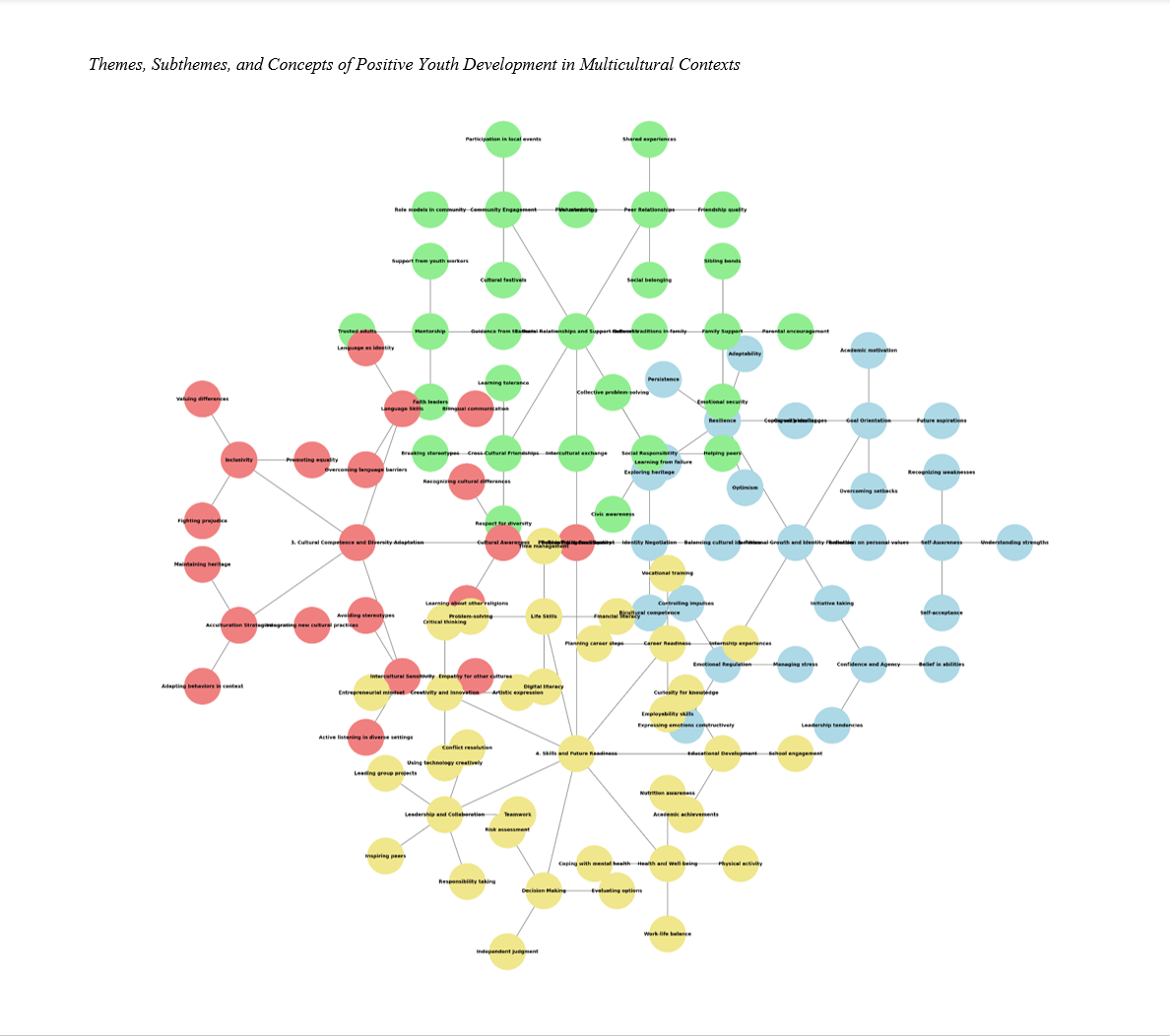
Findings: The analysis revealed four overarching themes and multiple subthemes that collectively represent the components of PYD in multicultural contexts. The first theme, personal growth and identity formation, emphasized self-awareness, resilience, and bicultural identity negotiation. The second, social relationships and support networks, included family support, peer bonds, mentorship, and community engagement. The third, cultural competence and diversity adaptation, reflected intercultural sensitivity, inclusivity, and strategies for balancing heritage with adaptation. The fourth, skills and future readiness, highlighted educational engagement, career planning, life skills, creativity, leadership, and health behaviors. Illustrative quotations demonstrated how youth integrated internal and external assets to foster resilience, belonging, and thriving.
Conclusion: The findings affirm the universality of developmental assets while underscoring their cultural variability in multicultural contexts. By situating PYD within diverse environments, this study highlights the interplay of identity, relationships, cultural competence, and future readiness in shaping youth development. The results provide valuable implications for educators, policymakers, and practitioners in designing culturally responsive and inclusive youth programs.
Downloads
References
Beck, M., & Wiium, N. (2019). Promoting Academic Achievement Within a Positive Youth Development Framework. Norsk Epidemiologi, 28(1-2). https://doi.org/10.5324/nje.v28i1-2.3054
Dejenie, M. A., Abebe, A. S., & Getahun, D. A. (2023). Theoretical Relationships Among Developmental Assets, Well-Being and Thriving: Scoping Review of the Strength-Based Perspective. International Journal of Educational Reform. https://doi.org/10.1177/10567879231213058
Delgado, S. N., Huang, N. K., & Wiium, N. (2021). Positive Youth Development and Thriving in Norwegian Youth. 15-35. https://doi.org/10.32320/978-961-270-341-7.15-35
Desie, Y. (2019). From Surviving to Thriving: Characterizing Positive Youth Development Among Youth in Ethiopia. International Journal of Adolescence and Youth, 25(1), 200-209. https://doi.org/10.1080/02673843.2019.1608272
Dost‐Gözkan, A., Kozina, A., Ștefenel, D., & Wiium, N. (2021). External Developmental Assets and Positive Identity Among Emerging Adults in Norway, Romania, Slovenia, and Turkey. Frontiers in psychology, 12. https://doi.org/10.3389/fpsyg.2021.656972
Fernandes, D., Pivec, T., Dost‐Gözkan, A., Uka, F., Matos, M. G. d., & Wiium, N. (2021). Global Overview of Youth Development: Comparison of the 5 Cs and Developmental Assets Across Six Countries. Frontiers in psychology, 12. https://doi.org/10.3389/fpsyg.2021.685316
Gómez‐Baya, D., Salinas-Pérez, J. A., Sánchez-López, Á., Paíno-Quesada, S., & Berjano, R. M. (2022). The Role of Developmental Assets in Gender Differences in Anxiety in Spanish Youth. Frontiers in Psychiatry, 13. https://doi.org/10.3389/fpsyt.2022.810326
Kim, Y., & Han, J. (2025). A Systematic Literature Review on Ego-Resilience of Middle and High School Students From Multicultural Families. Korean Association for Learner-Centered Curriculum and Instruction, 25(9), 437-451. https://doi.org/10.22251/jlcci.2025.25.9.437
Kozina, A., & Pivec, T. (2020). Contextual and Individual Predictors of Bullying and Victimization in Slovenia: Positive Youth Development Perspective. Erebea Revista De Humanidades Y Ciencias Sociales, 10. https://doi.org/10.33776/erebea.v10i0.4961
Maggiulli, L., Perry, J. L., & Aiello, J. (2019). The Impact of an Alternative to Detention Program on Developmental Assets For Adolescents Involved in the Juvenile Justice or Legal System. Journal of Applied Juvenile Justice Services, 91-103. https://doi.org/10.52935/19.1317.1
Manrique‐Millones, D., Wiium, N., Pineda‐Marín, C., Fernández-Arata, M., Alfonso-Murcia, D., Martínez, J. L. L., & Millones-Rivalles, R. (2021). Association Between Substance Use Behaviors, Developmental Assets and Mental Health: A Glance at Latin American Young College Students. Frontiers in psychology, 12. https://doi.org/10.3389/fpsyg.2021.639578
Messer, L. C., Halladay, C., Hofert, G., & Sheppard, B. K. (2020). Youth Assets and Associations With Adolescent Risk Taking. Journal of School Health, 91(1), 37-49. https://doi.org/10.1111/josh.12973
Miconi, D., Dervishi, E., Wiium, N., Johnson‐Lafleur, J., Ibrahımı, S., & Rousseau, C. (2021). Egyptian and Roma Adolescents’ Perspectives on Their Developmental Assets in Albania During the COVID‐19 Pandemic. Journal of Research on Adolescence, 31(3), 576-594. https://doi.org/10.1111/jora.12665
O’Connor, K., Kjærvik, S. L., Sullivan, T. N., & Thomson, N. D. (2025). Relations Between Developmental Assets and Youth Gun Violence. Youth & Society. https://doi.org/10.1177/0044118x251332648
Sam, D. L., Ferrer‐Wreder, L., & Dimitrova, R. (2021). Roma Youth Development in Context. 207-220. https://doi.org/10.1093/oso/9780190654061.003.0012
Uka, F., Gashi, S., Gashi, A., Gllogu, D., Musliu, A., Krasniqi, A., Statovci, A., Sopjani, V., Perçuku, V., Sadikovic, I., & Wiium, N. (2022). The Effectiveness of Internal Cohesion Psychotherapy in Treating Young Clients With Depression and Anxiety Disorders: The Role of Developmental Assets in Kosovo Context. Frontiers in psychology, 13. https://doi.org/10.3389/fpsyg.2022.1005709
Wiium, N., Beck, M., & Ferrer‐Wreder, L. (2021). The Importance of Developmental Assets to Mental Health in Norwegian Youth. Frontiers in psychology, 12. https://doi.org/10.3389/fpsyg.2021.687537
Xiang, G.-X., Gan, X., Jin, X., Zhang, Y., & Zhu, C.-S. (2022). Developmental Assets, Self-Control and Internet Gaming Disorder in Adolescence: Testing a Moderated Mediation Model in a Longitudinal Study. Frontiers in Public Health, 10. https://doi.org/10.3389/fpubh.2022.808264
Downloads
Additional Files
Publication Timeline
- Submitted
- Revised
- Accepted
Issue
Section
License
Copyright (c) 2025 Nadereh Saadati, Necati Çobanoglu, Olga Coelho (Author); Seyed Amir Saadati (Corresponding Author)

This work is licensed under a Creative Commons Attribution-NonCommercial 4.0 International License.