Indicators of Burnout and Recovery in Early-Career Psychologists: A Thematic Analysis
DOI:
https://doi.org/10.61838/kman.jarac.5155Keywords:
Burnout, Recovery, Early-career psychologists, Thematic analysis, Resilience, Professional identity, IrelandAbstract
Objective: The objective of this study was to explore the indicators of burnout and the strategies of recovery among early-career psychologists, with a focus on their lived experiences within the Irish professional context.
Methods and Materials: This qualitative study employed a thematic analysis design. Twenty early-career psychologists practicing in Ireland participated in semi-structured interviews, selected through purposive sampling. Participants represented diverse professional settings including public health services, private practice, community organizations, and academic contexts. Data collection continued until theoretical saturation was achieved. Interviews were audio-recorded, transcribed verbatim, and analyzed using Braun and Clarke’s six-phase framework, supported by NVivo 14 software for data management and coding.
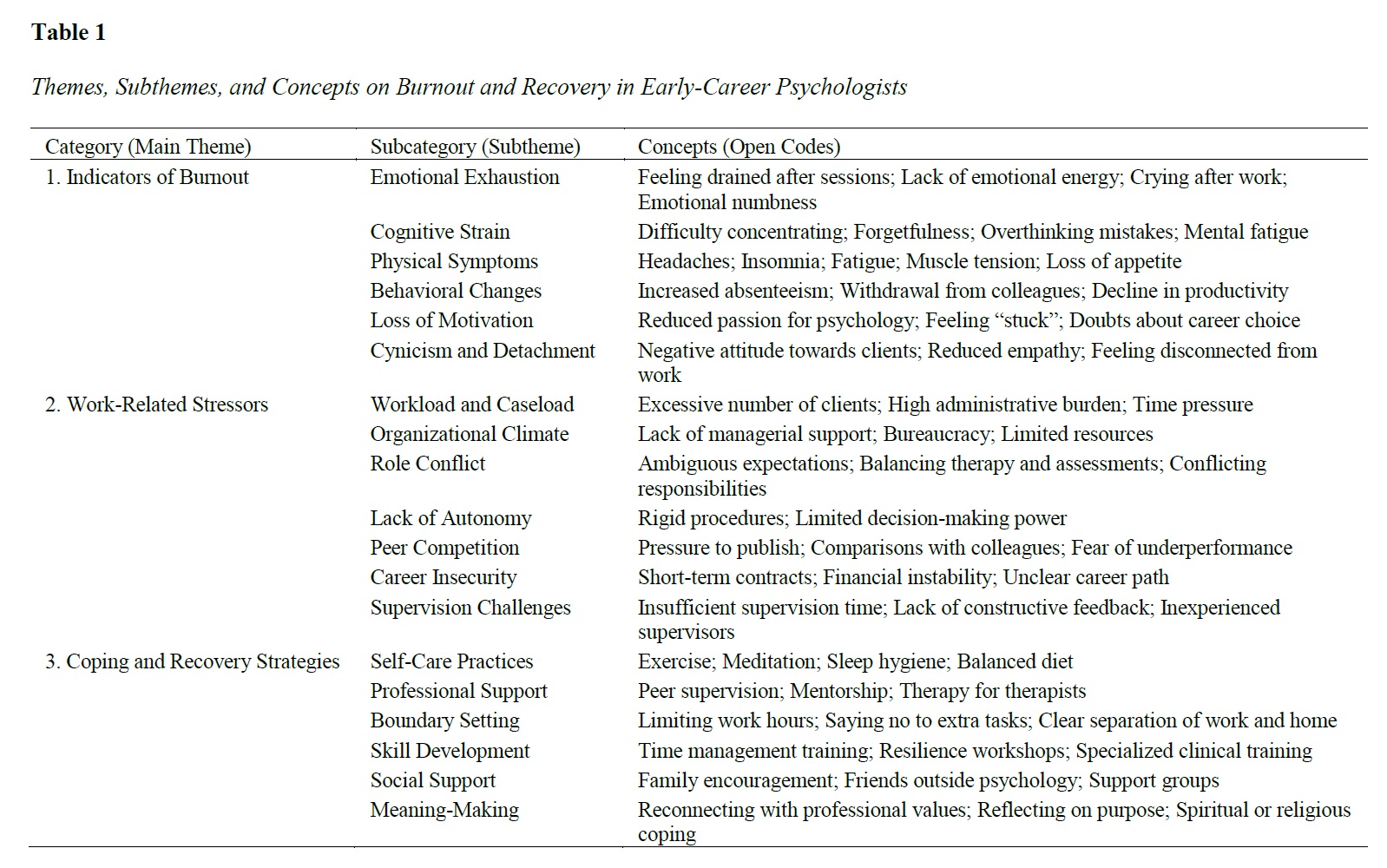
Findings: Analysis revealed four overarching themes: (1) Indicators of Burnout, including emotional exhaustion, cognitive strain, physical symptoms, behavioral withdrawal, loss of motivation, and cynicism; (2) Work-Related Stressors, such as excessive caseloads, limited autonomy, organizational climate challenges, career insecurity, peer competition, and inadequate supervision; (3) Coping and Recovery Strategies, encompassing self-care practices, professional and social support, boundary setting, skill development, and meaning-making processes; and (4) Facilitators of Resilience and Growth, including personal traits, supportive work environments, professional identity, work-life integration, positive client outcomes, and continuous development. Illustrative participant quotations highlighted the interplay between strain and recovery, underscoring both vulnerabilities and strengths in early-career practice.
Conclusion: The findings demonstrate that early-career psychologists face significant burnout risks shaped by organizational and systemic stressors, but also employ diverse coping mechanisms and resilience-building strategies. Recovery from burnout is not only possible but often accompanied by professional growth when adequate supports are in place. These results highlight the need for organizational policies, training programs, and supervisory practices that foster resilience, enhance professional identity, and promote sustainable career development for emerging psychologists.
Downloads
References
Demetri, C., Saidel, S., Ingall, F., Hefferman-Clarke, R., Armstrong, J. D., Kramarz, E., Jones, E., Fialho, C., Caglar, F. D., Gezehagn, E., & Riches, S. (2023). Work-Life Balance for Aspiring Clinical Psychologists: Topics From Reflective Practice Sessions. Clinical Psychology Forum, 1(361), 53-59. https://doi.org/10.53841/bpscpf.2023.1.361.53
Diener, M. J., Hilsenroth, M. J., & Giannopoulos, E. (2025). Therapist affect focus and patient outcomes in psychodynamic therapy: An updated systematic review and meta-analysis. Psychotherapy. https://doi.org/10.1037/pst0000568
Dorociak, K. E., Rupert, P. A., & Zahniser, E. (2017). Work Life, Well-Being, and Self-Care Across the Professional Lifespan of Psychologists. Professional Psychology Research and Practice, 48(6), 429-437. https://doi.org/10.1037/pro0000160
Elsey, V., Thompson, N., Sillence, E., Longstaff, L., & Moss, M. (2020). Becoming a Professional: The Five Pillars of Identification in Occupational Psychology in the UK. 13(1). https://doi.org/10.21825/ewopinpractice.87129
Fletcher, D., Rumbold, J. L., Tester, R., & Coombes, M. S. (2011). Sport Psychologists’ Experiences of Organizational Stressors. The Sport Psychologist, 25(3), 363-381. https://doi.org/10.1123/tsp.25.3.363
Fris, D. A. H., Vianen, A. E. M. v., Edwin, A. J. v. H., Hoog, M. d., & Pagter, A. P. d. (2023). Career Coach Preferences of Medical Students: Coaching Specialist or Specialistic Coach? BMC Medical Education, 23(1). https://doi.org/10.1186/s12909-023-04882-1
Israel, T. (2012). Letters to a Young Psychologist. The counseling psychologist, 40(6), 847-855. https://doi.org/10.1177/0011000012438420
Jin, T., Zhou, Y., & Zhang, L. (2023). Job Stressors and Burnout Among Clinical Nurses: A Moderated Mediation Model of Need for Recovery and Career Calling. BMC Nursing, 22(1). https://doi.org/10.1186/s12912-023-01524-1
Karim, A. H. A., & Nordin, N. W. (2022). Exploring Occupational Stress and the Likelihood of Turnover Among Two Early Career Teachers. International Journal of Advanced Research in Education and Society. https://doi.org/10.55057/ijares.2022.4.3.6
Kolar, C., Treuer, K. v., & Koh, C. (2017). Resilience in Early‐Career Psychologists: Investigating Challenges, Strategies, Facilitators, and the Training Pathway. Australian Psychologist, 52(3), 198-208. https://doi.org/10.1111/ap.12197
Kurinna, І. (2022). Professional Stress of Beginning Psychologists. Humanitarian Studios Pedagogics Psychology Philosophy, 13(2). https://doi.org/10.31548/hspedagog13(2).2022.84-90
O’Shaughnessy, T., & Burnes, T. R. (2016). The Career Adjustment Experiences of Women Early Career Psychologists. The counseling psychologist, 44(6), 786-814. https://doi.org/10.1177/0011000016650264
Park, J., & Lee, A. Y. (2025). A Qualitative Study on Art Therapists’ Experiences of Art Therapy for Individuals With Borderline Intellectual Functioning. Soc Art Educ Korea, 93, 121-146. https://doi.org/10.25297/aer.2025.93.121
Senter, A., Morgan, R. D., Serna-McDonald, C., & Bewley, M. T. (2010). Correctional Psychologist Burnout, Job Satisfaction, and Life Satisfaction. Psychological Services, 7(3), 190-201. https://doi.org/10.1037/a0020433
Silla, J. M. P., & Tetrick, L. E. (2011). Occupational Health Psychology. 292-315. https://doi.org/10.1002/9781444395150.ch12
Stiegler, J. R., Schanche, E., Danielsen, Y. S., & Hjeltnes, A. (2024). Growth in challenging situations: A qualitative investigation of therapists' experience of delivering emotion-focused therapy. Psychotherapy Research, 1-13. https://doi.org/10.61838/ijbmc.v12i2.844 10.1080/10503307.2024.2432680
Stoicescu, M., & Stanescu, M. (2019). Managing the Occupational Stress in Early Coaches’ Career. https://doi.org/10.15405/epsbs.2019.02.4
Thorn, I. M., & Yancey, G. B. (2021). Becoming an Organizational Leader: A Different Career Path for Psychologists. The Psychologist-Manager Journal, 24(3), 183-198. https://doi.org/10.1037/mgr0000117
Williams, A. M., Reed, B., Self, M. M., Robiner, W. N., & Ward, W. L. (2019). Psychologists’ Practices, Stressors, and Wellness in Academic Health Centers. Journal of Clinical Psychology in Medical Settings, 27(4), 818-829. https://doi.org/10.1007/s10880-019-09678-4
Yates, J., & Cahill, S. (2018). What Kind of Shoes Does a Social Worker Wear? A Content Analysis of Four Occupational Prototypes. British Journal of Guidance and Counselling, 47(3), 355-370. https://doi.org/10.1080/03069885.2018.1437596
Yıldızhan, C., Kafescioğlu, N., Zeytinoğlu-Saydam, S., Erdem, G., Söylemez, Y., & Yumbul, Ç. (2024). Emotion regulation in emotionally focused therapists working with high-conflict couples. J Marital Fam Ther, 50(4), 840-866. https://doi.org/10.1111/jmft.12725
Zhong, H., & Xu, J. (2023). Precarious Employment and Subjective Career Success During the School-to-Work Transition. Psychology research and behavior management, Volume 16, 2327-2339. https://doi.org/10.2147/prbm.s418017
Živković, S., & Veljković, M. (2021). Stress and Importance of Psychological Preparation of Firefighters. Safety Engineering, 11(1), 37-42. https://doi.org/10.5937/se2101037z
Казаренков, В. И., Карнелович, М. М., & Казаренкова, Т. Б. (2021). Coping Strategies in Professional Activities of Educational Psychologists. Психолого-Педагогический Поиск(4(56)), 71-81. https://doi.org/10.37724/rsu.2020.56.4.008
Downloads
Additional Files
Publication Timeline
- Submitted
- Revised
- Accepted