The Psychology of Uncertainty: An Interpretative Phenomenological Analysis of Identity Reconstruction During Major Life Transitions
Keywords:
Uncertainty, Identity Reconstruction, Major Life Transitions, Interpretative Phenomenological Analysis, Self-Identity, Meaning-Making, Psychological AdaptationAbstract
Objective: This study aimed to explore and interpret the lived experiences of uncertainty and the processes through which adults reconstruct their identities during major life transitions.
Methods and Materials: This qualitative study employed Interpretative Phenomenological Analysis (IPA). Participants were 18 adults residing in Tehran, Iran, who had experienced a significant life transition within approximately six months to three years before participation. Participants were selected through purposive sampling to ensure direct experience of identity-relevant transitions, including divorce, occupational change, relocation, educational transition, marriage, and changes in family or social roles. Data were collected through in-depth semi-structured interviews lasting approximately 60–90 minutes. Interviews were audio-recorded, transcribed verbatim, and analyzed using the systematic stages of IPA, including repeated reading, exploratory noting, development of experiential statements, clustering of related meanings, within-case analysis, and cross-case comparison. Reflexive notes, an audit trail, and repeated checking of themes against original transcripts were used to enhance analytic rigor.
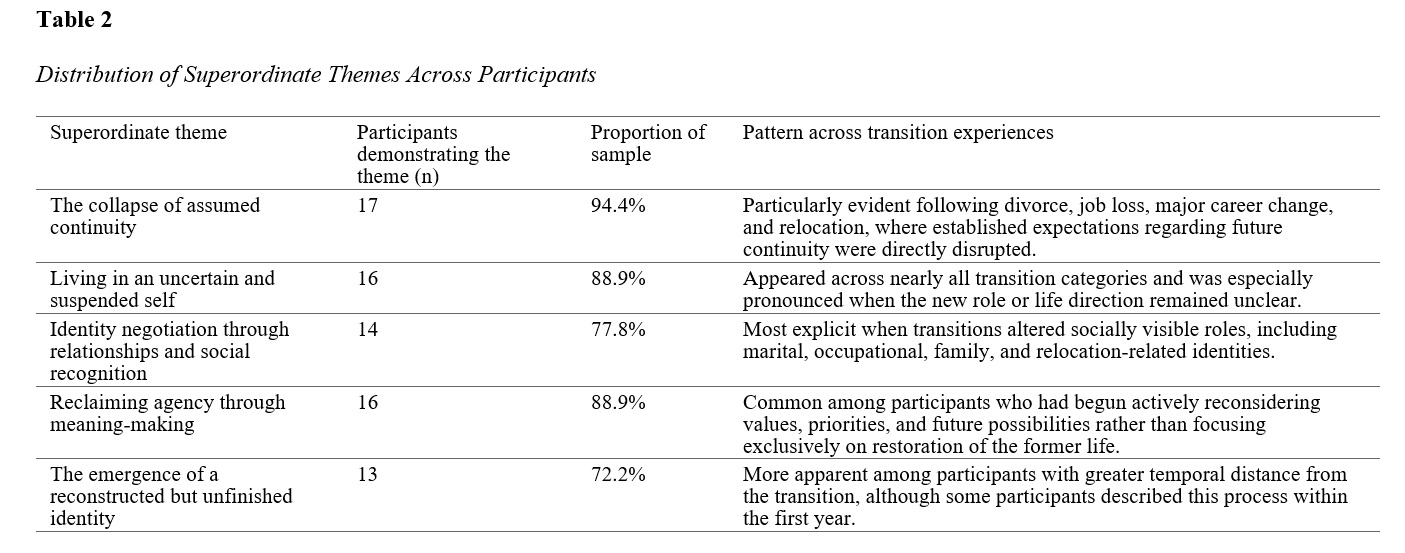
Findings: Analysis generated five interrelated superordinate themes: the collapse of assumed continuity, living in an uncertain and suspended self, identity negotiation through relationships and social recognition, reclaiming agency through meaning-making, and the emergence of a reconstructed but unfinished identity. The findings indicated that major life transitions disrupted participants’ established self-narratives and identity anchors, creating a liminal state between former and emerging identities. Identity reconstruction was facilitated by reinterpretation of the transition, re-evaluation of personal values, experimentation with new roles, and supportive social recognition. Greater adaptation was characterized not by elimination of uncertainty, but by increased tolerance of ambiguity and a more flexible, revisable understanding of selfhood.
Conclusion: Identity reconstruction during major life transitions appears to be a dynamic and recursive process in which uncertainty initially destabilizes self-continuity but can subsequently promote reflection, agency, and the development of a more flexible identity capable of integrating both continuity and change.
Downloads
References
Becht, A. I., Nelemans, S. A., Branje, S. J. T., Vollebergh, W. A. M., Koot, H. M., & Meeus, W. H. J. (2017). Identity uncertainty and commitment making across adolescence: Five-year within-person associations using daily identity reports. Developmental Psychology, 53(11), 2103-2112. https://doi.org/10.1037/dev0000374
Belavadi, S., Gardikiotis, A., & Hogg, M. A. (2023). Social Identity Uncertainty During the Greek Financial Crisis: The Role of Media Narratives. Psychology of Language and Communication. https://doi.org/10.58734/plc-2023-0005
Bolano, D., & Bernardi, L. (2024). Transition to grandparenthood and early retirement in midlife. Journal of Family Studies, 30(4), 719-737. https://doi.org/10.1080/13229400.2024.2318325
Bosworth, M. (2014). Uncertainty, Identity, and Power in Detention. 161-185. https://doi.org/10.1093/acprof:oso/9780199675470.003.0007
Burke, P. J. (2020). Identity Dispersion: Flexibility, Uncertainty, or Inconsistency? , 89-117. https://doi.org/10.1007/978-3-030-41231-9_4
Duell, D. (2022). Shared Social Identity and Strategic Uncertainty. https://doi.org/10.17605/osf.io/pkzhr
Dyar, C., Feinstein, B. A., Schick, V., & Davila, J. (2017). Minority Stress, Sexual Identity Uncertainty, and Partner Gender Decision Making Among Nonmonosexual Individuals. Psychology of Sexual Orientation and Gender Diversity, 4(1), 87-104. https://doi.org/10.1037/sgd0000213
Flores, C. (2025). A Qualitative Phenomenological Study of Military Veterans' Lived Experiences with the Cultural Transition Process: Navigating from the Military Culture to Civilian Life
Frost, J. (2019). Certainty, Uncertainty, or Indifference? Examining Variation in the Identity Narratives of Nonreligious Americans. American Sociological Review, 84(5), 828-850. https://doi.org/10.1177/0003122419871957
Garrison, Y. L., Lee, K.-H., & Ali, S. R. (2016). Career Identity and Life Satisfaction: The Mediating Role of Tolerance for Uncertainty and Positive/Negative Affect. Journal of Career Development, 44(6), 516-529. https://doi.org/10.1177/0894845316668410
Haseli Songhori, M., & Salamti, K. (2024). The Linkage Between University Students’ Academic Engagement and Academic Support: The Mediating Role of Psychological Capital [Research Article]. Iranian Journal of Educational Sociology, 7(2), 72-84. https://doi.org/10.61838/kman.ijes.7.2.10
Hogg, M. A. (2022). Self-Uncertainty and Social Identity Processes in Organizations. https://doi.org/10.1093/oxfordhb/9780197501061.013.8
Hogg, M. A. (2023). Walls Between Groups: Self‐uncertainty, Social Identity, and Intergroup Leadership. Journal of Social Issues, 79(2), 825-840. https://doi.org/10.1111/josi.12584
Identity Uncertainty. (2010). https://doi.org/10.4135/9781412979306.n122
Jung, J., Hogg, M. A., Choi, H. S., & Lewis, G. F. (2014). Identity Uncertainty and Group Identification in the Nested Identity Context. https://doi.org/10.1037/e578192014-837
Jung, J., Hogg, M. A., Livingstone, A., & Choi, H. S. (2019). From Uncertain Boundaries to Uncertain Identity: Effects of Entitativity Threat on Identity–uncertainty and Emigration. Journal of Applied Social Psychology, 49(10), 623-633. https://doi.org/10.1111/jasp.12622
Kleyberg, Y. (2015). The Uncertainty of Self-Identity: Deviantological Construct. Penza Psychological Newsletter, 1(4). https://doi.org/10.17689/psy-2015.1.11
Mastorci, F., Lazzeri, M. F. L., Vassalle, C., & Pingitore, A. (2024). The Transition from Childhood to Adolescence: Between Health and Vulne rability. Children, 11(8), 989. https://doi.org/10.3390/children11080989
Milesi, P. (2022). Identity Leadership, Procedural Justice, and Group Identification in Uncertain Organizational Contexts. Journal of Applied Social Psychology, 52(9), 886-911. https://doi.org/10.1111/jasp.12897
Monin, J. K., & Newsom, J. T. (2023). Marital Transitions in Mid and Late Life. Innovation in Aging, 7(Supplement_1), 94-94. https://doi.org/10.1093/geroni/igad104.0306
Rozina, I. V., Маланюк, Н., Kalyniuk, A., Потапюк, Л., & Tsumarieva, N. (2024). Tolerance to Uncertainty as a Factor in the Development of Higher Education Students’ Professional Identity. Sapienza International Journal of Interdisciplinary Studies, 5(4), e24080. https://doi.org/10.51798/sijis.v5i4.881
Tracey, M. W., & Hutchinson, A. (2016). Uncertainty, Reflection, and Designer Identity Development. Design Studies, 42, 86-109. https://doi.org/10.1016/j.destud.2015.10.004
Wagoner, J. A., Antonini, M., Hogg, M. A., Barbieri, B., & Talamo, A. (2018). Identity‐centrality, Dimensions of Uncertainty, and Pursuit of Subgroup Autonomy: The Case of Sardinia Within Italy. Journal of Applied Social Psychology, 48(10), 582-589. https://doi.org/10.1111/jasp.12549
Wagoner, J. A., & Hogg, M. A. (2017). Uncertainty-Identity Theory. 1-8. https://doi.org/10.1007/978-3-319-28099-8_1195-1
Wahring, I. V., Neyer, F. J., Hoppmann, C. A., Ram, N., & Gerstorf, D. (2025). Men and Women Transitioning to Singlehood in Young Adulthood and Midlife. Psychology and Aging, 40(2), 117-136. https://doi.org/10.1037/pag0000859
Wallace, D. (2012). Uncertainty, Possibility, and Identity. 257-291. https://doi.org/10.1093/acprof:oso/9780199546961.003.0010
Wu, D., Zhao, Y. C., Zhang, Y., & Song, S. (2024). Contextual information needs of people in life transitions struggling with obsessive-compulsive disorder. Information Research: an international electronic journal, 29(2), 669-679. https://publicera.kb.se/ir/article/view/55507
Yoon, D. B., & Theiss, J. A. (2021). The Role of Identity Uncertainty in Predicting Relational Turbulence and Perceived Partner Communication for Women Coping With Infertility. Journal of Social and Personal Relationships, 39(3), 670-691. https://doi.org/10.1177/02654075211044493
Downloads
Additional Files
Publication Timeline
- Submitted
- Revised
- Accepted