Components of Body–Self Ambiguity in Dermatology Patients: A Qualitative Study
DOI:
https://doi.org/10.61838/kman.jppr.4248Keywords:
Body–self ambiguity, dermatology patients, qualitative study, body image, phenomenology, self-identity, psychological adaptationAbstract
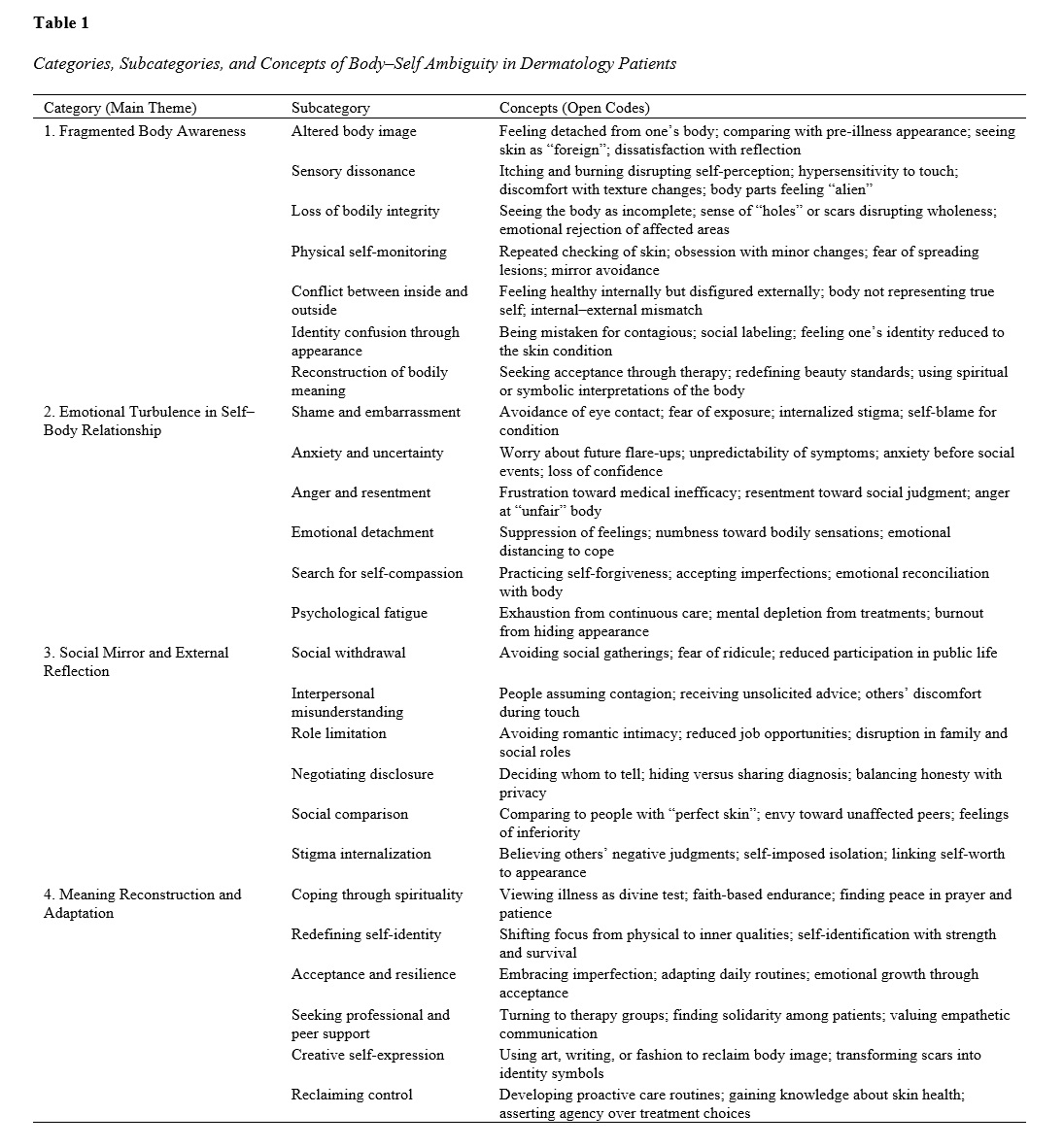
This study aimed to explore the lived experiences and psychological components of body–self ambiguity among patients with chronic dermatological conditions, focusing on how individuals interpret, negotiate, and reconstruct the meaning of their altered embodiment. This qualitative phenomenological study was conducted with 16 dermatology patients (9 women and 7 men) from clinical centers in Tehran between March and August 2025. Participants were selected through purposive sampling to ensure variation in age, gender, diagnosis, and illness duration. Data were collected using semi-structured, in-depth interviews that invited participants to describe their personal experiences of body–self disconnection and social perception. Interviews were recorded, transcribed verbatim, and analyzed through Braun and Clarke’s six-phase thematic analysis using NVivo 14 software. Theoretical saturation was achieved after the sixteenth interview. Trustworthiness was ensured through triangulation, member checking, and maintaining an audit trail of analytical decisions. Analysis revealed four overarching themes representing the components of body–self ambiguity in dermatology patients: (1) Fragmented Body Awareness, describing disconnection from one’s bodily image and sensory estrangement; (2) Emotional Turbulence in the Self–Body Relationship, involving shame, anxiety, and emotional fatigue in response to visible changes; (3) Social Mirror and External Reflection, capturing stigma, social withdrawal, and the internalization of others’ judgments; and (4) Meaning Reconstruction and Adaptation, denoting acceptance, spirituality, and creative self-expression as pathways toward re-integrating body and self. These findings highlight body–self ambiguity as a fluid and multidimensional experience shaped by emotional, social, and cultural contexts. The study concludes that dermatological illness profoundly alters patients’ bodily self-concept, evoking fragmentation yet also fostering potential for meaning reconstruction.
Downloads
References
Abeyrathna, P., Nadeesha, T., Malika, N., Wijerathna, N., & Agampodi, S. (2023). Common Dermatological Complaints and Their Psychosocial Impact: A Descriptive Cross-Sectional Study Among Undergraduates of an Outstation University of &Amp;nbsp;Sri Lanka. Anuradhapura Medical Journal, 17(2), 20-24. https://doi.org/10.4038/amj.v17i2.7730
Adkins, K. V., Overton, P. G., & Thompson, A. R. (2022). A Brief Online Writing Intervention Improves Positive Body Image in Adults Living With Dermatological Conditions. Frontiers in Medicine, 9. https://doi.org/10.3389/fmed.2022.1064012
Almudimeegh, A., Almukhadeb, E., Nagshabandi, K. N., Alshehri, N. J., Almusa, H. A., Aldosari, O., & Aldakhil, I. (2025). The Impact of Individuals’ Self-Esteem on Cosmetic Dermatology Preferences Assessed Using the Rosenberg Self-Esteem Scale: A Cross-Sectional Study. Medicine, 104(26), e43109. https://doi.org/10.1097/md.0000000000043109
Anaba, E. L., Cole‐Adeife, O., & Oaku, R. I. (2021). Prevalence, Pattern, Source of Drug Information, and Reasons for Self‐medication Among Dermatology Patients. Dermatologic Therapy, 34(2). https://doi.org/10.1111/dth.14756
Aperi, S., & Koliouli, F. (2021). Self-Reported Dermatological Manifestations, Perceived Stress, and Body Image of Young Adults During the Greek Lockdown Caused by the COVID-19 Outbreak. Trends in Psychology, 30(2), 328-344. https://doi.org/10.1007/s43076-021-00111-0
Bazen, A., Barg, F. K., & Takeshita, J. (2021). Research Techniques Made Simple: An Introduction to Qualitative Research. Journal of Investigative Dermatology, 141(2), 241-247.e241. https://doi.org/10.1016/j.jid.2020.11.029
Costeris, C., Petridou, M., & Ioannou, Y. (2021a). The Critical Role of Body Dysmorphic Disorder in Dermatological Patients’ Body Image: Patients’ Desire to Seek Even More Medical Treatments Increases After Dermatological Treatment. GLOBAL PSYCHIATRY ARCHIVES, 4(1), 95-108. https://doi.org/10.52095/gp.2021.10423
Costeris, C., Petridou, M., & Ioannou, Y. (2021b). Social Support and Appearance Satisfaction Can Predict Changes in the Psychopathology Levels of Patients With Acne, Psoriasis and Eczema, Before Dermatological Treatment and in a Six-Month Follow-Up Phase. Psych, 3(3), 259-268. https://doi.org/10.3390/psych3030020
El-Banna, G., Rezaei, S. J., Chang, M. J., Merrell, S. B., Bailey, E. E., & Kibbi, N. (2024). Perceptions of US-Based Muslim Patients of Their Dermatology Care. Jama Dermatology, 160(1), 45. https://doi.org/10.1001/jamadermatol.2023.4439
Ezzedine, K., Shourick, J., Bergqvist, C., Misery, L., Chuberre, B., Kérob, D., Halioua, B., Fur, G. L., Paul, C., Richard, M. A., & Taïeb, C. (2022). Patient Unique Stigmatization Holistic Tool in Dermatology (PUSH‐D): Development and Validation of a Dermatology‐specific Stigmatization Assessment Tool. Journal of the European Academy of Dermatology and Venereology, 37(2), 443-450. https://doi.org/10.1111/jdv.18641
Jankowiak, B., Kowalewska, B., Krajewska-Kułak, E., Kowalczuk, K., & Хворик, Д. Ф. (2020). The Sense of Stigmatization in Patients With Plaque Psoriasis. Dermatology, 237(4), 611-617. https://doi.org/10.1159/000510654
Jk, K., Nielsen, C., & Haloob, N. (2022). Patient Reported Outcome Measures (PROMS) for Body Image in Dermatology: A Systematic Review. Skin Health and Disease, 2(4). https://doi.org/10.1002/ski2.167
Kowalewska, B., Jankowiak, B., Krajewska-Kułak, E., Хворик, Д. Ф., & Niczyporuk, W. (2020). Quality of Life in Skin Diseases as Perceived by Patients and Nurses. Advances in Dermatology and Allergology, 37(6), 956-961. https://doi.org/10.5114/ada.2019.86182
Mohammed, G. F., Al‐Dhubaibi, M. S., Atef, L. M., Bahaj, S. S., & Al‐Dhubaibi, A. M. (2025). The Relationship Between Dermatology and Visual Arts. Dermatological Reviews, 6(4). https://doi.org/10.1002/der2.70046
Muzaffar, K. H., Halilu, H. B., Dantata, B. A., Saati, S. M., & Salah, L. A. (2024). Prevalence of Anxiety, Depression, and Body Dysmorphic Disorders Among Dermatology Outpatients With Acne Vulgaris at a Public Hospital in Saudi Arabia. Cureus. https://doi.org/10.7759/cureus.64917
Pascual, M. G., Morris, M. A., & Kohn, L. L. (2023). Publication Trends of Qualitative Research in Dermatology. Jama Dermatology, 159(6), 648. https://doi.org/10.1001/jamadermatol.2023.0839
Porter, E., O’Connor, C., & Murphy, M. (2024). Re-Engagement, Quality of Life, and Burden of Treatment in Adults on Dupilumab for Severe Atopic Dermatitis—A Mixed Methods Study. Skin Health and Disease, 4(4). https://doi.org/10.1002/ski2.372
Rees, S., & Arnold, S. (2024). Loss, Shame and Secrecy in Women’s Experiences of a Vulval Skin Condition: A Qualitative Study. Health an Interdisciplinary Journal for the Social Study of Health Illness and Medicine, 29(3), 355-372. https://doi.org/10.1177/13634593241271041
Rivera, S., Dykstra, C., Flood, A., Herbenick, D., & DeMaria, A. L. (2022). “Worse Than Disappointing”: Prediagnostic Health Care Challenges of Women With Inflammatory Vulvar Dermatoses. Journal of Lower Genital Tract Disease, 26(1), 53-59. https://doi.org/10.1097/lgt.0000000000000632
Shuhayb, B. S. A., Bukhamsin, S., Albaqshi, A. A., & Mohamed, F. O. (2023). The Prevalence and Clinical Features of Body Dysmorphic Disorder Among Dermatology Patients in the Eastern Province of Saudi Arabia. Cureus. https://doi.org/10.7759/cureus.42474
Soto‐Moreno, A., Ureña‐Paniego, C., Montero‐Vílchez, T., Sánchez‐Díaz, M., Díaz‐Calvillo, P., Rodríguez‐Pozo, J. Á., Molina‐Leyva, A., Martínez‐López, A., & Arias‐Santiago, S. (2023). Fears, Concerns and Expectations in Dermatologic Emergencies: A Qualitative and Descriptive Study in a Tertiary Hospital. Journal of the European Academy of Dermatology and Venereology, 37(5). https://doi.org/10.1111/jdv.18866
Tros, B. G., Kemperman, P. M. J. H., Kuckulus, J., Hoekzema, R., & Vulink, N. (2023). Body Dysmorphic Disorder and Self-Esteem in Adolescents and Young Adults With Acne Vulgaris. Acta Dermato Venereologica, 103, adv6232. https://doi.org/10.2340/actadv.v103.6232
Downloads
Additional Files
Publication Timeline
- Submitted
- Revised
- Accepted