Cognitive Flexibility Mediates the Impact of Adverse Childhood Experiences on Somatization
DOI:
https://doi.org/10.61838/kman.jppr.3.2.1Keywords:
Adverse Childhood Experiences, Cognitive Flexibility, Somatization, Structural Equation Modeling, Trauma, Mediation AnalysisAbstract
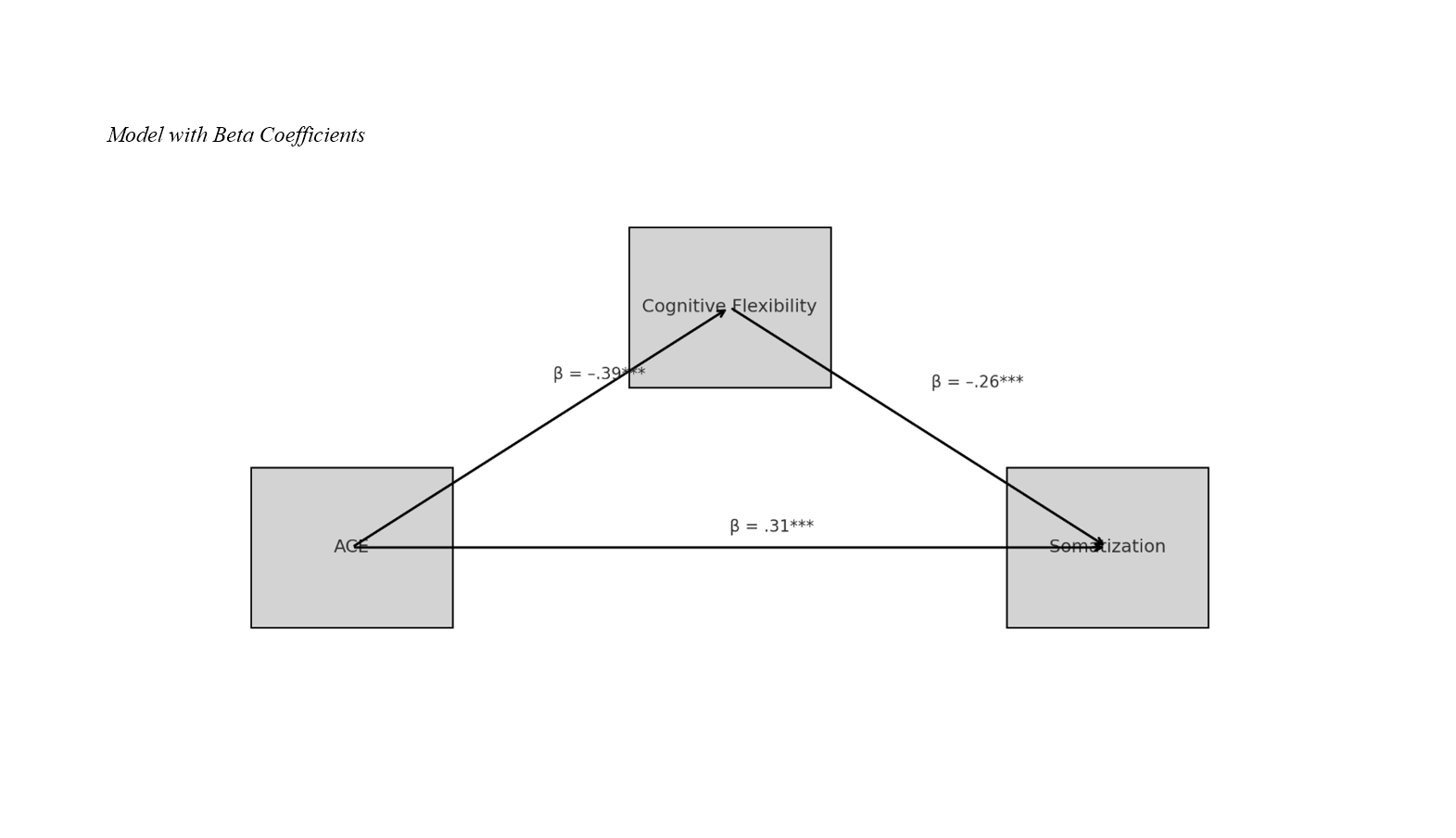
This study aimed to examine whether cognitive flexibility mediates the relationship between adverse childhood experiences (ACEs) and somatization in adults. A descriptive correlational design was employed using data from 440 adult participants in the United States. The sample size was determined based on the Morgan and Krejcie table. Participants completed standardized self-report measures including the Adverse Childhood Experiences Questionnaire (ACE-Q), the Cognitive Flexibility Inventory (CFI), and the Patient Health Questionnaire-15 (PHQ-15) for somatization. Data were analyzed using SPSS-27 for descriptive statistics and Pearson correlation coefficients, and AMOS-21 was used for Structural Equation Modeling (SEM) to test the hypothesized mediation model. The results revealed that ACEs were positively correlated with somatization (r = .46, p < .001) and negatively correlated with cognitive flexibility (r = –.39, p < .001). Cognitive flexibility also showed a significant negative correlation with somatization (r = –.41, p < .001). The structural model demonstrated good fit (χ²/df = 2.21, GFI = .96, CFI = .97, RMSEA = .052). SEM results indicated that ACEs significantly predicted somatization both directly (β = .31, p < .001) and indirectly through cognitive flexibility (β = .10, p < .001), with a total effect of β = .41 (p < .001). The mediating role of cognitive flexibility was statistically significant, confirming partial mediation. These findings suggest that cognitive flexibility plays a protective role in the pathway from childhood adversity to physical symptom expression. Interventions aimed at enhancing cognitive flexibility may reduce the severity of somatization among trauma-exposed individuals and contribute to more effective trauma-informed care.
Downloads
References
Adamowicz, J. L., Sirotiak, Z., & Thomas, E. B. (2024). Childhood Maltreatment and Somatic Symptoms: Examining the Role of Specific Types of Childhood Maltreatment and Alexithymia. Psychological Trauma Theory Research Practice and Policy, 16(Suppl 1), S2-S9. https://doi.org/10.1037/tra0001315
Crismayanti, M. P., Dwidiyanti, M., & Anggorowati, A. (2024). Psychological Impact of Childhood Trauma on Adolescents: A Scoping Review. Indonesian Journal of Global Health Research, 7(1), 367-380. https://doi.org/10.37287/ijghr.v7i1.4073
Gardoki-Souto, I., Redolar-Ripoll, D., Fontana-McNally, M., Hogg, B., Castro, M. J., Josep Maria Blanch i, R., Ojeda, F., Solanes, A., Raduà, J., Valiente-Gómez, A., Cirici, R., Pérez, V., Amann, B. L., & Moreno‐Alcázar, A. (2022). Prevalence and Characterization of Psychological Trauma in Patients With Fibromyalgia: A Cross-Sectional Study. Pain Research and Management, 2022, 1-16. https://doi.org/10.1155/2022/2114451
Heule, M. (2025). Adverse Childhood Experiences and Urogenital Pain: Examining the Mediating Effects of Negative Affect and Pain Catastrophizing. Neurourology and Urodynamics. https://doi.org/10.1002/nau.70022
Laube, N., Mader, L., Heinzelmann, M.-A., Hunziker, S., Michel, G., Kuehni, C. E., & Laube, G. F. (2024). Psychological Distress in Adults After Pediatric Kidney Replacement Therapy. https://doi.org/10.21203/rs.3.rs-4527030/v1
Lee, H., & Yoon, S. (2024). The Effect of Childhood Abuse Experience on Somatization: The Mediating Effects of Clarity on Emotional Awareness and Maladaptive Cognitive Emotion Regulation Strategy. Korean Association for Learner-Centered Curriculum and Instruction, 24(4), 57-72. https://doi.org/10.22251/jlcci.2024.24.4.57
Lombardo, C. (2024). A Psychoanalytic Perspective on the Neuropsychological Impact of Anabolic Steroid Abuse: The Role of Bio-Neurofeedback as a Therapeutic Tool. J Emerg Med OA, 2(1), 01-06. https://doi.org/10.33140/jemoa.02.01.15
Ma, R. (2025). The Role of Adverse Childhood Experiences and Protective Factors in the Co-Occurrence of Somatization and Post-Traumatic Stress Symptoms. Journal of Mind and Medical Sciences, 12(1), 9. https://doi.org/10.3390/jmms12010009
Mancone, S., Corrado, S., Tosti, B., Spica, G., Siena, F. D., & Diotaiuti, P. (2024). Exploring the Interplay Between Sleep Quality, Stress, and Somatization Among Teachers in the Post-Covid-19 Era. Healthcare, 12(15), 1472. https://doi.org/10.3390/healthcare12151472
Marmet, S., Bötschi, S., Vetsch, N., Stallmann, L., & Brodbeck, J. (2024). Associations of Exposure Frequencies of Single Adverse Childhood Experiences With Psychological Distress: Evidence From a Cohort Study Among Emerging Adults. https://doi.org/10.31234/osf.io/hq2vy
Nakhaei Moghadam, R., Bahrainian, S. A., & Nasri, M. (2024). The effectiveness of intensive and short-term dynamic psychotherapy on attachment styles, somatization and health anxiety in patients with chronic pain. Journal of Assessment and Research in Applied Counseling (JARAC), 6(1). https://journals.kmanpub.com/index.php/jarac/article/view/1287
Nudin, N. S. M., & Mohamed, N. F. (2023). Exploring the Long-Term Psychological Impact of Childhood Abuse on Intimate Partner Violence Victims in Malaysia. International Journal of Academic Research in Business and Social Sciences, 13(5). https://doi.org/10.6007/ijarbss/v13-i5/17156
Okur, S., Ümmet, D., Satıcı, S. A., & Kütük, H. (2025). Relations Among Family Communication, Cognitive Flexibility, and Happiness in Turkish Adults: A Longitudinal Mediation Model. Current Psychology, 1-11. https://doi.org/10.1007/s12144-024-07224-6
Pichel, A. N., & Suryadi, D. (2021). Somatic Symptoms in Young Adult Women Who Experienced Sexual Violence Throughout Life Development: A Systematic Review. https://doi.org/10.2991/assehr.k.210805.084
Portilla-Saavedra, D., Pinto‐Cortez, C., & Moya-Vergara, R. (2023). Psychological Distress in Young Chilean Adults Exposed to Parental Alienating Behaviors During Childhood/Adolescence. European Journal of Investigation in Health Psychology and Education, 13(9), 1707-1716. https://doi.org/10.3390/ejihpe13090123
Prasetya, E. C., Afifah, I., Mahyuddin, M. H., Haniifah, U., & Abdullah, K. H. A. (2023). Physical Complaints of Pain and Heartburn as Part of the Symptoms of Somatization. Jurnal Psikiatri Surabaya, 12(2), 186-193. https://doi.org/10.20473/jps.v12i2.39192
Rahapsari, S., & Levita, L. (2024). The Impact of Adverse Childhood Experiences on Cognitive Control Across the Lifespan: A Systematic Review and Meta-Analysis of Prospective Studies. Trauma Violence & Abuse. https://doi.org/10.1177/15248380241286812
Rostami, M., & Mehdiabadi, P. (2024). Qualitative Examination of the Relationship Between Childhood Trauma, Dissociative Identity Disorder, and Somatic Symptoms. JPPR, 2(4), 4-11. https://doi.org/10.61838/kman.jppr.2.4.2
Saadati, N., Kılıçaslan, F., & Salami, M. O. (2023). The Psychosomatic Effects of Childhood Trauma: Insights From Adult Survivors. JPPR, 2(2), 34-40. https://doi.org/10.61838/kman.jppr.2.2.6
Tao, Z. (2023). Exploring Memory—An Exploration of the Relationship Between Childhood Experience and Artist's Art Creation. Frontiers in Art Research, 5(4). https://doi.org/10.25236/far.2023.050403
Torgah, N. A. E. (2024). Stolen Childhoods: Adverse Childhood Experiences and Mental Wellbeing Among Adult Survivors of Child Labor. International Journal of Research and Innovation in Social Science, VIII(X), 366-378. https://doi.org/10.47772/ijriss.2024.8100031
Vakilian, K., Ebrahimi, S., Fouladvand, M., Moslemi, A., & Najdi, N. (2024). Predicting Commitment of Married Women Based on Emotional Intimacy, Cognitive Flexibility, and Irrational Beliefs of Infertile Couples in Arak City in the 2021:A Cross-Sectional Study. The Open Public Health Journal, 17(1). https://doi.org/10.2174/0118749445267020240209073345
Wang, S. (2024). The Association Between Childhood Trauma and Adult Mental Disorders: A General Overview. SHS Web of Conferences, 193, 03004. https://doi.org/10.1051/shsconf/202419303004
Zhang, K., Sun, J., Zhang, Q., Zhang, J., He, L., Wang, Z., & Hu, L. (2023). The Association Between Childhood Trauma and Pain Symptoms in Depressed Adults: The Moderating Role of Anxious Attachment. Clinical Psychology & Psychotherapy, 30(3), 679-689. https://doi.org/10.1002/cpp.2824
Zhou, X., Meng, Y., Li, J., & Shen, X. (2024). Childhood Adversity and Mind Wandering: The Mediating Role of Cognitive Flexibility and Habitual Tendencies. European Journal of Psychotraumatology, 15(1). https://doi.org/10.1080/20008066.2024.2301844
Downloads
Publication Timeline
- Submitted
- Revised
- Accepted
Issue
Section
License
Copyright (c) 2025 2025

This work is licensed under a Creative Commons Attribution-NonCommercial 4.0 International License.