The Effectiveness of Mobile-Based Mental Health App on Anxiety and Cognitive Distortions
DOI:
https://doi.org/10.61838/kman.jppr.3.3.3Keywords:
mobile mental health app, anxiety, cognitive distortions, randomized controlled trial, cognitive-behavioral therapy, digital interventionAbstract
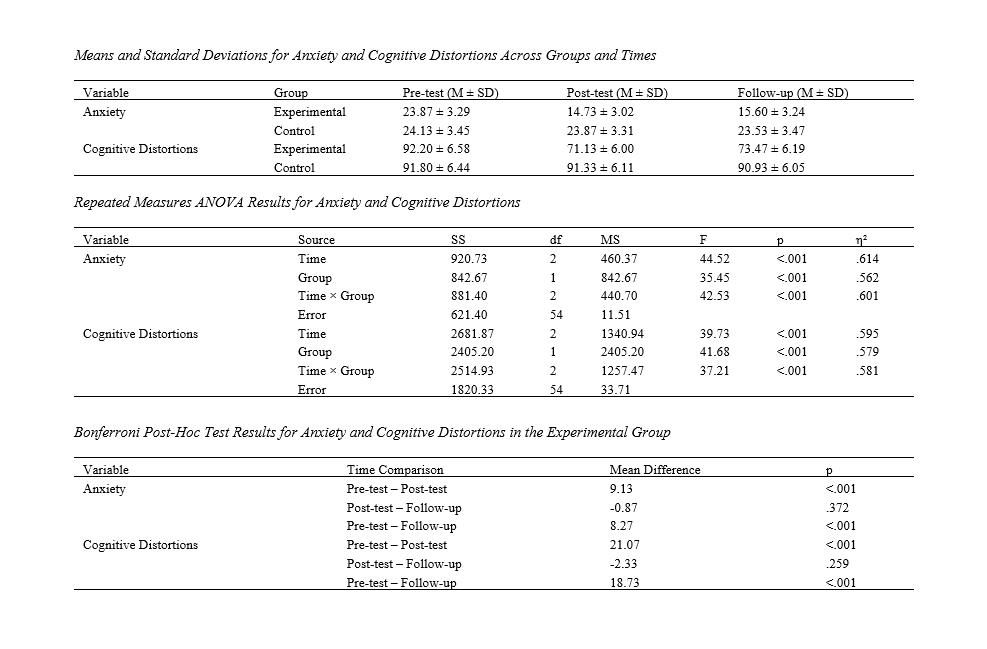
This study aimed to evaluate the effectiveness of a mobile-based mental health application in reducing anxiety symptoms and cognitive distortions among young adult users. A randomized controlled trial was conducted with 30 participants (15 in the experimental group and 15 in the control group) recruited from Iran. The intervention consisted of a mobile application delivering 12 CBT-based sessions over six weeks. Standardized tools—the Beck Anxiety Inventory (BAI) and the Cognitive Distortions Scale (CDS)—were used to assess outcomes at pre-test, post-test, and five-month follow-up. Data were analyzed using repeated measures ANOVA and Bonferroni post-hoc tests via SPSS-27. The repeated measures ANOVA revealed significant main effects of time (F = 44.52, p < .001, η² = .614 for anxiety; F = 39.73, p < .001, η² = .595 for cognitive distortions), group (F = 35.45, p < .001 for anxiety; F = 41.68, p < .001 for cognitive distortions), and time × group interactions (F = 42.53, p < .001 for anxiety; F = 37.21, p < .001 for cognitive distortions). Bonferroni post-hoc tests confirmed that the experimental group experienced significant reductions in both anxiety and cognitive distortions from pre-test to post-test (p < .001) and from pre-test to follow-up (p < .001), with no significant relapse over time (p > .05). The findings support the effectiveness of a structured mobile-based mental health application in reducing anxiety and maladaptive thinking patterns. The sustained improvements at five-month follow-up suggest that such digital interventions can offer accessible and durable mental health support.
Downloads
References
Bakhsh, M. M., Saimon, A. S. M., & Khan, A. (2024). Digital Interventions for Anxiety Management Using AI-Driven Mobile Applications. International Journal of Computer Science and Information Technology, 16(6), 17-34. https://doi.org/10.5121/ijcsit.2024.16602
Bentley, W. (2024). Personal Mobile Devices and Mental Health: A Double-Edged Sword? Stellenbosch Theological Journal, 9(1). https://doi.org/10.17570/stj.2023.v9n1.at6
Bunova, A. (2023). Mobile Applications for the Control of Anxiety and Depression Symptoms: Search and Quality Evaluation. Profilakticheskaya Meditsina, 26(10), 27. https://doi.org/10.17116/profmed20232610127
Doğan, T., Koçtürk, N., Akın, E., Kurnaz, M. F., Öztürk, C. D., Şen, A., & Yalçın, M. (2024). Science‐Based Mobile Apps for Reducing Anxiety: A Systematic Review and Meta‐Analysis. Clinical Psychology & Psychotherapy, 31(5). https://doi.org/10.1002/cpp.3058
Ferguson, T., & Krigolson, O. E. (2022). Using a Mobile Application to Reduce Anxiety Levels, Stress Levels, and Panic Severity in a Sample of the General Population. https://doi.org/10.31234/osf.io/mjrbx
Günay, A., & Karahan, A. (2025). Evaluation of the Effects of Mobile Applications on the Care Outcomes of Patients Undergoing Surgery for Breast Cancer : Systematic Review. Archives of Breast Cancer, 12(1), 5-14. https://doi.org/10.32768/abc.20251215-14
Husnain, A., Alomari, G., & S., A. (2024). Ai-Driven Integrated Hardware and Software Solution for EEG-based Detection of Depression and Anxiety. International Journal for Multidisciplinary Research, 6(3). https://doi.org/10.36948/ijfmr.2024.v06i03.22645
Karimzadeh, Z., Aliakbari, F., Salehi, S., & Shahraki, H. R. (2023). The Effect of Psychological Intervention Based on the Mobile Application on the Anxiety Level of Cholecystectomy Candidates. Journal of Multidisciplinary Care, 12(1), 24-30. https://doi.org/10.34172/jmdc.1170
Kermani, F., Kahouei, M., Valinejadi, A., Sadeghi, M., Momeni, M., & Pahlevanynejad, S. (2023). Outcome’s Classification in Mobile Applications Tailored to Parents of Premature Infants: A Systematic Review. Iranian Journal of Public Health. https://doi.org/10.18502/ijph.v52i8.13402
Kwon, H.-R., Choi, I. Y., Kim, D. J., & Yoo, J. H. (2024). A Review of Current Digital Mental Health Care Applications for Anxiety Symptoms and Future Prospects. Psychiatry Investigation, 21(6), 551-560. https://doi.org/10.30773/pi.2023.0339
McCall, T., Foster, M., Tomlin, H. R., & Schwartz, T. A. (2023). Black American Women’s Attitudes Toward Seeking Mental Health Services and Use of Mobile Technology to Support the Management of Anxiety. Jamia Open, 6(4). https://doi.org/10.1093/jamiaopen/ooad088
Moulaei, K., Bahaadinbeigy, K., Mashoof, E., & Dinari, F. (2022). Design and Development a Mobile-Based Self-Care Application for Patient With Depression and Anxiety Disorders: An Applied and Developmental Study. https://doi.org/10.21203/rs.3.rs-1979259/v1
Moulaei, K., Bahaadinbeigy, K., Mashoof, E., & Dinari, F. (2023). Design and Development of a Mobile-Based Self-Care Application for Patients With Depression and Anxiety Disorders. BMC Medical Informatics and Decision Making, 23(1). https://doi.org/10.1186/s12911-023-02308-y
Na, H., Jo, M., Lee, C., & Kim, D. (2022). Development and Evaluation: A Behavioral Activation Mobile Application for Self-Management of Stress for College Students. Healthcare, 10(10), 1880. https://doi.org/10.3390/healthcare10101880
Rahayu, T. B., Supriyanti, S., Kasim, J., Munazar, M., & Vandika, A. Y. (2024). Use of Mobile Applications for Monitoring Adolescent Mental Health. J. Of World Future Medicine, Health and Nursing, 2(2), 264-275. https://doi.org/10.70177/health.v2i2.761
Robinson, R., Narsinghani, R., & Nguyen, E. (2021). Mobile Health (mHealth) Apps for Self-Management of Depression or Anxiety: A Cross-Sectional Analysis (Preprint). https://doi.org/10.2196/preprints.28160
Robinson, R., Nguyen, E., & narsinghan, r. (2022). Cross-Sectional Analysis of Mobile Health (mHealth) Apps for Self-Management of Depression or Anxiety (Preprint). https://doi.org/10.2196/preprints.39083
Saraç, F. S., İLhan, S. E., Kutun, S., & Kutlutürkan, S. (2024). The Effect of Informative Mobile App Use on Anxiety, Distress, and Quality of Life of Women With Breast Cancer. European Journal of Breast Health, 207-214. https://doi.org/10.4274/ejbh.galenos.2024.2024-3-9
Shakeri, A., Saeidnia, H. R., Keshavarz, H., Babajani, A., & Mohammadzadeh, Z. (2022). A Mobile Application to Reduce Death Anxiety During the Covid-19 Pandemic: Design of a High-Fidelity Prototype. https://doi.org/10.21203/rs.3.rs-2012924/v1
Shakeri, A., Saeidnia, H. R., Keshavarz, H., Babajani, A., Mohammadzadeh, Z., & Hassanzadeh, M. (2024). Crafting a High-Fidelity Mobile Application to Mitigate Death Anxiety Amidst the COVID-19 Pandemic. https://doi.org/10.21203/rs.3.rs-3881050/v1
Xu, C., Wang, C., & Yang, N. (2023). Study on University Students' Preference of Learning Management System Application Mode and Its Influencing Factors. https://doi.org/10.4108/eai.23-12-2022.2329118
Zamyatin, K. A., Nozdrachev, D. I., & Solovieva, M. (2021). Mobile Applications for Anxiety and Stress Reduction: Potential for Preventing Noncommunicable Diseases. Russian Journal of Cardiology, 26(9), 4681. https://doi.org/10.15829/1560-4071-2021-4681
Downloads
Additional Files
Publication Timeline
- Submitted
- Revised
- Accepted
Issue
Section
License

This work is licensed under a Creative Commons Attribution-NonCommercial 4.0 International License.