The Effectiveness of Breathing and Relaxation Techniques on Somatic Tension and Trait Anger
DOI:
https://doi.org/10.61838/kman.jppr.3.3.5Keywords:
Breathing techniques, Somatic tension, Trait anger, Relaxation therapy, Randomized controlled trialAbstract
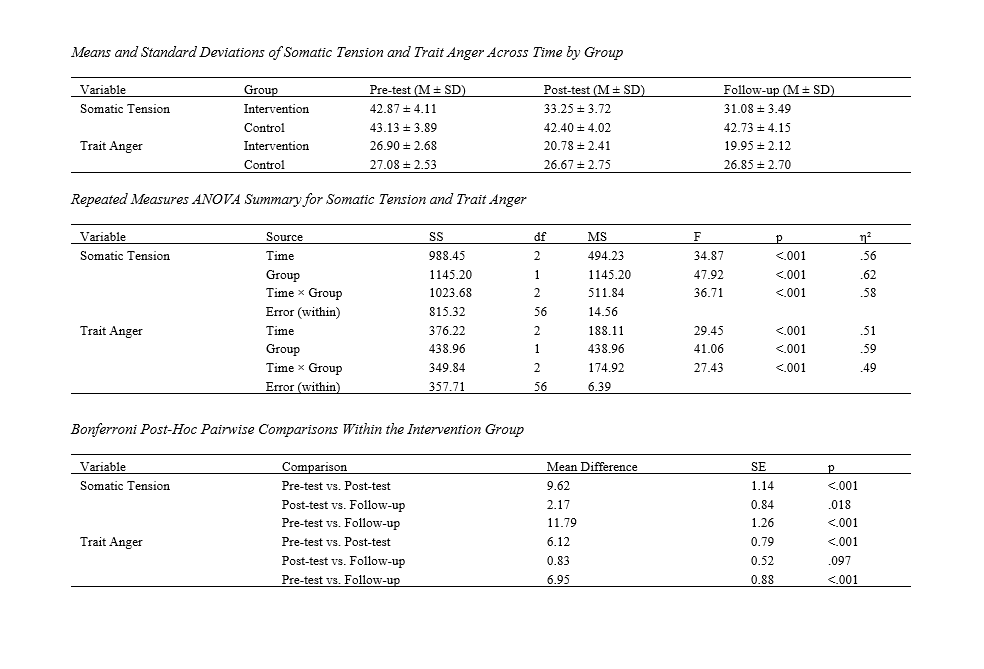
This study aimed to evaluate the effectiveness of a structured breathing and relaxation intervention in reducing somatic tension and trait anger among Canadian adults. A randomized controlled trial was conducted with 30 participants (15 intervention, 15 control) recruited from community and educational centers in Isfahan, Iran. The intervention group underwent ten 60-minute sessions over five weeks, incorporating diaphragmatic breathing, progressive muscle relaxation, and guided imagery techniques. Assessments were conducted at pre-test, post-test, and five-month follow-up using the Pennebaker Inventory of Limbic Languidness (Muscle Tension Subscale) and the State-Trait Anger Expression Inventory-2 (STAXI-2). Data were analyzed using repeated measures ANOVA with Bonferroni post-hoc tests via SPSS-27. Significant main effects of time and group, as well as time × group interactions, were found for both somatic tension (F(2,56) = 36.71, p < .001, η² = .58) and trait anger (F(2,56) = 27.43, p < .001, η² = .49). Post-hoc comparisons revealed a significant reduction in somatic tension from pre-test to post-test (MD = 9.62, p < .001) and from pre-test to follow-up (MD = 11.79, p < .001). Trait anger also decreased significantly between pre-test and post-test (MD = 6.12, p < .001), and between pre-test and follow-up (MD = 6.95, p < .001), with sustained effects over time. Breathing and relaxation techniques are effective in reducing both somatic and emotional symptoms, with benefits persisting up to five months post-intervention. These findings support the integration of psychophysiological self-regulation practices into mental health and stress management programs as non-invasive and cost-effective strategies.
Downloads
References
Açıkel, S. B., Bi̇lgi̇ç, A., Derin, H., Eroğlu, A., Akça, Ö. F., & Çaksen, H. (2019). Comparison of Children With Migraine and Those With Tension-Type Headache for Psychiatric Symptoms and Quality of Life. Journal of Pediatric Neurology, 19(01), 014-023. https://doi.org/10.1055/s-0039-1692138
Blevins, R., Doles, B., Buck, J., Blevins, S., Babos, M., Taylor, C., Baines-Waiz, O., & Bergman, S. (2022). The Relationship Between Osteopathic Manipulative Treatment and Focused Breath Work: A Pilot Study. Scholar Pilot and Validation Studies, 3(2), 13-16. https://doi.org/10.32778/spvs.71366.2022.31
Bodycoat, N., Grauaug, L., Olson, A., & Page, A. C. (2000). Constant Versus Rhythmic Muscle Tension in Applied Tension. Behaviour Change, 17(2), 97-102. https://doi.org/10.1375/bech.17.2.97
Catalano, E. (2014). Shaping Experience in Dance: Perspectives on Body–mind Relationships in Odissi. Journal of Dance & Somatic Practices, 6(1), 9-28. https://doi.org/10.1386/jdsp.6.1.9_1
Deshmukh, M., Harilal, S. L., Palekar, T. J., & Chitale, N. (2025). Effect of Muscle Energy Technique to Respiratory Accessory Muscles on Breathing Dysfunction in Individuals With Forward Head Posture. Journal of Datta Meghe Institute of Medical Sciences University, 20(1), 106-110. https://doi.org/10.4103/jdmimsu.jdmimsu_641_23
Giovanis, A., & Zeszutek, S. L. (2020). Somatic Dysfunctions of Hip and Pelvis Overlooked in a Case of Vulvodynia. Journal of Osteopathic Medicine, 120(11), 792-795. https://doi.org/10.7556/jaoa.2020.140
Hamdan, A. L., Deeb, R., Tohme, R. A., Rifai, H., Husseini, S. T., & Fuleihan, N. (2008). Vocal Technique in a Group of Middle Eastern Singers. Folia Phoniatrica Et Logopaedica, 60(4), 217-221. https://doi.org/10.1159/000148258
Hsia, C. C. W., Johnson, R. L., McDonough, P., Dane, D. M., Hurst, M. D., Fehmel, J. L., Wagner, H., & Wagner, P. D. (2007). Residence at 3,800-M Altitude for 5 Mo in Growing Dogs Enhances Lung Diffusing Capacity for Oxygen That Persists at Least 2.5 Years. Journal of Applied Physiology, 102(4), 1448-1455. https://doi.org/10.1152/japplphysiol.00971.2006
Jones, R., & Jacobson, M. (2000). Angiogenesis in the Hypertensive Lung: Response to Ambient Oxygen Tension. Cell and Tissue Research, 300(2), 263-284. https://doi.org/10.1007/s004419900100
Kawakami, M., Tani, T., Yin, X. J., Kato, Y., & Tsunoda, Y. (2002). Effect of Oxygen Tension on the Developmental Potential of Parthenogenetic Oocytes and Nuclear-Transferred Porcine Oocytes Receiving Fetal Fibroblast Cells. Journal of Reproduction and Development, 48(4), 409-414. https://doi.org/10.1262/jrd.48.409
Liu, Y., Zhao, J., Fan, X., & Guo, W. (2019). Dysfunction in Serotonergic and Noradrenergic Systems and Somatic Symptoms in Psychiatric Disorders. Frontiers in Psychiatry, 10. https://doi.org/10.3389/fpsyt.2019.00286
Luo, Q., Li, X., Zhao, J., Qiu, J., & Wei, D. (2025). The Effect of Slow Breathing in Regulating Anxiety. Scientific reports, 15(1). https://doi.org/10.1038/s41598-025-92017-5
Naismith, S. L., Winter, V. R., Gotsopoulos, H., Hickie, I. B., & Cistulli, P. A. (2004). Neurobehavioral Functioning in Obstructive Sleep Apnea: Differential Effects of Sleep Quality, Hypoxemia and Subjective Sleepiness. Journal of Clinical and Experimental Neuropsychology, 26(1), 43-54. https://doi.org/10.1076/jcen.26.1.43.23929
Pedersen, D. B. (2004). Indomethacin Lowers Optic Nerve Oxygen Tension and Reduces the Effect of Carbonic Anhydrase Inhibition and Carbon Dioxide Breathing. British Journal of Ophthalmology, 88(8), 1088-1091. https://doi.org/10.1136/bjo.2003.041251
Polskaya, A. V., & Aleksenko, O. V. (2024). The Follow-Up Examination of Children With Breath-Holding Spells. Zhurnal Nevrologii I Psikhiatrii Im S S Korsakova, 124(11), 76. https://doi.org/10.17116/jnevro202412411276
Rahman, N. M., & Isnaeny. (2024). The Relationship of Respiratory Relaxation Techniques With the Intensity of Dysmenorrhea Menstrual Pain in School-Out Adolescents. International Journal of Pharmaceutical and Bio-Medical Science, 04(02), 37-40. https://doi.org/10.47191/ijpbms/v4-i2-01
Rosa, K., Noorratri, E. D., & Widodo, P. (2023). Penerapan Terapi Genggam Jari Dan Nafas Dalam Untuk Mengetahui Perubahan Tekanan Darah Pada Lansia Penderita Hipertensi. Termometer Jurnal Ilmiah Ilmu Kesehatan Dan Kedokteran, 1(4), 48-57. https://doi.org/10.55606/termometer.v1i4.2358
Rydén, A., Sullivan, M., Torgerson, J., Karlsson, J., Lindroos, A. K., & Taft, C. (2003). Severe Obesity and Personality: A Comparative Controlled Study of Personality Traits. International Journal of Obesity, 27(12), 1534-1540. https://doi.org/10.1038/sj.ijo.0802460
Sharma, V. P. (2007). Prânâyâma Can Be Practiced Safely. International Journal of Yoga Therapy, 17(1), 75-79. https://doi.org/10.17761/ijyt.17.1.b240x01504q44278
Shkëmbi, F. (2023). "Mindfulness, Somatic and Cognitive Symptoms of Anxiety, and Self-Esteem: A Randomized Controlled Trial". https://doi.org/10.36315/2023inpact076
Smith, J. C., Amutio, A., Anderson, J. P., & Aria, L. A. (1996). Relaxation: Mapping an Uncharted World. Applied Psychophysiology and Biofeedback, 21(1), 63-90. https://doi.org/10.1007/bf02214150
Thomson, S., Morrell, M. J., Cordingley, J., & Semple, S. J. G. (2005). Ventilation Is Unstable During Drowsiness Before Sleep Onset. Journal of Applied Physiology, 99(5), 2036-2044. https://doi.org/10.1152/japplphysiol.01040.2004
Wahyuningsih, W., Sukesi, N., & Rahayu, W. (2024). Penerapan Hipnotis Lima Jari Untuk Menurunkan Tingkat Kecemasan Pada Orang Tua Di Kelurahan Kalipanpur. Alkhidmah, 2(3), 35-41. https://doi.org/10.59246/alkhidmah.v2i3.961
Wahyuningsih, W., Sutanta, S., & Afifah, V. A. (2020). Pengaruh Teknik Relaksasi Nafas Dalam Terhadap Tingkat Kecemasan Pasien Pre Operasi Fraktur Femur. Media Ilmu Kesehatan, 8(3), 230-236. https://doi.org/10.30989/mik.v8i3.334
Young, J. (2001). Doing Research: A Tutorial for Yoga Teachers. International Journal of Yoga Therapy, 11(1), 23-33. https://doi.org/10.17761/ijyt.11.1.r3xx494640206188
Downloads
Additional Files
Publication Timeline
- Submitted
- Revised
- Accepted
Issue
Section
License

This work is licensed under a Creative Commons Attribution-NonCommercial 4.0 International License.