Cognitive Flexibility Mediating the Link Between Perfectionism and Impostor Feelings Among Female Undergraduate Students
DOI:
https://doi.org/10.61838/kman.jppr.4566Keywords:
Perfectionism, Cognitive Flexibility, Impostor Feelings, Female StudentsAbstract
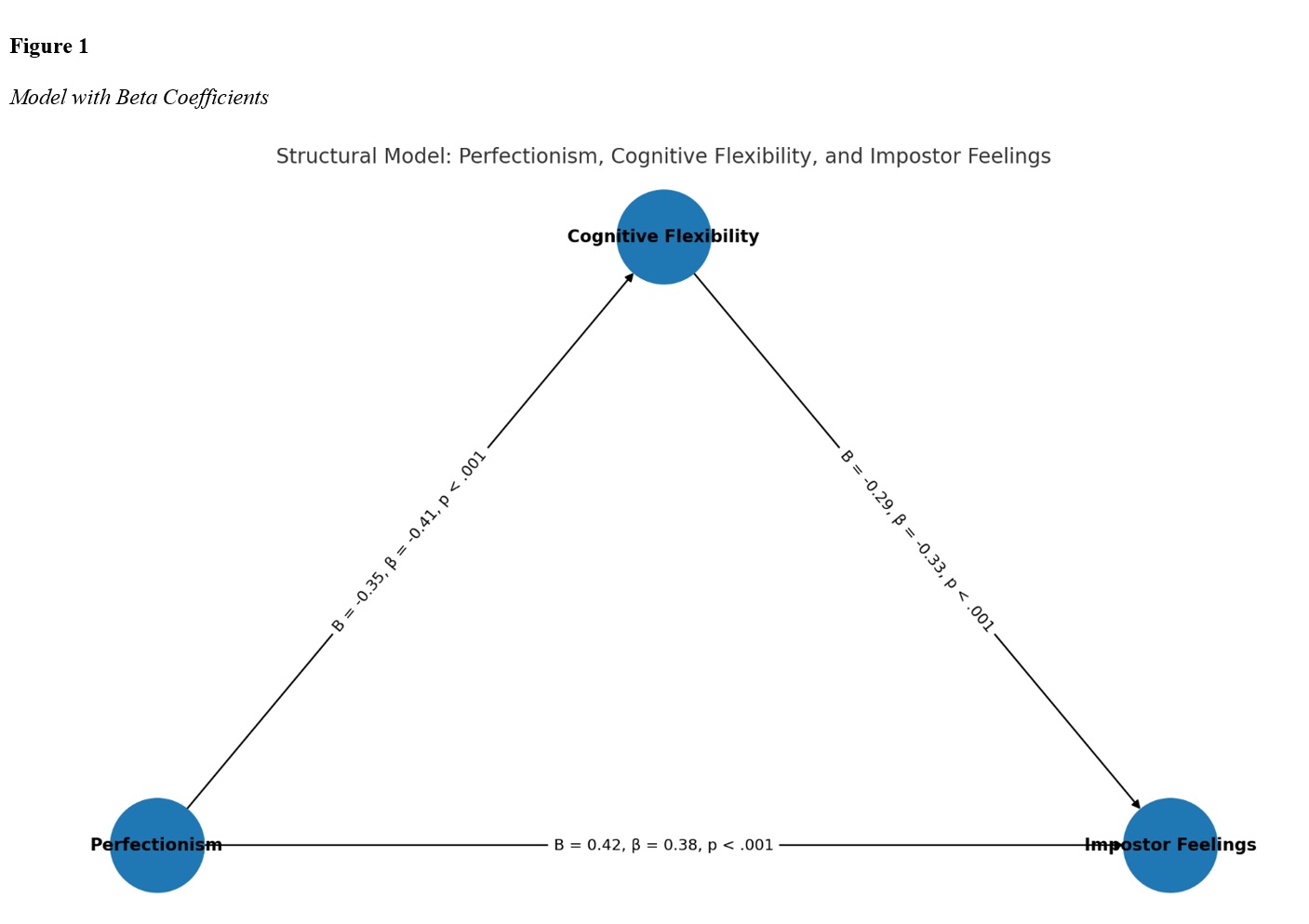
This study aimed to examine the mediating role of cognitive flexibility in the relationship between perfectionism and impostor feelings among female undergraduate students in Canada. A descriptive correlational research design was employed with a total sample of 400 female undergraduate students selected through stratified random sampling based on the Morgan and Krejcie (1970) table. Standardized self-report instruments were used: the Frost Multidimensional Perfectionism Scale (FMPS; Frost et al., 1990) to assess perfectionism, the Cognitive Flexibility Scale (CFS; Dennis & Vander Wal, 2010) to measure cognitive flexibility, and the Clance Impostor Phenomenon Scale (CIPS; Clance, 1985) to assess impostor feelings. Data were analyzed using SPSS version 27 for descriptive and correlation analyses and AMOS version 21 for structural equation modeling (SEM). Model fit was evaluated through indices including χ²/df, GFI, AGFI, CFI, TLI, and RMSEA, with significance determined at p < .05. Results revealed significant relationships among the study variables. Perfectionism was positively correlated with impostor feelings (r = .57, p < .001), while cognitive flexibility was negatively correlated with both perfectionism (r = −.48, p < .001) and impostor feelings (r = −.53, p < .001). The SEM analysis demonstrated excellent model fit (χ²/df = 1.48, GFI = .95, CFI = .97, RMSEA = .035). Perfectionism exerted a significant direct effect on impostor feelings (β = 0.38, p < .001) and a negative effect on cognitive flexibility (β = −0.41, p < .001). Cognitive flexibility significantly predicted lower impostor feelings (β = −0.33, p < .001) and partially mediated the perfectionism–impostor relationship (indirect β = 0.13, p < .01). The findings suggest that cognitive flexibility functions as a protective cognitive mechanism that mitigates the negative impact of perfectionism on impostor feelings. Enhancing cognitive flexibility may therefore reduce self-doubt and promote adaptive coping among perfectionistic female students.
Downloads
References
An, D., Wang, J., Xia, Y.-l., & Xing, W. (2025). The Effect of Cognitive Avoidance on Rumination in College Students: The Chain Mediating Role of Perfectionism and Stress. Frontiers in psychology, 16. https://doi.org/10.3389/fpsyg.2025.1562927
Andira, D. P., & Daulay, A. A. (2025). Understanding the Impostor Phenomenon Among Active Student Organization Members in Indonesian Universities. Journal of Mathematics Instruction Social Research and Opinion, 4(3), 739-750. https://doi.org/10.58421/misro.v4i3.668
Bagheri, S., Farahani, H., Watson, P., Bezdan, T., & Rezaiean, K. (2024). Unraveling Symptom Interplay: A Network Analysis of Procrastination in Gifted Students. BMC psychology, 12(1). https://doi.org/10.1186/s40359-024-01868-6
Choi, J., & Lee, Y. E. (2025). Exploring the Impostor Phenomenon Among Korean Daycare Directors: A Grounded Theory Approach. Behavioral Sciences, 15(5), 565. https://doi.org/10.3390/bs15050565
Duncan, L. R., Taasoobshirazi, G., Vaudreuil, A., Kota, J. S., & Sneha, S. (2023). An Evaluation of Impostor Phenomenon in Data Science Students. International journal of environmental research and public health, 20(5), 4115. https://doi.org/10.3390/ijerph20054115
Fahroedin, D. K., & Morris, E. (2024). Perfectionism and Allied Health Professional Training: The Role Psychological Flexibility in Burnout and Depression. https://doi.org/10.31219/osf.io/cq6kr
Fimiani, R., Mannocchi, C., Gorman, B. S., & Gazzillo, F. (2024). Guilt Over Success, Impostor Phenomenon, and Self-Sabotaging Behaviors. Current Psychology, 43(21), 19081-19090. https://doi.org/10.1007/s12144-024-05697-z
Guedes, M. J. (2023). Can Top Managers' Impostor Feelings Affect Performance? Journal of Strategy and Management, 17(1), 188-204. https://doi.org/10.1108/jsma-01-2023-0008
Hasheminejad, F. H., Salehi, M., & Sharifi, N. (2024). Modeling the General Health of Iranian Immigrants Based on Cognitive Flexibility and Perfectionism With the Mediation of Acculturation Stress. Jayps, 5(1), 78-86. https://doi.org/10.61838/kman.jayps.5.1.10
Jannesari, Z. (2025). Predicting Parental Stress in Mothers of Children With Behavioral Problems Based on Perfectionism Mediated by Psychological Flexibility. Ijhespub, 3(1), 11-18. https://doi.org/10.63053/ijhes.108
Lee, J. Y., & Choi, H. (2025). Mediating Effects of Cognitive Flexibility and Self-Compassion in the Relationship Between Evaluative Concerns Perfectionism and Social Anxiety: A Meta-Analytic Path Analysis. Korean Association for Learner-Centered Curriculum and Instruction, 25(8), 209-225. https://doi.org/10.22251/jlcci.2025.25.8.209
Miles, S., Nedeljkovic, M., & Phillipou, A. (2022). Can Cognitive Flexibility and Clinical Perfectionism Be Used to Identify People With Anorexia Nervosa? Journal of clinical medicine, 11(7), 1954. https://doi.org/10.3390/jcm11071954
Nurfadhilah, A., & Archianti, P. (2024). Dinamika Kecemasan Akademik Pada Mahasiswa Berprestasi Yang Mengalami Impostor Syndrome. Jurnal Psikologi, 17(1), 43-55. https://doi.org/10.35760/psi.2024.v17i1.8769
Park, S., & Shin, Y. (2022). Is Perfectionism Beneficial or Detrimental to Creativity? Relationships Between Creativity, Regulatory Focus, Cognitive Flexibility, and Creative Performance. Korean Academy of Management, 30(3), 237-263. https://doi.org/10.26856/kjom.2022.30.3.237
Pereira, J., & Deemer, E. D. (2023). A Test of a Cognitive Appraisal Model of the Influence of Perceptions of Seriousness and Self-Compassion as Influencing Impostor Experiences. Psi Chi Journal of Psychological Research, 28(3), 191-200. https://doi.org/10.24839/2325-7342.jn28.3.191
Perkins, T. R., & Durkee, M. I. (2025). Impostor Phenomenon Among Black Undergraduates: Contributions of Microaggressions, Gender, and School Belonging. Cultural Diversity and Ethnic Minority Psychology, 31(4), 637-648. https://doi.org/10.1037/cdp0000694
Shayesteh, A., Boman, J., & Nylander, E. (2024). Impostor Phenomenon Is a Common Feature Among Individuals With Primary Hyperhidrosis. Sage Open Medicine, 12. https://doi.org/10.1177/20503121231220828
Tasya, M. A., Nurihsan, J., Yudha, E. S., Dakes, P. S. P., & Farmadi, R. F. (2024). The Urgency of Impostor Phenomenon in Educational Institutions. G-Couns Jurnal Bimbingan Dan Konseling, 9(1), 552-560. https://doi.org/10.31316/gcouns.v9i1.4902
Westover, J. (2025). Overcoming Impostor Phenomenon: My Journey to Confront Self-Doubt in the Workplace. HCLReview, 18(1). https://doi.org/10.70175/hclreview.2020.18.1.3
Yaffe, Y. (2023). Maternal and Paternal Authoritarian Parenting and Adolescents’ Impostor Feelings: The Mediating Role of Parental Psychological Control and the Moderating Role of Child’s Gender. Children, 10(2), 308. https://doi.org/10.3390/children10020308
Yang, W., Xu, S., & Yoon, S. (2025). Beneficial Banter: How Chit-Chat and Self-Oriented Perfectionism Influence Feelings of Energy and Burnout. Journal of Hospitality & Tourism Research. https://doi.org/10.1177/10963480251346210
Yang, X., Yeo, K. J., Lee, S.-H., & Handayani, L. (2024). A Systematic Review of Impostor Syndrome in Higher Education. International Journal of Evaluation and Research in Education (Ijere), 13(6), 3884. https://doi.org/10.11591/ijere.v13i6.30726
Yosopov, L., Saklofske, D. H., Smith, M. M., Flett, G. L., & Hewitt, P. L. (2024). Failure Sensitivity in Perfectionism and Procrastination: Fear of Failure and Overgeneralization of Failure as Mediators of Traits and Cognitions. Journal of Psychoeducational Assessment, 42(6), 705-724. https://doi.org/10.1177/07342829241249784
Zhang, Y., Bai, X., & Yang, W. (2022). The Chain Mediating Effect of Negative Perfectionism on Procrastination: An Ego Depletion Perspective. International journal of environmental research and public health, 19(15), 9355. https://doi.org/10.3390/ijerph19159355
Downloads
Additional Files
Publication Timeline
- Submitted
- Revised
- Accepted