Prioritizing Personality-Based Pathways of Stress Reactivity and Psychosomatic Illness
DOI:
https://doi.org/10.61838/kman.jppr.4575Keywords:
Personality traits, Psychosomatic illness, Stress reactivity, Alexithymia, Neuroticism, Emotional regulation, Mind–body interactionAbstract
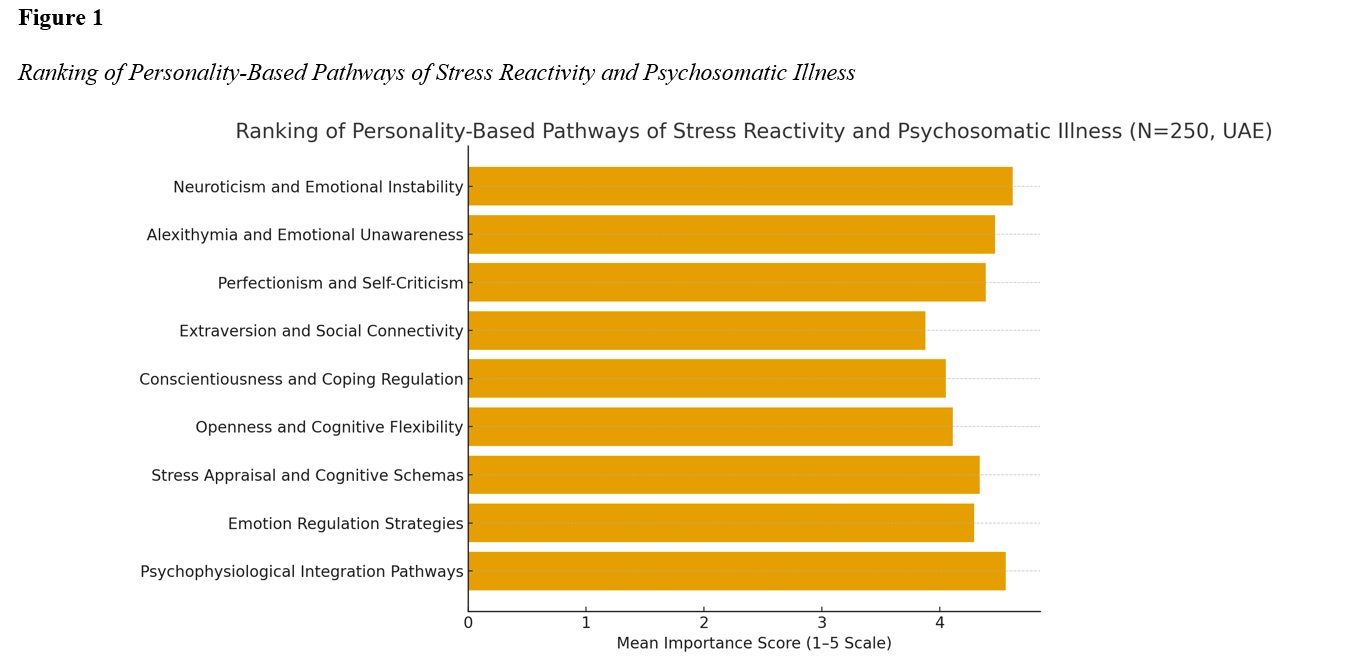
This study aimed to identify, conceptualize, and prioritize the personality-based pathways that contribute to stress reactivity and psychosomatic illness through an integrated mixed-method approach. The research employed a two-phase sequential mixed-method design. In the qualitative phase, a comprehensive literature review was conducted until theoretical saturation was achieved, and the extracted data were analyzed using NVivo 14 to identify recurring personality-based mechanisms underlying psychosomatic illness. In the quantitative phase, a structured questionnaire developed from the qualitative findings was distributed to 250 adult participants in the United Arab Emirates. Respondents rated the importance of nine personality-based pathways on a five-point Likert scale. Data were analyzed using SPSS-26, employing descriptive and inferential statistics to rank the identified pathways based on mean scores and standard deviations. The analysis revealed that neuroticism and emotional instability (M = 4.62, SD = 0.41), psychophysiological integration pathways (M = 4.56, SD = 0.48), and alexithymia and emotional unawareness (M = 4.47, SD = 0.53) were the top-ranked predictors of psychosomatic vulnerability. Mid-level contributors included perfectionism and self-criticism, stress appraisal and cognitive schemas, and emotion regulation strategies, while extraversion and social connectivity and conscientiousness and coping regulation ranked lowest, indicating a primarily protective rather than causative role. Inferential tests confirmed significant differences in perceived importance across demographic groups (p < .05), reinforcing the robustness of the model. The findings demonstrate that psychosomatic illness arises from a hierarchical interaction of personality-driven emotional, cognitive, and physiological processes, with neuroticism, alexithymia, and physiological dysregulation forming the core vulnerability triad. These results underscore the importance of personality assessment in psychosomatic health management and highlight the need for personality-informed preventive and therapeutic interventions.
Downloads
References
Aghaziarati, A., Jun, H., & Dai, G.-S. (2024). Mind-Body Interactions in Chronic Pain Sufferers: A Qualitative Study on Personality Factors. Journal of Personality and Psychosomatic Research (JPPR), 1(3), 27-33. https://doi.org/10.61838/kman.jppr.1.3.5
Bulut, S., Bukhori, B., & Bhat, R. H. (2024). The Experience of Psychosomatic Disorders among Adolescents: Challenges and Coping Strategies. Journal of Personality and Psychosomatic Research (JPPR), 2(2), 19-25. https://doi.org/10.61838/kman.jppr.2.2.4
Doustkam, M., Pourheydari, S., Mansouri, A., Shahraki, M. A., Ebrahimi, A., Goli, F., Afshar, H., & Hekmatipour, B. (2021). The mediating role of psychosomatic symptoms in the relationship between personality characteristics and marital conflicts. International Journal of Body, Mind and Culture, 8(1), 27-35. https://ijbmc.org/index.php/ijbmc/article/view/244
Goli, F. (2024). Beyond Biology: The Personality Underpinnings of Chronic Pain. Journal of Personality and Psychosomatic Research (JPPR), 2(2), 1-3. https://doi.org/10.61838/kman.jppr.2.2.1
Grabe, H. J., Schwahn, C., Barnow, S., Spitzer, C., John, U., Freyberger, H. J., Schminke, U., Felix, S., & Völzke, H. (2010). Alexithymia, hypertension, and subclinical atherosclerosis in the general population. Journal of psychosomatic research, 68(2), 139-147. https://doi.org/10.1016/j.jpsychores.2009.07.015
Li, J., & Zhou, L. (2024). Efficacy of Mindfulness-Based Stress Reduction on Reducing Somatization and Attachment Anxiety: A Randomized Controlled Trial. Journal of Personality and Psychosomatic Research (JPPR), 1(4), 14-22. https://journals.kmanpub.com/index.php/jppr/article/view/2571
Majlessi Koupaei, H., & Farista, R. (2024). Psychological Pathways to Immunity: The Role of Emotions and Stress in Health and Disease. Journal of Personality and Psychosomatic Research (JPPR), 2(1), 1-3. https://doi.org/10.61838/kman.jppr.2.1.1
Martine, E. H., Wolfgang, L. J., Jeremy, C., & Anderson, J. (2003). Type D personality is related to cardiovascular and neuroendocrine reactivity to acute stress. Journal of psychosomatic research, 55, 235-245. https://doi.org/10.1016/S0022-3999(02)00553-6
Rahimi, R., Ahadi, H., Tajeri, B., & Khoshlahjeh Sedgh, A. (2023). The effectiveness of acceptance and commitment therapy on perceived stress in diabetic elderly. Journal of Personality and Psychosomatic Research (JPPR), 1(1), 1-5. https://doi.org/10.61838/kman.jppr.1.1.1
Sefotho, M. M., Serjanaj, B., Karthik, S., & Saadati, S. A. (2024). The Psychosomatic Interface of Stress and Skin Disorders: Patient Experiences and Perceptions. Journal of Personality and Psychosomatic Research (JPPR), 2(2), 26-33. https://doi.org/10.61838/kman.jppr.2.2.5
Seiffge‐Krenke, I., & Sattel, H. (2024). How Personality Factors, Coping With Identity-Stress, and Parental Rearing Styles Contribute to the Expression of Somatic Complaints in Emerging Adults in Seven Countries. Frontiers in Psychiatry, 15. https://doi.org/10.3389/fpsyt.2024.1257403
Shen, Q., Mu, Y., & Shin, P.-Y. (2024). Health Behavior Change in Post-Traumatic Stress Disorder: Patient Perspectives. Journal of Personality and Psychosomatic Research (JPPR), 2(3), 35-42. https://doi.org/10.61838/kman.jppr.2.3.6
Wang, Y., Hong, A., Yang, W., & Wang, Z. (2023). The impact of childhood trauma on perceived stress and personality in patients with obsessive-compulsive disorder: A cross-sectional network analysis. Journal of psychosomatic research, 172, 111432. https://doi.org/10.1016/j.jpsychores.2023.111432
Xiang, Y.-T., Chi, X., Jiang, Y., Wang, R., & Mo, L. (2016). Psychosomatic Status, Personality Traits, and Coping Styles of Bereaved and Non-Bereaved Survivors of the 2008 Wenchuan Earthquake, China. Frontiers in Psychiatry, 7. https://doi.org/10.3389/fpsyt.2016.00017
Downloads
Additional Files
Publication Timeline
- Submitted
- Revised
- Accepted