Predicting Depression Based on Ego Weakness and Integrative Self-Knowledge with the Mediating Role of Defense Mechanisms and Psychological Pain
DOI:
https://doi.org/10.61838/kman.cp.psynexus.3710Keywords:
Depression , Integrative Self-Knowledge, Psychological Pain , Ego Weakness , Defense MechanismsAbstract
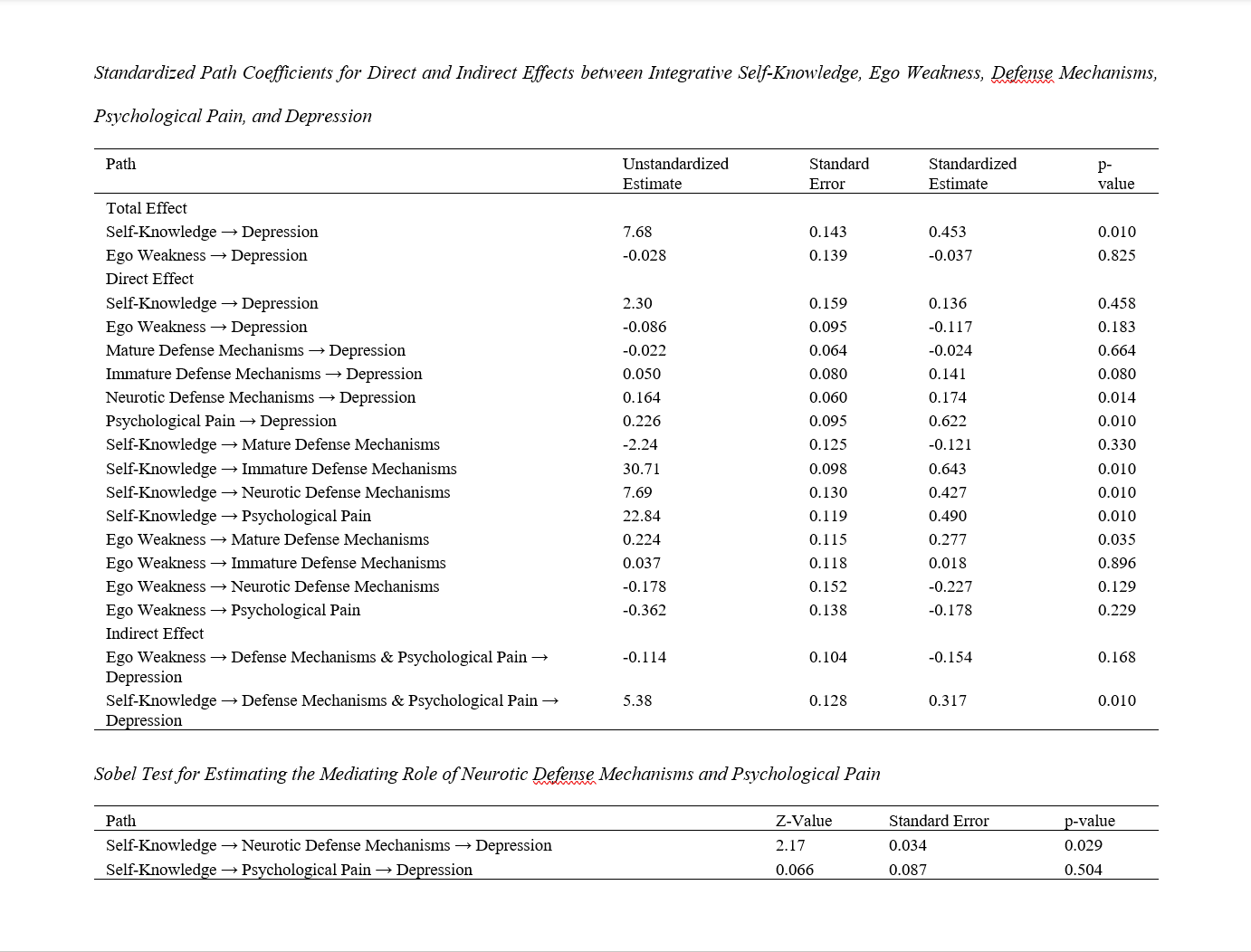
The aim of the present study was to predict depression based on ego weakness and integrative self-knowledge with the mediating role of defense mechanisms and psychological pain. The research method was descriptive-correlational, and the aim was applied. The statistical population of this study included all men employed in a marine transportation company in the years 2020-2021, from which 378 participants were selected through convenience sampling. The research instruments included the Tangney et al. Self-Control Scale (2004), the Ghorbani et al. Integrative Self-Knowledge Scale (2008), the Andrews et al. Defense Style Questionnaire-40 (1993), the Orbach et al. Psychological Pain Scale (2003), and the Beck Depression Inventory (1961). The data of the present study were analyzed using structural equation modeling. By creating covariance between errors, the goodness-of-fit indices improved, and the resulting structural model fitted the collected data. There was a significant positive direct relationship between integrative self-knowledge and depression at the 0.01 level (P=0.010, β=0.453). There was a significant positive direct relationship between neurotic defense mechanisms and depression at the 0.05 level (P=0.014, β=0.174). There was a significant positive direct relationship between psychological pain and depression at the 0.01 level (P=0.010, β=0.622). Neurotic defense mechanisms mediated the relationship between integrative self-knowledge and depression (P=0.029, Z=2.17). The results of the present study showed that there was a significant direct relationship between integrative self-knowledge, neurotic defense mechanisms, and psychological pain with depression.
Downloads
References
Ahmaadi Joybari, M. (2017). The Relationship between Self-control and Responsibility of the Sixth Grade Girl Elementary School Students (Case Study: Babolsar City). Specialized Quarterly Scientific Journal of Psychology, Social Sciences and Educational Sciences, 1(2), 63-70. https://doi.org/10.21859/psychol-01026
Akbari, A., & Tizdast, T. (2017). The Relationship between integrative Self-knowledge, Mindfulness, Defense Mechanism with the Possibility of Suicide among Students. Journal of Applied Psychology & Behavioral Science, 2(4), 196-202. https://japbs.com/fulltext/paper-06012019101608.pdf
Akin, A., Demirci, I., Yildiz, E., Turan, M. E., & Ozcan, M. (2013). The Validity and reliability of the Turkish version of the Integrative Self-knowledge Scale. Procedia - Social and Behavioral Sciences, 84, 177-181. https://doi.org/10.1016/j.sbspro.2013.06.531
Ali, Y., Kotera, Y., Cotterill, M., Edwards, A. M., & Palmer, S. (2025). Sport Emotions, Anxiety, Task and Ego Orientation in Pakistani Adolescents: Mediating Role of Coaching Athlete Purpose. https://doi.org/10.20944/preprints202501.0334.v1
Andrews, P. W., & Thomson, J. A., Jr. (2009). The bright side of being blue: depression as an adaptation for analyzing complex problems. Psychological review, 116(3), 620-654. https://doi.org/10.1037/a0016242
Babl, A., Grosse Holtforth, M., Perry, J. C., Schneider, N., Dommann, E., Heer, S., Stähli, A., Aeschbacher, N., Eggel, M., Eggenberg, J., Sonntag, M., Berger, T., & Caspar, F. (2019). Comparison and change of defense mechanisms over the course of psychotherapy in patients with depression or anxiety disorder: Evidence from a randomized controlled trial. Journal of affective disorders, 252, 212-220. https://doi.org/10.1016/j.jad.2019.04.021
Beck, A. T., Ward, C. H., Mandelson, M., Mock, J., & Erbaugh, J. (1961). An inventory for measuring depression. Archives of General Psychiatry, 4, 561S-569S. https://doi.org/10.1001/archpsyc.1961.01710120031004
Caligor, E., Kernberg, O. F., & Clarkin, J. F. (2007). Handbook of Dynamic Psychotherapy for Higher Level Personality Pathology (1st Ed.). American Psychiatric Publishing. https://books.google.ch/books/about/Handbook_of_Dynamic_Psychotherapy_for_Hi.html?id=E6k3L6XarnEC&redir_esc=y
Carvalho, A. F., Hyphantis, T. N., Taunay, T. C., Macêdo, D. S., Floros, G. D., Ottoni, G. L., Fountoulakis, K. N., & Lara, D. R. (2013). The relationship between affective temperaments, defensive styles and depressive symptoms in a large sample. Journal of affective disorders, 146(1), 58-65. https://doi.org/10.1016/j.jad.2012.08.038
Ciocca, G., Collazzoni, A., Limoncin, E., Franchi, C., Mollaioli, D., Di Lorenzo, G., Santarnecchi, E., Troisi, A., Siracusano, A., Rossi, A., & Jannini, E. A. (2017). Defence mechanisms and attachment styles in paranoid ideation evaluated in a sample of non-clinical young adults. Rivista di Psichiatria, 52(4), 162-167. https://pubmed.ncbi.nlm.nih.gov/28845865/
Clarkin, J. F., Yeomans, F. E., & Kernberg, O. F. (2015). Transference-Focused Psychotherapy for Borderline Personality Disorder: A Clinical Guide. American Psychiatric Publication. https://books.google.ch/books/about/Transference_Focused_Psychotherapy_for_B.html?id=xnHBBwAAQBAJ&redir_esc=y
Cramer, P., & Porcerelli, J. H. (2016). Defense Mechanisms. In Encyclopedia of Mental Health (2nd Ed.) (pp. 13-17). Academic Press. https://doi.org/10.1016/B978-0-12-397045-9.00020-3
Ghorbani, N., Watson, P. J., Bing, M. N., Davison, H. K., & LeBreton, D. (2003). Two facets of self-knowledge: cross-cultural development of measures in Iran and the United States. Genetic, social, and general psychology monographs, 129(3), 238-268. https://pubmed.ncbi.nlm.nih.gov/15134127/
Ghorbani, N., Watson, P. J., & Hargis, M. B. (2008). Integrative self-knowledge scale: Correlations and incremental validity of a cross-cultural measure developed in Iran and United States. The Journal of psychology, 142, 395-412. https://doi.org/10.3200/JRPL.142.4.395-412
Hamidi, R., Fekrizadeh, Z., Azadbakht, M., Garmaroudi, G., Taheri Tanjani, P., Fathizadeh, S., & Ghisvandi, E. (2015). Validity and reliability Beck Depression Inventory-II among the Iranian elderly Population. Journal of Sabzevar University of Medical Sciences, 22(1), 189-198. https://jsums.medsab.ac.ir/article_550_en.html
Hao, Z., Li, H., & Lin, Y. (2022). The characterization of static and dynamic brain functional networks in suicide attempters with major depressive disorder and its relation to psychological pain. Psychiatry Research: Neuroimaging, 111562. https://doi.org/10.1016/j.pscychresns.2022.111562
Heidari Nasab, L., Mansouri, M., Azadfallah, P., & Shaieeri, M. R. (2007). Validity and Reliability of Defens Style Questionnaire (DSQ-40) in Iranian Samples. Clinical Psychology & Personality, 1(22), 11-27. https://cpap.shahed.ac.ir/article_2594.html?lang=en
Huang, Y. H., Liu, H. C., Tsai, F. J., Sun, F. J., Huang, K. Y., Chiu, Y. C., Huang, Y. H., Huang, Y. P., & Liu, S. I. (2017). Correlation of impulsivity with self-harm and suicidal attempt: a community study of adolescents in Taiwan. BMJ open, 7(12), e017949. https://doi.org/10.1136/bmjopen-2017-017949
Huprich, S. K. (2015). Personality Disorders: Toward Theoretical and Empirical Integration in Diagnosis and Assessment. American Psychological Association. https://doi.org/10.1037/14549-000
Hyphantis, T. N., Goulia, P., & Carvalho, A. F. (2013). Personality traits, defense mechanisms and hostility features associated with somatic symptom severity in both health and disease. Journal of psychosomatic research, 75(4), 362-369. https://doi.org/10.1016/j.jpsychores.2013.08.014
Iversen, R. T. (2012). The mental health of seafarers. International Maritime Health, 63(2), 78-89. https://journals.viamedica.pl/international_maritime_health/article/view/26143
Joe, S., Woolley, M. E., Brown, G. K., Ghahramanlou-Holloway, M., & Beck, A. T. (2008). Psychometric properties of the Beck Depression Inventory-II in low-income, African American suicide attempters. Journal of Personality Assessment, 90(5), 521-523. https://doi.org/10.1080/00223890802248919
Karami, J., Bagian, M. J., Momeni, K., & Elahi, A. (2018). Measurement of mental pain: Psychometric properties and confirmatory factor analysis of multidimensional mental pain questionnaire. Health Psychology, 7(25), 146-172. https://hpj.journals.pnu.ac.ir/article_4765_en.html
Karimi, Z., Karbalaei Mohammad Meigouni, A., & Sabet, M. (2016). Comparison of optimism, job satisfaction and quality of work life of seafarers and onshore staffs of national Iranian tanker company. Journal of Career & Organizational Counseling, 8(27), 78-95. https://jcoc.sbu.ac.ir/article_99598.html?lang=en
Kropp, D. R., & Hodes, G. E. (2023). Sex differences in depression: An immunological perspective. Brain Research Bulletin, 196, 34-45. https://doi.org/10.1016/j.brainresbull.2023.02.016
Landi, G., Grossman-Giron, A., Bitan, D. T., Mikulincer, M., Grandi, S., & Tossani, E. (2023). Mental Pain, Psychological Distress, and Suicidal Ideation during the COVID-19 Emergency: the Moderating Role of Tolerance for Mental Pain. International journal of mental health and addiction, 21(2), 1120-1131. https://doi.org/10.1007/s11469-021-00646-4
Lapsley, D. K., & Power, F. K. (2012). Self, Ego, and Identity. Springer. https://doi.org/10.1007/978-1-4615-7836-9
Lingiardi, V., & McWilliams, N. (2017). Psychodynamic Diagnostic Manual (2nd Ed.). Guilford Press. https://books.google.ch/books/about/Psychodynamic_Diagnostic_Manual.html?id=sJHfDgAAQBAJ&redir_esc=y
Mellbye, A., & Carter, T. (2017). Seafarers' depression and suicide. International Maritime Health, 68(2), 108-114. https://doi.org/10.5603/IMH.2017.0020
Meyers, L. S., Gamst, G., & Guarino, A. J. (2016). Applied Multivariate Research: Design and Interpretation (3rd Ed.). Sage Publications. https://doi.org/10.4135/9781071802687
Morin, A., & Racy, F. (2021). Dynamic self-processes. In The Handbook of Personality Dynamics and Processes (pp. 365-386). Academic Press. https://doi.org/10.1016/B978-0-12-813995-0.00015-7
Nikooseresht, T., & Shomali Oskoei, A. (2021). Structural Relationships between Emotional Regulation and Stress with Dissociation Symptoms: The Mediating Role of Depression. Journal of Applied Psychological Research, 12(1), 333-349. https://japr.ut.ac.ir/article_81337.html?lang=en
Orbach, I., Mikulincer, M., Sirota, P., & Gilboa-Schechtman, E. (2003). Mental pain: A multidimensional operationalization and definition. Suicide Life Threatening Behavior, 33(3), 219-230. https://doi.org/10.1521/suli.33.3.219.23219
Parviz, K., Aghamouhamadian Sharbaf, H., Ghanbarihashemabadi, B., & Dehghani, M. (2016). The relationship between ego strength and metacognition among male and female students. Education Strategies in Medical Sciences, 9(2), 118-126. https://www.researchgate.net/publication/328466160_The_relationship_between_ego_strength_and_metacognition_among_male_and_female_students
Pompili, M., Rinaldi, G., Lester, D., Girardi, P., Ruberto, A., & Tatarelli, R. (2006). Hopelessness and suicide risk emerge in psychiatric nurses suffering from burnout and using specific defense mechanisms. Archives of Psychiatric Nursing, 20(3), 135-143. https://doi.org/10.1016/j.apnu.2005.12.002
Prout, T. A., Malone, A., Rice, T. R., & Hoffman, L. (2019). Resilience, Defense Mechanisms, and Implicit Emotion Regulation in Psychodynamic Child Psychotherapy. Journal of Contemporary Psychotherapy, 49(4), 235-244. https://doi.org/10.1007/s10879-019-09423-w
Rice, T. R., & Hoffman, L. (2014). Defense mechanisms and implicit emotion regulation: A comparison of a psychodynamic construct with one from contemporary neuroscience. Journal of the American Psychoanalytic Association, 62(4), 693-708. https://doi.org/10.1177/0003065114546746
Ringwald, W. R., Nielsen, S. R., Mostajabi, J., Vize, C. E., van den Berg, T., Manuck, S. B., Marsland, A. L., & Wright, A. G. C. (2024). Characterizing stress processes by linking big five personality states, traits, and day-to-day stressors. Journal of research in personality, 110, 104487. https://doi.org/10.1016/j.jrp.2024.104487
Salehmirhassani, V., Ghorbani, N., Alipour, A., & Farzad, V. (2016). The mediating role of self-knowledge process (integrative self-knowledge and mindfulness) and self-control in regulating the relationship between perceived and objective stress and anxiety, depression, and physical symptoms. 10(3), 1-15. https://ndea10.khu.ac.ir/rph/article-1-2726-en.html&sw=Integrative+Self-Knowledg
Tangney, J. P., Baumeister, R. F., & Boone, A. L. (2004). High self-control predicts good adjustment, less pathology, better grades, and interpersonal success. Journal of personality, 72(2), 271-324. https://doi.org/10.1111/j.0022-3506.2004.00263.x
Vaillant, G. E. (1994). Ego mechanisms of defense and personality psychopathology. Journal of abnormal psychology, 103(1), 44-50. https://doi.org/10.1037/0021-843X.103.1.44
Vaillant, G. E. (1998). Conclusion: where do we go from here? Journal of abnormal psychology, 103(1), 44-50.
Vaillant, G. E. (2012). Defense Mechanisms. In Encyclopedia of Human Behavior (2nd Ed.) (pp. 659-666). Academic Press. https://doi.org/10.1016/B978-0-12-375000-6.00124-5
Viskovich, S., & De George-Walker, L. (2019). An investigation of self-care related constructs in undergraduate psychology students: Self-compassion, mindfulness, self-awareness, and integrated self-knowledge. International Journal of Educational Research, 95, 109-117. https://doi.org/10.1016/j.ijer.2019.02.005
Wen, L., Huang, W., Liang, X., & Zhang, S. (2025). Strengths Knowledge Defend Against Depression: The Contribution of University Students’ Family Functioning During COVID-19. Psychological Reports. https://doi.org/10.1177/00332941251315445
Yang, L. (2025). Childhood Maltreatment and Non-Suicidal Self-Injury: The Mediating Role of Mentalization and Depression. European Journal of Psychotraumatology, 16(1). https://doi.org/10.1080/20008066.2025.2466279
Zandi, S., Shahabi Nejad, Z., & Borhan, A. (2017). Predicting Defense Mechanisms based on Big Five Personality Traits among University Students. Zanko Journal of Medical Sciences, 18(56), 21-32. https://www.researchgate.net/publication/316999632_Predicting_defense_mechanisms_based_on_big_five_personality_traits_among_university_students
Zhao, J., Chen, S., Hua, W., & Hu, Y. (2025). Social Exclusion and Online Aggressive Behavior: Mediation Through Ego Depletion and Moderation Through Mindfulness. Behavioral Sciences, 15(3), 346. https://doi.org/10.3390/bs15030346
Zheng, Y., Dou, Z., Guo, T., Wang, Y., & Zeng, X. (2025). The Effects of Non-Mindfulness Practices and Human Support on Depression, Mental Well-Being, and Mindfulness in Digital Mindfulness-Based Interventions: A Four-Armed Randomized Dismantling Trial. Mindfulness, 1-13. https://doi.org/10.1007/s12671-025-02548-1
Ziadni, M. S., Jasinski, M. J., Labouvie-Vief, G., & Lumley, M. A. (2017). Alexithymia, defenses, and ego strength: Cross-sectional and longitudinal relationships with psychological well-being and depression. Journal of Happiness Studies: An Interdisciplinary Forum on Subjective Well-Being, 18(6), 1799-1813. https://doi.org/10.1007/s10902-016-9800-7
Downloads
Additional Files
Publication Timeline
- Submitted
- Revised
- Accepted
License
Copyright (c) 2025 Zahra Karimi (Author); Ahmad Karbalaee Mohammad Meygoni (Corresponding Author); Hossein Rezabakhsh, Robabeh Ataeifar (Author)

This work is licensed under a Creative Commons Attribution-NonCommercial 4.0 International License.