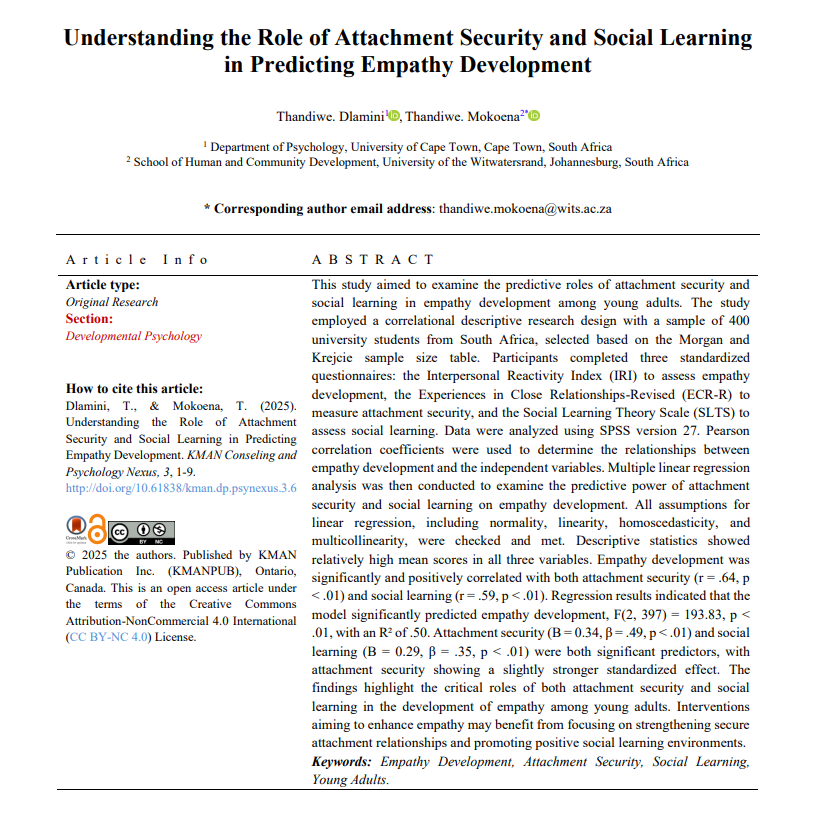
Understanding the Role of Attachment Security and Social Learning in Predicting Empathy Development
DOI:
https://doi.org/10.61838/kman.dp.psynexus.3.6Keywords:
Empathy Development, Attachment Security, Social Learning, Young AdultsAbstract
This study aimed to examine the predictive roles of attachment security and social learning in empathy development among young adults. The study employed a correlational descriptive research design with a sample of 400 university students from South Africa, selected based on the Morgan and Krejcie sample size table. Participants completed three standardized questionnaires: the Interpersonal Reactivity Index (IRI) to assess empathy development, the Experiences in Close Relationships-Revised (ECR-R) to measure attachment security, and the Social Learning Theory Scale (SLTS) to assess social learning. Data were analyzed using SPSS version 27. Pearson correlation coefficients were used to determine the relationships between empathy development and the independent variables. Multiple linear regression analysis was then conducted to examine the predictive power of attachment security and social learning on empathy development. All assumptions for linear regression, including normality, linearity, homoscedasticity, and multicollinearity, were checked and met. Descriptive statistics showed relatively high mean scores in all three variables. Empathy development was significantly and positively correlated with both attachment security (r = .64, p < .01) and social learning (r = .59, p < .01). Regression results indicated that the model significantly predicted empathy development, F(2, 397) = 193.83, p < .01, with an R² of .50. Attachment security (B = 0.34, β = .49, p < .01) and social learning (B = 0.29, β = .35, p < .01) were both significant predictors, with attachment security showing a slightly stronger standardized effect. The findings highlight the critical roles of both attachment security and social learning in the development of empathy among young adults. Interventions aiming to enhance empathy may benefit from focusing on strengthening secure attachment relationships and promoting positive social learning environments.
Downloads
References
Borelli, J. L., Stern, J., Marvin, M., Smiley, P. A., Pettit, C., & Samudio, M. (2021). Reflective Functioning and Empathy Among Mothers of School-Aged Children: Charting the Space Between. Emotion, 21(4), 783-800. https://doi.org/10.1037/emo0000747
Carnelley, K. B., & Boag, E. M. (2019). Attachment and Prejudice. Current opinion in psychology, 25, 110-114. https://doi.org/10.1016/j.copsyc.2018.04.003
Cheng, N., Ruan, X., Wu, Z., Yue, X., & Wang, Z. (2023). The Effect of Maternal Empathy on Infants’ Attachment Security: Moderation by Maternal Emotion Regulation and Infant Temperament. PsyCh Journal, 12(3), 368-378. https://doi.org/10.1002/pchj.631
Cricchio, M. G. L., Musso, P., Coco, A. L., Cassibba, R., & Liga, F. (2022). The Relation Between Empathy and Aggression: The Role of Attachment Style. Europe’s Journal of Psychology, 18(3), 319-336. https://doi.org/10.5964/ejop.4509
Denham, A. (2021). An Aetiology of Recognition. 195-223. https://doi.org/10.1093/oso/9780192898128.003.0011
Elyasi, F., Parkoohi, P. I., Hosseinnejad, S., Azizi, M., & Kamali, M. (2022). Relationship Between Secure and Insecure Attachment Style With Physician Empathy Among Medical Students: A Cross-Sectional Study in Iran. Iranian journal of psychiatry and behavioral sciences, 16(2). https://doi.org/10.5812/ijpbs.118529
Fakhruddiana, F., & Utomo, U. H. N. (2019). The Empathy Difference of Children in Late Childhood Seen on the Attachment Patterns to Mothers. Humanities & Social Sciences Reviews, 7(3), 108-114. https://doi.org/10.18510/hssr.2019.7317
Henschel, S., Nandrino, J. L., & Doba, K. (2020). Emotion Regulation and Empathic Abilities in Young Adults: The Role of Attachment Styles. Personality and individual differences, 156, 109763. https://doi.org/10.1016/j.paid.2019.109763
Heyam Salah Mustafa Al, R., & Mattar, J. W. (2024). Attachment to Peers and Its Relationship to Empathy Among Jordanian University Students. Jordanian Educational Journal, 9(4), 53-76. https://doi.org/10.46515/jaes.v9i4.1045
Heynen, E., Simon, E., Helm, P. v. d., Geert Jan, J. M. S., & Assink, M. (2021). Parents’ Empathy and Child Attachment Security. 30-42. https://doi.org/10.4324/9780429287459-4
Hollman, S. N., Marmarosh, Cheri. (2023). Providing a secure base: Facilitating a secure attachment to God in psychotherapy.
Ifthiharfi, R., Rizkyanti, C. A., & Akhyar, M. (2024). Korban Kekerasan Dalam Pacaran Yang Sulit Meninggalkan Hubungannya. Jurnal Psikologi Sosial, 22(2), 163-176. https://doi.org/10.7454/jps.2024.17
Ivana, J., Pemayun, T. U. N., & Mustika, I. K. (2024). Pet Attachment and Animal Abuse in Human Relationships With Pets as Inspiration for Digital Artworks. CTKR Jur. PP. Sen. Mur, 4(1), 30-39. https://doi.org/10.59997/ctkr.v4i1.3631
Juhl, J., Wildschut, T., Sedikides, C., Diebel, T., Cheung, W. Y., & Vingerhoets, A. J. J. M. (2019). Nostalgia Proneness and Empathy: Generality, Underlying Mechanism, and Implications for Prosocial Behavior. Journal of personality, 88(3), 485-500. https://doi.org/10.1111/jopy.12505
Kaewkerd, O., Othaganont, P., & Williams, C. L. (2021). A Mixed-Method Approach on Secure Attachment and Its Effects on Caregivers of Older Adults Living at Home. The Open Public Health Journal, 14(1), 71-78. https://doi.org/10.2174/1874944502114010071
Kawaguchi, Y. (2025). Effects of Childhood Maltreatment on Mothers’ Empathy and Parenting Styles in Intergenerational Transmission. Scientific reports, 15(1). https://doi.org/10.1038/s41598-025-92804-0
Khan, A. A., Altaf, R., Khan, G. N., Jamil, B., Fatima, U., Khalil, A., & Ikram, A. (2025). Exploring the Link Between Attachment Styles, Empathy Development, and Moral Decision-Making in Adolescents: A Comparative Study of Rural and Urban Areas of Punjab. South Eastern European Journal of Public Health, 1439-1447. https://doi.org/10.70135/seejph.vi.3947
Klimenkova, E. N. (2017). Empaty Ability and the Quality of Interpersonal Relations in Youth. Counseling Psychology and Psychotherapy, 25(4), 59-70. https://doi.org/10.17759/cpp.2017250405
Klimenkova, E. N. (2018). Attachment Quality and Empathic Ability in Adolescence. Counseling Psychology and Psychotherapy, 26(4), 119-131. https://doi.org/10.17759/cpp.2018260408
Li, S., Ran, G., & Chen, X. (2021). Linking Attachment to Empathy in Childhood and Adolescence: A Multilevel Meta-Analysis. Journal of Social and Personal Relationships, 38(11), 3350-3377. https://doi.org/10.1177/02654075211031006
Loheide‐Niesmann, L., Lijster, J. M. d., Hall, R., Bakel, H. J. A. v., & Cima, M. (2020). Toddlers' Preference for Prosocial Versus Antisocial Agents: No Associations With Empathy or Attachment Security. Social Development, 30(2), 410-427. https://doi.org/10.1111/sode.12487
Martins, M. C., Santos, C., Fernandes, M. l., & Veríssimo, M. (2022). Attachment and the Development of Prosocial Behavior in Children and Adolescents: A Systematic Review. Children, 9(6), 874. https://doi.org/10.3390/children9060874
Mittal, E., & Rani, T. (2022). Association Between Secure Attachment Style and Subjective Well-being: Examining the sequential mediation effects. Asia Pacific Journal of Health Management, 17(2). https://orcid.org/0000-0001-6966-0275
Murphy, T. P., Laible, D., & Augustine, M. (2017). The Influences of Parent and Peer Attachment on Bullying. Journal of Child and Family Studies, 26(5), 1388-1397. https://doi.org/10.1007/s10826-017-0663-2
Rasūl Zādeh Aghdam, S., Ja'farī, Q., Sa'ādatī, M., & Yūsufī Aghdam, R. (2015). A Sociological Study of the Role of Structural and Social Learning Factors in Juvenile Delinquency in Marginalized Areas of Tabriz. Social Sciences, Urban Sociological Studies(17).
Rozga, A., Hesse, E., Main, M., Duschinsky, R., Beckwith, L., & Sigman, M. (2017). A Short-Term Longitudinal Study of Correlates and Sequelae of Attachment Security in Autism. Attachment & Human Development, 20(2), 160-180. https://doi.org/10.1080/14616734.2017.1383489
Salessi, S. (2024). Estilos De Apego Y Riesgo Psicosocial De Desgaste Por Empatía en Psicólogos Y Psiquiatras. Revista De Salud Pública, 30(1), 30-36. https://doi.org/10.31052/1853.1180.v30.n1.43460
Shi, X., Wang, B., He, T., Wu, L., & Zhang, J. (2020). Secure Attachments Predict Prosocial Behaviors: A Moderated Mediation Study. PsyCh Journal, 9(5), 597-608. https://doi.org/10.1002/pchj.348
Tan, B., Wang, Z., Zhao, S., & Liao, J. (2023). A Dual-Path Model of Ethical Leadership's Influence on Civil Servants' Discretionary Work Behavior: Probing the Social Learning and Social Exchange Processes. Public Personnel Management, 00910260231196225. https://doi.org/10.1177/00910260231196225
Thompson, R. A. (2019). Early Moral Development and Attachment Theory. 20-40. https://doi.org/10.1093/oxfordhb/9780190638696.013.2
Ting, W., Guo, M., Jin, H., & Zhang, B. (2024). Attachment Styles and Empathy in Trainee Nurses: The Mediating and Moderating Roles of Attitudes Toward Death. Frontiers in psychology, 15. https://doi.org/10.3389/fpsyg.2024.1445587
Xu, X., Liu, Z., Gong, S., & Wu, Y. (2022). The Relationship Between Empathy and Attachment in Children and Adolescents: Three-Level Meta-Analyses. International journal of environmental research and public health, 19(3), 1391. https://doi.org/10.3390/ijerph19031391
Downloads
Additional Files
Publication Timeline
- Submitted
- Revised
- Accepted
Issue
Section
Categories
License

This work is licensed under a Creative Commons Attribution-NonCommercial 4.0 International License.