Effect of Peer-Mentoring Programs on Academic Motivation and School Belonging in First-Generation Learners
DOI:
https://doi.org/10.61838/kman.ec.psynexus.3.7Keywords:
peer mentoring, academic motivation, school belonging, first-generation learnersAbstract
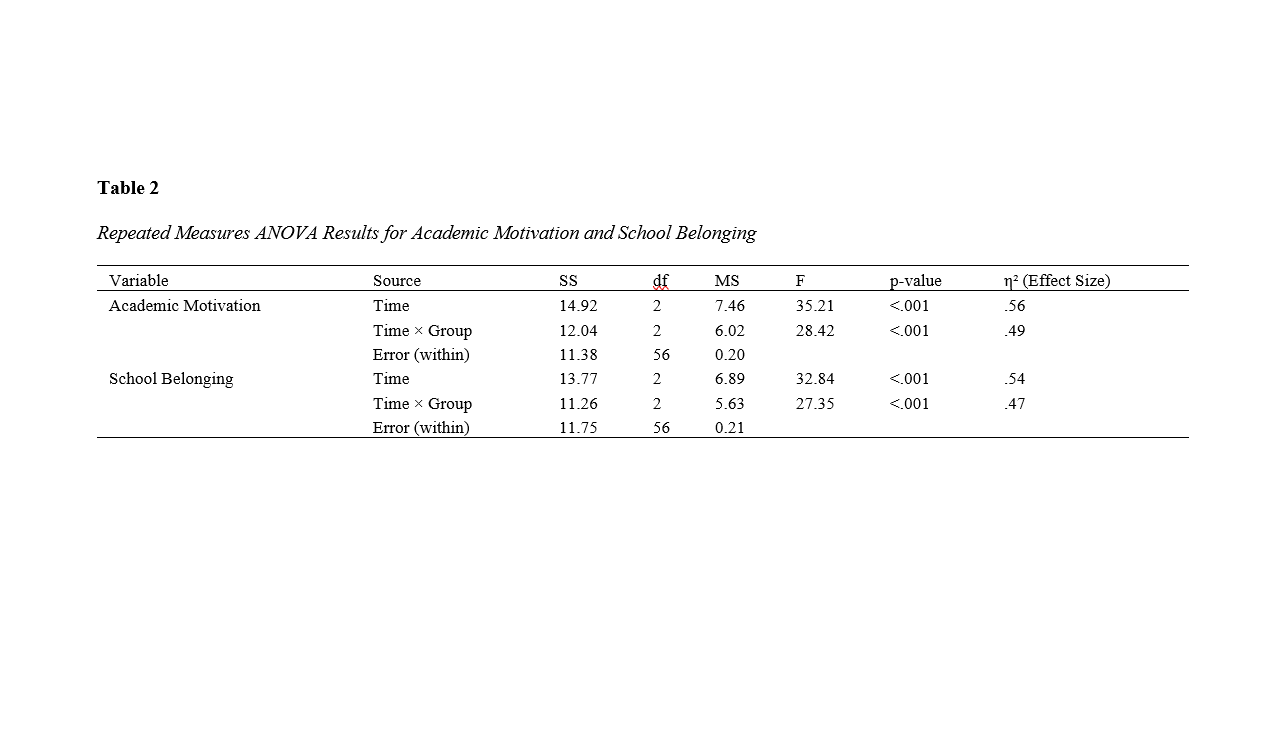
This study aimed to examine the effectiveness of a peer-mentoring program on enhancing academic motivation and school belonging in first-generation learners. A randomized controlled trial design was used with 30 first-generation students from Canada, randomly assigned to either an intervention group (n = 15) that participated in an eleven-session peer-mentoring program or a control group (n = 15) that received no intervention. The sessions, conducted weekly over three months, focused on academic goal setting, motivation, school engagement, and emotional support. Data were collected at three time points—pre-test, post-test, and five-month follow-up—using the Academic Motivation Scale and the Psychological Sense of School Membership scale. Repeated measures ANOVA with Bonferroni post-hoc tests were conducted in SPSS-27 to analyze group differences over time. The intervention group showed significant improvements in both academic motivation and school belonging across time compared to the control group. Repeated measures ANOVA revealed a significant interaction effect between time and group for academic motivation (F(2, 56) = 28.42, p < .001, η² = .49) and for school belonging (F(2, 56) = 27.35, p < .001, η² = .47). Bonferroni post-hoc tests confirmed significant increases from pre-test to post-test and pre-test to follow-up for both variables in the intervention group (p < .001), with no significant change between post-test and follow-up, indicating sustained effects. The control group showed no significant changes over time. Peer mentoring significantly improves academic motivation and school belonging among first-generation learners, and these gains are sustained over time. Structured, relational interventions that emphasize shared experience, goal setting, and emotional support can play a key role in fostering educational engagement and persistence in marginalized student populations.
Downloads
References
Alek, A., Nguyen, T. V., & Dollah, S. (2023). Assessing the Nexus of EFL Learners’ Academic Self-Concept and Their Formal English Vocabulary Knowledge. International Journal of Language Education, 7(2). https://doi.org/10.26858/ijole.v7i2.36048
Alzahrani, M. (2024). An Investigation of the Fluctuation in Language Learning Motivation Over Time: A Qualitative Case Study. 243-244. https://doi.org/10.20319/icssh.2024.243244
Arslan, G., & Burke, J. (2022). Strength-based parenting and social-emotional wellbeing in Turkish young people: does school belonging matter? Educational and Developmental Psychologist, 39(2), 161-170. https://doi.org/10.1177/00332941221087915
Arslan, G., & Coşkun, M. (2022). School Belongingness in Academically at-Risk Adolescents: Addressing Psychosocial Functioning and Psychological Well-Being. Journal of Happiness and Health, 3(1), 1-13. https://doi.org/10.47602/johah.v3i1.9
Brenda Lyn Amanda Basas, O., & Linaugo, J. D. (2023). Screencast and Its Effect on Improving Learners’ Academic Achievement and Motivation in Physics. Jurnal Pena Sains, 10(1), 1-10. https://doi.org/10.21107/jps.v10i1.19248
Canino, L. B. C., Malayao, S. O., & Sayson, N. L. B. (2024). Implementation of Inquiry – Based Lesson on Lights, Mirrors and Lenses in a Gamified Classroom. International Journal of Research and Innovation in Social Science, VIII(V), 2614-2624. https://doi.org/10.47772/ijriss.2024.805190
Choi, J. A., & Yang, J. (2024). The Role of Should-Thinking on the Academic Procrastination Process of High Achievement Motivators. Korean Association for Learner-Centered Curriculum and Instruction, 24(1), 1-17. https://doi.org/10.22251/jlcci.2024.24.1.1
Davidovitch, N., & Dorot, R. (2023). The Effect of Motivation for Learning Among High School Students and Undergraduate Students—A Comparative Study. International Education Studies, 16(2), 117. https://doi.org/10.5539/ies.v16n2p117
Dogomeo, A. (2023). Factors Influencing Motivation in Korean Adults' English Language Learning. Asia-pacific Journal of Convergent Research Interchange, 9(12), 619-628. https://doi.org/10.47116/apjcri.2023.12.50
Edouard, M., Venuste, N., & Andala, H. O. (2024). Influence of Parental Participation in School Academic Activities on Learners’ Motivation in Rwandan Public Primary Schools; A Case of Huye District. Journal of Education, 6(5), 61-76. https://doi.org/10.53819/81018102t5308
Gan, E. N. (2024). Academic Motivation and Learner Readiness for Online Learning. International Journal of Management Studies and Social Science Research, 06(05), 162-169. https://doi.org/10.56293/ijmsssr.2024.5213
Herrera, M. T., & Blanca, M. J. (2022). Assessing Satisfaction With Online Courses: Spanish Version of the Learner Satisfaction Survey. Frontiers in psychology, 13. https://doi.org/10.3389/fpsyg.2022.875929
Hosseinmardi, A. A., Ghorban Shiroodi, S., Zarbakhshbahri, M. R., & Tizdast, T. (2022). The Relationship of Academic Engagement, School Engagement and School Belonging with Academic Achievement by Mediated the Academic Achievement Motivation in Male Students. Sociology of Education, 7(2), 178-189. https://doi.org/10.22034/ijes.2021.534830.1123
Iwe, D. N. N., Chidi-Onwuta, G., & Chikamadu, C. P. (2022). The Impact of Project Based Instruction on English Language Achievements: The Mediating Role of ‘Motivation and Group Work’ for Language Teaching Research. IJHS, 2(2), 36-39. https://doi.org/10.69792/ijhs.22.2.6
Kenah, A., & Nash, C. J. (2023). Teaching, Engaging, and Motivating Learners Online Through Weekly, Tailored, and Relevant Communication. Jofdl, 26(2), 107-123. https://doi.org/10.61468/jofdl.v26i2.559
Kim, D. (2022). The Structural Relationship Educational Service Quality, Participative Motivation, Academic Efficacy and Career Decision Level Adult Learners in Chinese Degree Acquisition Process. Korean Comparative Education Society, 32(4), 1-21. https://doi.org/10.20306/kces.2022.9.30.1
Mashraki, S. S. (2025). Verifying a Causal Model of the Relationship Between the Fixed Mindset and the Growth Mindset, Academic Motivation and Academic Engagement Among Teachers' College Students Inside the Green Line. Jordanian Educational Journal, 10(1), 148-172. https://doi.org/10.46515/jaes.v10i1.1323
Michikyan, M., Subrahmanyam, K., Regan, P. C., Cano, M. Á., Castillo, L. G., Harkness, A., & Schwartz, S. J. (2025). Differences in and Relationship Between Digital Access, Use, Connectivity, Skill, Engagement, and Motivation: Implications for Digital Inequality in Online Learning Among First-Generation and Continuing-Generation Undergraduate Students. Discover Education, 4(1). https://doi.org/10.1007/s44217-024-00371-9
Naparan, H. J. (2025). Learning Styles, Motivation, and Academic Achievement of Grade IV Learners: A Study in Pangantucan North District. Pemj, 34(2), 163-172. https://doi.org/10.70838/pemj.340202
Pandey, G. P. (2025). Motivational Drivers in English for Academic Purposes: Teaching, Texts and Tasks. International Journal of Social Sciences and Management, 12(1), 18-26. https://doi.org/10.3126/ijssm.v12i1.73492
Pulana, A. D. (2022). Motivational Strategies of Teachers in Relation to Learners’ Academic Performance. International Journal of Multidisciplinary Research and Analysis, 05(01). https://doi.org/10.47191/ijmra/v5-i1-28
Sengupta, S., & Guchhait, S. K. (2024). While Stairing Up: Perceiving Shades of Academic Motivation of High School First-Generation Learners and Desired Academic Outcomes. Discover Education, 3(1). https://doi.org/10.1007/s44217-024-00315-3
Shields, D. S. (2023). Predicting Academic Difficulty Among First-Semester College Students. Journal of College Orientation Transition and Retention, 30(1). https://doi.org/10.24926/jcotr.v30i1.4804
Tan, Y., Fan, Z., Wei, X., & Yang, T. (2022). School Belonging and Reading Literacy: A Multilevel Moderated Mediation Model [Original Research]. Frontiers in psychology, 13. https://doi.org/10.3389/fpsyg.2022.816128
Wei, Y. (2022). Toward Technology-Based Education and English as a Foreign Language Motivation: A Review of Literature. Frontiers in psychology, 13. https://doi.org/10.3389/fpsyg.2022.870540
Weyage, A., & Adade, R. (2024). Entry Behaviour, Learner Motivation, Self-Regulation and Academic Performance of First Year ICT Students: Evidence From Kibi Technical Institute. Ijcs, 2(4), 243-264. https://doi.org/10.55927/ijcs.v2i4.8934
Попандопуло, А., Kazhikenova, G., Nurgaliyeva, M., & Meiramgaliyeva, A. (2023). Рractical Research and Study of International Experience on the Development of Students' Metacognitive Abilities. 3i Intellect Idea Innovation - Интеллект Идея Инновация, 4, 241-251. https://doi.org/10.52269/22266070_2023_4_241
Downloads
Additional Files
Publication Timeline
- Submitted
- Revised
- Accepted
Issue
Section
Categories
License

This work is licensed under a Creative Commons Attribution-NonCommercial 4.0 International License.