The Effect of Content-Related and Unrelated Humor on Academic Engagement in Fourth-Grade Male Elementary Students
DOI:
https://doi.org/10.61838/kman.ec.psynexus.3.11Keywords:
academic engagement, content-related humor, unrelated humor, elementary educationAbstract
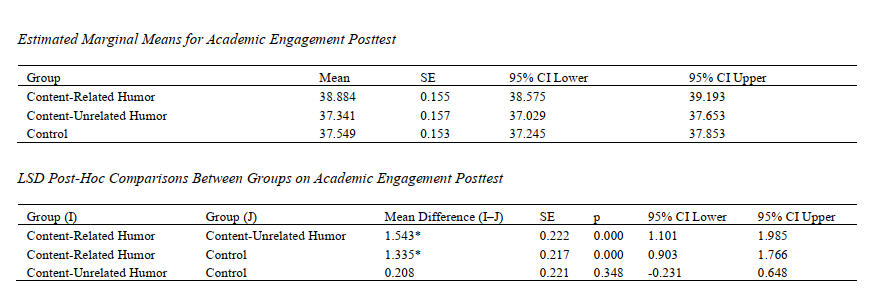
This study aimed to investigate the effect of content-related and content-unrelated humor on academic engagement among fourth-grade male students in Tehran. A quasi-experimental research design with pretest-posttest and control group structure was used. The statistical population included all fourth-grade male students in non-profit schools in District 5 of Tehran during the 2023–2024 academic year. Through multi-stage cluster sampling, three schools and three fourth-grade male classes were selected, with two classes assigned to the intervention groups (content-related and unrelated humor) and one class to the control group. A total of 88 students completed the study (29 in each intervention group and 30 in the control group). The academic engagement questionnaire by Wang et al. (2011), validated for Iranian samples, was used to assess outcomes. The intervention consisted of eight 45-minute sessions, in which science content was taught using either content-related humor or unrelated humor. Data were analyzed using ANCOVA and post hoc LSD tests in SPSS-23. The ANCOVA results indicated a significant effect of the intervention on academic engagement (F(2, 86) = 16.688, p < 0.001, η² = 0.14), showing that 14% of the variance in posttest scores was due to group membership. Post hoc comparisons revealed that the content-related humor group had significantly higher academic engagement than both the content-unrelated humor group (mean difference = 1.543, p < 0.001) and the control group (mean difference = 1.335, p < 0.001). However, no significant difference was found between the content-unrelated humor group and the control group (p = 0.348). The results demonstrate that humor strategies aligned with academic content significantly enhance student engagement, while unrelated humor does not yield a meaningful effect. Content-related humor should be prioritized as a pedagogical tool for fostering academic engagement in elementary education.
Downloads
References
Afshar Kohan, Z., Maleki, H., Mehrmohammadi, M., & Mohajer, Y. (2016). The Effect of a Humor-Integrated Mathematics Curriculum on Students' Mathematical Creativity Allameh Tabataba'i University]. https://cstp.khu.ac.ir/article-1-2676-fa.html
Amerstorfer, C. M., & Freiin von Münster-Kistner, C. (2021). Student perceptions of academic engagement and student-teacher relationships in problem-based learning. Frontiers in psychology, 12, 713057. https://doi.org/10.3389/fpsyg.2021.713057
Azila-Gbettor, E. M., Abiemo, M. K., & Glate, S. N. (2023). University support and online learning engagement during the Covid-19 period: The role of student vitality. Heliyon, 9(1). https://doi.org/10.1016/j.heliyon.2023.e13625
Balta, E. E. (2016). Teachers' attitudes towards humor in education. Elementary Education Online, 15(4), 1268-1279. https://ilkogretim-online.org/index.php/pub/article/view/7399
Banas, J. A., Dunbar, N., Rodriguez, D., & Liu, S. J. (2011). A review of humor in educational settings: Four decades of research. Communication Education, 60(1), 115-144. https://doi.org/10.1080/03634523.2010.496867
Ben-Eliyahu, A., Moore, D., Dorph, R., & Schunn, C. D. (2018). Investigating the multidimensionality of engagement: affective, behavioral, and cognitive engagement across science activities and contexts. Contemporary Educational Psychology, 53, 87-105. https://doi.org/10.1016/j.cedpsych.2018.01.002
Demir, S., & Konik, A. (2021). Examining the Relationship Between the Sense of Humor and the Social Exclusion Perceived by Gifted and Talented Students. Shanlax International Journal of Education, 9(2), 60-67. https://doi.org/10.34293/education.v9i2.3597
Dowling, J. S. (2014). School-age children talking about humor: Data from focus groups. https://doi.org/10.1515/humor-2013-0047
Faramarzi, H., Behroozi, N., & Farzadi, F. (2019). The relationship of antecedents of academic emotions, academic identity, and achievement goals with students' academic achievement. School Psychology, 8(2), 91-112. https://jsp.uma.ac.ir/article_815.html?lang=en
Fasihezadeh, S., Dowlatabadi, H., & Pazdani, H. (2018). The effect of reading humorous texts on language learning in Iranian male and female students Arak University]. Arak.
Fazlollahi, I., Shabani, K., & Marzban, A. (2016). The impact of teachers' use of humorous educational videos on language comprehension and learning among Iranian students Allameh Mohaddes Noori University]. Noor. https://elmnet.ir/doc/10923741-51351
Ghayasvandian, S., Shahsavari, H., Kazemnejad, A., Goodarzi, Z., & Razavi, S. N. (2019). The relationship between classroom management style and students' reading enthusiasm and academic success. Nursing research, 14(2), 59-66. https://sid.ir/paper/381831/fa
Kahrizi, S., Askari, S., & Kahrizi, M. (2013). The role of self-efficacy and life satisfaction in predicting the academic performance of third-year female high school students in Kermanshah. School Psychology Journal, 2, 107-123. https://jsp.uma.ac.ir/article_66.html?lang=en
Lashkarlouki, G. (2013). Iranian students in the mirror of TIMSS 2011. Roshd Journal of Guidance Education, 18, 13. https://www.roshdmag.ir/fa/article/8115/
Neaami, A., & Piryaei, S. (2012). The relationship between dimensions of academic motivation and academic enthusiasm among third-year high school students in Ahvaz. Journal of Research in Educational Systems, 1(2), 29-42. https://www.jiera.ir/article_53140.html?lang=en
Pashaei, Z., Mesrabadi, J., & Farid, A. (2020). The effectiveness of group concept mapping on academic progress and enthusiasm in 5th grade science Shahid Madani University of Azerbaijan]. Azerbaijan.
Sadat, S., & Setayeshiazhar, M. (2019). The Mediation Roles of Academic Buoyancy and Humor in relationship between Academic Emotions and Academic Engagement [Original Research]. Bimonthly of Education Strategies in Medical Sciences, 12(4), 26-40. http://edcbmj.ir/article-1-1806-en.html
Salavera, C., Usán, P., & Jarie, L. (2020). Styles of humor and social skills in students. Gender differences. Current Psychology, 39(2), 571-580. https://doi.org/10.1007/s12144-017-9770-x
Seif, A. A. (2015). Modern Educational Psychology (Psychology of Learning and Instruction). Douran Publishing.
Wang, Y. (2024). Correlation Between Students Perceived Parental Expectations and Students Academic Engagement: The Intermediary Effect of Academic Self-Efficacy. Journal of Pedagogical Research. https://doi.org/10.33902/jpr.202427683
Woreta, G. T. (2024). Predictors of Academic Engagement of High School Students: Academic Socialization and Motivational Beliefs. Frontiers in psychology, 15. https://doi.org/10.3389/fpsyg.2024.1347163
Zahed-Babalan, A., Karimianpour, G., & Dashti, E. (2017). The role of school quality of life and academic self-concept in academic enthusiasm of 5th and 6th grade students in Salas-e Babajani County. New Educational Approaches, 12(1), 75-91. https://sid.ir/paper/201671/fa
Zahrehvand, R. (2015). A comparison of academic self-efficacy, emotional intelligence, gender beliefs, and gender satisfaction between high school girls and boys, and the predictive power of each variable in academic achievement. School Psychology Journal, 6(3), 46-67. https://psychstudies.alzahra.ac.ir/article_1577.html
Ziaei-Mehr, A. (2014). The application of educational humor in the teaching-learning process: Special facilitation for second language learners. Quarterly Journal of Education, 30(2). https://qjoe.ir/article-1-185-en.html
Downloads
Additional Files
Publication Timeline
- Submitted
- Revised
- Accepted
Issue
Section
Categories
License
Copyright (c) 2025 Mehrzad Tavakolian (Author); Hassan Asadzadeh (Corresponding Author); Seyed Ali Hosseini-Almadani, Ali Jalili Shishvan (Author)

This work is licensed under a Creative Commons Attribution-NonCommercial 4.0 International License.